Source scans · vol_I_p057
recto · open full
scan recto
verso · open full
scan verso
Bṛhaddeśī · Volume I
pp. 96–97folio 057
Devanāgarī (Bṛhaddeśī)
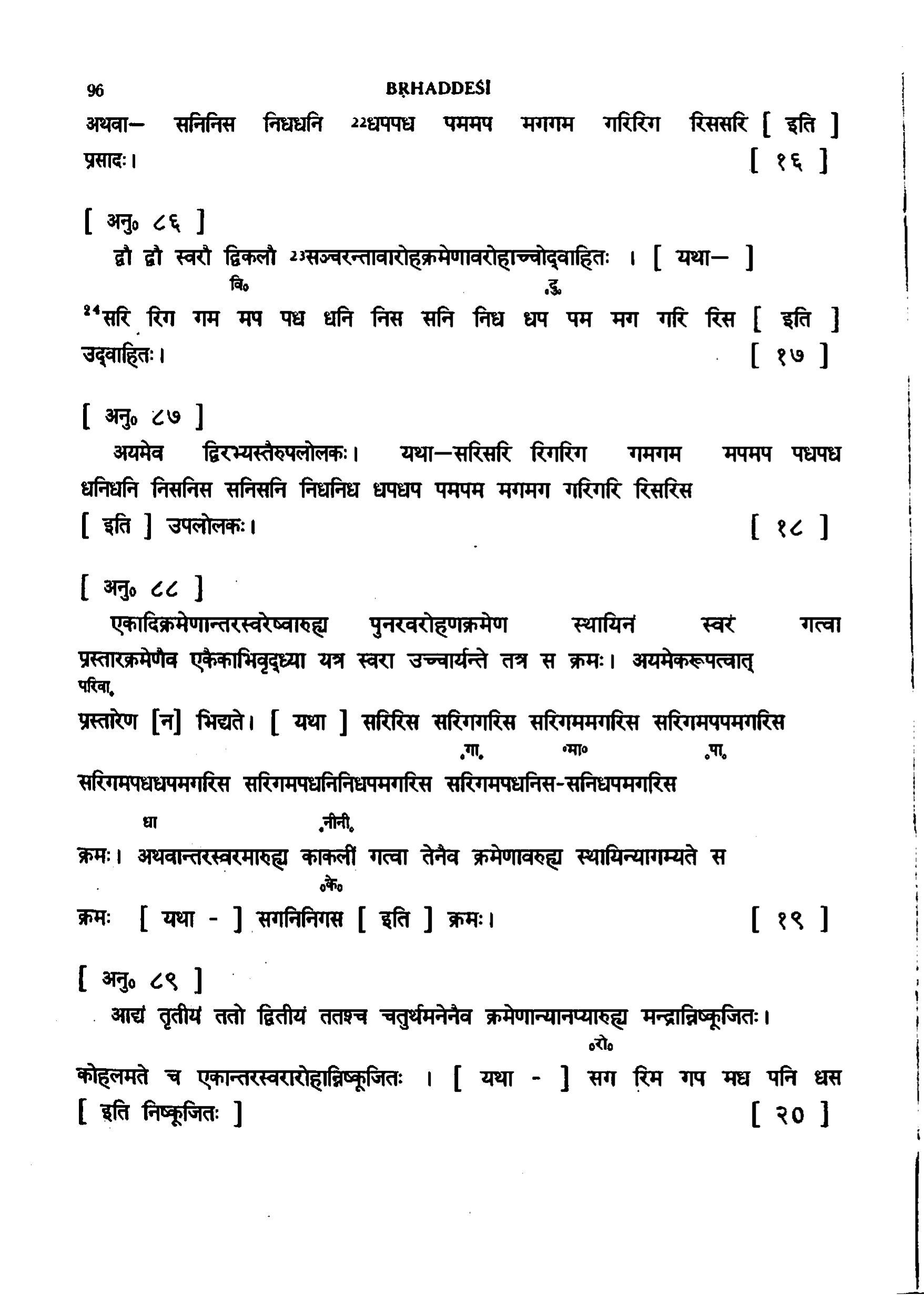
[अनु。 ८९]
अाद्यं तृतीयं ततो द्वितीयं ततश्च चतुर्थमनेनैव क्रमेणान्यानप्यारुह्य मन्द्राव्निष्कृजितः।
कोहलमते च एकान्तरस्वरारोहान्निष्कूजितः2 । [ यथा - ] सग रिम गप मध पनि धस [ इति निष्कृजितः ]1
[२०]
English — Sharma (translation)
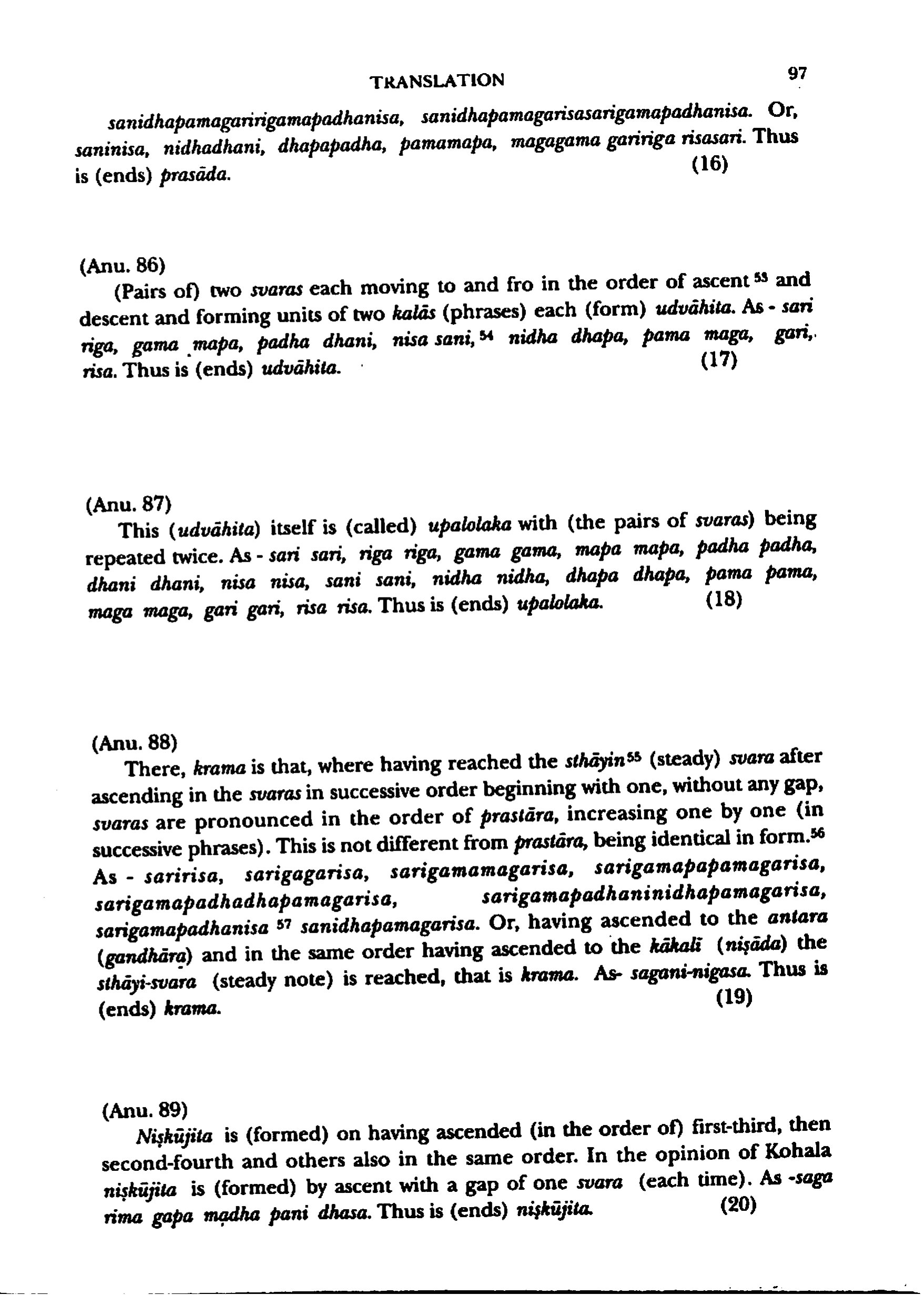
sanidhapamagaririgamapadhanisa, sanidhapamagarisasarigamapadhanisa. Or, saninisa, nidhadhani, dhapapadha, pamamapa, magagama gaririga risasari. Thus (16) is (ends) prasāda.3 (Anu. 86) (Pairs of) two svaras each moving to and fro in the order of ascent 53 and descent and forming units of two kalās (phrases) each (form) udvāhita.4 As - sari riga, gama mapa, padha dhani, nisa sani, 54 nidha dhapa, pama maga, gari,
(17)
risa. Thus is (ends) udvāhita. (Anu. 87) This (udvāhita) itself is (called) upalolaka with (the pairs of svaras) being repeated twice.5 As - sari sari, riga riga, gama gama, mapa mapa, padha padha, dhani dhani, nisa nisa, sani sani, nidha nidha, dhapa dhapa, pama pama,
(18)
maga maga, gari gari, risa risa. Thus is (ends) upalolaka. (Anu. 88) There, krama is that, where having reached the sthayin55 (steady) svara after ascending in the svaras in successive order beginning with one, without any gap9, svaras are pronounced in the order of prastara, increasing one by one (in successive phrases).76 This is not different from prastara, being identical in form.5612 As - saririsa, sarigagarisa, sarigamamagarisa, sarigamapapamagarisa, sarigamapadhadhapamagarisa, sarigamapadhaninidhapamagarisa, sarigamapadhanisa 57 sanidhapamagarisa. Or, having ascended to the antara (gandhāra) and in the same order having ascended to the kākali (niṣāda)10 the sthāyi-svara (steady note) is reached11, that is krama.13 As- sagani-nigasa. Thus is
(19)
(ends) krama. (Anu. 89) Niṣkūjita is (formed) on having ascended (in the order of) first-third, then second-fourth and others also in the same order.8 In the opinion of Kohala niṣkūjita is (formed) by ascent with a gap of one svara (each time). As -saga
(20)
rima gapa madha pani dhasa. Thus is (ends) nişküjita.
1.[attribution] According to Kohala, niṣkūjita is formed by ascent with a gap of one svara each timeकोहलमते च एकान्तरस्वरारोहान्निष्कूज?ितः । [ यथा - ] सग रिम गप मध पनि धस [ इति निष्कृज?ितः ]
2.[attribution] Kohala is an authority cited for a particular interpretation of niṣkūjita formationकोहलमते च एकान्तरस्वरारोहान्निष्कूज?ितः
3.[definition] prasāda is a musical pattern formed by pairs of svaras moving in ascent and descent orderम ग ग म गरिरिंग रिसंसरि [ इति ] नि ध ध नि २२धपपध प म म प स नि नि स अथवा— १६ | प्रसादः ।
4.[definition] udvāhita consists of pairs of two svaras each moving in ascent and descent order, forming two-kāla unitsद्वौ द्वौ स्वरौ द्विकलौ २३सञ्चरन्तावारोहक्रमेणावरोहाच्चोद्वाहितः
5.[definition] upalolaka is udvāhita with the pairs of svaras being repeated twiceद्विरभ्यस्तैरुपलोलकः
6.[definition] krama involves ascending through svaras in successive order without gaps and pronouncing them in prastara order, increasing one by oneएकादिक्रमेणान्तरस्वरेष्वारुह्य पुनरवरोहणक्रमण स्थायिन स्वर गत्वा प्रस्तारक्रमेणैव एकैकाभिवृद्ध्या यत्र स्वरा उच्चार्यन्ते तत्र स क्रमः
7.[definition] prastara involves successive phrases with increasing numbers of svarasप्रस्तारक्रमेणैव एकैकाभिवृद्ध्या यत्र स्वरा उच्चार्यन्ते तत्र स क्रमः
9.[definition] sthayin is a steady or foundational svara reached after ascending through successive svarasएकादिक्रमेणान्तरस्वरेष्वारुह्य पुनरवरोहणक्रमण स्थायिन स्वर गत्वा
10.[relation] antara is identified with gandhāra and is used in ascending patterns within kramaअथवान्तरस्वरमारुह्य काकली गत्वा तेनैव क्रमेणावरुह्य स्थायिन्यागम्यते
12.[structural] krama is not different from prastara and is identical in formअयमेकरूपत्वात् परिवा प्रस्तारेण [न] भिद्यते
13.[structural] krama involves ascending to antara and then to kākali to reach the sthayin-svaraअथवान्तरस्वरमारुह्य काकली गत्वा तेनैव क्रमेणावरुह्य स्थायिन्यागम्यते स वके क्रमः
1.[attribution]According to Kohala, niṣkūjita is formed by ascent with a gap of one svara each timeIn the opinion of Kohala niṣküjita is (formed) by ascent with a gap of one svara (each time). As -saga rima gapa madha pani dhasa.
2.[attribution]Kohala is an authority cited for a particular interpretation of niṣkūjita formationIn the opinion of Kohala niṣküjita is (formed) by ascent with a gap of one svara (each time).
3.[definition]prasāda is a musical pattern formed by pairs of svaras moving in ascent and descent ordersanidhapamagaririgamapadhanisa, sanidhapamagarisasarigamapadhanisa. Or, saninisa, nidhadhani, dhapapadha, pamamapa, magagama gaririga risasari. Thus (16) is (ends) prasāda.
4.[definition]udvāhita consists of pairs of two svaras each moving in ascent and descent order, forming two-kāla units(Pairs of) two svaras each moving to and fro in the order of ascent 53 and descent and forming units of two kalās (phrases) each (form) udvāhita.
5.[definition]upalolaka is udvāhita with the pairs of svaras being repeated twiceThis (udvāhita) itself is (called) upalolaka with (the pairs of svaras) being repeated twice.
6.[definition]krama involves ascending through svaras in successive order without gaps and pronouncing them in prastara order, increasing one by oneThere, krama is that, where having reached the sthayin55 (steady) svara after ascending in the svaras in successive order beginning with one, without any gap, svaras are pronounced in the order of prastara, increasing one by one (in successive phrases).
7.[definition]prastara involves successive phrases with increasing numbers of svarassvaras are pronounced in the order of prastara, increasing one by one (in successive phrases).
8.[definition]niṣkūjita is formed by ascending in first-third and second-fourth order patternsNiṣkūjita is (formed) on having ascended (in the order of) first-third, then second-fourth and others also in the same order.
9.[definition]sthayin is a steady or foundational svara reached after ascending through successive svarashaving reached the sthayin55 (steady) svara after ascending in the svaras in successive order beginning with one, without any gap
10.[relation]antara is identified with gandhāra and is used in ascending patterns within kramahaving ascended to the antara (gandhāra) and in the same order having ascended to the kākali (niṣāda)
11.[relation]kākali is identified with niṣāda and is reached after antara in ascending patternshaving ascended to the antara (gandhāra) and in the same order having ascended to the kākali (niṣāda) the sthāyi-svara (steady note) is reached
12.[structural]krama is not different from prastara and is identical in formThis is not different from prastara, being identical in form.56
13.[structural]krama involves ascending to antara and then to kākali to reach the sthayin-svaraOr, having ascended to the antara (gandhāra) and in the same order having ascended to the kākali (niṣāda) the sthāyi-svara (steady note) is reached, that is krama.