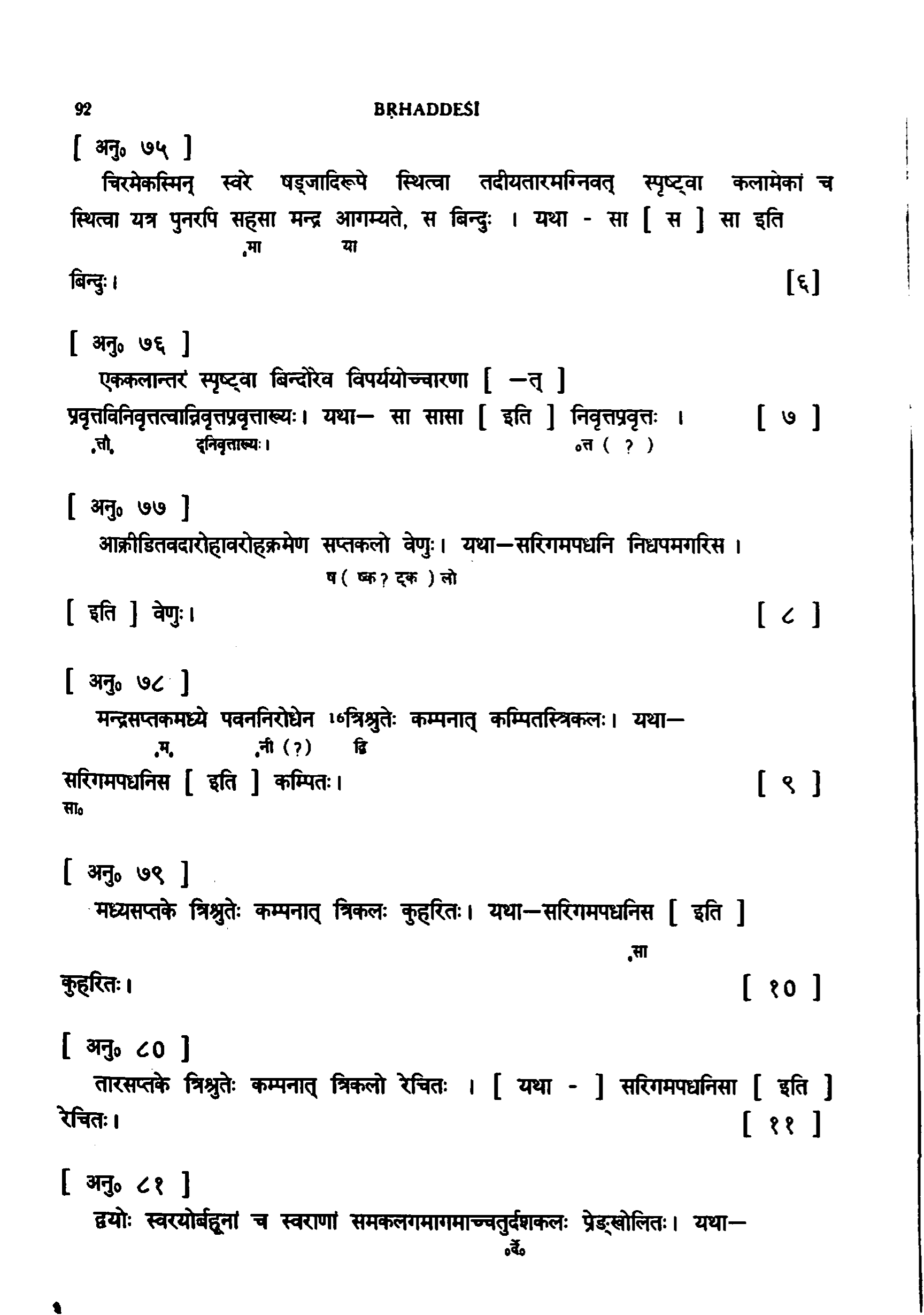
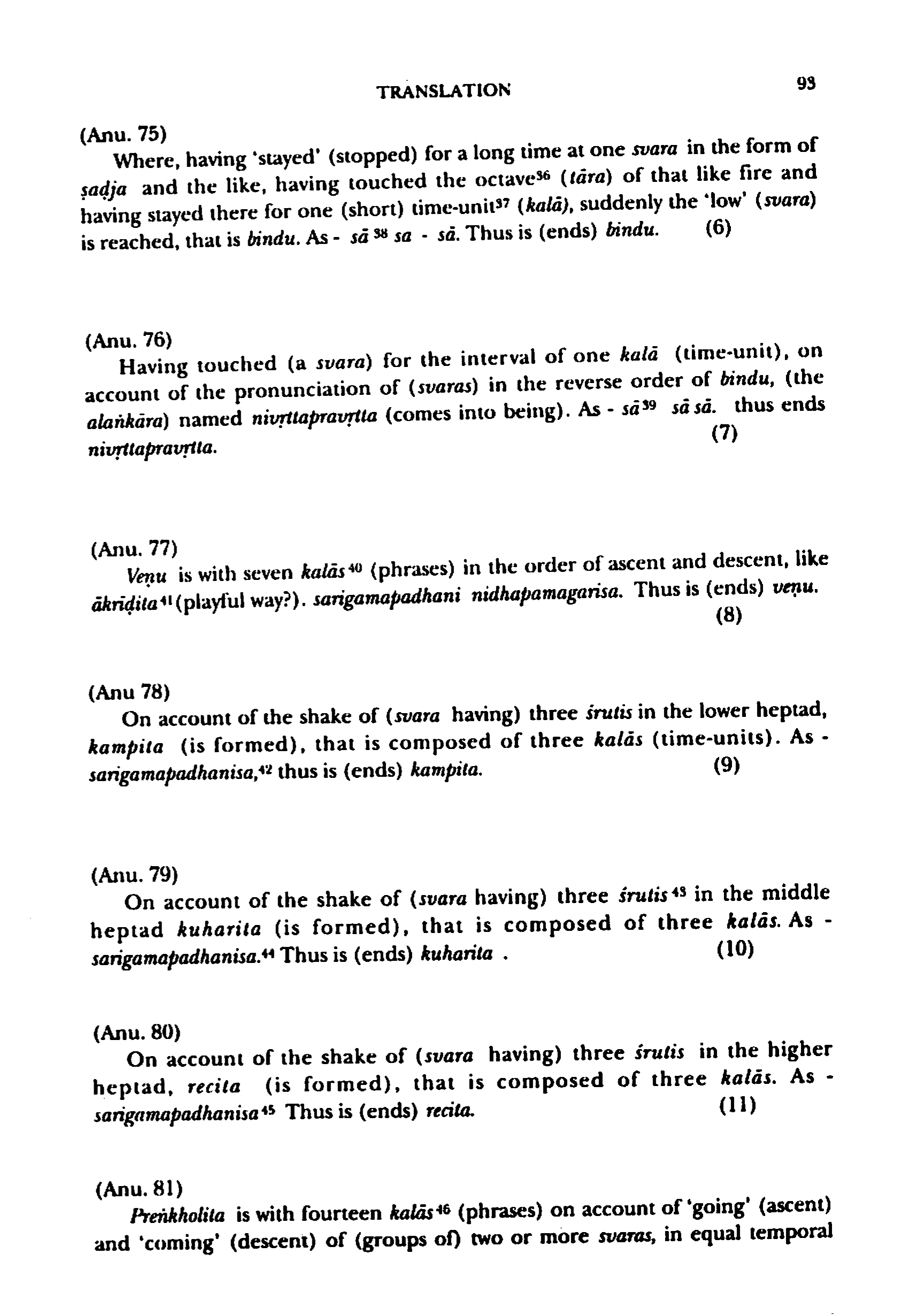
(Anu. 75)
Where, having 'stayed' (stopped) for a long time at one svara in the form of
șadja and the like, having touched the octave36 (tara) of that like fire and
having stayed there for one (short) time-unit
37 (kalā), suddenly the 'low' (svara)
is reached, that is bindu.
As - sā sa - sā. Thus is (ends) bindu.8
(6)
(Anu. 76)
Having touched (a svara) for the interval of one kalā (time-unit), on
account of the pronunciation of (svaras) in the reverse order of bindu, (the
alankāra) named nivīttapravītta (comes into being). As - sā sā sā. thus ends
(7)
nivṛttapravṛtta.
(Anu. 77)
Veņu is with seven kalās 40 (phrases) in the order of ascent and descent, like
ākrīḍita 11 (playful way?).6 sarigamapadhani nidhapamagarisa. Thus is (ends) veņu.
(8)
(Anu 78)
On account of the shake of (svara having) three srutis in the lower heptad,
kampita (is formed), that is composed of three kalās7 (time-units).2 As -
(9)
sarigamapadhanisa,42 thus is (ends)
kampita.
(Anu. 79)
On account of the shake of (svara having) three śrutis 43 in the middle
heptad kuharita (is formed), that is composed of three kalās.3 As -
(10)
sarigamapadhanisa.44 Thus is (ends)
kuharita.
(Anu. 80)
On account of the shake of (svara having) three śrutis in the higher
heptad, recita (is formed), that is composed of three kalās.4 As -
(11)
sarigamapadhanisa 45 Thus is (ends) recita.
(Anu. 81)
Prenkholita is with fourteen kalās 16 (phrases) on account of 'going' (ascent)
and 'coming' (descent) of (groups of) two or more svaras, in equal temporal