Source scans · vol_I_p058
recto · open full
scan recto
verso · open full
scan verso
Bṛhaddeśī · Volume I
pp. 98–99folio 058
Devanāgarī (Bṛhaddeśī)
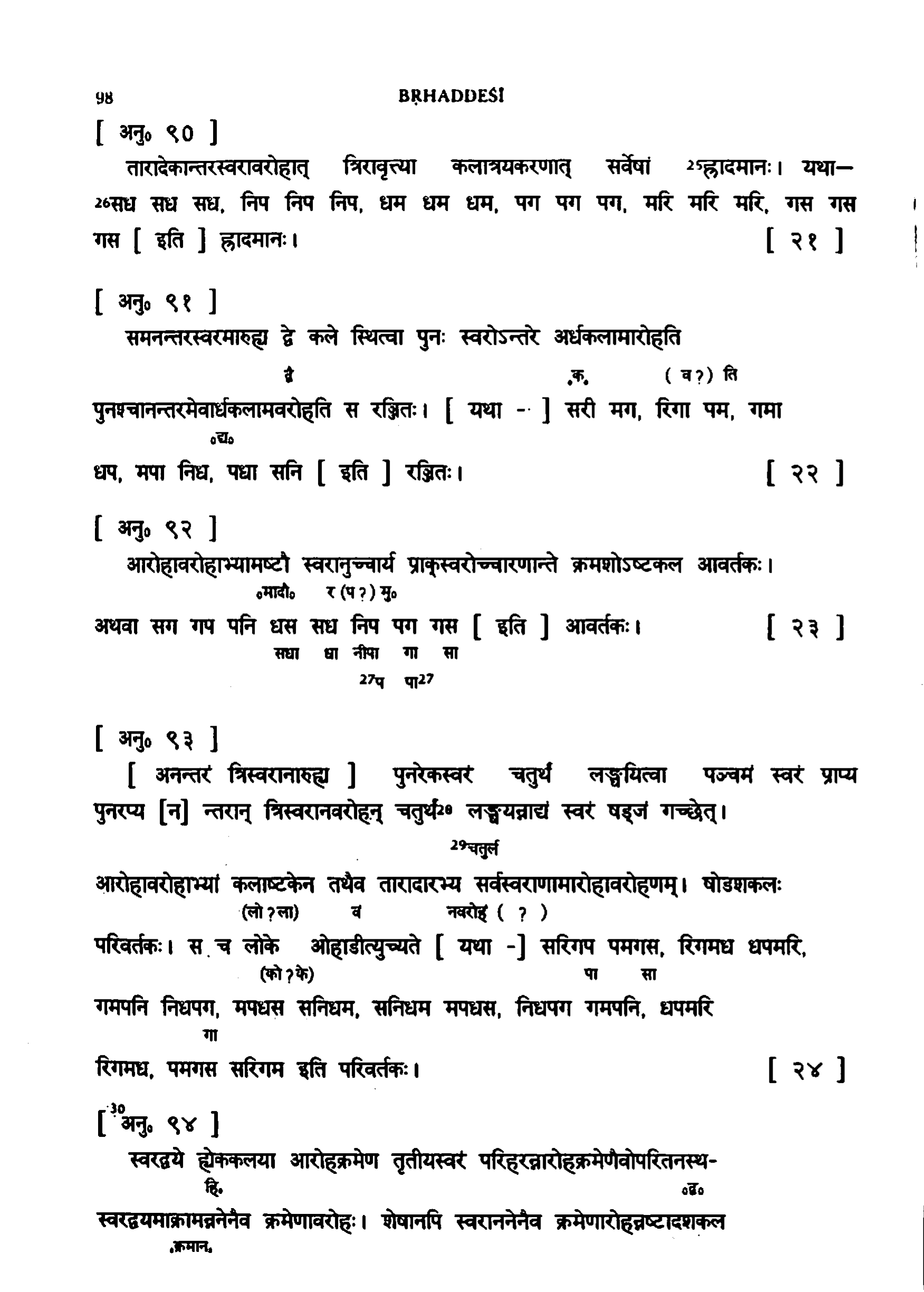
| अनु₀ 0 | तारादेकान्तरस्वरावरोहात् त्रिरावृत्त्या कलात्रयकरणात् सर्वेषां 25ह्रादमानः2। यथा— 26सध सध सध, निप निप निप, धम धम धम, पग पग पग, मरि मरि मरि, गस गस Ĺ
[२१]
गस इति ह्रादमानः11
अनु₀ ९१ ] समनन्तरस्वरमारुह्य द्वेर्द कले स्थित्वा पुनः स्वरोऽन्तरे अर्धकलामारोहति(व?) ति . पुनश्चानन्तरमेवार्धकलामवरोहित स रिक्षतः। [ यथा - ] सरी मग, रिगा पम, गमा ₀ಪು
धप, मपा निध, पधा सनि [ इति ] रञ्जितः10
[२२]
[अनु₀ ९२]
आरोहावरोहाभ्यामष्टौ०मादौ₀सधा स्वरानुच्चार्यर (प २) मु₀धानीपा गासा प्राकृस्वरोच्चारणान्ते क्रमशोऽष्टकल आवर्तकः1
अथवा सग गप पनि धस सध निप पग गस5 [ इति ] आवर्तकः।
[२३]
27q q127
[अनु₀ ९३]
[ अनन्तरं त्रिस्वरानारुह्य ] पुनरेकस्वरं चतुर्थं लङ्घयित्वा पञ्चमं स्वरं प्राप्य
पुनरप्य [न] न्तरान् त्रिस्वरानवरोहृन् चतुर्थं । लङ्क्षयन्नाद्यं स्वरं षड्जं गच्छेत्।
29चतुर्ल आरोहावरोहाभ्यां कलाष्टकेन(लो २ला) व तथैव तारादारभ्य सर्वस्वराणामारोहावरोहणम्। षोडशकलः नवरोई (?) परिवर्तकः। स.च लोके ओहाडीत्युच्यते9 [ यथा -] सरिगप पमगस, रिगमध धपमरि, (को १ के)सापा गमपनि निधपग,गा मपधस सनिधम, सनिधम मपधस, निधपग गमपनि, धपमरि
रिगमध, पमगस सरिगम इति परिवर्तकः।
[२४]
ं३0<br>अनु ९४ ] स्वरद्वये ह्येककलयाहि. आरोहक्रमेण तृतीयस्वरं परिहरन्नारोहक्रमेणैवोपरितनस्थ-0 इ स्वरद्वयमाक्रामन्ननेनैव.क्रमान, क्रमेणावरोहः। शेषानिप स्वराननेनैव क्रमेणारोहन्नष्टादशकल
English — Sharma (translation)
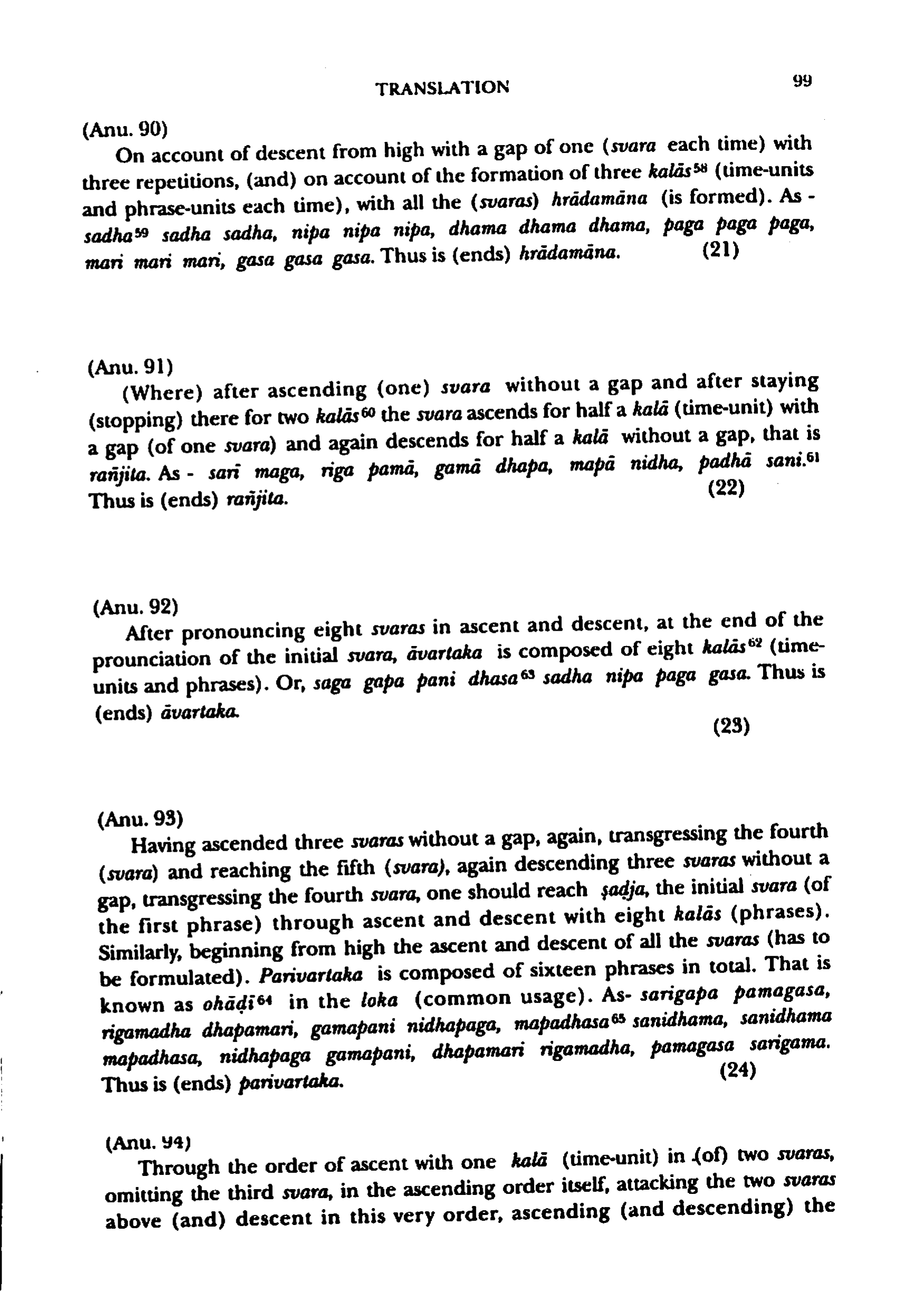
(Anu. 90) On account of descent from high with a gap of one (svara each time) with three repetitions, (and) on account of the formation of three kalās 58 (time-units and phrase-units each time), with all the (svaras) hrādamāna (is formed). As - sadha59 sadha sadha, nipa nipa nipa, dhama dhama dhama, paga paga,
(21)
mari mari, gasa gasa gasa. Thus is (ends) hrādamāna.11 (Anu. 91) (Where) after ascending (one) svara without a gap and after staying (stopping) there for two kalās 60 the svara ascends for half a kalā (time-unit) with a gap (of one svara) and again descends for half a kalā without a gap, that is ranjita. As - sarī maga, riga pamā, gamā dhapa, mapā nidha, padhā sani.761
(22)
Thus is (ends) ranjita.10 (Anu. 92) After pronouncing eight svaras in ascent and descent, at the end of the prounciation of the initial svara, āvartaka is composed of eight kalās 62 (time- units and phrases). Or, saga gapa pani dhasa 63 sadha nipa paga gasa. Thus is (ends) āvartaka.
(23)
(Anu. 93) Having ascended three svaras without a gap, again, transgressing the fourth (svara) and reaching the fifth (svara), again descending three svaras without a gap, transgressing the fourth svara, one should reach sadja, the initial svara (of the first phrase) through ascent and descent with eight kalās (phrases). Similarly, beginning from high the ascent and descent of all the svaras (has to be formulated). Parivartaka is composed of sixteen phrases in total.4 That is known as ohādi64 in the loka (common usage). As- sarigapa pamagasa, rigamadha dhapamari, gamapani nidhapaga, mapadhasa 65 sanidhama, sanidhama mapadhasa, nidhapaga gamapani, dhapamari rigamadha, pamagasa sarigama.
(24)
Thus is (ends) parivartaka. (Anu. 94) Through the order of ascent with one kalā (time-unit) in (of) two svaras, omitting the third svara, in the ascending order itself, attacking the two svaras above (and) descent in this very order, ascending (and descending) the
1.[definition]āvartaka is composed of eight kalās (time-units and phrases) after pronouncing eight svaras in ascent and descentआरोहावरोहाभ्यामष्टौ स्वरानुच्चार्य प्राकृस्वरोच्चारणान्ते क्रमशोऽष्टकल आवर्तकः
2.[definition]hrādamāna is formed through descent from high with a gap of one svara each time, with three repetitions, and formation of three kalāsतारादेकान्तरस्वरावरोहात् त्रिरावृत्त्या कलात्रयकरणात् सर्वेषा ह्रादमानः
3.[definition]ranjita is characterized by ascending one svara without a gap, staying for two kalās, then ascending for half a kalā with a gap, and descending for half a kalā without a gapसमनन्तरस्वरमारुह्य द्वे कले स्थित्वा पुनः स्वरोऽन्तरे अर्धकलामारोहति पुनश्चानन्तरमेवार्धकलामवरोहित
4.[definition]parivartaka is composed of sixteen kalās (phrases) formed through ascent and descent beginning from high with formulation of all svarasआरोहावरोहाभ्या कलाष्टकेन तथैव तारादारभ्य सर्वस्वराणामारोहावरोहणम्। षोडशकल परिवर्तकः
5.[enumeration]āvartaka follows the pattern: saga gapa pani dhasa sadha nipa paga gasaअथवा सग गप पनि धस सध निप पग गस
6.[enumeration]hrādamāna consists of the following pattern: sadha sadha sadha, nipa nipa nipa, dhama dhama dhama, paga paga, mari mari, gasa gasa gasaसध सध सध, निप निप निप, धम धम धम, पग पग पग, मरि मरि मरि, गस गस गस
7.[enumeration]ranjita consists of the following patterns: sarī maga, riga pamā, gamā dhapa, mapā nidha, padhā saniसरी मग, रिगा पम, गमा धप, मपा निध, पधा सनि
8.[enumeration]parivartaka consists of eight patterns demonstrating ascent and descent combinations: sarigapa pamagasa, rigamadha dhapamari, and othersस रि ग प पमगस, रि ग म ध धपमरि, ग म प नि निधपग, म प ध स सनिधम
9.[relation]parivartaka is known as ohādi in common usage (loka)स.च लोके ओहाडीत्युच्यते
10.[structural]ranjita is concluded after stating its complete patternरञ्ज?ितः
11.[structural]hrādamāna is concluded after stating its complete patternइति ह्रादमानः
4.[definition] parivartaka is composed of sixteen kalās (phrases) formed through ascent and descent beginning from high with formulation of all svarasSimilarly, beginning from high the ascent and descent of all the svaras (has to be formulated). Parivartaka is composed of sixteen phrases in total.
7.[enumeration] ranjita consists of the following patterns: sarī maga, riga pamā, gamā dhapa, mapā nidha, padhā saniAs - sarī maga, riga pamā, gamā dhapa, mapā nidha, padhā sani.
10.[structural] ranjita is concluded after stating its complete patternThus is (ends) ranjita.
11.[structural] hrādamāna is concluded after stating its complete patternThus is (ends) hrādamāna.