Source scans · vol_I_p060
recto · open full
scan recto
verso · open full
scan verso
Bṛhaddeśī · Volume I
pp. 102–103folio 060
Devanāgarī (Bṛhaddeśī)
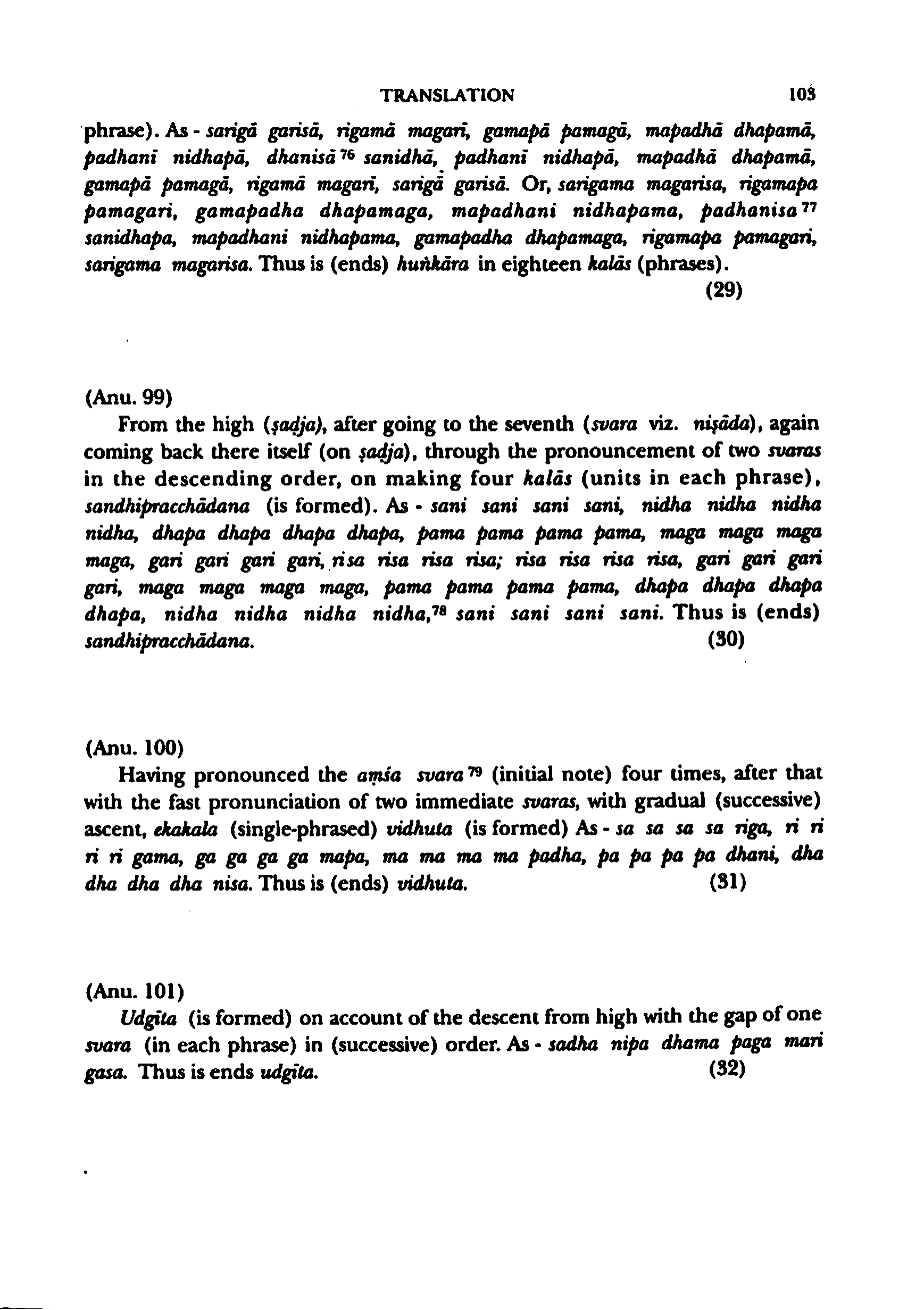
निधपा,सनिधा. मपधा धपमा, गमपा पमगा, रिगमा मगरी, सरिगा गरिसा।
पधनी मगरिस,अथवा— सरिगम रिगमप पमगरि, गमपध धपमग, मपधनि निधपम, पधनिस सनिधप, मपधनि निधपम, गमपध धपमग, रिगमप पमगरि, सरिगम मगरिसइति
[२९]
अष्टादशकलो हुङ्कारः।4 अनु₀ ९९ तारात् सप्तमं स्वरं गत्वा पुनस्तत्रैवागत्य6ावरोहक्रमेण.वमा. स्वरद्वयोच्चारणेन
कलाचतुष्टयकरणात् सन्धिप्रच्छादनःकारणनात् ( ? )
यथा - ] सनि सनि सनि सनि, निध निध निध निध, धप धप धप धप, पम पम पम
पम9, मग मग मग मग, गरि गरि गरि गरि, रिस रिस रिस रिस।
ordered sequence list
huṅkāra (aṣṭādaśakala) — descending phrase variant 1 — Continuation of verse [29] at top of page. Pairwise descending sequence demonstrating the 18-kalā huṅkāra ornament.
s · a · · n · i · · d · h · ā
p · a · · d · h · a · · n · i
n · i · · d · h · a · · p · a
m · a · · p · a · · d · h · a
d · h · a · · p · a · · m · a
g · a · · m · a · · p · a
p · a · · m · a · · g · a
r · i · · g · a · · m · a
m · a · · g · a · · r · i
s · a · · r · i · · g · a
g · a · · r · i · · s · a
— [ २९ ] / अष्टादशकलो हुङ्कारः
[ इति ] विधुतः।
[३१]
[अनुः १०१]
तारादेकान्तरस्वरावरोहात् क्रमेणोद्गीतः । [ यथा - ] सध निप धम पग मरि गस .तिः
[ इति ] उद्गीतः।
[३२]
English — Sharma (translation)
ordered sequence list
huṅkāra (continuation from previous anu., variant 1) — Translation, p.105. Continuation of a phrase ending with huṅkāra in eighteen kalās; first listed variant of sequence groupings.
s · a · r · i · g · a · · g · a · r · i · s · ā
r · i · g · a · m · ā · · m · a · g · a · r · i
g · a · m · a · p · ā · · p · a · m · a · g · ā
p · a · d · h · a · n · i · · n · i · d · h · a · p · ā
d · h · a · n · i · s · ā · · ?
s · a · n · i · d · h · ā
p · a · d · h · a · n · i · · n · i · d · h · a · p · ā
m · a · p · a · d · h · ā · · d · h · a · p · a · m · ā
g · a · m · a · p · ā · · p · a · m · a · g · ā
r · i · g · a · m · ā · · m · a · g · a · r · i
s · a · r · i · g · ā · · g · a · r · i · s · ā
— phrase (29)
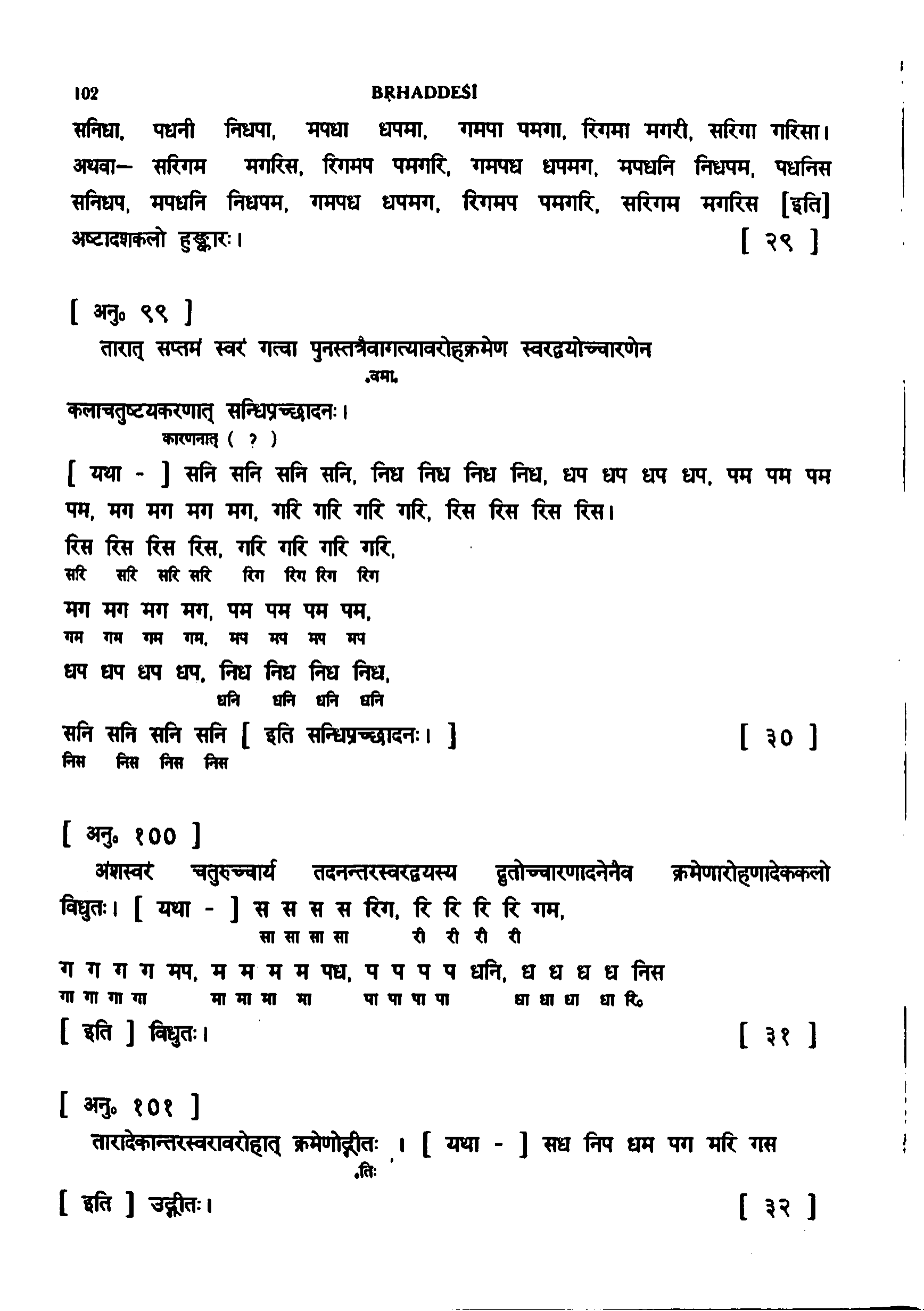
From the high (şadja), after going to the seventh (svara viz. nişāda), again coming back there itself (on sadja)6, through the pronouncement of two svaras in the descending order, on making four kalās (units in each phrase),
dhapa, nidha nidha nidha nidha,78 sani sani sani sani. Thus is (ends)
(30)
sandhipracchādana. (Anu. 100) Having pronounced the amsa svara 79 (initial note) four times8, after that with the fast pronunciation of two immediate svaras, with gradual (successive)
Udgita (is formed) on account of the descent from high with the gap of one svara (in each phrase) in (successive) order.2 As - sadha nipa dhama paga mari
(32)
gasa. Thus is ends udgita.
4.[structural] huṅkāra is structured in eighteen kalās (phrases)अष्टादशकलो हुङ्कारः।
6.[structural] sandhipracchādana involves ascending from sadja to nişāda and then descending back to sadjaतारात् सप्तमं स्वरं गत्वा पुनस्तत्रैवागत्य
8.[structural] amsa svara is the initial note that is pronounced four times in vidhuta formationsअंशस्वरं चतुरुच्चार्य
9.[structural] sandhipracchādana involves repetition of two-svara dyads four times eachसनि सनि सनि सनि, निध निध निध निध, धप धप धप धप, पम पम पम पम
1.[definition]sandhipracchādana is formed by pronouncing two svaras in descending order while making four kalās units in each phrasethrough the pronouncement of two svaras in the descending order, on making four kalās (units in each phrase), sandhipracchādana (is formed).
2.[definition]udgita is formed by descending from high with the gap of one svara in each successive phraseUdgita (is formed) on account of the descent from high with the gap of one svara (in each phrase) in (successive) order.
3.[definition]vidhuta is formed by pronouncing the amsa svara four times followed by fast pronunciation of two immediate svarasHaving pronounced the amsa svara four times, after that with the fast pronunciation of two immediate svaras
4.[structural]huṅkāra is structured in eighteen kalās (phrases)Thus is (ends) huṅkāra in eighteen kalās (phrases).
5.[structural]huṅkāra consists of repeated ascending and descending sequences of two-svara phrasessarigā garisā, rigamā magarī, gamapā pamagā, mapadhā dhapamā, padhanī nidhapā, dhanisā sanidhā
6.[structural]sandhipracchādana involves ascending from sadja to nişāda and then descending back to sadjaFrom the high (şadja), after going to the seventh (svara viz. nişāda), again coming back there itself (on sadja)
7.[structural]ekakala vidhuta is formed through gradual successive ascent of two svaraswith gradual (successive) ascent, ekakala (single-phrased) vidhuta (is formed)
8.[structural]amsa svara is the initial note that is pronounced four times in vidhuta formationsHaving pronounced the amsa svara 79 (initial note) four times
9.[structural]sandhipracchādana involves repetition of two-svara dyads four times eachsani sani sani sani, nidha nidha nidha nidha, dhapa dhapa dhapa, pama pama pama pama
10.[structural]vidhuta exemplifies the pattern of repeating a single svara four times followed by a two-svara unitsa sa sa sa riga, ri ri ri ri gama, ga ga ga mapa, ma ma ma padha, pa pa pa dhani