Source scans · vol_I_p101
recto · open full
scan recto
verso · open full
scan verso
Bṛhaddeśī · Volume I
pp. 1–185folio 101
Bṛhaddeśī
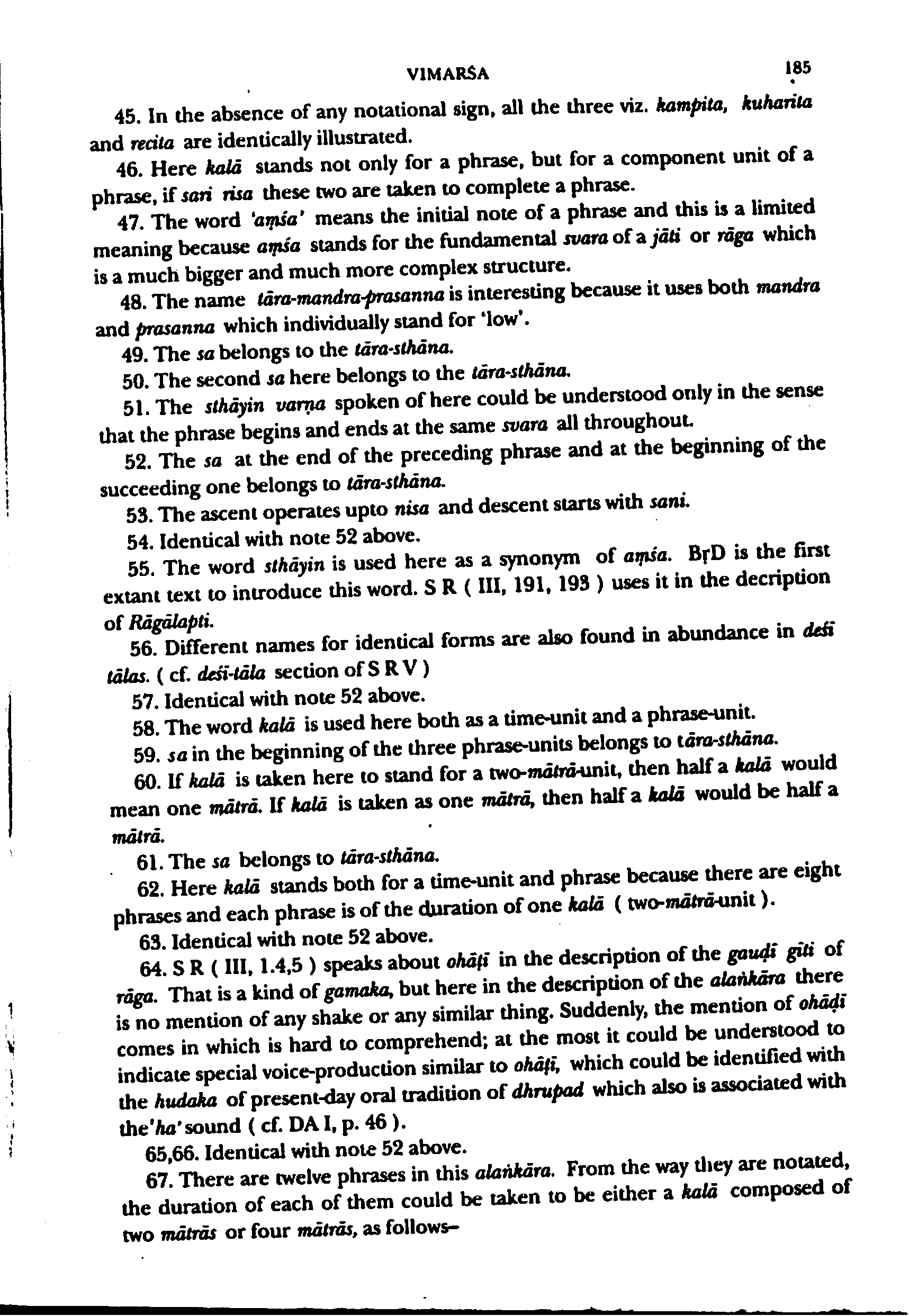
24. The number thirty-three with respect to alankāras is the same in NS(XXIX). 25. The Sanskrit word alaṅkāra is translated into English as ornament, but really speaking, it is something that makes a thing adequate ( alam ) and not an ornament exterior to the inherent nature of a thing. A.K. Coomaraswamy has written extensively on the concept of alankara, which is relevant to the understanding of alaṅkāra in music. (See glossary) 26. These names have been roughly translated by us in order to provide glimpses of the imagery inherent in them. 27. S R notates this alaṅkāra as sa-tārasa-sa. BṛD takes all the seven svaras in ascent and justifies the name prasannadi on the ground that the starting point is 'low' and the movement is from 'low' to 'high'. 28. 'Mandra' here simply means low, no relationship of octave is implied here. 29. This sa belongs to the tara (high register). BrD does not use signs for tāra and mandra. S R does that, but we have not added these signs. Notes for the tara (high register) have been given by us at almost all places. 30. Tāra, like mandra, means only 'high', no relationship of octave is implied. 31, 32, 33, 34. The sa belongs to tāra-sthāna. 35. The idea seems to be that the original intervals have to be kept intact. 36. Here tara stands for the octave. 37. Usually kalā as a time-unit stands for two mātrās in the ancient tāla- system, but here it means just one mātrā, because the high svara has to be touched like fire i.e. it is not to be prolonged. The same will be the meaning of kalā in the next alaṅkāra, viz. nivīttapravītta. 38. The second sa belongs to the tāra-sthāna. 39. The first sa belongs to the tara sthana. 40. Kalā here means a phrase. 41. The exact implication of ākrīḍita (playful) is not clear here. There is no notational sign for this specification. 42. There is no notational sign for shake. Only Somanātha in the 17th cent. evolved notational signs for shakes, pulls and the like called vādana-bhedas ( kinds of instrumental rendering ). 43. Shake on svaras with three śrutis viz. ṛṣabha and dhaivata is prescribed also in NS and Abhi Bhā ( see note no. 16 in the textual notes on this section ). The text of NS speaks only of shake with three kalās and Abhinavagupta comments that kalā there stands for śruti. But our text prescribes both triśruti interval of svaras to be shaken and 3-kalā duration of shake. We could only note this, because it is difficult to comment on this dual statement. The implication of 3 kalās is also not clear, kalā could niether be a phrase, nor a time-unit here. 44. All the seven svaras ending with the eighth viz. tāra-şadja are listed here; it could be conjectured that the shake on n and dha would give a special colour to this group of eight svaras.
translation
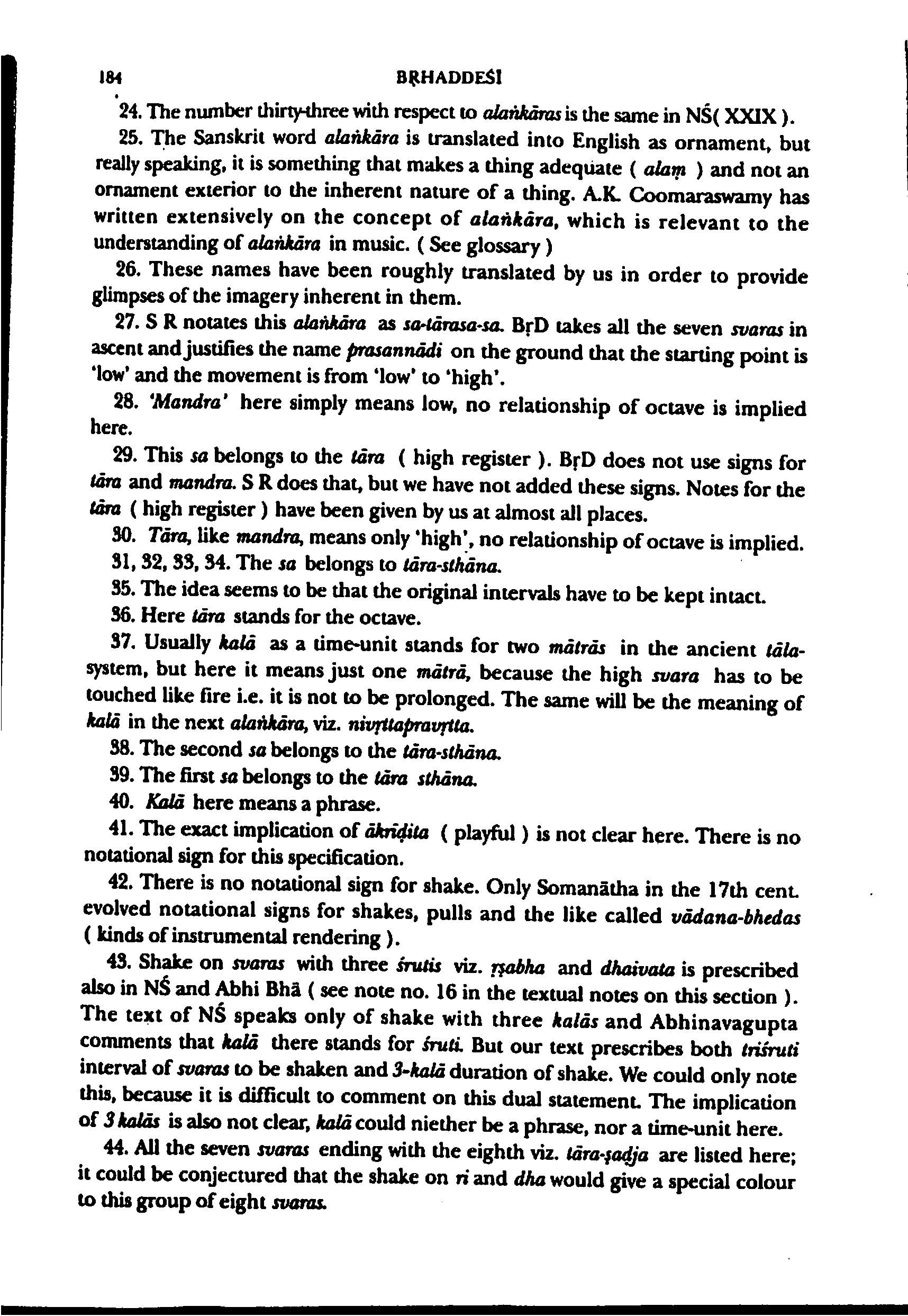
45. In the absence of any notational sign, all the three viz. kampita, kuharita and recita are identically illustrated. 46. Here kalā stands not only for a phrase, but for a component unit of a phrase, if sani risa these two are taken to complete a phrase. 47. The word 'amsa' means the initial note of a phrase and this is a limited meaning because amsa stands for the fundamental svara of a jāti or rāga which is a much bigger and much more complex structure. 48. The name tāra-mandra-prasanna is interesting because it uses both mandra and prasanna which individually stand for 'low'. 49. The sa belongs to the tāra-sthāna. 50. The second sa here belongs to the tāra-sthāna. 51. The sthāyin varņa spoken of here could be understood only in the sense that the phrase begins and ends at the same svara all throughout. 52. The sa at the end of the preceding phrase and at the beginning of the succeeding one belongs to tāra-sthāna. 53. The ascent operates upto nisa and descent starts with sani. 54. Identical with note 52 above. 55. The word sthāyin is used here as a synonym of amsa. BrD is the first extant text to introduce this word. S R (III, 191, 193) uses it in the decription of Rāgālapti. 56. Different names for identical forms are also found in abundance in desi tālas. (cf. deśī-tāla section of SRV) 57. Identical with note 52 above. 58. The word kalā is used here both as a time-unit and a phrase-unit. 59. sa in the beginning of the three phrase-units belongs to tāra-sthāna. 60. If kalā is taken here to stand for a two-mātrā-unit, then half a kalā would mean one mātrā. If kalā is taken as one mātrā, then half a kalā would be half a mālrā. 61. The sa belongs to tāra-sthāna. 62. Here kalā stands both for a time-unit and phrase because there are eight phrases and each phrase is of the duration of one kalā (two-mātrā-unit). 63. Identical with note 52 above. 64. SR (III, 1.4,5) speaks about ohāţī in the description of the gaudī gîti of rāga. That is a kind of gamaka, but here in the description of the alankāra there is no mention of any shake or any similar thing. Suddenly, the mention of ohāḍī comes in which is hard to comprehend; at the most it could be understood to ¥ indicate special voice-production similar to ohāţī, which could be identified with the hudaka of present-day oral tradition of dhrupad which also is associated with the 'ha' sound (cf. DA I, p. 46). 65,66. Identical with note 52 above. 67. There are twelve phrases in this alankara. From the way they are notated, the duration of each of them could be taken to be either a kalā composed of two mātrās or four mātrās, as follows-
1.[attribution]Coomaraswamy has written extensively on the concept of alaṅkāraA.K. Coomaraswamy has written extensively on the concept of alankara, which is relevant to the understanding of alaṅkāra in music.
2.[attribution]Somanātha in the 17th century evolved notational signs for shakes, pulls and vādana-bhedasOnly Somanātha in the 17th cent. evolved notational signs for shakes, pulls and the like called vādana-bhedas
3.[attribution]Abhinavagupta comments that kalā in NS stands for śrutiThe text of NS speaks only of shake with three kalās and Abhinavagupta comments that kalā there stands for śruti.
4.[attribution]BṛD is the first extant text to introduce the word sthāyin as synonym of amsaBrD is the first extant text to introduce this word.
5.[citation]NS contains thirty-three alaṅkāras, same count as in BṛDThe number thirty-three with respect to alankāras is the same in NS(XXIX).
6.[definition]Alaṅkāra means something that makes a thing adequate, not an ornament exterior to inherent natureThe Sanskrit word alaṅkāra is translated into English as ornament, but really speaking, it is something that makes a thing adequate ( alam ) and not an ornament exterior to the inherent nature of a thing.
7.[definition]Vādana-bhedas are kinds of instrumental rendering including notational signs for shakes, pulls and similar effectsOnly Somanātha in the 17th cent. evolved notational signs for shakes, pulls and the like called vādana-bhedas ( kinds of instrumental rendering ).
8.[definition]Tāra means high register only, with no octave relationship impliedTāra, like mandra, means only 'high', no relationship of octave is implied.
9.[definition]Mandra means low register only, with no octave relationship implied'Mandra' here simply means low, no relationship of octave is implied here.
10.[definition]Amsa means the initial note of a phrase, though more broadly it represents the fundamental svara of a jāti or rāgaThe word 'amsa' means the initial note of a phrase and this is a limited meaning because amsa stands for the fundamental svara of a jāti or rāga which is a much bigger and much more complex structure.
11.[relation]Hudaka is associated with special voice-production similar to ohāţī and the 'ha' sound in dhrupad traditionwhich could be identified with the hudaka of present-day oral tradition of dhrupad which also is associated with the 'ha' sound
12.[structural]S R uses notational signs for tāra and mandra registersS R does that, but we have not added these signs.
13.[structural]Kalā has multiple meanings: time-unit of two mātrās, single mātrā, phrase, or component unit of phrase depending on contextUsually kalā as a time-unit stands for two mātrās in the ancient tāla- system, but here it means just one mātrā
14.[structural]Different names for identical forms are found in abundance in deśī-tālasDifferent names for identical forms are also found in abundance in desi tālas.