Source scans · vol_I_p102
recto · open full
scan recto
verso · open full
scan verso
Bṛhaddeśī · Volume I
pp. 186–187folio 102
Bṛhaddeśī
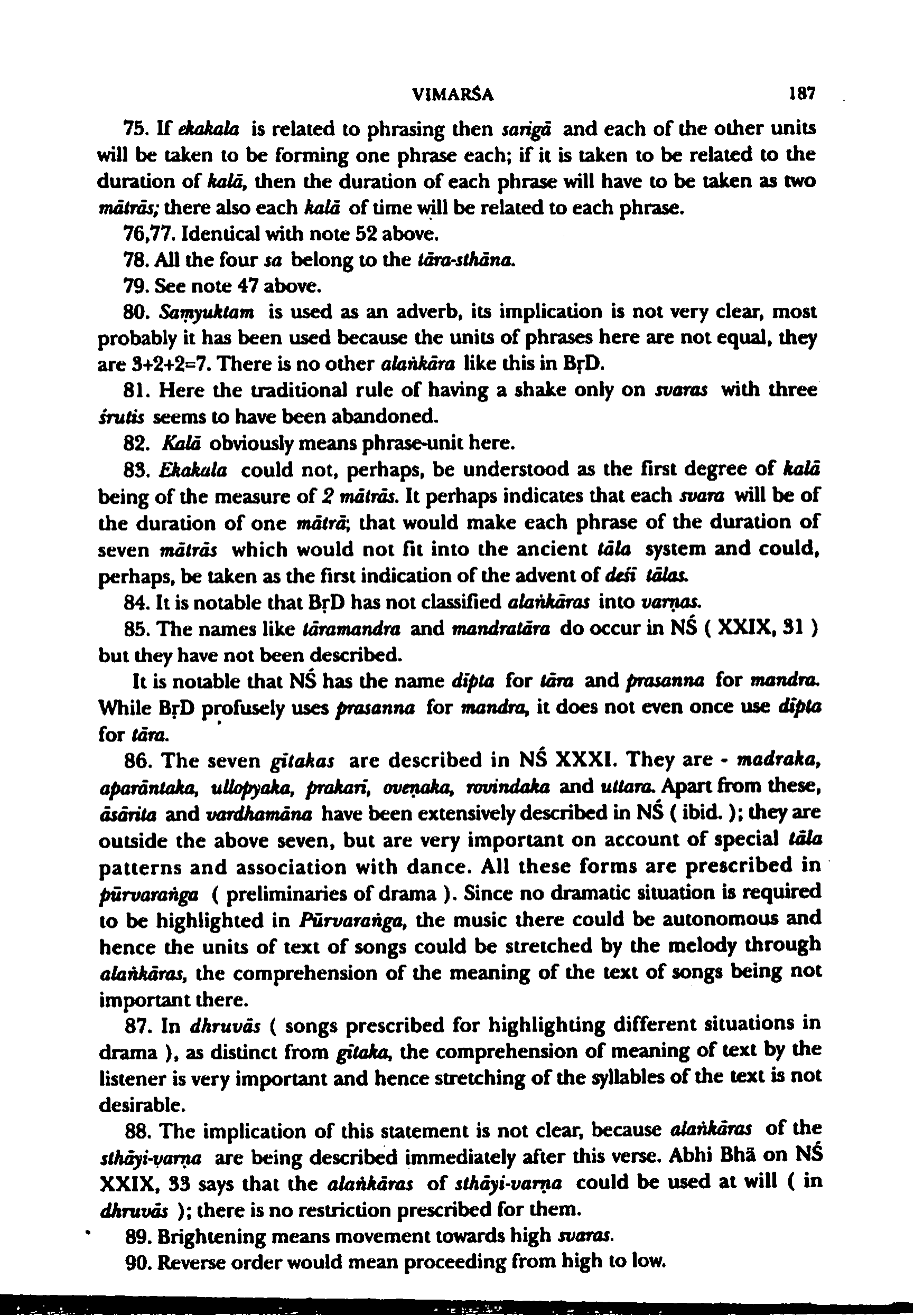
sa - ri - g\bar{a} = 2 \text{ or } sa - ri 1/2 + 1/2 + 1 + 1 - g\bar{a} = 4 It has been prescribed that the duration of the kalās (phrases) has to be gradually increased from one to six kalās, which means that each succeeding kalā should be half-a kalā more in duration than the preceding one. The extension could either be suffixed to the last svara of each phrase which is already long or be spread over all the three components of a phrase. Half kalā would mean one or two matras in accordance with the accepted duration of the original kalā viz. two mātrās or four mātrās; the extension of half kalā could take two alternative forms as - \vec{n} - \vec{ga} - \vec{ma} + 2 (as an extension of \vec{ma}) = \vec{6} \vec{ma}tr\vec{a}s = 1 1/2 kal\vec{a} 1 + 1 + 2 Or - ga - m\bar{a} = 6 m\bar{a}tr\bar{a}s = 1 1/2 kal\bar{a}s ni 11/2 + 11/2 + 3 Extension in either way would reach the 6-kalā duration on the eleventh phrase as follows - 1st phrase 1 kalā, second phrase 1 1/2 kalās, third phrase 2 kalās, fourth 2 1/2 kalās, fifth phrase 3 kalās, sixth phrase 3 1/2 kalās, seventh phrase phrase 4 kalās, eighth phrase 4 1/2 kalās, ninth phrase 5 kalās, tenth phrase 5 1/2 kalās, eleventh phrase 6 kalās. The twelfth phrase will have again to be of 6 kalās, without any extension. 68. The illustration of this alaṅkāra is curious as it includes 'nu' after each phrase. This 'nu' could not be taken to be a variation of the solfa 'ni' as there is no description to the effect that each phrase would be followed by 'ni' or its variation. The Telugu language has 'nu' as suffix or indeclinable meaning 'am' of English, suffixed to verbal forms for first person in the present tense. Here it could be taken as a sign for a pause following the long svara at the end of each phrase. 69,70. The first two references to chakala seem to be related to the duration of kalā which would be two mātrās in the ekakala form and the 'dvikala' seems to be related to the dual unit phrases, but again when the kalās are said to be twenty-two in number, each phrase-unit like sagamā is taken to be one phrase or it is possible that kalā here refers to the total number of time-units. 71. This alternative version is uniform in ascent and descent. 72. The image of laughter, perhaps indicates the association of 'ha' sound. 73. Dvikala here has parhaps to be understood as the dual composition of each phrase-unit i.e. there are two svaras in each phrase-unit. It could also be related to the duration of kalā being four mātrās instead of two, but since the phrases are composed of three units each, the dvikala will have to be related to a six-mātrā-kalā, which is not accepted in the ancient system. 74. Identical with note 52 above.
Vimarśa
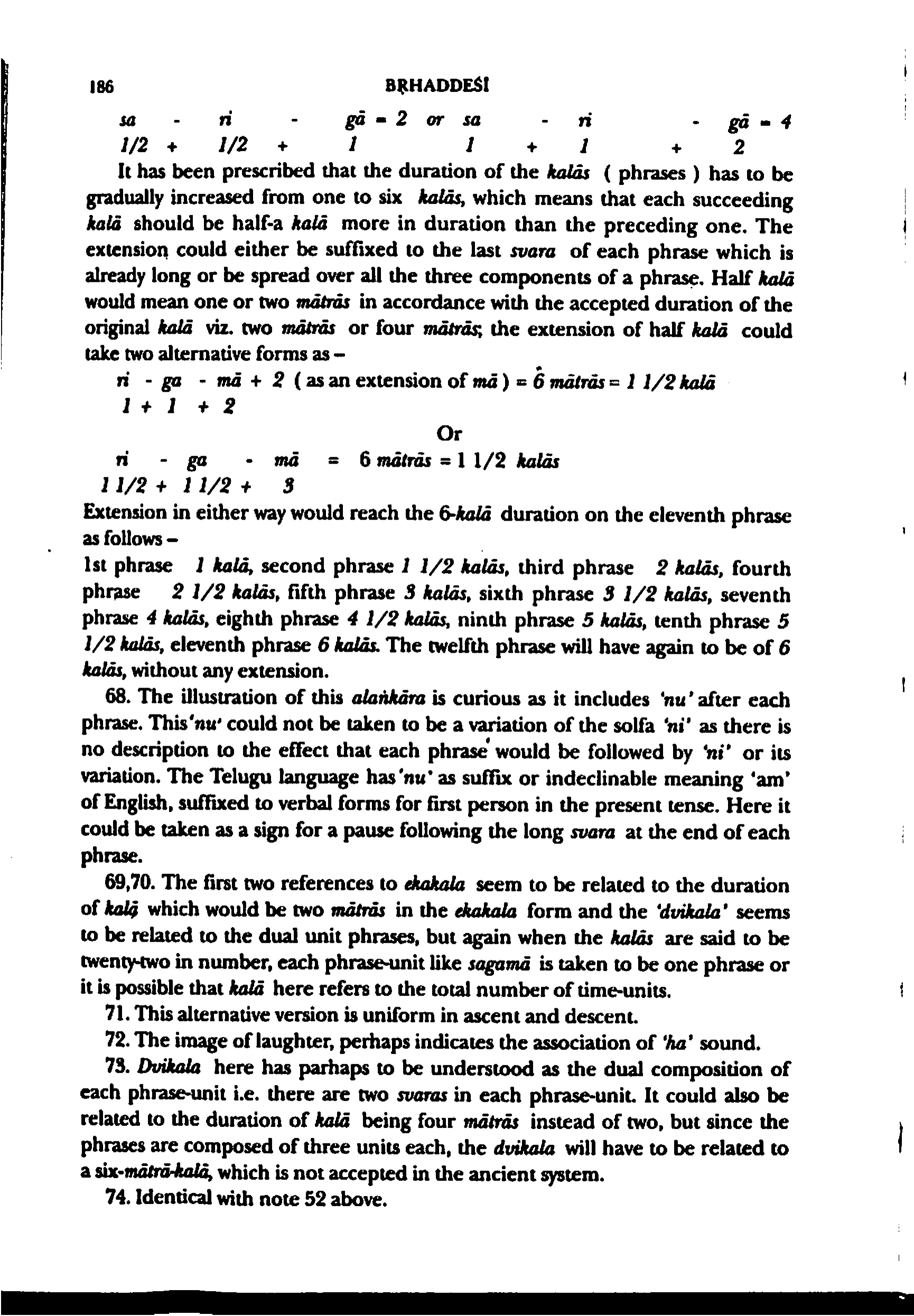
75. If ekakala is related to phrasing then sarigā and each of the other units will be taken to be forming one phrase each; if it is taken to be related to the duration of kalā, then the duration of each phrase will have to be taken as two mātrās; there also each kalā of time will be related to each phrase. 76,77. Identical with note 52 above. 78. All the four sa belong to the tāra-sthāna. 79. See note 47 above. 80. Samyuktam is used as an adverb, its implication is not very clear, most probably it has been used because the units of phrases here are not equal, they are 3+2+2=7. There is no other alankāra like this in BrD. 81. Here the traditional rule of having a shake only on svaras with three śrutis seems to have been abandoned. 82. Kalā obviously means phrase-unit here. 83. Ekakula could not, perhaps, be understood as the first degree of kalā being of the measure of 2 mātrās. It perhaps indicates that each svara will be of the duration of one mātrā; that would make each phrase of the duration of seven mātrās which would not fit into the ancient tāla system and could, perhaps, be taken as the first indication of the advent of desi talas. 84. It is notable that BrD has not classified alankāras into varņas. 85. The names like tāramandra and mandratāra do occur in NŠ (XXIX, 31) but they have not been described. It is notable that NS has the name dipta for tara and prasanna for mandra. While BrD profusely uses prasanna for mandra, it does not even once use dipta for tāra. 86. The seven gitakas are described in NS XXXI. They are - madraka, aparāntaka, ullopyaka, prakarī, oveņaka, rovindaka and uttara. Apart from these, āsārita and vardhamāna have been extensively described in NŠ (ibid.); they are outside the above seven, but are very important on account of special tala patterns and association with dance. All these forms are prescribed in pūrvaranga (preliminaries of drama). Since no dramatic situation is required to be highlighted in Pūrvaranga, the music there could be autonomous and hence the units of text of songs could be stretched by the melody through alankāras, the comprehension of the meaning of the text of songs being not important there. 87. In dhruvās (songs prescribed for highlighting different situations in drama), as distinct from gîtaka, the comprehension of meaning of text by the listener is very important and hence stretching of the syllables of the text is not desirable. 88. The implication of this statement is not clear, because alankaras of the sthāyi-varņa are being described immediately after this verse. Abhi Bhā on NŠ XXIX, 33 says that the alankāras of sthāyi-varņa could be used at will (in dhruvās ); there is no restriction prescribed for them. 89. Brightening means movement towards high svaras. 90. Reverse order would mean proceeding from high to low. e le par Alle and the second
1.[attribution]Prasanna is used by BrD to denote the lower register (mandra), but dipta is not used by BrD for tāra despite both terms appearing in NSWhile BrD profusely uses prasanna for mandra, it does not even once use dipta for tāra.
2.[attribution]According to Abhi Bhā on NS, alaṅkāras of sthāyi-varņa can be used at will in dhruvās with no restrictionAbhi Bhā on NŠ XXIX, 33 says that the alankāras of sthāyi-varņa could be used at will (in dhruvās ); there is no restriction prescribed for them.
3.[attribution]BrD has not classified alaṅkāras into varṇas, distinguishing it from other treatisesIt is notable that BrD has not classified alankāras into varņas.
4.[citation]Āsārita is described in NS outside the seven gitakas but is very important due to special tala patterns and association with danceApart from these, āsārita and vardhamāna have been extensively described in NŠ (ibid.); they are outside the above seven, but are very important on account of special tala patterns and association with dance.
5.[citation]Vardhamāna is described in NS outside the seven gitakas but is very important due to special tala patterns and association with danceApart from these, āsārita and vardhamāna have been extensively described in NŠ (ibid.); they are outside the above seven, but are very important on account of special tala patterns and association with dance.
6.[enumeration]Seven gitakas are enumerated: madraka, aparāntaka, ullopyaka, prakarī, oveņaka, rovindaka and uttaraThe seven gitakas are described in NS XXXI. They are - madraka, aparāntaka, ullopyaka, prakarī, oveņaka, rovindaka and uttara.
7.[relation]Gitakas are prescribed in pūrvaranga (preliminaries of drama) where musical units can be stretched by melody through alaṅkārasAll these forms are prescribed in pūrvaranga (preliminaries of drama). Since no dramatic situation is required to be highlighted in Pūrvaranga, the music there could be autonomous and hence the units of text of songs could be stretched by the melody through alankāras
8.[relation]In dhruvās, comprehension of text meaning by the listener is important, so stretching of syllables through alaṅkāras is not desirableIn dhruvās (songs prescribed for highlighting different situations in drama), as distinct from gîtaka, the comprehension of meaning of text by the listener is very important and hence stretching of the syllables of the text is not desirable.
9.[relation]Half kalā corresponds to one or two matras depending on whether the original kalā is two or four mātrāsHalf kalā would mean one or two matras in accordance with the accepted duration of the original kalā viz. two mātrās or four mātrās
10.[relation]Seven-mātrā phrases in ekakala may represent the first indication of the advent of desi talasthat would not fit into the ancient tāla system and could, perhaps, be taken as the first indication of the advent of desi talas.
11.[structural]Alaṅkāras are ornamental musical phrases whose duration is systematically increased from one to six kalāsIt has been prescribed that the duration of the kalās (phrases) has to be gradually increased from one to six kalās, which means that each succeeding kalā should be half-a kalā more in duration than the preceding one.
12.[structural]Ekakala may indicate that each svara has a duration of one mātrā, making each phrase seven mātrās, which does not fit the ancient tāla systemIt perhaps indicates that each svara will be of the duration of one mātrā; that would make each phrase of the duration of seven mātrās which would not fit into the ancient tāla system
13.[structural]Dvikala may relate to either dual composition of phrase-units with two svaras each, or to kalā duration of four mātrāsDvikala here has parhaps to be understood as the dual composition of each phrase-unit i.e. there are two svaras in each phrase-unit. It could also be related to the duration of kalā being four mātrās instead of two
14.[structural]The traditional rule limiting shakes to svaras with three śrutis appears to have been abandoned in certain alaṅkārasHere the traditional rule of having a shake only on svaras with three śrutis seems to have been abandoned.