Source scans · vol_II_p047
recto · open full
scan recto
verso · open full
scan verso
Bṛhaddeśī · Volume II
p. 1folio 047
Devanāgarī
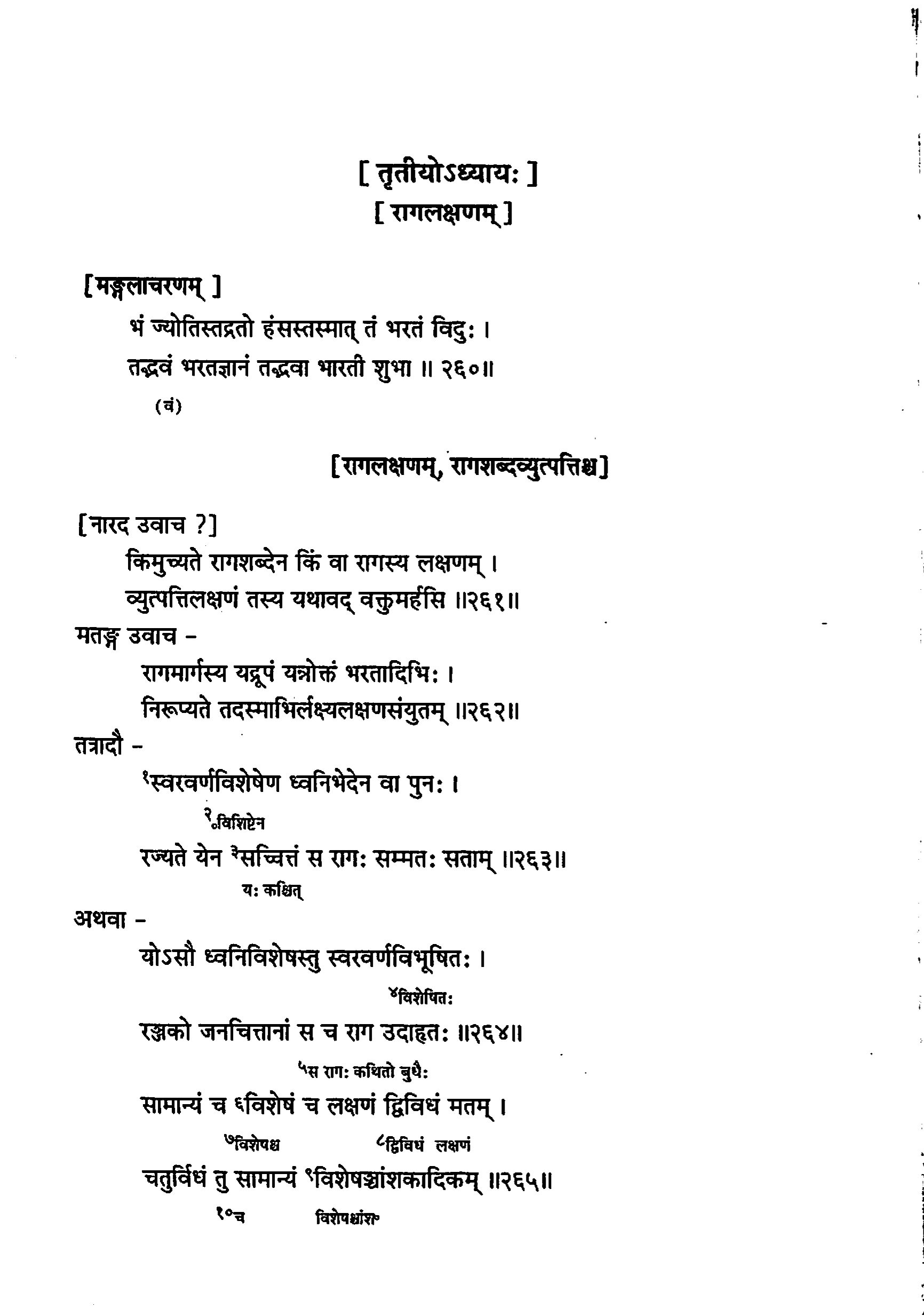
[तृतीयोऽध्याय:]
[रागलक्षणम्]
[मङ्गलाचरणम्]
भं ज्योतिस्तद्रतो हंसस्तस्मात् तं भरतं विदु:।
तद्भवं(वं) भरतज्ञानं तद्भवा भारती शुभा ॥२६०॥
[रागलक्षणम्, रागशब्दव्युत्पत्तिश्च]
[नारद उवाच ?]
किमुच्यते रागशब्देन किं वा रागस्य लक्षणम् ।
व्युत्पत्तिलक्षणंमतङ्ग उवाच - तस्य यथावद् वक्तुमर्हसि ॥२६१॥ रागमार्गस्य यद्रूपं यन्नोक्तं भरतादिभि:। निरूप्यतेतत्रादौ - तदस्माभिर्3लक्ष्यलक्षणसंयुतम्71 ॥२६२॥
१स्वरवर्णविशेषेण ध्वनिभेदेन वा पुन:।
。विशिप्टेन रज्यते येन रसिच्चत्तंयः कश्चित् स रागः सम्मतः सताम् ॥२६३॥ अथवा -
योऽसौ ध्वनिविशेषस्तु स्वरवर्णविभूषित:४विशेपित:
• रञ्जको जनचित्तानां स च राग उदाहृत: ॥२६४॥ > स रागः कथितो बुधैः
सामान्यं च ६विशेषं७विशेषध च लक्षणं द्विविधं मतम् ।
८द्विविधं लक्षणं चतुर्विधं तु१०च सामान्यं 'विशेषञ्चांशकादिकम्1211विशेषश्चांश ॥२६५॥
English — Sharma
,1
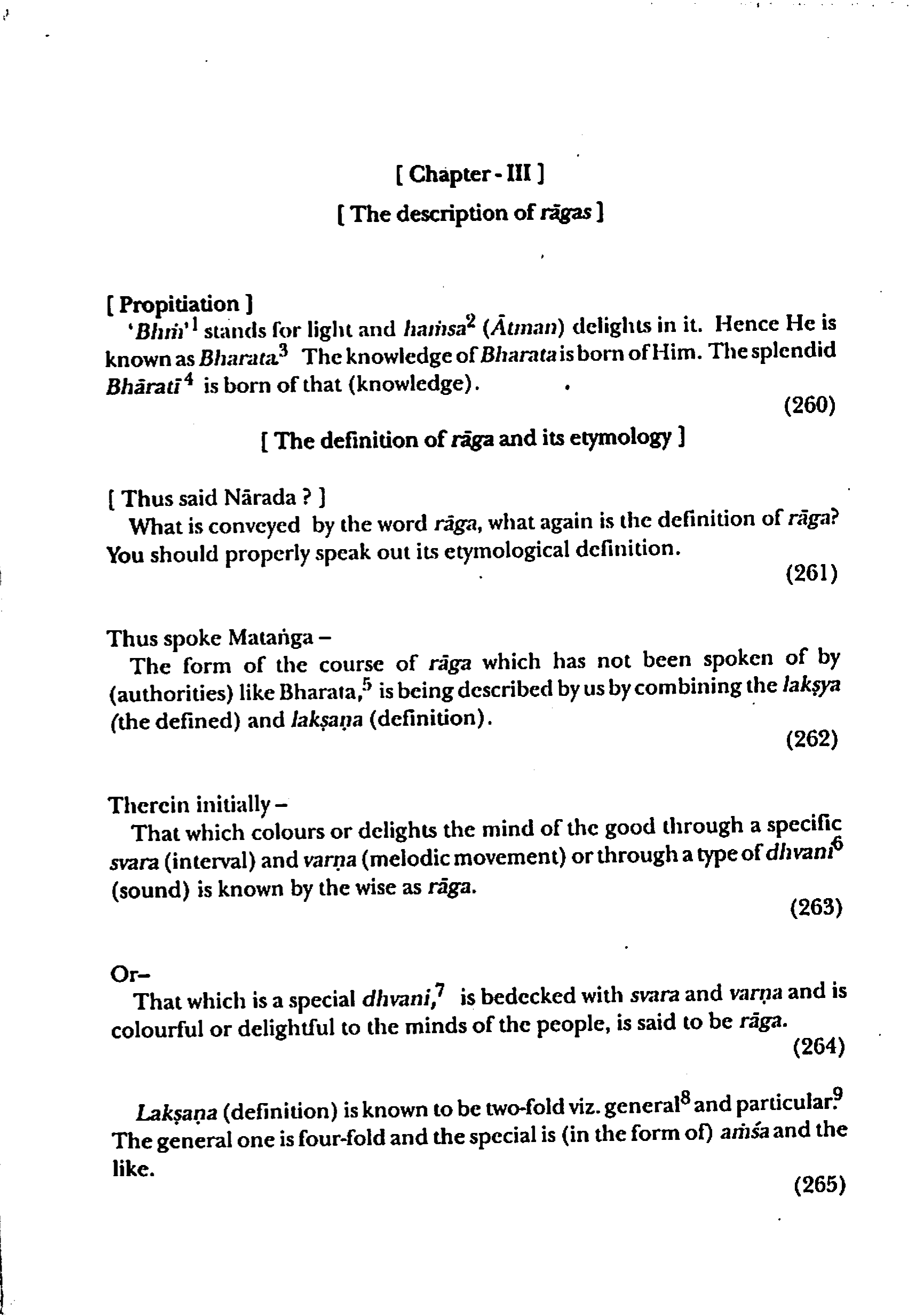
[Chapter-III]
[The description of ragas]
[Propitiation]
'Bhm' 1 stands for light and hamsa2 (Atman) delights in it. Hence He is known as Bharata3 The knowledge of Bharata is born of Him. The splendid Bhāratī4 is born of that (knowledge).
(260)
[The definition of raga and its etymology]
[ Thus said Nārada? ] What is conveyed by the word rāga, what again is the definition of rāga?2 You should properly speak out its etymological definition.
(261)
Thus spoke MatangaThe form of the course of raga which has not been spoken of by (authorities) like Bharata, 5 is being described by us by combining the lakşya (the defined) and lakṣaṇa (definition).1
(262)
Therein initially - That which colours or delights the mind of the good through a specific svara (interval) and varṇa (melodic movement) or through a type of dhvani6 (sound) is known by the wise as rāga.4
(263)
Or- That which is a special dhvani,7 is bedecked with svara and varna and is colourful or delightful to the minds of the people, is said to be rāga.5
(264)
Lakṣaṇa (definition) is known to be two-fold viz. general8 and particular.9 The general one is four-fold and the special is (in the form of) amisa and the like.12
(265)
1.[attribution] Matanga describes the form of the course of rāga by combining lakṣya and lakṣaṇaरागमार्गस्य यद्रूपं यन्नोक्तं भरतादिभिः। निरूप्यते तदस्माभिर्लक्ष्यलक्षणसंयुतम्
2.[attribution] Nārada poses the question about the definition and etymology of the word rāga[नारद उवाच ?] किमुच्यते रागशब्देन कि वा रागस्य लक्षणम्
3.[citation] Bharata is cited as a prior authority whose formulations of rāga are contrasted with Matanga's approachरागमार्गस्य यद्रूपं यन्नोक्तं भरतादिभिः। निरूप्यते तदस्माभिर्
7.[relation] Lakṣya (the defined) is one element combined with lakṣaṇa in the description of rāgaनिरूप्यते तदस्माभिर्लक्ष्यलक्षणसंयुतम्
11.[relation] Amśa is a form through which particular lakṣaṇa manifestsविशेषञ्चांशकादिकम्
12.[structural] General lakṣaṇa is four-fold; particular lakṣaṇa is in the form of amśa and the likeचतुर्विधं तु सामान्यं 'विशेषञ्चांशकादिकम्
1.[attribution]Matanga describes the form of the course of rāga by combining lakṣya and lakṣaṇaThe form of the course of raga which has not been spoken of by (authorities) like Bharata, 5 is being described by us by combining the lakşya (the defined) and lakṣaṇa (definition).
2.[attribution]Nārada poses the question about the definition and etymology of the word rāga[ Thus said Nārada? ] What is conveyed by the word rāga, what again is the definition of rāga?
3.[citation]Bharata is cited as a prior authority whose formulations of rāga are contrasted with Matanga's approachThe form of the course of raga which has not been spoken of by (authorities) like Bharata, 5 is being described by us
4.[definition]Rāga is that which colours or delights the mind of the good through specific svara, varṇa, or dhvaniThat which colours or delights the mind of the good through a specific svara (interval) and varṇa (melodic movement) or through a type of dhvani (sound) is known by the wise as rāga.
5.[definition]Rāga is a special dhvani bedecked with svara and varṇa that is colourful or delightful to the minds of peopleThat which is a special dhvani,7 is bedecked with svara and varna and is colourful or delightful to the minds of the people, is said to be rāga.
6.[enumeration]Lakṣaṇa (definition) is two-fold, consisting of general and particular varietiesLakṣaṇa (definition) is known to be two-fold viz. general8 and particular.9
7.[relation]Lakṣya (the defined) is one element combined with lakṣaṇa in the description of rāgais being described by us by combining the lakşya (the defined) and lakṣaṇa (definition).
8.[relation]Svara (interval) is a component through which rāga colours or delights the mind of the goodThat which colours or delights the mind of the good through a specific svara (interval) and varṇa (melodic movement) or through a type of dhvani (sound) is known by the wise as rāga.
9.[relation]Varṇa (melodic movement) is a component through which rāga colours or delights the mind of the goodThat which colours or delights the mind of the good through a specific svara (interval) and varṇa (melodic movement) or through a type of dhvani (sound) is known by the wise as rāga.
10.[relation]Dhvani (sound) is a type through which rāga can colour or delight the mind of the goodThat which colours or delights the mind of the good through a specific svara (interval) and varṇa (melodic movement) or through a type of dhvani (sound) is known by the wise as rāga.
11.[relation]Amśa is a form through which particular lakṣaṇa manifestsand the special is (in the form of) amisa and the like.
12.[structural]General lakṣaṇa is four-fold; particular lakṣaṇa is in the form of amśa and the likeThe general one is four-fold and the special is (in the form of) amisa and the like.