Source scans · vol_II_p048
recto · open full
scan recto
verso · open full
scan verso
Bṛhaddeśī · Volume II
pp. 78–79folio 048
Devanāgarī
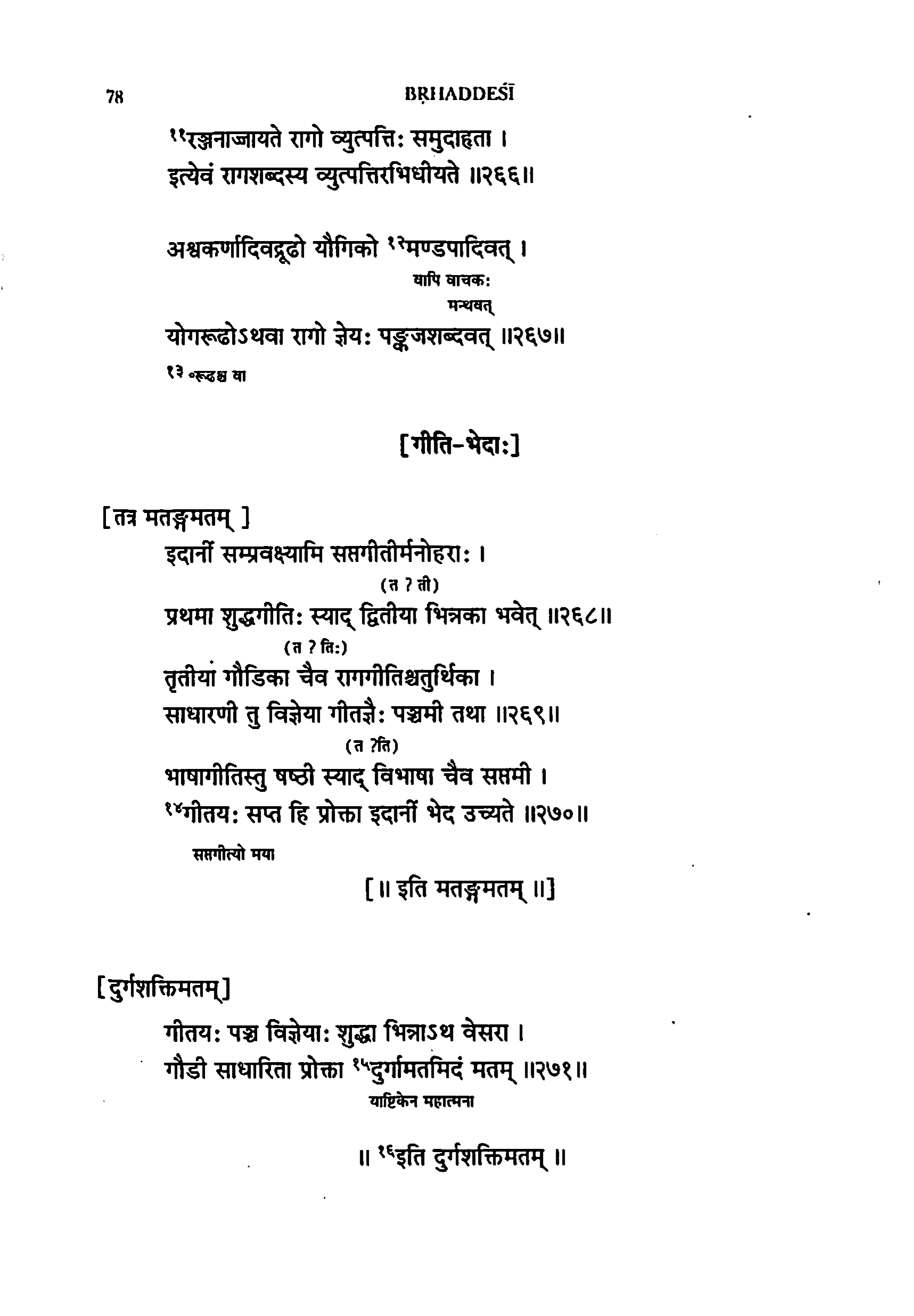
१९रञ्जनाज्जायते रागो व्युत्पत्तिः समुदाहता ।
इत्येवं रागशब्दस्य व्युत्पत्तिरभिधीयते ॥२६६॥
अश्वकर्णादिवद्रुढो यौगिको १२मण्डपादिवत्यापि वाचकःमन्थवत्
योगरूढोऽथवा१३ ०रूदश्च वा रागो ज्ञेय: पङ्कजशब्दवत् ॥२६७॥
[गीति-भेदाः]
[तत्र मतङ्गमतम्]
इदानीं सम्प्रवक्ष्यामि सप्तगीतीर्मनोहरा:(त ? ती)
प्रथमा शुद्धगीति: स्याद्8(त ? ति:) द्वितीया भिन्नका भवेत्6 ॥२६८॥
तृतीयां गौडिका चैव7 रागगीतिश्चतुर्थिका ।
साधारणी तु विज्ञेया गीतज्ञै:(त ?ति) पञ्चमी तथा ॥२६९॥
भाषागीतिस्तु षष्ठी स्याद् विभाषा चैव सप्तमी ।
१४गीतय: सप्तसप्तगीत्यो मया हि प्रोक्ता इदानीं भेद उच्यते ॥२७०॥
[॥ इति मतङ्गमतम्॥]
[दुर्गशक्तिमतम्]
गीतय: पञ्च विज्ञेया: शुद्धा भिन्नाऽथ वेसरा ।
ं गौडी साधारिता प्रोक्ता १५दुर्गामतिमदंयाष्ट्रिकेन महात्मना मतम् ॥२७१॥
१६इति दुर्गशक्तिमतम् ॥
English — Sharma (translation)
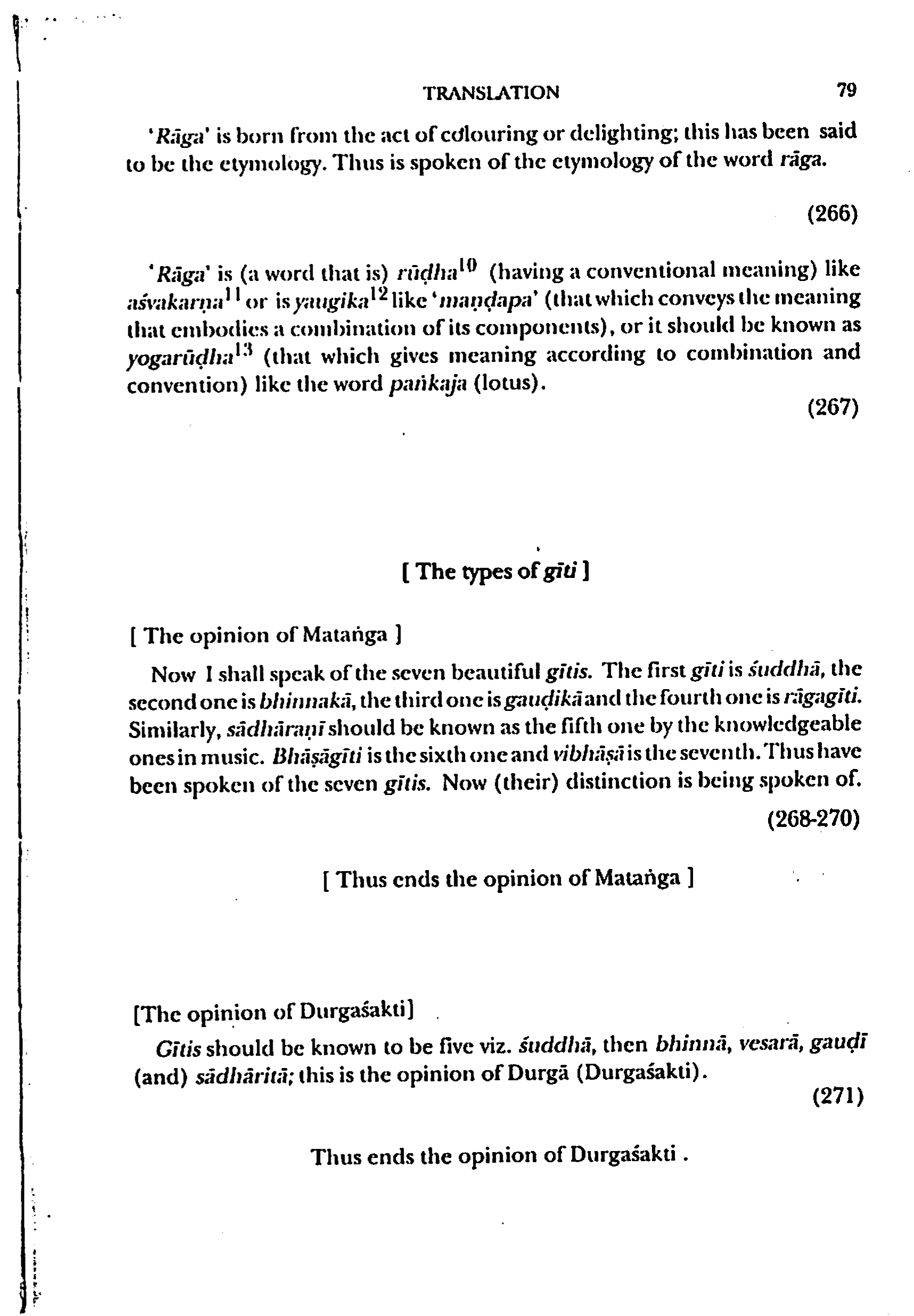
'R\bar{a}ga' is born from the act of colouring or delighting; this has been said to be the etymology. Thus is spoken of the etymology of the word rāga.
(266)
'Rāga' is (a word that is) r\bar{u}\phi ha^{10} (having a conventional meaning) like aśvakarņa11 or is yaugika12 like 'maṇḍapa' (that which conveys the meaning that embodies a combination of its components), or it should be known as yogarūdha13 (that which gives meaning according to combination and convention) like the word pankaja (lotus).
(267)
[The types of giti]
[ The opinion of Matanga ] Now I shall speak of the seven beautiful gītis.1 The first gīti is śuddhā, the second one is bhinnakā6, the third one is gaudikā7 and the fourth one is rāgagīti. Similarly, sādhāraņī should be known as the fifth one by the knowledgeable ones in music. Bhāṣāgīti is the sixth one and vibhāṣā is the seventh. Thus have been spoken of the seven gitis. Now (their) distinction is being spoken of. (268-270)
[Thus ends the opinion of Matanga]
[The opinion of Durgaśakti] Gītis should be known to be five viz. śuddhā, then bhinnā, vesarā, gauḍī (and) sādhāritā; this is the opinion of Durgā (Durgaśakti).2
(271)
Thus ends the opinion of Durgaśakti.
1.[attribution] Matanga presents a doctrine of seven gītis[तत्र मतङ्गमतम् ] इदानी सम्प्रवक्ष्यामि सप्तगीतीर्मनोहराः ।
6.[relation] Bhinnakā in Matanga's system corresponds to or relates to bhinnā in Durgaśakti's systemप्रथमा शुद्धगीतिः स्याद् द्वितीया भिन्नका भवेत्
7.[relation] Gaudikā in Matanga's system corresponds to or relates to gauḍī in Durgaśakti's systemतृतीया गौडिका चैव
8.[structural] Śuddhā is the first gīti in both Matanga's and Durgaśakti's classificationsप्रथमा शुद्धगीतिः स्याद्
1.[attribution]Matanga presents a doctrine of seven gītis[ The opinion of Matanga ] Now I shall speak of the seven beautiful gītis.
2.[attribution]Durgaśakti presents an alternative doctrine of five gītis[The opinion of Durgaśakti] Gītis should be known to be five viz. śuddhā, then bhinnā, vesarā, gauḍī (and) sādhāritā; this is the opinion of Durgā (Durgaśakti).
3.[definition]The word rāga is etymologically derived from the act of coloring or delighting'Rāga' is born from the act of colouring or delighting; this has been said to be the etymology.
4.[enumeration]There are seven types of gītis: śuddhā, bhinnakā, gaudikā, rāgagīti, sādhāraņī, bhāṣāgīti, and vibhāṣāNow I shall speak of the seven beautiful gītis. The first gīti is śuddhā, the second one is bhinnakā, the third one is gaudikā and the fourth one is rāgagīti. Similarly, sādhāraņī should be known as the fifth one by the knowledgeable ones in music. Bhāṣāgīti is the sixth one and
5.[enumeration]According to Durgaśakti, there are five gītis: śuddhā, bhinnā, vesarā, gauḍī, and sādhāritāGītis should be known to be five viz. śuddhā, then bhinnā, vesarā, gauḍī (and) sādhāritā; this is the opinion of Durgā (Durgaśakti).
6.[relation]Bhinnakā in Matanga's system corresponds to or relates to bhinnā in Durgaśakti's systemThe first gīti is śuddhā, the second one is bhinnakā
7.[relation]Gaudikā in Matanga's system corresponds to or relates to gauḍī in Durgaśakti's systemthe third one is gaudikā
8.[structural]Śuddhā is the first gīti in both Matanga's and Durgaśakti's classificationsThe first gīti is śuddhā