Source scans · vol_II_p058
recto · open full
scan recto
verso · open full
scan verso
Bṛhaddeśī · Volume II
pp. 98–99folio 058
Devanāgarī (Bṛhaddeśī)
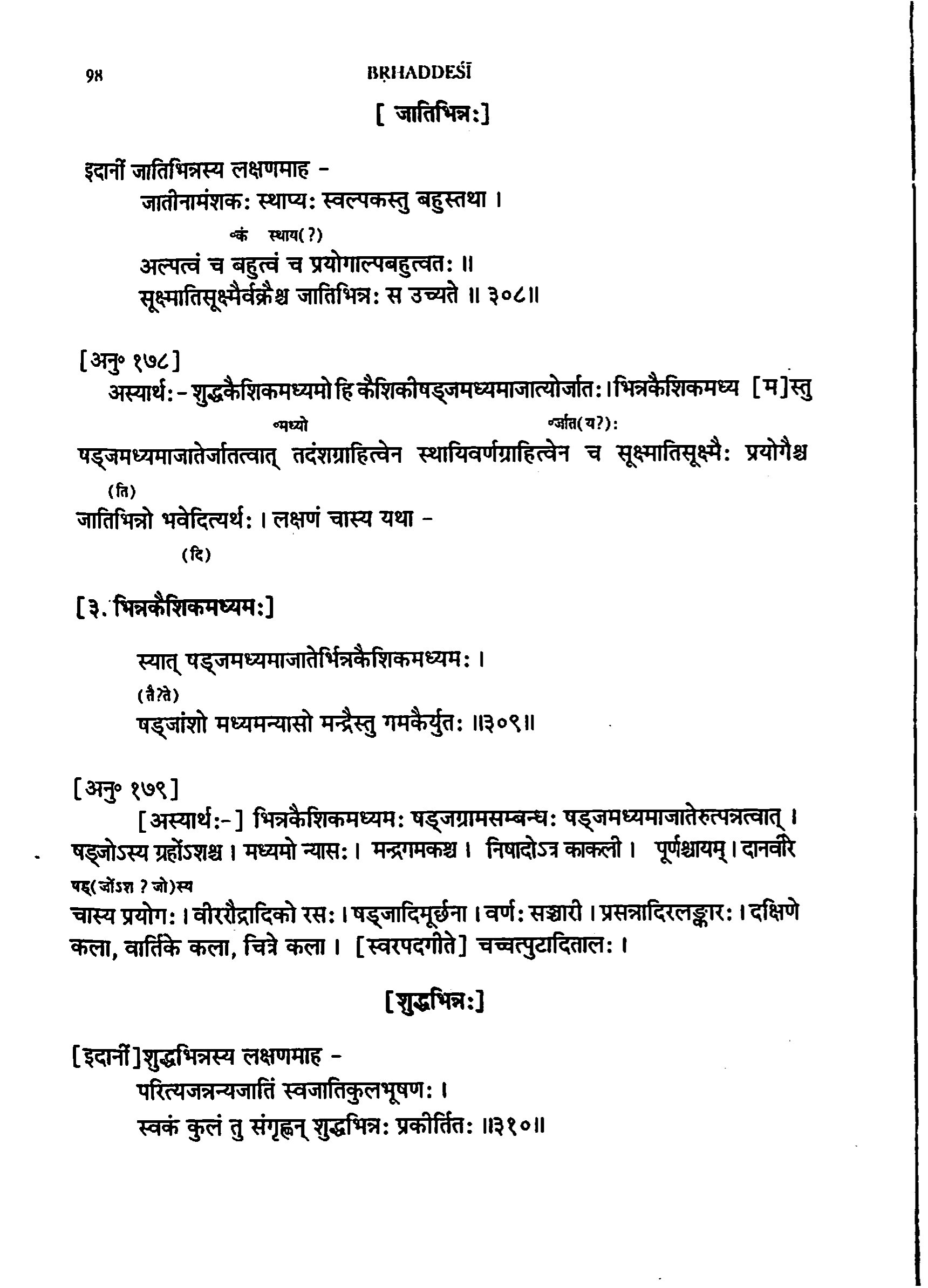
[जातिभिन्न:]
इदानीं जातिभिन्नस्य लक्षणमाह -
जातीनामंशक: स्थाप्य:॰कं स्थाय(?) स्वल्पकस्तु बहुस्तथा ।
अल्पत्वं च बहुत्वं च प्रयोगाल्पबहुत्वतः ॥
सूक्ष्मातिसूक्ष्मैर्वक्रैश्चन्मध्यो जातिभिन्नः स उच्यते1३०८<b>र्जात(य?):</b>
[अनु॰ १७८]
अस्यार्थ: - शुद्धकैशिकमध्यमो हि कैशिकीषड्जमध्यमाजात्योर्जात:5।भित्रकैशिकमध्य [म]स्तु पड्जमध्यमाजातेर्जातत्वात्(ति) तदंशग्राहित्वेन स्थायिवर्णग्राहित्वेन11 च सूक्ष्मातिस्क्ष्मै: प्रयोगैश्च जातिभिन्नो भवेदित्यर्थ:(दि)। लक्षणं चास्य यथा -
[३.भिन्नकैशिकमध्यमः]
स्यात् षड्जमध्यमाजातेभित्रकैशिकमध्यमः।
(तै?ते) षङ्जांशो मध्यमन्यासो मन्द्रैस्तु गमकैर्युत: ॥३०९॥
[अन्॰ १७९]
[अस्यार्थ:-] भित्रकैशिकमध्यमः षड्जग्रामसम्बन्धः षड्जमध्यमाजातेरुत्पन्नत्वात् ।
षङ्जोऽस्यपह्(जॉऽश ? जो)स्य ग्रहोंऽशश्च9मध्यमो न्यासः10 । मन्द्रगमकश्च । निषादोऽत्र काकली4 । पूर्णश्चायम् । दानवीर चास्य प्रयोगः । वीररौद्रादिको रसः । षड्जादिमूर्छना12 । वर्णः सञ्चारी । प्रसन्नादिरलङ्कारः । दक्षिणे
कला, वार्तिके कला, चित्रे कला। [स्वरपदगीते] चच्चत्पुटादिताल:6
[शुद्धभिनः]
[इदानी]शुद्धभित्रस्य लक्षणमाह - परित्यजन्नन्यजातिं स्वजातिकुलभूषणः। स्वकं कुलं तु संगृह्धन् शुद्धभित्रः प्रकीर्तितः ॥३१०॥3
English — Sharma (translation)
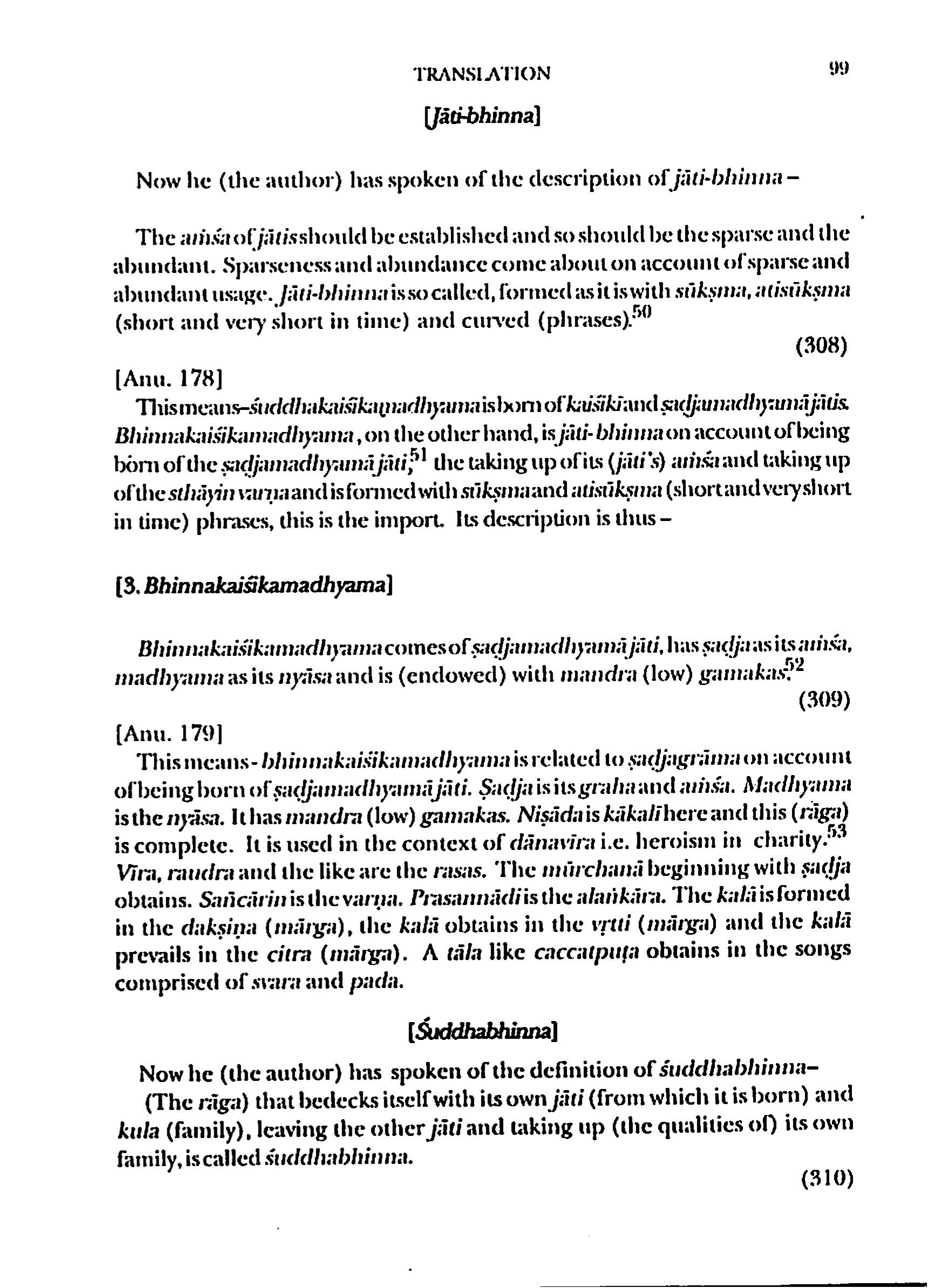
Now he (the author) has spoken of the description of jāti-bhinna - The amśa of jātis should be established and so should be the sparse and the abundant. Sparseness and abundance come about on account of sparse and abundant usage. Jāti-bhinnais so called, formed as it is with sūkṣma, atisūkṣma (short and very short in time)2 and curved (phrases).150
(308)
[Anu. 178]
This means-śuddhakaiśika madhyamais born of kaiśiki and ṣadjamadhyamā jā ūs.5 Bhinnakaisikamadhyama, on the other hand, is jāti-bhinna on account of being born of the sadjamadhyamā jāti,51 the taking up of its (jāti's) amsaand taking up of the sthāyin varņa11 and is formed with sūkṣma and atisūkṣma (short and very short in time) phrases, this is the import. Its description is thus - Bhinnakaisikamadhyamacomes of ṣadjamadhyamā jāti, has ṣadja as its ainśa, <math>madhyama</math> as its <math>ny\bar{a}sa</math> and is (endowed) with <math>mandra</math> (low) <math>gamakas^{52}</math>
(309)
[Anu. 179]
This means-bhinnakaisikamadhyama is related to şadjagrāma on account of being born of şadjamadhyamā jāti. Şadja is its graha and ainša.9 Madhyama is the nyāsa.10 It has mandra (low) gamakas. Niṣāda is kākalī here4 and this (rāga) is complete. It is used in the context of dānavīra i.e. heroism in charity.7 53 Vīra, raudra and the like are the rasas. The mūrchanā beginning with ṣaḍja obtains.12 Sañcārin is the varņa. Prasannādi is the alankāra. The kalā is formed in the dakṣiṇa (mārga), the kalā obtains in the vṛtti (mārga) and the kalā prevails in the citra (mārga). A tāla like caccatpuța obtains in the songs comprised of svara and pada.6 Now he (the author) has spoken of the definition of śuddhabhinna- (The rāga) that bedecks itself with its own jāti (from which it is born) and kula (family), leaving the other jāti and taking up (the qualities of) its own family, is called śuddhabhinna.
(310)
1.[definition] jāti-bhinna is formed with sūkṣma, atisūkṣma and curved phrasesसूक्ष्मातिसूक्ष्मैर्वक्रैश्च ज?ातिभिन्नः स उच्यते
3.[definition] śuddhabhinna is defined as a rāga that adorns itself with its own jāti and kula while leaving other jātisपरित्यजन्नन्यजाति स्वजातिकुलभूषणः। स्वकं कुलं तु संगृह्धन् शुद्धभित्रः प्रकीर्तितः ॥३१०॥
4.[relation] In Bhinnakaisikamadhyama, niṣāda has the role of kākalīनिषादोऽत्र काकली
5.[relation] kaiśiki is a jāti from which śuddhakaiśika madhyama is bornशुद्धकैशिकमध्यमो हि कैशिकीषड्जमध्यमाज?ात्योर्ज?ातः
6.[relation] caccatpuța is a tāla that obtains in songs comprised of svara and pada[स्वरपदगीते] चच्चत्पुटादितालः
7.[relation] Bhinnakaisikamadhyama is used in the context of dānavīra (heroism in charity)दानवीर पह्(ज?ॉऽश ? ज?ो)स्य चास्य प्रयोगः
9.[structural] graha and ainša are structural elements; in Bhinnakaisikamadhyama, ṣaḍja serves as graha and ainšaषङ्ज?ोऽस्य ग्रहोंऽशश्च
10.[structural] nyāsa is a structural element; in Bhinnakaisikamadhyama, madhyama serves as nyāsaमध्यमो न्यासः
11.[structural] sthāyin varņa is taken up as part of the characteristic features of jāti-bhinnaस्थायिवर्णग्राहित्वेन
12.[structural] In Bhinnakaisikamadhyama, mūrchanā begins with ṣaḍjaषड्ज?ादिमूर्छना
1.[definition]jāti-bhinna is formed with sūkṣma, atisūkṣma and curved phrasesJāti-bhinnais so called, formed as it is with sūkṣma, atisūkṣma (short and very short in time) and curved (phrases).
2.[definition]sūkṣma and atisūkṣma are short and very short temporal units used in phrase constructionsūkṣma, atisūkṣma (short and very short in time)
3.[definition]śuddhabhinna is defined as a rāga that adorns itself with its own jāti and kula while leaving other jātisThe rāga) that bedecks itself with its own jāti (from which it is born) and kula (family), leaving the other jāti and taking up (the qualities of) its own family, is called śuddhabhinna.
4.[relation]In Bhinnakaisikamadhyama, niṣāda has the role of kākalīNiṣāda is kākalī here
5.[relation]kaiśiki is a jāti from which śuddhakaiśika madhyama is bornśuddhakaiśika madhyamais born of kaiśiki and ṣadjamadhyamā jā ūs.
6.[relation]caccatpuța is a tāla that obtains in songs comprised of svara and padaA tāla like caccatpuța obtains in the songs comprised of svara and pada.
7.[relation]Bhinnakaisikamadhyama is used in the context of dānavīra (heroism in charity)It is used in the context of dānavīra i.e. heroism in charity.
8.[structural]The aṁśa of jātis should be established and sparseness and abundance should be determined by usage patternsThe aṁśa of jātis should be established and so should be the sparse and the abundant. Sparseness and abundance come about on account of sparse and abundant usage.
9.[structural]graha and ainša are structural elements; in Bhinnakaisikamadhyama, ṣaḍja serves as graha and ainšaŞadja is its graha and ainša.
10.[structural]nyāsa is a structural element; in Bhinnakaisikamadhyama, madhyama serves as nyāsaMadhyama is the nyāsa.
11.[structural]sthāyin varņa is taken up as part of the characteristic features of jāti-bhinnataking up of the sthāyin varņa
12.[structural]In Bhinnakaisikamadhyama, mūrchanā begins with ṣaḍjaThe mūrchanā beginning with ṣaḍja obtains.