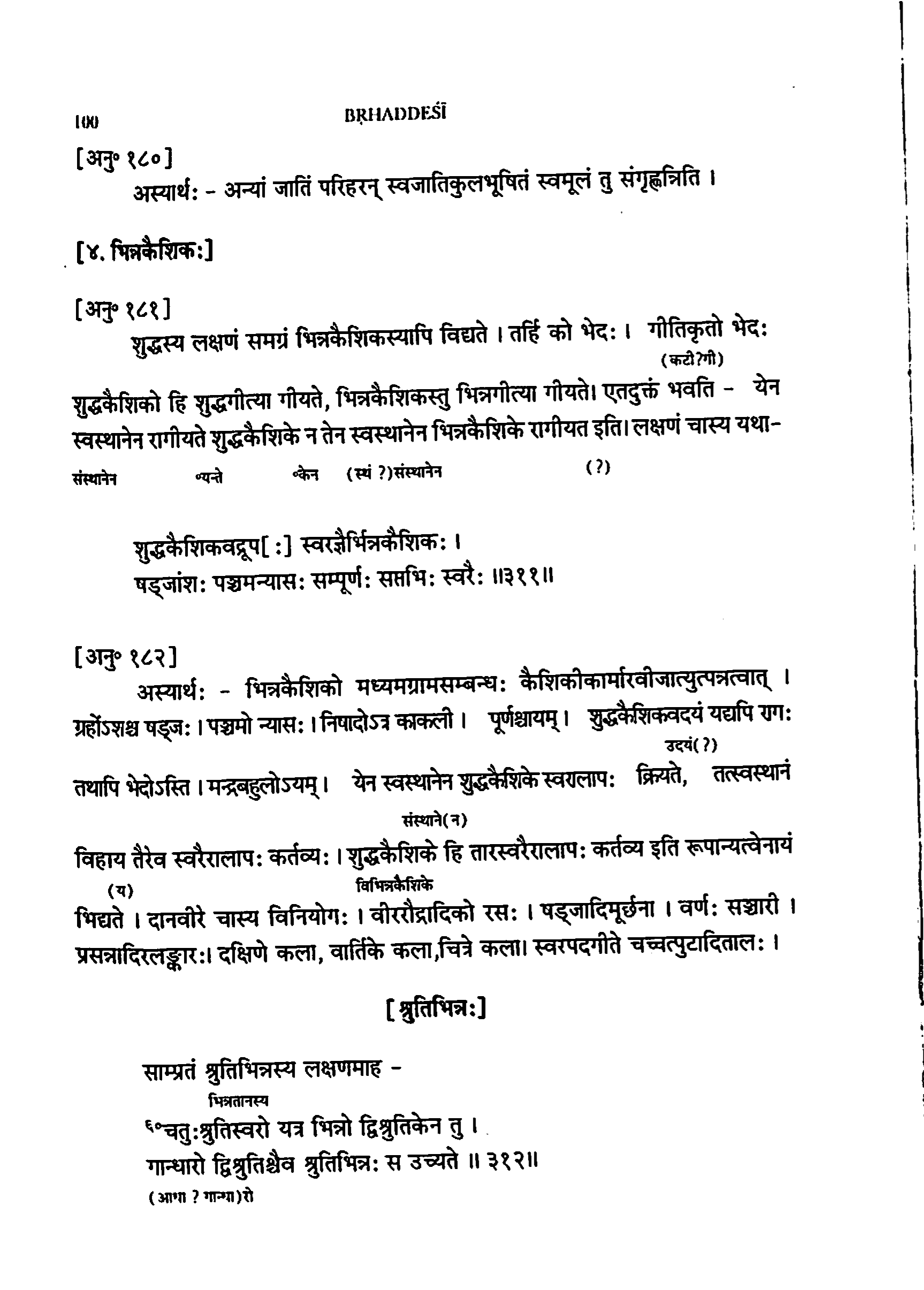
[Anu. 180]
This means-leaving the other jāti and taking up its own root i.e. bedecked
with its own jāti and kula (is formed the
śuddhabhinna).54
[Anu. 181]
The description of śuddha (kaiśika) applies in its totality also to
bhinnakaiśika.
What is then the difference? The difference is formed by gīti.
Śuddhakaiśika
is sung in the <math>\acute{s}uddh\~{a}</math> <math>g\~{i}ti</math>, whereas <math>bhinnakai\acute{s}ika</math> is sung in the <math>bhinn\~{a}</math> <math>g\~{i}ti</math>.
This is being said -
The
svasthāna<math>^{56}</math> (unit of tonal range) with which the rāga is elaborated in
śuddhakaiśika, the rāga is not elaborated with the same
svasthāna in
bhinnakaisika. And its description is thus -
Bhinnakaiśika is known by the knowledgeable ones in svara to have a form
similar to that of
śuddhakaiśika.
It has ṣaḍja as its aṁśa, pañcama as its nyāsa
(and) is complete with the seven svaras.6
(311)
[Anu. 182]
This means -
bhinnakaiśika is related to madhyamagrāma on account of being
born of kaiśikī and kārmāravī jātis.53 Şadja is the graha and amśa.
Pañcama is the
nyāsa, niṣāda is kākalī here11 and it is complete. Although this rāga is like
śuddhakaiśika, yet there is a difference.
This has abundance of mandra (low
notes).7 The svasthāna with which svara - ālāpa (tonal elaboration) is done in
śuddhakaiśika, ālāpa has to be done with the same svaras (here), leaving that
svasthāna857 In śuddhakaiśika, ālāpa should be done with tāra (high) svaras and
thus it becomes distinct on account of difference in form.9 Its application is
prescribed in dānavīra (heroism in charity).4 Vīra, raudra and the like are the rasas.10
The
mūrchanā beginning with ṣadja obtains. Sañcārinis the varņa.
Prasannādi is
the
alankāra. The kalā is formed in the
dakṣiṇa (mārga), the kalā obtains in the
vṛtii (mārga) and the kalā prevails in the
citra (mārga).
A tālalike caccatpuṭa obtains
in the songs comprised of svara and pada.12
(
Śruti-bhinna)
Now he (the author) has spoken of the definition of
śruti-bhinna -
Where the svara comprised of four śrutis is modified by the one comprised of two
śrutis and gāndhāra is comprised of only two śrutis, that is called śruti-bhinna.1
(312)