Source scans · vol_II_p116
recto · open full
scan recto
verso · open full
scan verso
Bṛhaddeśī · Volume II
pp. 214–215folio 116
Devanāgarī (Bṛhaddeśī)
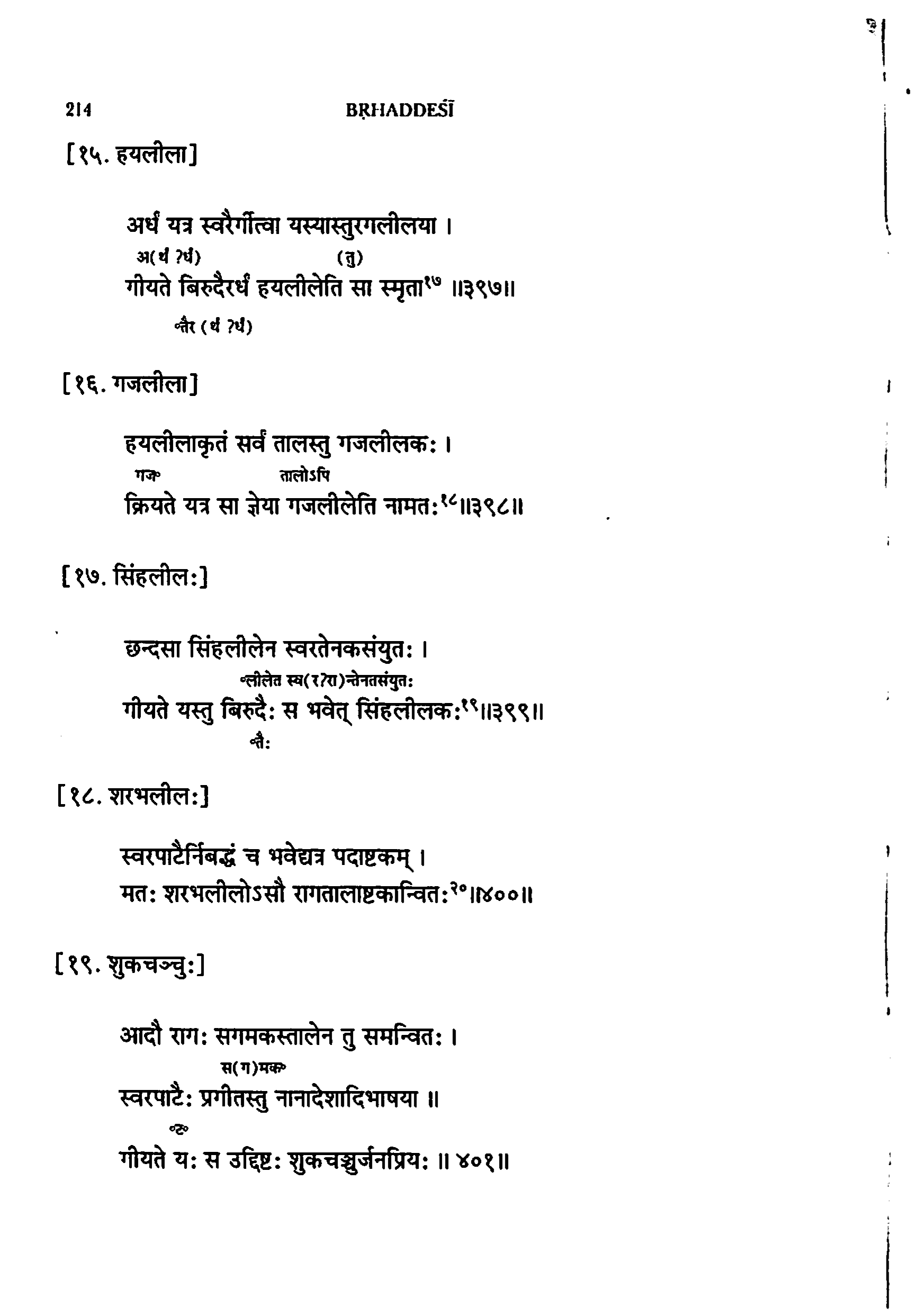
[१५. हयलीला]
अर्धंअ(र्थ ?र्ध) यत्र स्वरैगींत्वा यस्यास्तुरगलीलया6
(নু) गीयते बिरुदैरर्धं हयलीलेति सा स्मृता8र७ ॥३९७॥ नीर (थं ?धं)
[१६. गजलीला]
हयलीलाकृतंगज्ञ सर्वं तालस्तुतालोऽपि गजलीलक:।
क्रियते यत्र सा ज्ञेया गजलीलेति नामतः १८॥३९८॥
[१७. सिंहलील:]
छन्दसा सिंहलीलेन स्वरतेनकसंयुत:7॰लीलेत स्थ(र?रा)न्तेनतसंयुत:
गीयते यस्तु बिरुदै:न्तै: स भवेत् सिंहलीलक: १९॥३९९॥
[१८. शरभलील:]
स्वरपाटैर्निबद्धं च भवेद्यत्र पदाष्टकम्5
मतः शरभलीलोऽसौ रागतालाष्ट्रकान्वितः २०॥४००॥
[१९. शुकचञ्चु:]
आदौ राग: सगमकस्तालेनस(ग)मक तु समन्वित:9
स्वरपाटै: प्रगीतस्तु नानादेशादिभाषया ॥
गीयते यः स उद्दिष्टः शुकचञ्जूर्जनप्रियः ॥४०१॥
English — Sharma
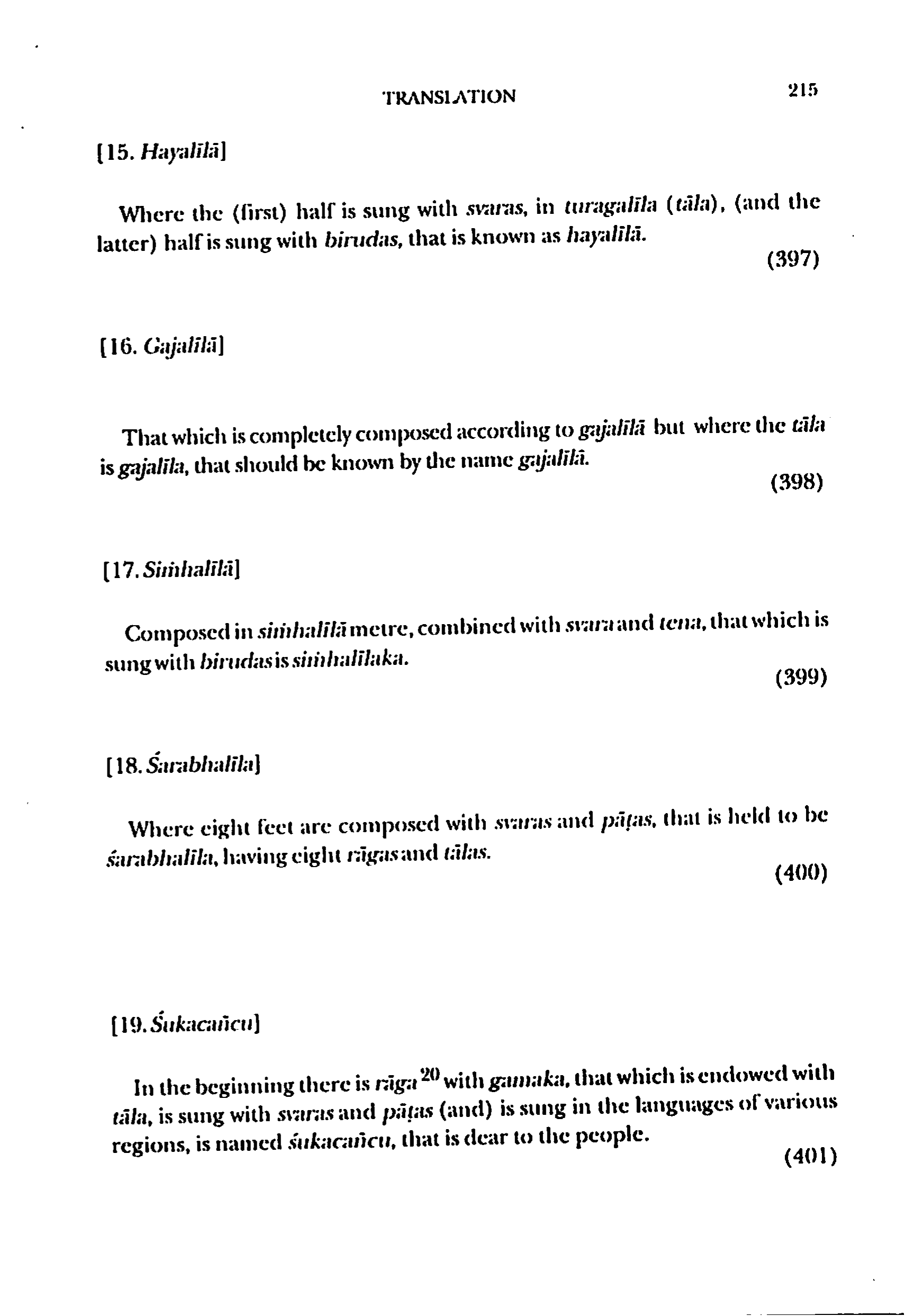
Where the (first) half is sung with svaras, in turagalīla (tāla)6, (and the latter) half is sung with birudas, that is known as hayalīlā.1
(397)
That which is completely composed according to gajalīlā but where the tāla is gajalīla, that should be known by the name gajalīlā.2
(398)
[17. Simhalīlā]
Composed in simhalilā metre, combined with svara and tena7, that which is sung with birudas is sinihalīlaka.3
(399)
Where eight feet are composed with svaras and pāṭas5, that is held to be śarabhalīla, having eight rāgas and tālas.10
(400)
In the beginning there is <math>r\bar{s}ga^{20}</math> with <math>gamaka</math>, that which is endowed with <math>t\bar{a}la</math>, is sung with svaras and <math>p\bar{a}t</math>as (and) is sung in the languages of various regions, is named śukacańcu, that is dear to the people.
(401)
5.[relation] Pāṭas are used in śarabhalīla and śukacańcu compositions alongside svarasस्वरपाटैर्निबद्धं च भवेद्यत्र पदाष्टकम्
6.[relation] Turagalīla is a tāla form used in hayalīlā compositionsयस्यास्तुरगलीलया
7.[relation] Tena is combined with svara in simhalīlā metre compositionsछन्दसा सिंहलीलेन स्वरतेनकसंयुतः
8.[relation] Birudas are sung in the second half of hayalīlā and in simhalīlā compositionsगीयते बिरुदैरर्धं हयलीलेति सा स्मृता
9.[relation] Gamaka appears at the beginning of śukacańcu compositions, in association with rāgaआदौ रागः सगमकस्तालेन तु समन्वितः
1.[definition]Hayalīlā is defined as a composition where the first half is sung with svaras and the second half with birudas, performed in turagalīla tālaWhere the (first) half is sung with svaras, in turagalīla (tāla), (and the latter) half is sung with birudas, that is known as hayalīlā.
2.[definition]Gajalīlā is a composition type where the tāla itself is gajalīlaThat which is completely composed according to gajalīlā but where the tāla is gajalīla, that should be known by the name gajalīlā.
3.[definition]Simhalilā is a meter composed with svara and tena, sung with birudasComposed in simhalilā metre, combined with svara and tena, that which is sung with birudas is sinihalīlaka.
4.[definition]Śukacańcu is sung with svaras and pāṭas in various regional languages, beginning with rāga with gamaka, endowed with tālathat which is endowed with tāla, is sung with svaras and pātas (and) is sung in the languages of various regions, is named śukacańcu
5.[relation]Pāṭas are used in śarabhalīla and śukacańcu compositions alongside svarasWhere eight feet are composed with svaras and pāṭas
6.[relation]Turagalīla is a tāla form used in hayalīlā compositionsin turagalīla (tāla)
7.[relation]Tena is combined with svara in simhalīlā metre compositionsComposed in simhalilā metre, combined with svara and tena
8.[relation]Birudas are sung in the second half of hayalīlā and in simhalīlā compositionsthat which is sung with birudas, that is known as hayalīlā.
9.[relation]Gamaka appears at the beginning of śukacańcu compositions, in association with rāgaIn the beginning there is rāga with gamaka, that which is endowed with tāla
10.[structural]Śarabhalīla is a composition of eight feet (pāda) created with svaras and pāṭas, having eight rāgas and tālasWhere eight feet are composed with svaras and pāṭas, that is held to be śarabhalīla, having eight rāgas and tālas.