Source scans · vol_II_p124
recto · open full
scan recto
verso · open full
scan verso
Bṛhaddeśī · Volume II
pp. 1–231folio 124
Devanāgarī (Bṛhaddeśī)
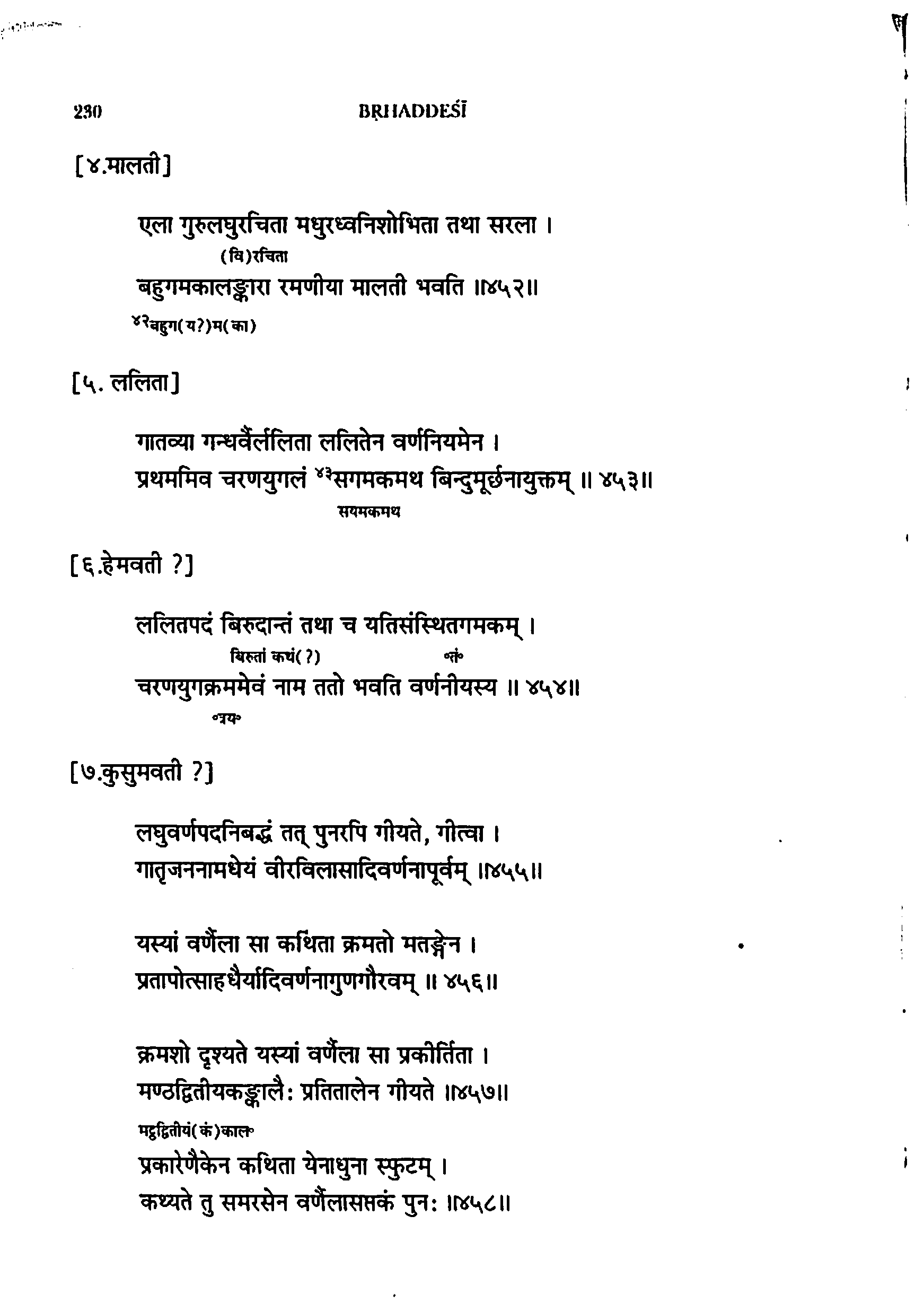
[४.मालती]
एला गुरुलघुरचिता(वि)रचिता मधुरध्वनिशोभिता तथा सरला ।
बहुगमकालङ्कारा रमणीया मालती भवति ॥४५२॥ ४२बहुग(य?)म(का)
[५. ललिता]
गातव्या गन्धर्वैर्ललिता ललितेन वर्णनियमेन76
प्रथमिव चरणयुगलं ४३सगमकमथसयमकमथ बिन्दुमूर्छनायुक्तम्8 ॥४५३॥
[६.हेमवती ?]
लिलतपदं बिरुदान्तंबिरुतां कथं(?) तथा च यतिसंस्थितगमकम्11oतं
चरणयुगक्रममेवं°त्रयः नाम ततो भवति वर्णनीयस्य ॥४५४॥
लघुवर्णपदनिबद्धं तत् पुनरिप गीयते, गीत्वा ।
गातृजननामधेयं वीरविलासादिवर्णनापूर्वम् ॥४५५॥
यस्यां वर्णेला सा कथिता क्रमतो मतङ्गेन1
प्रतापोत्साहधैर्यादिवर्णनागुणगौरवम् ॥४५६॥
क्रमशो दृश्यते यस्यां वर्णेला सा प्रकीर्तिता2
मण्ठद्वितीयकङ्कालै:मद्रद्वितीयं(कं)काल॰ प्रतितालेन गीयते94 ॥४५७॥
प्रकारेणैकेन कथिता येनाधुना स्फुटम् ।
कथ्यते तु समरसेन वर्णेलासप्तकं पुन:5 ॥४५८॥
English — Sharma (translation)
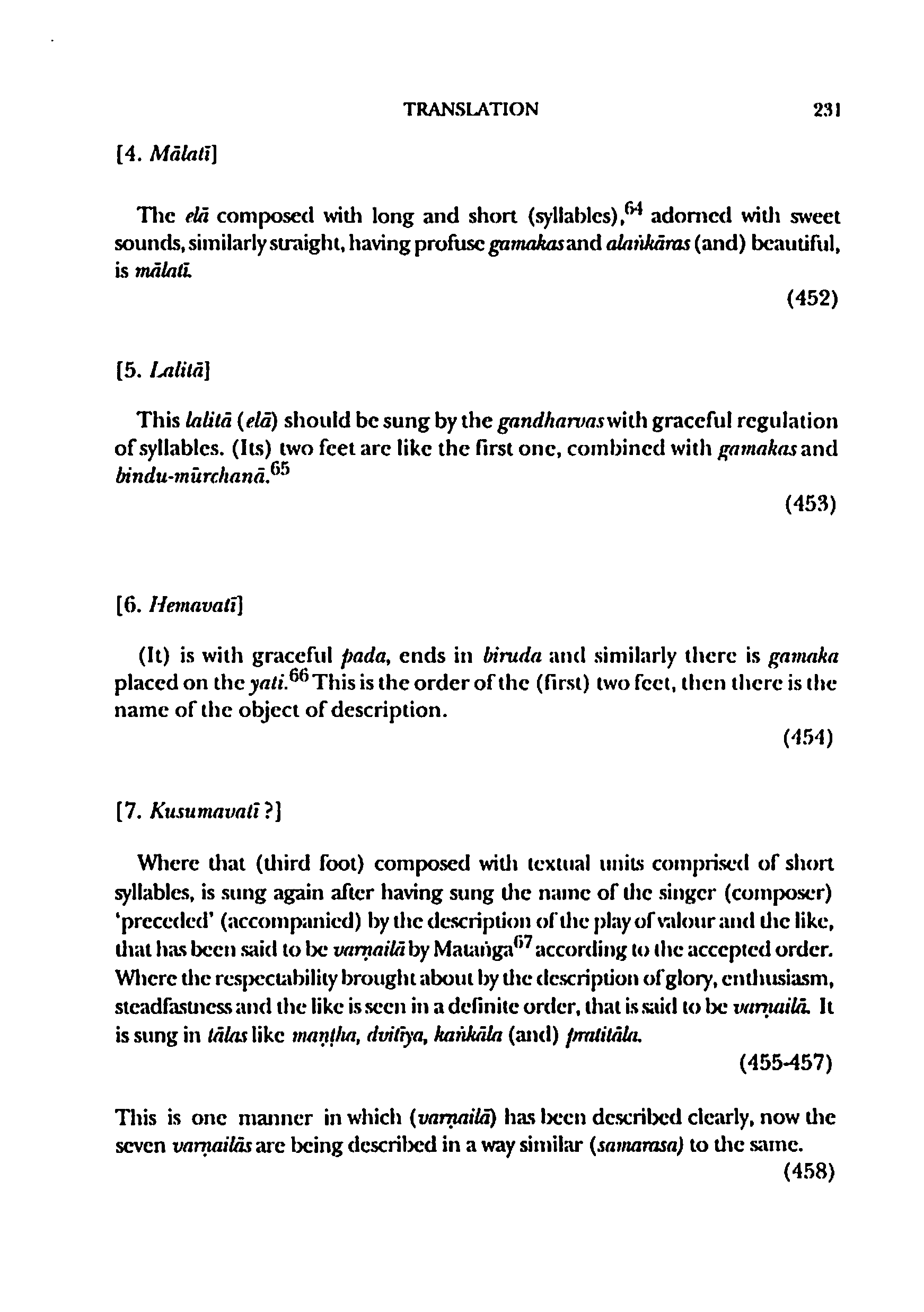
[4. Mālatī]
The elā composed with long and short (syllables), 64 adorned with sweet sounds, similarly straight, having profuse gamakas and alankāras (and) beautiful, is mālatī.3
(452)
[5. Lalitā]
This lalitā (elā) should be sung by the gandharvas with graceful regulation of syllables. (Its) two feet are like the first one, combined with gamakas and hindu-mūrchanā.10865
(453)
(It) is with graceful pada, ends in biruda and similarly there is gamaka placed on the yati.11 66 This is the order of the (first) two feet, then there is the name of the object of description.
(454)
Where that (third foot) composed with textual units comprised of short syllables, is sung again after having sung the name of the singer (composer) 'preceded' (accompanied) by the description of the play of valour and the like, that has been said to be varṇailā by Matanga67 according to the accepted order. Where the respectability brought about by the description of glory, enthusiasm, steadfastness and the like is seen in a definite order, that is said to be varyailā.2 It is sung in tālas like maņļha, dvitīya, kankāla (and) įmatitāla.94 <math>(455-457)</math> This is one manner in which (varnaila) has been described clearly, now the seven varnailās are being described in a way similar (samarasa) to the same.5
(458)
1.[attribution] The doctrine of varṇailā is attributed to Matanga, who described it according to accepted orderयस्या वर्णेला सा कथिता क्रमतो मतङ्गेन
2.[definition] varṇailā is a musical form characterized by descriptions of qualities like glory, enthusiasm, and steadfastness presented in definite orderक्रमशो दृश्यते यस्या वर्णेला सा प्रकीर्तिता
4.[enumeration] Kankāla is one of the tālas in which varṇailā is performedमण्ठद्वितीयकङ्कालैः प्रतितालेन गीयते
5.[enumeration] There are seven varieties of varṇailā that are described in similar mannerकथ्यते तु समरसेन वर्णेलासप्तकं पुनः
6.[relation] Lalitā should be sung by gandharvas with graceful regulation of syllablesगातव्या गन्धर्वैर्ललिता ललितेन वर्णनियमेन
7.[relation] Gandharvas are the performers or singers of lalitā elāगातव्या गन्धर्वैर्ललिता ललितेन वर्णनियमेन
8.[relation] Hindu-mūrchanā is a musical element combined with gamakas in the structure of lalitāसगमकमथ बिन्दुमूर्छनायुक्तम्
9.[structural] varṇailā is sung in specific tālas including maņļha, dvitīya, kankāla, and įmatitālaमण्ठद्वितीयकङ्कालैः प्रतितालेन गीयते
11.[structural] Biruda is a structural element that marks the ending of the graceful pada in certain elāsलिलतपदं बिरुदान्तं तथा च यतिसंस्थितगमकम्
1.[attribution]The doctrine of varṇailā is attributed to Matanga, who described it according to accepted orderthat has been said to be varṇailā by Matanga according to the accepted order.
2.[definition]varṇailā is a musical form characterized by descriptions of qualities like glory, enthusiasm, and steadfastness presented in definite orderWhere the respectability brought about by the description of glory, enthusiasm, steadfastness and the like is seen in a definite order, that is said to be varyailā.
3.[definition]Mālatī is an elā composed with long and short syllables, adorned with sweet sounds, straight in form, with profuse gamakas and alankārasThe elā composed with long and short (syllables), 64 adorned with sweet sounds, similarly straight, having profuse gamakas and alankāras (and) beautiful, is mālatī.
4.[enumeration]Kankāla is one of the tālas in which varṇailā is performedIt is sung in tālas like maņļha, dvitīya, kankāla (and) įmatitāla.
5.[enumeration]There are seven varieties of varṇailā that are described in similar mannernow the seven varnailās are being described in a way similar (samarasa) to the same.
6.[relation]Lalitā should be sung by gandharvas with graceful regulation of syllablesThis lalitā (elā) should be sung by the gandharvas with graceful regulation of syllables.
7.[relation]Gandharvas are the performers or singers of lalitā elāThis lalitā (elā) should be sung by the gandharvas with graceful regulation of syllables.
8.[relation]Hindu-mūrchanā is a musical element combined with gamakas in the structure of lalitācombined with gamakas and hindu-mūrchanā.
9.[structural]varṇailā is sung in specific tālas including maņļha, dvitīya, kankāla, and įmatitālaIt is sung in tālas like maņļha, dvitīya, kankāla (and) įmatitāla.
10.[structural]The two feet of lalitā include gamakas and hindu-mūrchanā combined(Its) two feet are like the first one, combined with gamakas and hindu-mūrchanā.
11.[structural]Biruda is a structural element that marks the ending of the graceful pada in certain elās(It) is with graceful pada, ends in biruda and similarly there is gamaka placed on the yati.