Source scans · vol_I_p066
recto · open full
scan recto
verso · open full
scan verso
Bṛhaddeśī · Volume I
pp. 114–115folio 066
Devanāgarī (Bṛhaddeśī)
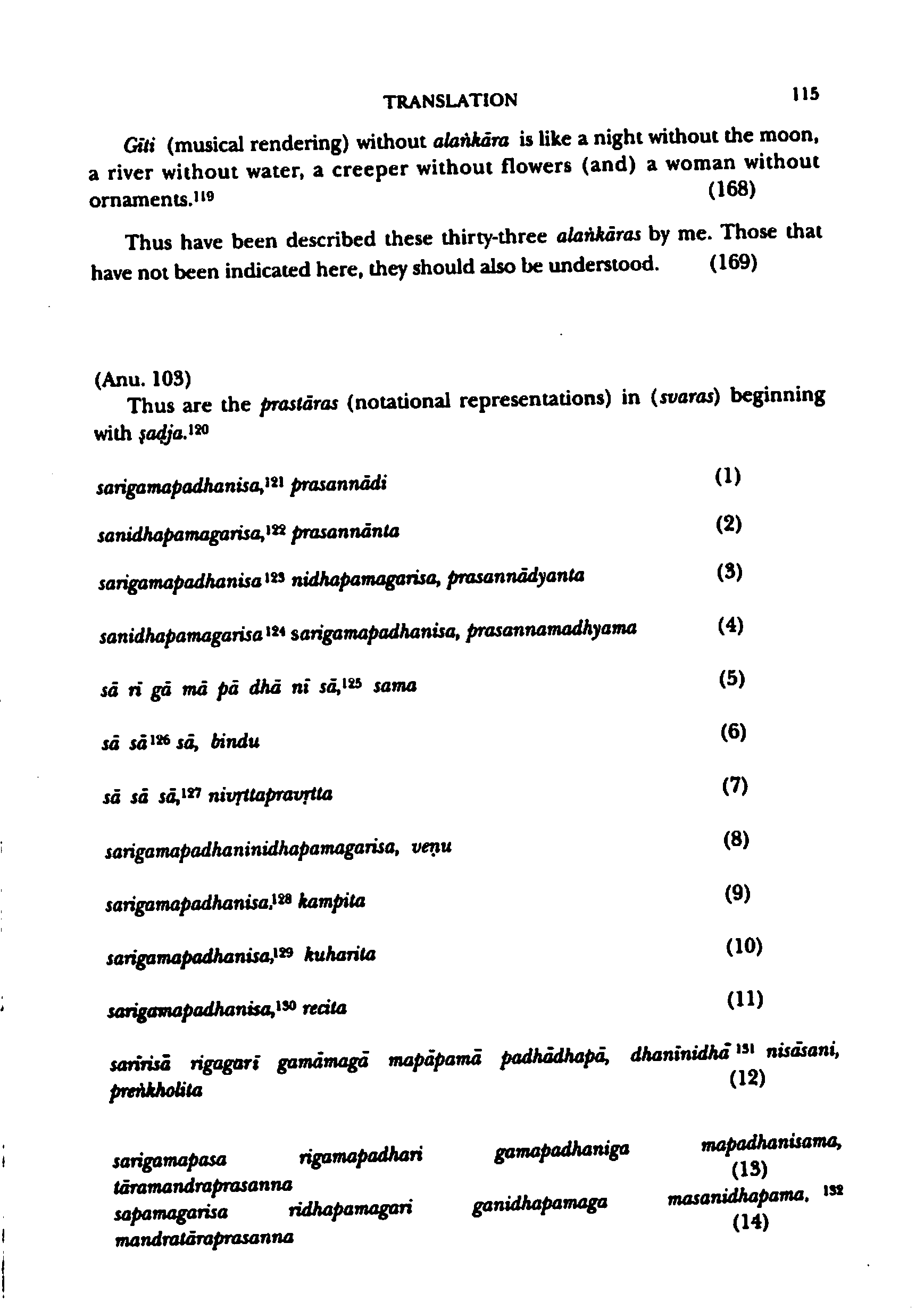
शशिविरहितेव रजनी विजलेव नदी लता ह्यपुष्पेव ।
अनलङ्कृतेव नारी गीतिरलङ्कारहीना स्यात्2 ॥१६८॥ अलङ्कारास्त्रयस्त्रिंशदेवमेते मयोदिता1 नोदिता ये तु तेऽप्यत्र प्रत्येतव्या मनीषिभि ॥१६९॥ .दीयोऽपि (?)
[अनु. १०३]
तत्र प्रस्तारा यथा षड्ज?ादिषु8— •रो सरिगमपधनिसा, प्रसन्नादि3 [ १ ] सनिधपमगरिसा, प्रसन्नान्तः4 [ २ ] स रि ग म प ध नि स निधपमगरिसा, प्रसन्नाद्यन्तः9 [ ३ ] स नि ध प म ग रि सा सरिगमपधनिसा, प्रसन्नमध्यमः10 [ ४ ] सारी गामापाधानीसा, समः11 [५] स रि ग म प ध नि ॰म सा सा सा, बिन्दु [ ६ ] स स्यात् (?) स सा सा सा, निवृत्तप्रवृत्तः [ ७ ] सदससा स रि ग म प ध नि निधपमगरिस, वेणु [ ८ ]13 सरिगमपधनिसा, कम्पितः5 [ ९ ] सरिगमपधनिसा, कुहरितः [१० ]6 सनि (事) सरिगमपधनिसा, रेचितः [ ११ ]7 सरीरिसा रिगागरी ग मा म गा म पा प मा रि स प धा ध पा ध नी नि धा निसासनी, प्रेङ्खोलितः [ १२ ] मम्भे • स रि ग म प स रि ग म प ध रि ग म प ध नि ग मपधनिसम, तारमन्द्रप्रसन्नः [ १३ ]14 स प म ग रि स रि ध प म ग रि ग नि ध प म ग मप मसनिधपम्, मन्द्रतारप्रसन्नः [ १४ ]15
ordered sequence list
prastāra of svara-phrases (alaṅkāra / prasanna varieties) — Section [anu. 103] opens: 'tatra prastārā yathā ṣaḍjādiṣu—'. Followed by a numbered list of 14 svara-sequences, each labelled with a named variety (prasannādiḥ, prasannāntaḥ, etc.) and indexed [1]–[14].
n · svaras · label
n · svaras · label
n · svaras · label
n · svaras · label
n · svaras · label
n · svaras · label
n · svaras · label
n · svaras · label
n · svaras · label
n · svaras · label
n · svaras · label
n · svaras · label
n · svaras · label
n · svaras · label
— [ अनु. १०३ ] तत्र प्रस्तारा यथा षड्जादिषु—
English — Sharma
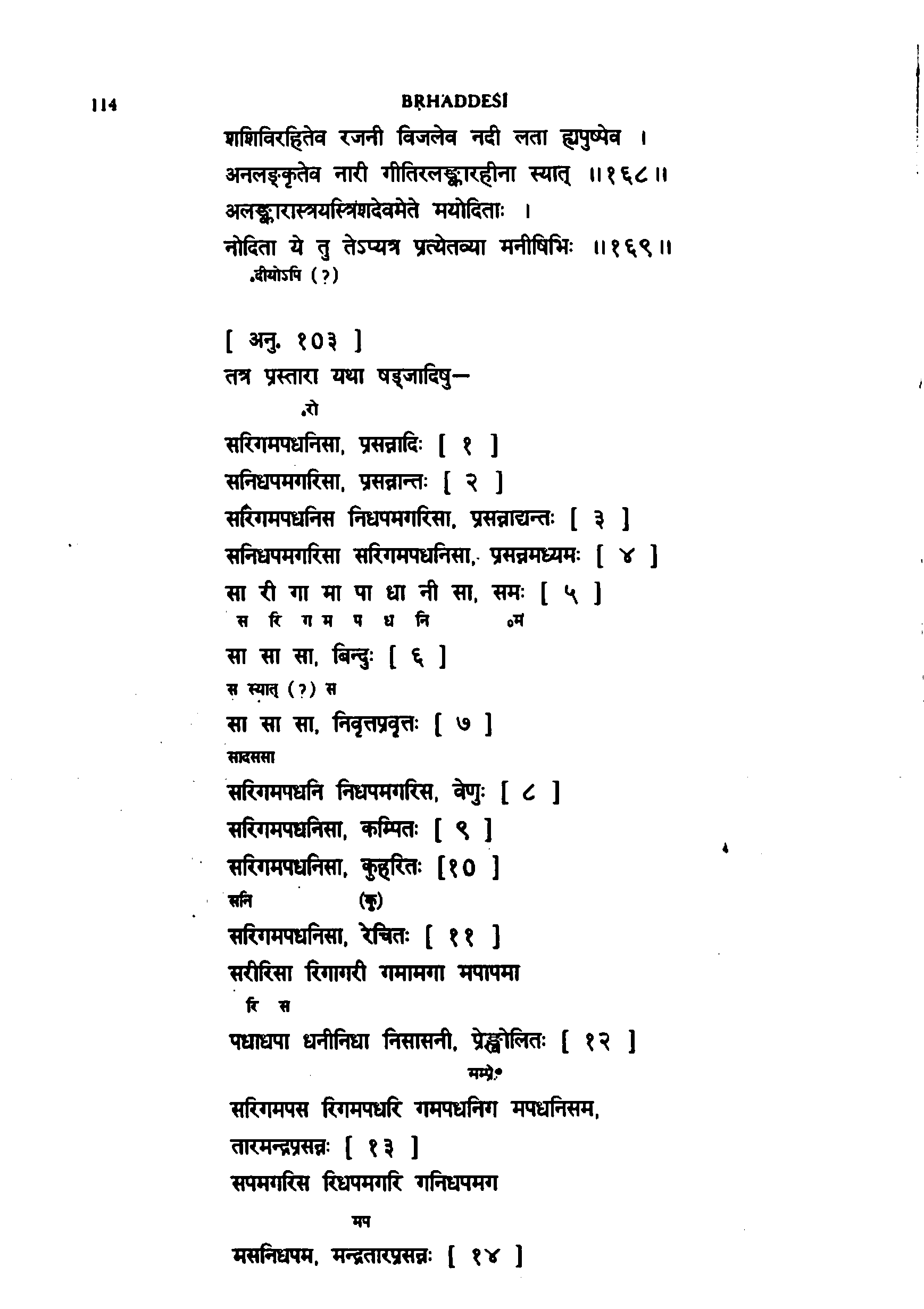
Giti (musical rendering) without alankāra is like a night without the moon, a river without water, a creeper without flowers (and) a woman without
(168)
ornaments.119 Thus have been described these thirty-three alankāras by me.1 Those that have not been indicated here, they should also be understood.
ordered sequence list
alaṅkāra — the 14 alaṅkāras (Anu. 103) with their svara-prastāra illustrations
prasannādi
prasannānta
prasannādyānta
prasannamadhyama
sama
bindu
nivṛttapravṛtta
veṇu
kampita
kuhārita
recita
preṅkholita
tāramandraprasanna
mandratāraprasanna
— alaṅkāra-prastāra (14 figures, prasannādi through mandratāraprasanna)
1.[enumeration] There are thirty-three alaṅkāra that have been systematically describedअलङ्कारास्त्रयस्त्रिंशदेवमेते मयोदिता
2.[relation] Musical rendering without alaṅkāra is fundamentally deficient, compared to natural entities lacking essential attributesशशिविरहितेव रजनी विजलेव नदी लता ह्यपुष्पेव । अनलङ्कृतेव नारी गीतिरलङ्कारहीना स्यात्
3.[relation] Prasannādi is a variant designation for the first prastara using the note sequence sarigamapadhanisaसरिगमपधनिसा, प्रसन्नादि
4.[relation] Prasannānta is a variant designation for a prastara using reversed note sequence sanidhapamagarisaसनिधपमगरिसा, प्रसन्नान्तः
5.[relation] Kampita is an alaṅkāra applied to the complete ascending note sequence sarigamapadhanisaसरिगमपधनिसा, कम्पितः
6.[relation] Kuharita is an alaṅkāra applied to the complete ascending note sequence sarigamapadhanisaसरिगमपधनिसा, कुहरितः [१० ]
7.[relation] Recita is an alaṅkāra applied to the complete ascending note sequence sarigamapadhanisaसरिगमपधनिसा, रेचितः [ ११ ]
8.[structural] Prastaras are notational representations organized according to svaras (pitches) beginning with ṣadjaतत्र प्रस्तारा यथा षड्ज?ादिषु
9.[structural] Prasannādyanta combines ascending and descending note sequences in a single prastaraस रि ग म प ध नि स निधपमगरिसा, प्रसन्नाद्यन्तः
10.[structural] Prasannamadhyama is a prastara where reversed and ascending sequences are centered structurallyस नि ध प म ग रि सा सरिगमपधनिसा, प्रसन्नमध्यमः
11.[structural] Sama designates a prastara with all seven notes presented in uniform mannerसारी गामापाधानीसा, समः
13.[structural] Veņu is a prastara combining ascending and descending note sequences without terminal repetitionस रि ग म प ध नि निधपमगरिस, वेणु [ ८ ]
14.[structural] Tāramandraprasanna is a prastara featuring multiple ascending sequences from lower to higher registerतारमन्द्रप्रसन्नः [ १३ ]
15.[structural] Mandratāraprasanna is a prastara featuring sequences moving from lower to higher and back to lower registerमन्द्रतारप्रसन्नः [ १४ ]
1.[enumeration]There are thirty-three alaṅkāra that have been systematically describedThus have been described these thirty-three alankāras by me.
2.[relation]Musical rendering without alaṅkāra is fundamentally deficient, compared to natural entities lacking essential attributesGiti (musical rendering) without alaṅkāra is like a night without the moon, a river without water, a creeper without flowers (and) a woman without (168) ornaments.
3.[relation]Prasannādi is a variant designation for the first prastara using the note sequence sarigamapadhanisa(1) sarigamapadhanisa,121 prasannādi
4.[relation]Prasannānta is a variant designation for a prastara using reversed note sequence sanidhapamagarisa(2) sanidhapamagarisa, 122 prasannānta
5.[relation]Kampita is an alaṅkāra applied to the complete ascending note sequence sarigamapadhanisa(9) sarigamapadhanisa.128 kampita
6.[relation]Kuharita is an alaṅkāra applied to the complete ascending note sequence sarigamapadhanisa(10) sarigamapadhanisa,129 kuharita
7.[relation]Recita is an alaṅkāra applied to the complete ascending note sequence sarigamapadhanisa(11) sarigamapadhanisa,150 recita
8.[structural]Prastaras are notational representations organized according to svaras (pitches) beginning with ṣadjaThus are the prastaras (notational representations) in (svaras) beginning with şadja.
9.[structural]Prasannādyanta combines ascending and descending note sequences in a single prastara(3) sarigamapadhanisa 123 nidhapamagarisa, prasannādyanta
10.[structural]Prasannamadhyama is a prastara where reversed and ascending sequences are centered structurally(4) sanidhapamagarisa 124 sarigamapadhanisa, prasannamadhyama
11.[structural]Sama designates a prastara with all seven notes presented in uniform manner(5) sā rī gā mā pā dhā nī sā,125 sama
12.[structural]Bindu is a prastara consisting of repeated statements of the same note (ṣadja)(6) sā sā 126 sā, bindu
13.[structural]Veņu is a prastara combining ascending and descending note sequences without terminal repetition(8) sarigamapadhaninidhapamagarisa, veņu
14.[structural]Tāramandraprasanna is a prastara featuring multiple ascending sequences from lower to higher register(13) tāramandraprasanna
15.[structural]Mandratāraprasanna is a prastara featuring sequences moving from lower to higher and back to lower register(14) mandratāraprasanna