Source scans · vol_I_p078
recto · open full
scan recto
verso · open full
scan verso
Bṛhaddeśī · Volume I
pp. 138–139folio 078
Pāṭha-vimarśa — recto
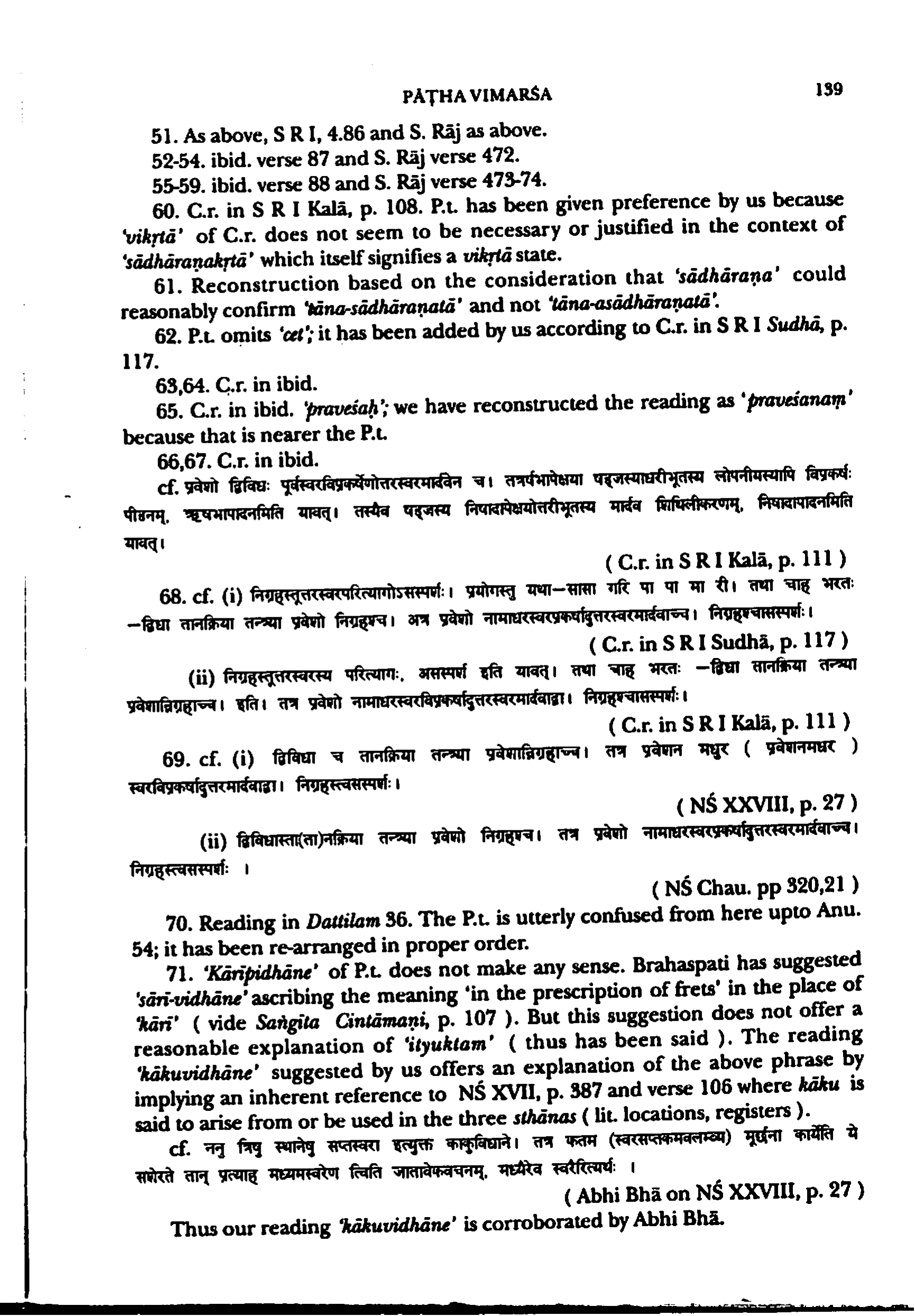
19. This sentence has been repeated in the MSS; the ed. has put it in paranthesis with a sign of interrogation. 20. MS A reading as recorded by the ed. 21. Verses 102 and 103 are both in the āryā metre, but they have been treated as prose in the P.t. 22. P.t. gives the first two sets of hexatonic tanas in the descending order like ni-dha-pa-ma-ga-ri etc. These have been changed by us into the ascending order; the crosses indicating the omitted svaras have also been added by us for the sake of clarity.
23. cf. (a) ननु कथ मूर्छनातानयोर्भेदः प्रतिपादितः, उच्यते ।
आरोहाबरोहक्रमयुक्तः स्वरसमुदायो मूर्छनेत्युच्यते ।
तानस्तु आरोहक्रमेण भवतीति भेदः ।
( Saṃ S Sā, p. 18 ) (b) यद्यपि मूर्छना एव शुद्धास्तानाः स्युरित्युक्तौ तानेष्वारोहावरोहत्व प्रतीयते, तथापि मतङ्गमतेनारोह एव तान इति जेयम्। तथा च मतङ्गः —ननु कथ मूर्छनातानयोर्भेद ? उच्यते। आरोहावरोहक्रमयुक्तः स्वरसमुदायो मुर्छनेत्युच्यते, तानस्त्वारोहण भवतीति भेदः ।4 ( Rā Vi, p. 31 ) 24. C.r. in S R I Sudhā, p. 114. 25. C.r. in Bha Ko, p. 502. 26. C.r. ( as in no. 24 ). 27. C.r. in Bha Ko, p. 502 adds 'bharatasya' in the beginning of the sentence. 28. C.r. in S R I Sudhā, p. 114 reads -
ननु कथ मूर्छनातानयोर्भेदः ? वूमः ।
29. Portion added from Sam S Sa, p. 18; S R I Sudha, p. 114 and Ra Vi, p. 31. 30. P.t. modified on the basis of ibid. 31. P.t. adds 'svarasystih?' after this, but it is totally out of context. 32,33,34. Our reconstruction is based on S R I, 4. 74. 35. Our reconstruction is based on S. Raj II, 1.1.457. The chart illustrating these tānas in S. Rāj I, p. 133 reads 'balabhṛt' and 'nāgayakşa'; S R I,4.76 reads balabhinnāgapakṣakaḥ. 36,37,38. Our reconstruction is based on S R I, 4.77. 39. S R I, 4.77. 40,41,42. Our reconstruction is based on S R I, 4.79. 43. ibid., verse 80. 44. Reconstruction based on S R I, 4.82 and S. Rāj II, 1.1.465. 45,46. Reconstruction based on S R I, 4. 83 and S. Rāj II, 1.1.467. 47. Reading in S R I, 4.84 and S. Rāj II, 1.1.468. 48. ibid. 49. Reconstruction based on ibid. 50. Reconstruction based on S R I, 4.85 and S. Rāj II, 1.1.469.
Pāṭha-vimarśa — verso
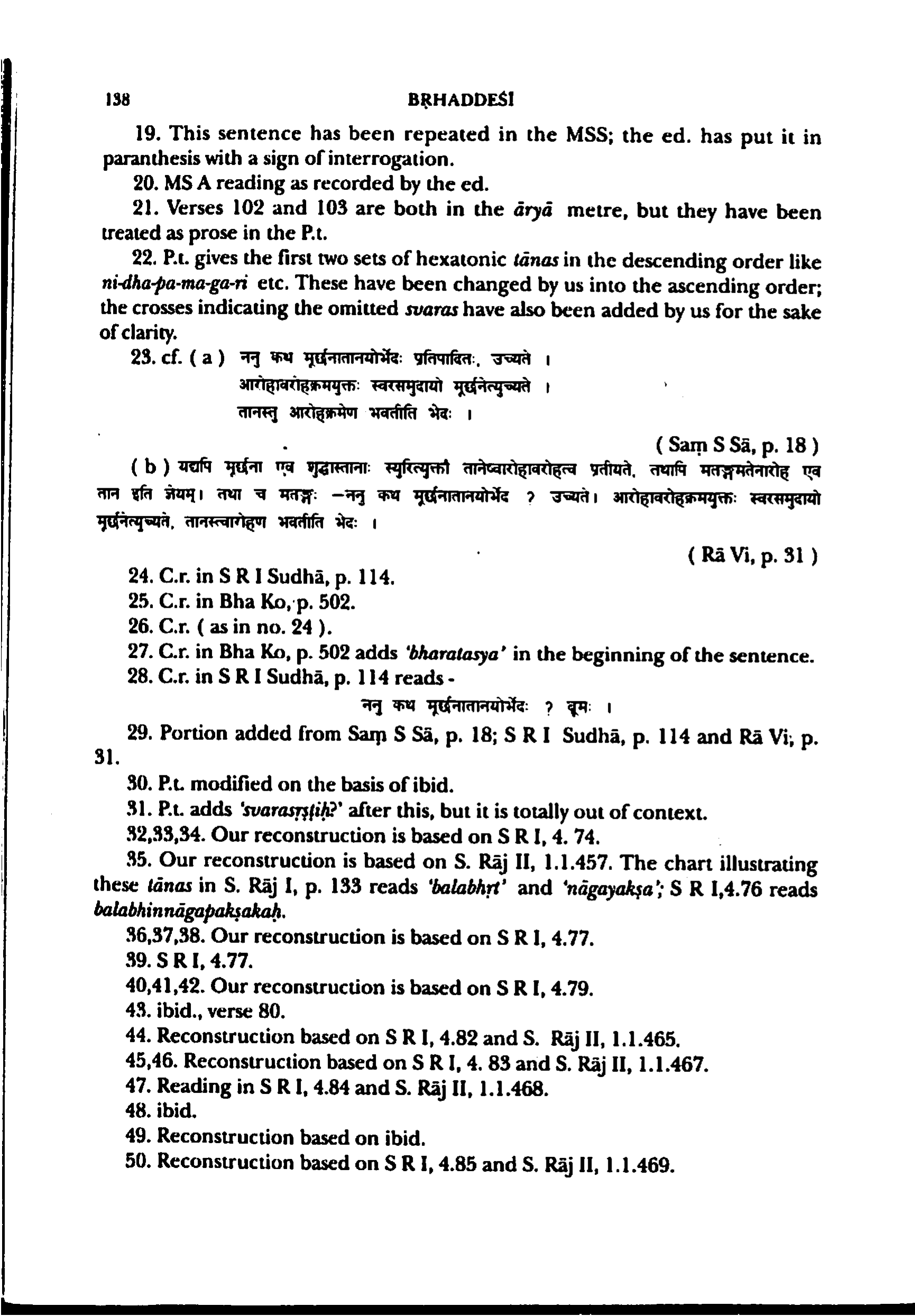
51. As above, S R I, 4.86 and S. Rāj as above. 52-54. ibid. verse 87 and S. Rāj verse 472. 55-59. ibid. verse 88 and S. Rāj verse 473-74. 60. C.r. in S R I Kalā, p. 108. P.t. has been given preference by us because 'vikṛtā' of C.r. does not seem to be necessary or justified in the context of 'sādhāraṇakṛtā' which itself signifies a vikṛtā state.10 61. Reconstruction based on the consideration that 'sādhāraņa' could reasonably confirm 'tāna-sādhāraņatā' and not 'tāna-asādhāraņatā'. 62. P.t. omits 'et'; it has been added by us according to C.r. in S R I Sudhā, p. 117. 63,64. C.r. in ibid. 65. C.r. in ibid. 'praveśaḥ'; we have reconstructed the reading as 'praveśanam' because that is nearer the P.t. 66,67. C.r. in ibid. cf. प्रवेशो द्विविधः पूर्वस्वरिवप्रकर्षेणोत्तरस्वरमार्ववेन च। तत्रर्थभाषेक्षया घड्जस्याधरीभूतस्य लोपनीयस्यापि विप्रकर्षः पीउनम्, ऋषभापादनमिति यावत्। तस्यैव पङ्जस्य निपादापेक्षयोत्तरीभूतस्य मार्दव शिथिलीकरणम्, निपादापादनमिति
यावत्।
(C.r. in S R I Kalā, p. 111) 68. cf. (i) निग्रहस्तूत्तरस्वरपरित्यागोऽसस्पर्णः। प्रयोगस्तु यथा—सासा गरि पा पा मा री। तथा चाह भरतः
—द्विधा तानक्रिया तन्त्र्या प्रवेशो निग्रहश्च। अत्र प्रवेशो नामाधरस्वरप्रकर्यादुत्तरस्वरमार्दवाच्च। निग्रहश्चासस्पर्शः।
(C.r. in S R I Sudhā, p. 117) (ii) निग्रहस्तूत्तरस्वरस्य परित्यागः, असस्पर्ध इति यावत्। तथा चाह् भरतः —िक्वधा तानक्रिया तन्त्र्या
प्रवेशात्रिगृहाच्च। इति। तत्र प्रवेशो नामाधरस्वरविप्रकर्यादुत्तरस्वरमार्ववाद्वा। निग्रहश्चासस्पर्शः।
(C.r. in S R I Kalä, p. 111) 69. cf. (i) द्विविधा च तानक्रिया तन्त्र्या प्रवेशाद्विग्रहाच्च। तत्र प्रवेशन मधुर ( प्रवेशनमधर )
स्वरविप्रकर्षादुत्तरमार्ववाद्वा। निग्रहस्त्वसस्पर्धः।
( NŚ XXVIII, p. 27 )
(ii) द्विविधास्ता(ता)नक्रिया तन्त्र्या प्रवेशो निग्रहण्च। तत्र प्रवेशो नामाधरस्वरप्रकर्यादुत्तरस्वरमार्दवाज?्च।
निग्रहस्त्वसस्पर्शः ।
( NŠ Chau. pp 320,21 ) 70. Reading in Dattilam 36.3 The P.t. is utterly confused from here upto Anu. 54; it has been re-arranged in proper order. 71. 'Kārīpidhāne' of P.t. does not make any sense. Brahaspati has suggested 'sārī-vidhāne' ascribing the meaning 'in the prescription of frets' in the place of 'kārī' (vide Sangīta Cintāmaņi, p. 107).1 But this suggestion does not offer a reasonable explanation of 'ityuktam' (thus has been said). The reading 'hākuvidhāne' suggested by us offers an explanation of the above phrase by implying an inherent reference to NS XVII, p. 387 and verse 106 where kāku is said to arise from or be used in the three sthānas (lit. locations, registers). cf. ननु त्रिषु स्थानेषु सप्तस्वरा इत्युक्त काकुविधाने। तत्र फतम (स्वरसप्तकमवलम्ब्य) मूर्खना कार्येति ये
संशेरते तान् प्रत्याह् मध्यमस्वरेण त्विति ज?ातावेफवचनम्, मध्येरेव स्वरेरित्यर्थः ।
(Abhi Bhā on NŚ XXVIII, p. 27) Thus our reading 'hākuvidhāne' is corroborated by Abhi Bhā.
4.[definition]Tāna is defined as an ascending sequence of svaras, distinguished from mūrchana which includes both ascending and descending orderतानस्त्वारोहण भवतीति भेदः ।
5.[definition]Tānas occur in ascending order (āroha) specifically, as opposed to mūrchanaतानस्तु आरोहक्रमेण भवतीति भेदः ।
6.[definition]Sthāna refers to three locations or registers within which svaras operateत्रिषु स्थानेषु
7.[definition]Praveśa is one of two types of tāna-kriyā (tāna practice), distinguished from nigrahaद्विविधा तानक्रिया तन्त्र्या प्रवेशो निग्रहश्च।
8.[definition]Praveśa involves lowering (softening) an upper svar through lowering of a lower svarप्रवेशो नामाधरस्वरप्रकर्यादुत्तरस्वरमार्ववाद्वा।
9.[relation]Kāku arises from or is used in three sthānas (registers/locations)त्रिषु स्थानेषु सप्तस्वरा इत्युक्त काकुविधाने।
1.[citation]Sangīta Cintāmaņi is cited as a comparative reference for interpretation of fret prescriptions and kāku terminologyBrahaspati has suggested 'sārī-vidhāne' ascribing the meaning 'in the prescription of frets' in the place of 'kārī' (vide Sangīta Cintāmaņi, p. 107).
2.[citation]NŚ (Nāṭyaśāstra) is cited for information on tāna-kriyā and its two types (praveśa and nigraha)( NŚ XXVIII, p. 27 )
3.[citation]Dattilam contains passage (verse 36) on tāna practice that Sharma uses to reconstruct textReading in Dattilam 36.
10.[relation]Sādhāraņa itself denotes a vikṛtā (modified/altered) state and relates to tāna-sādhāraņatā (commonality of tānas)'vikṛtā' of C.r. does not seem to be necessary or justified in the context of 'sādhāraṇakṛtā' which itself signifies a vikṛtā state.
11.[structural]Hexatonic tānas are presented in descending order in the P.t. but have been converted to ascending order with omitted svaras markedP.t. gives the first two sets of hexatonic tanas in the descending order like ni-dha-pa-ma-ga-ri etc. These have been changed by us into the ascending order
12.[structural]Verses 102 and 103 are both composed in āryā metre but treated as prose in the P.t.Verses 102 and 103 are both in the āryā metre, but they have been treated as prose in the P.t.