Source scans · vol_I_p077
recto · open full
scan recto
verso · open full
scan verso
Bṛhaddeśī · Volume I
pp. 136–137folio 077
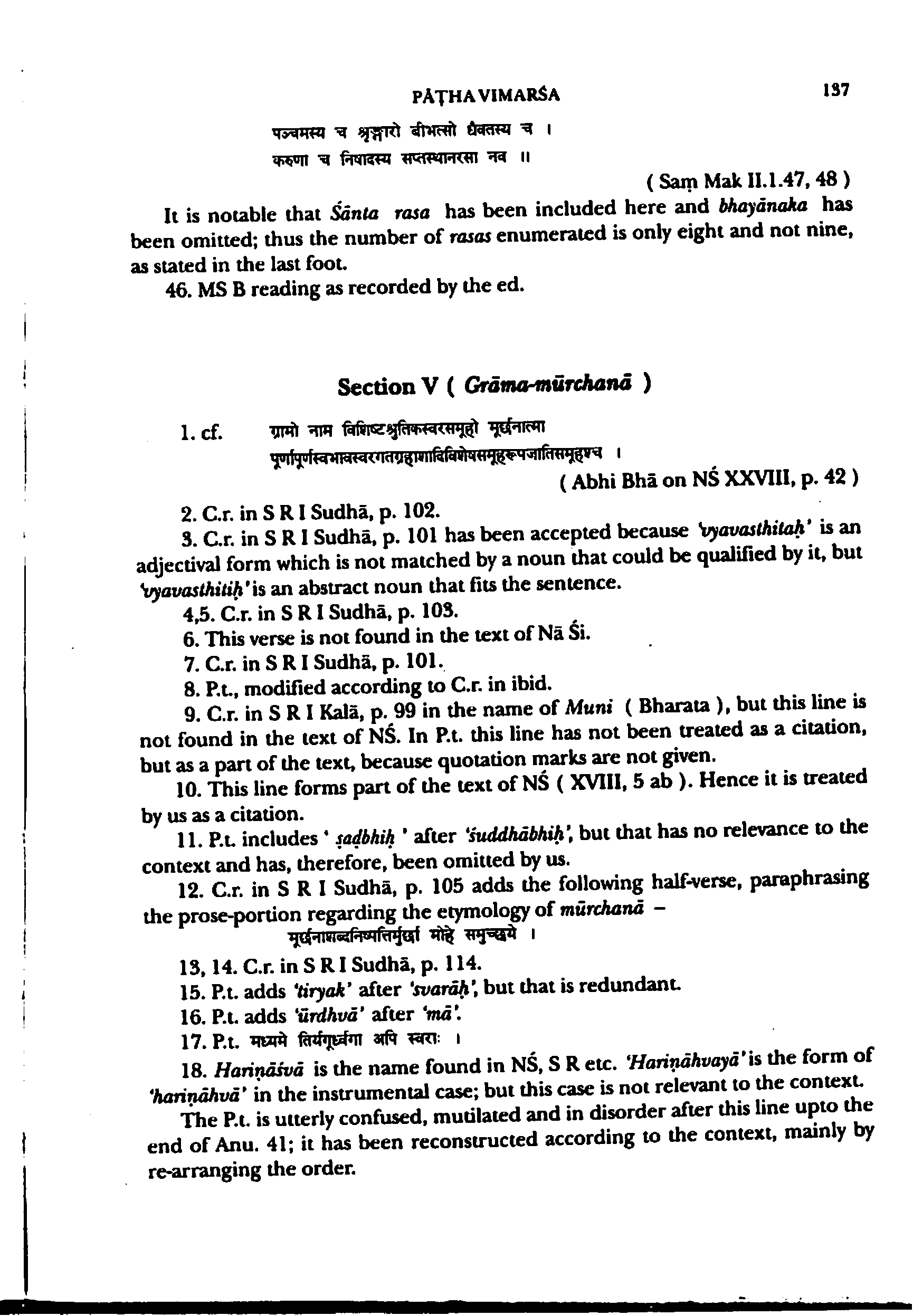
Pāṭha-vimarśa — recto
22. C.r. in S R I Sudhā, p. 94. 23. Added according to C.r. in S R I Sudhā, p. 94. 24. Portion added according to C.r. in S R I Sudhā, p. 95. 25. P.t. adds 'pañcama' before 'ṛṣabhaḥ' which is unwarranted. 26. P.t. combines sapta-svarāķ etc. and that has led to a misunderstanding among scholars to the effect that Matanga has accepted the 'samvāda' of seven- sruti interval in addition to that of nine and thirteen-sruti interval. (cf. IMJ, No. 11-12, p. 57, article by P.L.S. on Matanga's Brhaddess ). Actually sapta is related to 'svarāḥ'; hence a full-stop has been added after sapta and that clears the whole confusion. 27. The ed. states that the text is broken here; the missing portion has been taken by us from S R I Sudhā, p. 121. 28. Missing portion (verse 55-60) taken from C.r. in S R I Kalā, p. 79-81. The cited verses are interspersed by Kallinatha with prose sentences of his own, but they have been omitted by us. 29. C.r. in S R I Kalā, p. 81. 30. Sam S Sā, p. 14 and C.r. in S R I Kalā, p. 81. 31. This portion is missing in the MSS, it has been paraphrased in S R I Kalā, p. 81 and cited in ibid. Sudhā, p. 97.
32. cf. व्हाजाती समी जेयी रिधी क्षत्रियजातिको ।
निर्गा वैश्याविति प्रौक्तौ पञ्चमः शूद्रजातिकः ॥
( Sam Mak I. 29 ) 33. C.r. in S R I Sudhā, p. 97 and Sam Cû, p. 71. 34. C.r. in S R I Sudhā, p. 98. 35. Reading suggested by the ed. 36. C.r. in S R I Sudhā, p. 98. 37. C.r. in Sam Cu, p. 72. 38. C.r. in S R I Sudhā, p. 98.
39. cf. स्वराः सरिगमाश्चैव चत्वारो राक्षसाः स्मृताः ।
पधौ मानुषसज्ञौ च निपाद दैवत विदुः ॥
(Sam Mak I. 1.46) 40. After this P.t. has the following half-verse –
शृद्धजातिसमृत्पन्नी तौ काकल्यन्तरी स्वरी ।
This is redundant and misplaced because verse 61 d has already spoken of kākali and antara svaras being śūdra and this line does not fit into the context after verse 72; hence it has been omitted by us. 41. cf. Nā Ši I.4.1,2 and Gītālankāra, p. 50. 42. cf. Nā Ši I.5.14-18. 43. The reading 'hara' suggested by the ed. in the place of 'bhi' of MSS. 44. cf. Nā Ši 1.5.12-14.
पर्जाञ्चतर्वारी च ऋषभस्य च गंद्रकः ।
45. cf.
गान्धारस्य च शान्त च हास्यास्य मध्यमस्य च ॥
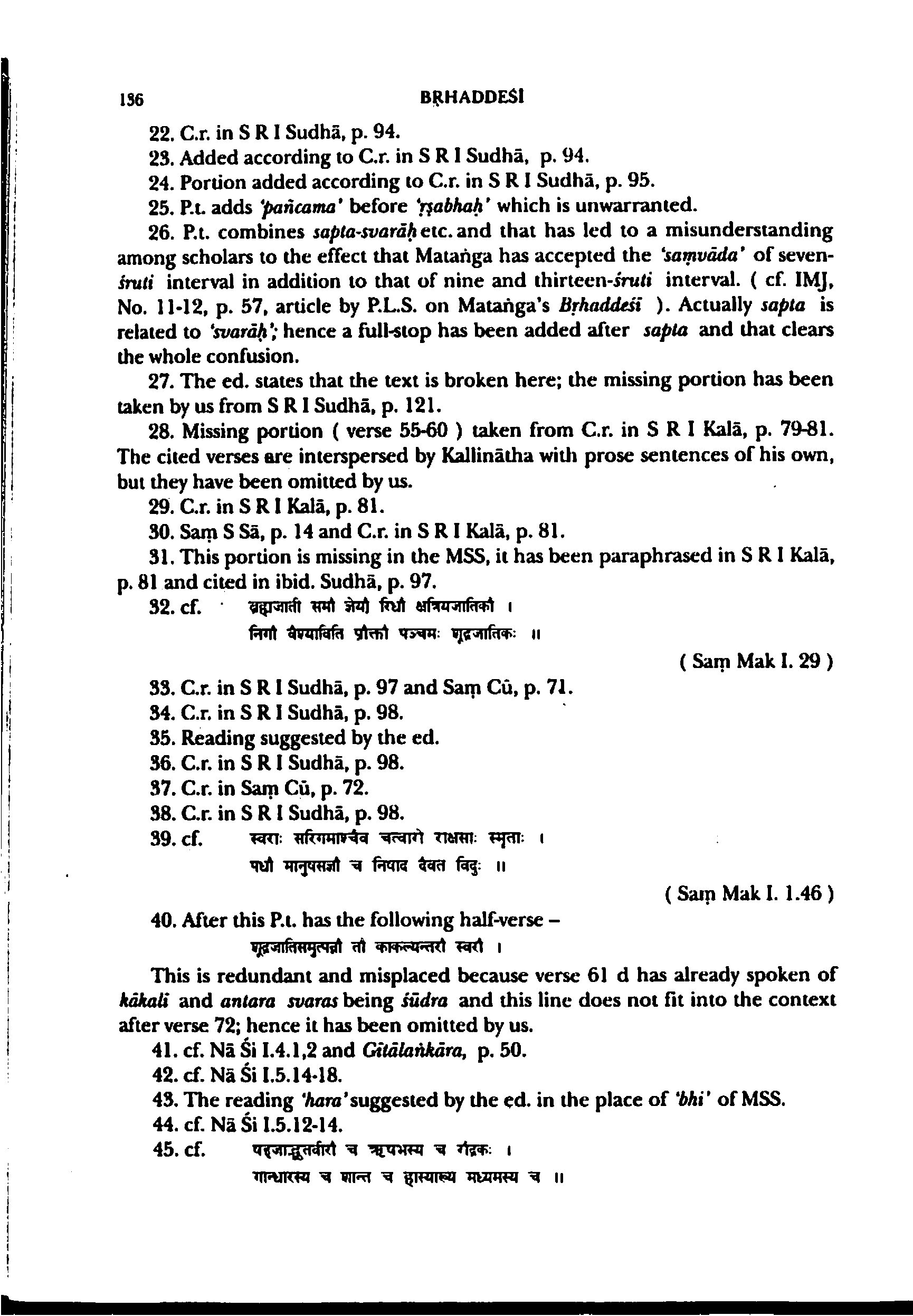
Pāṭha-vimarśa — verso
पञ्चमस्यश्रृङ्गारोकरुणा च निषादस्य सप्तस्थानरसा नव ॥ बीभत्सो धैवतस्य च ।
(Sam Mak II.1.47, 48) It is notable that Santa rasa has been included here and bhayanaka has been omitted12; thus the number of rasas enumerated is only eight and not nine13, as stated in the last foot.10 46. MS B reading as recorded by the ed.
Section V ( Grāma-mūrchanā )
ग्रामो नाम विशिष्टश्रुतिकस्वरसमूहो मूर्छनात्मा8 1. cf. पूर्णापूर्णस्वभावस्वरगतग्रहाशादिविशेषसमूहरूपजातिसमूहश्च ।7 (Abhi Bhā on NŚ XXVIII, p. 42) 2. C.r. in S R I Sudhā, p. 102. 3. C.r. in S R I Sudhā, p. 101 has been accepted because 'vyavasthitaḥ' is an adjectival form which is not matched by a noun that could be qualified by it, but 'vyavasthitih' is an abstract noun that fits the sentence. 4,5. C.r. in S R I Sudhā, p. 103. 6. This verse is not found in the text of Nā Ši. 7. C.r. in S R I Sudhä, p. 101. 8. P.t., modified according to C.r. in ibid. 9. C.r. in S R I Kalā, p. 99 in the name of Muni (Bharata), but this line is not found in the text of NS. In P.t. this line has not been treated as a citation, but as a part of the text, because quotation marks are not given. 10. This line forms part of the text of NS (XVIII, 5 ab). Hence it is treated by us as a citation. 11. P.t. includes ' sadbhih' after 'suddhābhih', but that has no relevance to the context and has, therefore, been omitted by us. 12. C.r. in S R I Sudhā, p. 105 adds the following half-verse, paraphrasing the prose-portion regarding the etymology of mūrchanā -
मूर्खनामब्दनिष्यतिर्मुखं मोहे समुच्छये ।
13, 14. C.r. in S R I Sudhā, p. 114. 15. P.t. adds 'tiryak' after 'svarāḥ', but that is redundant. 16. P.t. adds 'ürdhvā' after 'mā'.
17. P.t. मध्यमे तिर्यगूर्ध्वगा अपि स्वराः ।
18. Hariņāśvā is the name found in NŚ, S R etc. 'Hariņāhvayā' is the form of 'hariṇāhvā' in the instrumental case; but this case is not relevant to the context.6 The P.t. is utterly confused, mutilated and in disorder after this line upto the end of Anu. 41; it has been reconstructed according to the context, mainly by re-arranging the order.
3.[attribution] Brhaddess is the work by Matanga; scholars have misunderstood its treatment of samvāda intervalsP.t. combines sapta-svarāķ etc. and that has led to a misunderstanding among scholars to the effect that Matanga has accepted the 'samvāda' of seven- sruti interval in addition to that of nine and thirteen-sruti interval. (cf. IMJ, No. 11-12, p. 57, article by P.L.S. on Matanga's
5.[citation]Sam Mak is cited as a source for rasa classifications and caste associations with svarascf. व्हाज?ाती समी ज?ेयी रिधी क्षत्रियजातिको । निर्गा वैश्याविति प्रौक्तौ पञ्चमः शूद्रजातिकः ॥ ( Sam Mak I. 29 )
7.[citation]Abhi Bhā is cited as a source defining jāti as a collection of qualities and characteristics of svarasपूर्णापूर्णस्वभावस्वरगतग्रहाशादिविशेषसमूहरूपजातिसमूहश्च । (Abhi Bhā on NŚ XXVIII, p. 42)
8.[definition]Grāma-mūrchanā is defined as a specific collection of śrutis and svaras constituting a mūrchanāग्रामो नाम विशिष्टश्रुतिकस्वरसमूहो मूर्छनात्मा
1.[attribution]Matanga has accepted samvāda of nine and thirteen-sruti interval, not seven-sruti intervalMatanga has accepted the 'samvāda' of seven- sruti interval in addition to that of nine and thirteen-sruti interval. (cf. IMJ, No. 11-12, p. 57, article by P.L.S. on Matanga's Brhaddess ). Actually sapta is related to 'svarāḥ'
2.[attribution]Kallinatha is cited as a commentator (C.r.) who provides interpretations and reconstructions of missing textual portions28. Missing portion (verse 55-60) taken from C.r. in S R I Kalā, p. 79-81. The cited verses are interspersed by Kallinatha with prose sentences of his own
3.[attribution]Brhaddess is the work by Matanga; scholars have misunderstood its treatment of samvāda intervalsarticle by P.L.S. on Matanga's Brhaddess ). Actually sapta is related to 'svarāḥ'
4.[citation]Nā Ši is cited as a source text for rasa doctrine and svaric classificationscf. Nā Ši I.4.1,2 and Gītālankāra, p. 50. 42. cf. Nā Ši I.5.14-18.
6.[citation]Hariņāśvā is a name appearing in Nā Ši and other texts; P.t. contains a corrupted instrumental case formHariņāśvā is the name found in NŚ, S R etc. 'Hariņāhvayā' is the form of 'hariṇāhvā' in the instrumental case; but this case is not relevant to the context.
7.[citation] Abhi Bhā is cited as a source defining jāti as a collection of qualities and characteristics of svarasपूर्णापूर्णस्वभावस्वरगतग्रहाशादिविशेषसमूहरूपजातिसमूहश्च । (Abhi Bhā on NŚ XXVIII, p. 42)
8.[definition] Grāma-mūrchanā is defined as a specific collection of śrutis and svaras constituting a mūrchanāग्रामो नाम विशिष्टश्रुतिकस्वरसमूहो मूर्छनात्मा
9.[definition]The etymology of mūrchanā relates to 'mukha' (mouth) and 'moha' (confusion/delusion)C.r. in S R I Sudhā, p. 105 adds the following half-verse, paraphrasing the prose-portion regarding the etymology of mūrchanā - मूर्खनामब्दनिष्यतिर्मुखं मोहे समुच्छये ।
10.[enumeration]Eight rasas are enumerated in Matanga's text: Paroksa, Sringara, Bibhatsa, Hasya, Karuna, and Niṣada, with Santa rasa included but bhayanaka omittedIt is notable that Santa rasa has been included here and bhayanaka has been omitted; thus the number of rasas enumerated is only eight and not nine, as stated in the last foot.
11.[relation]Sapta (seven) relates to svaras (notes), not to a separate samvāda interval system; a full-stop clarifies the confusionP.t. combines sapta-svarāķ etc. and that has led to a misunderstanding among scholars to the effect that Matanga has accepted the 'samvāda' of seven- sruti interval in addition to that of nine and thirteen-sruti interval. (cf. IMJ, No. 11-12, p. 57, article by P.L.S. on Matanga's
12.[structural]Santa rasa is included in Matanga's enumeration of rasas, contrary to expectationsIt is notable that Santa rasa has been included here and bhayanaka has been omitted
13.[structural]Bhayanaka rasa has been omitted from Matanga's enumerationIt is notable that Santa rasa has been included here and bhayanaka has been omitted; thus the number of rasas enumerated is only eight and not nine