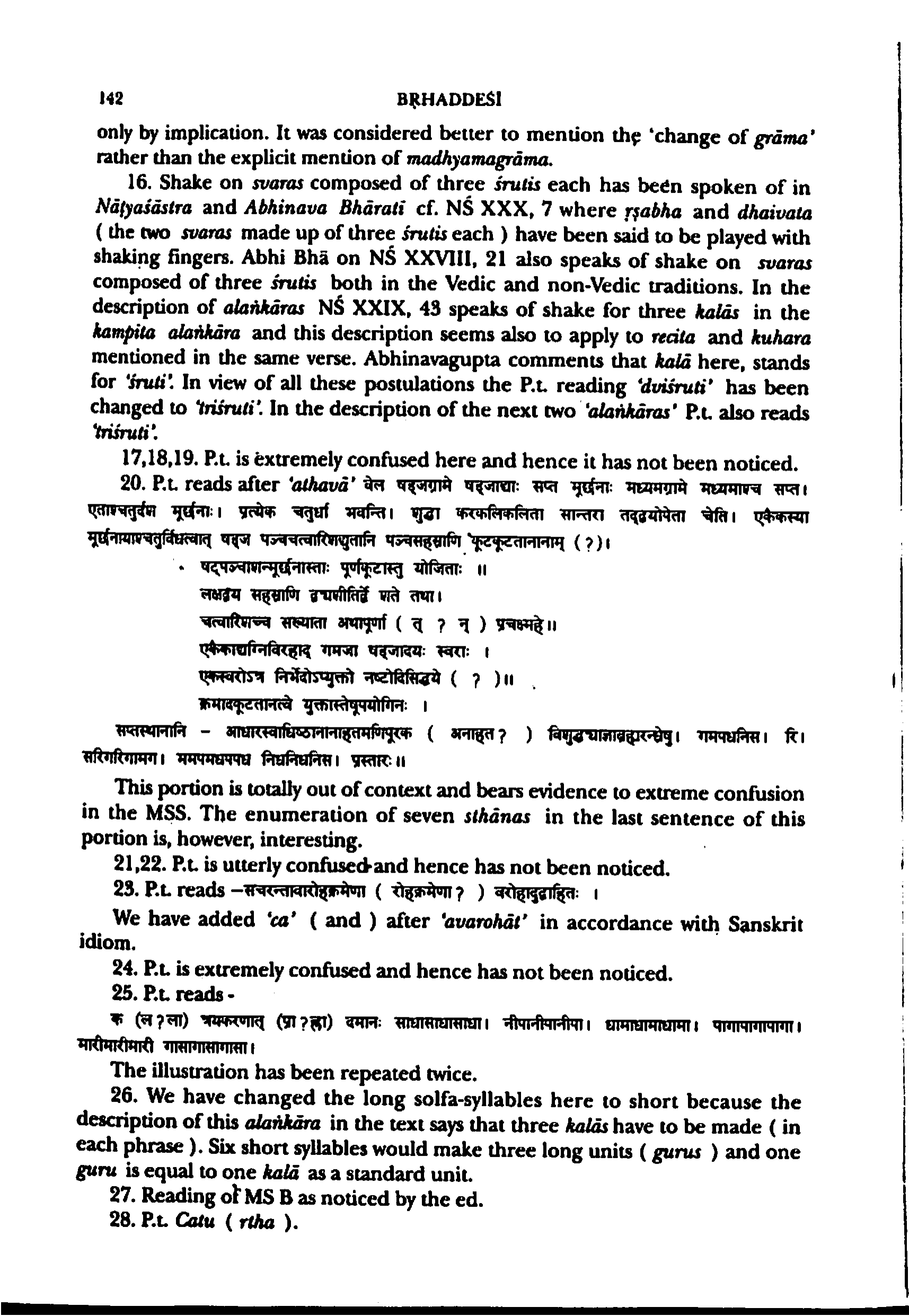
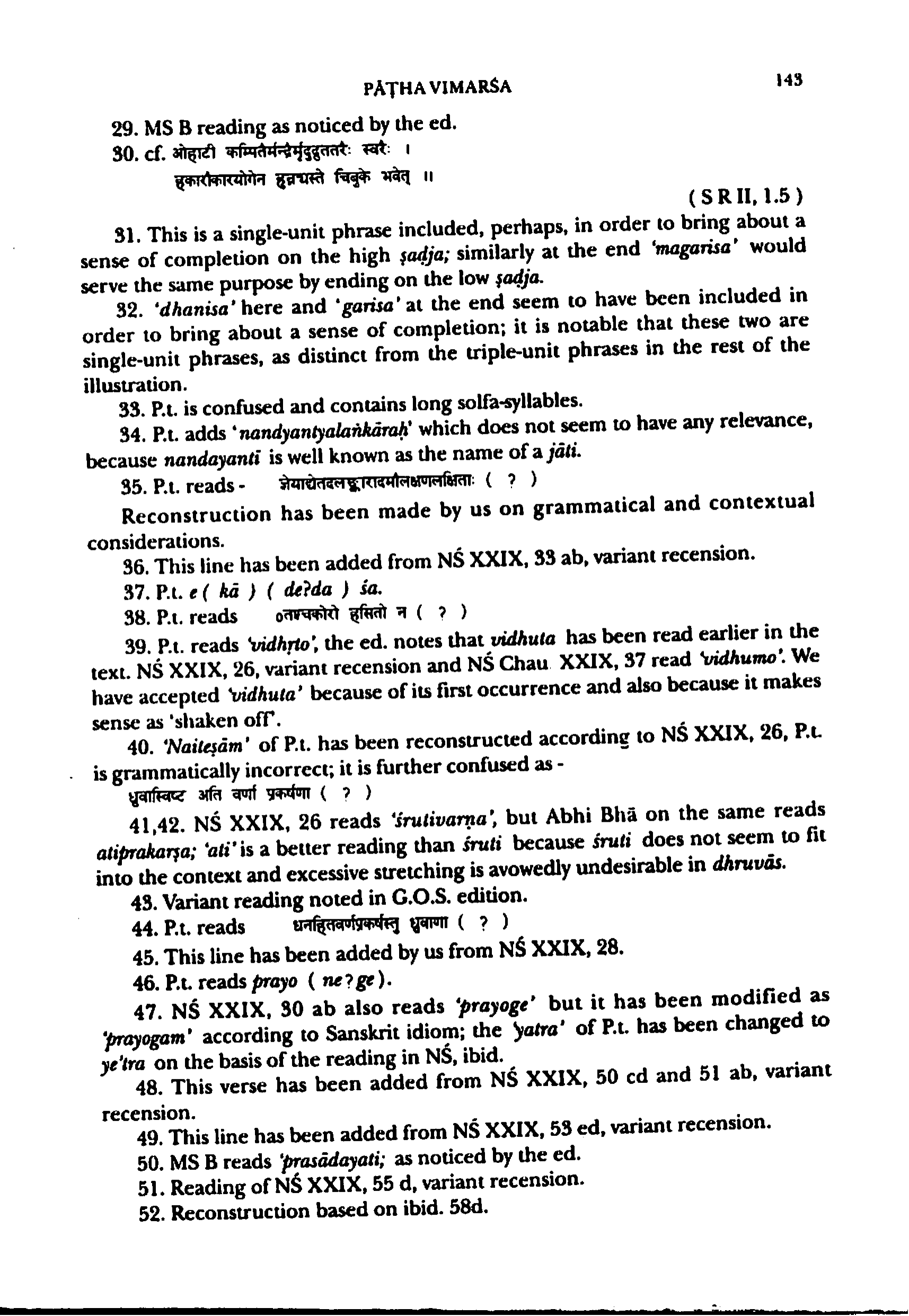
only by implication. It was considered better to mention the 'change of grāma'
rather than the explicit mention of
madhyamagrāma.
16. Shake on svaras composed of three śrutis each has been spoken of in
Nātyašāstra and
Abhinava Bhāratī cf. NŚ XXX, 7 where rṣabha and
dhaivata
(the two svaras made up of three śrutis each ) have been said to be played with
shaking fingers.
Abhi Bhā on NŚ XXVIII, 21 also speaks of shake on svaras
composed of three śrutis both in the Vedic and non-Vedic traditions. In the
description of
alankāras NŚ XXIX, 43 speaks of shake for three kalās in the
kampita alankāra and this description seems also to apply to recita and kuhara
mentioned in the same verse.
Abhinavagupta comments that kalā here, stands
for 'sruti'. In view of all these postulations the P.t. reading 'dvisruti' has been
changed to 'triśruti'. In the description of the next two '
alankāras' P.t. also reads
triśruti'.
17,18,19. P.t. is extremely confused here and hence it has not been noticed.
एताष्ट्रचतुर्दम मूर्खनाः। प्रत्येक चतुर्धा भवन्ति। धुद्धा करकलिकलिता सान्तरा तद्द्वयोपेता चेति। एकैकस्या
मूर्जनायाप्रचतुर्विधत्वात् यत्त्रज पञ्चचत्वारिष्ठायुतानि पञ्चसहस्राणि 'कूटकूटतानानाम् (?)।
षद्पञ्चाशन्पूर्छनास्ताः पूर्णकृटास्तु योजिताः ॥
लक्षड्रय सहस्राणि इचामीतिई मते तथा।
चत्वारिमञ्च संस्थाता अथापूर्णा ( त् ? न् ) प्रचक्ष्महे ॥
एकैकाद्यग्निवरहाद् गमजा घड्जादयः स्वराः ।
एक्स्बरोऽत्र निर्भेदोऽप्युक्तो नष्टोदिसिद्धये ( ७ )॥
क्रमादकूटतानत्वे युक्तास्तेषूपयोगिनः ।
सप्तस्थानानि – आधारस्वाधिष्ठानानाहतमणिपूरकसरिगरिगामग । ममपमधपपध निधनिधनिस । प्रस्तारः ॥ ( अनाहत ? ) विशुद्धचाजाब्रह्मरन्ध्रेषु। गमपधनिस। रि।
This portion is totally out of context and bears evidence to extreme confusion
in the MSS. The enumeration of seven sthanas in the last sentence of this
portion is, however, interesting.
21,22. P.t. is utterly confused and hence has not been noticed.
23. P.t. reads -सचरन्तावारोहक्रमेणा (रोहक्रमेणा?) वरोहादुद्वाहितः ।
We have added 'ca' (and) after 'avarohāt' in accordance with Sanskrit
idiom.
24. P.t. is extremely confused and hence has not been noticed.
25. P.t. reads -
कं (ल ? ला) त्रयकरणात् (प्रा ? हा) दमानः साधासाधासाधा। नीपानीपानीपा। धामाधामाधामा। पागापागापागा।
मारीमारीमारी गासागासागासा।
The illustration has been repeated twice.
26. We have changed the long solfa-syllables here to short because the
description of this alankara in the text says that three kalas have to be made (in
each phrase). Six short syllables would make three long units (gurus) and one
guru is equal to one kalā as a standard unit.
27. Reading of MS B as noticed by the ed.
28. P.t. Catu (rtha).