Source scans · vol_I_p093
recto · open full
scan recto
verso · open full
scan verso
Bṛhaddeśī · Volume I
pp. 168–169folio 093
Devanāgarī (Bṛhaddeśī)
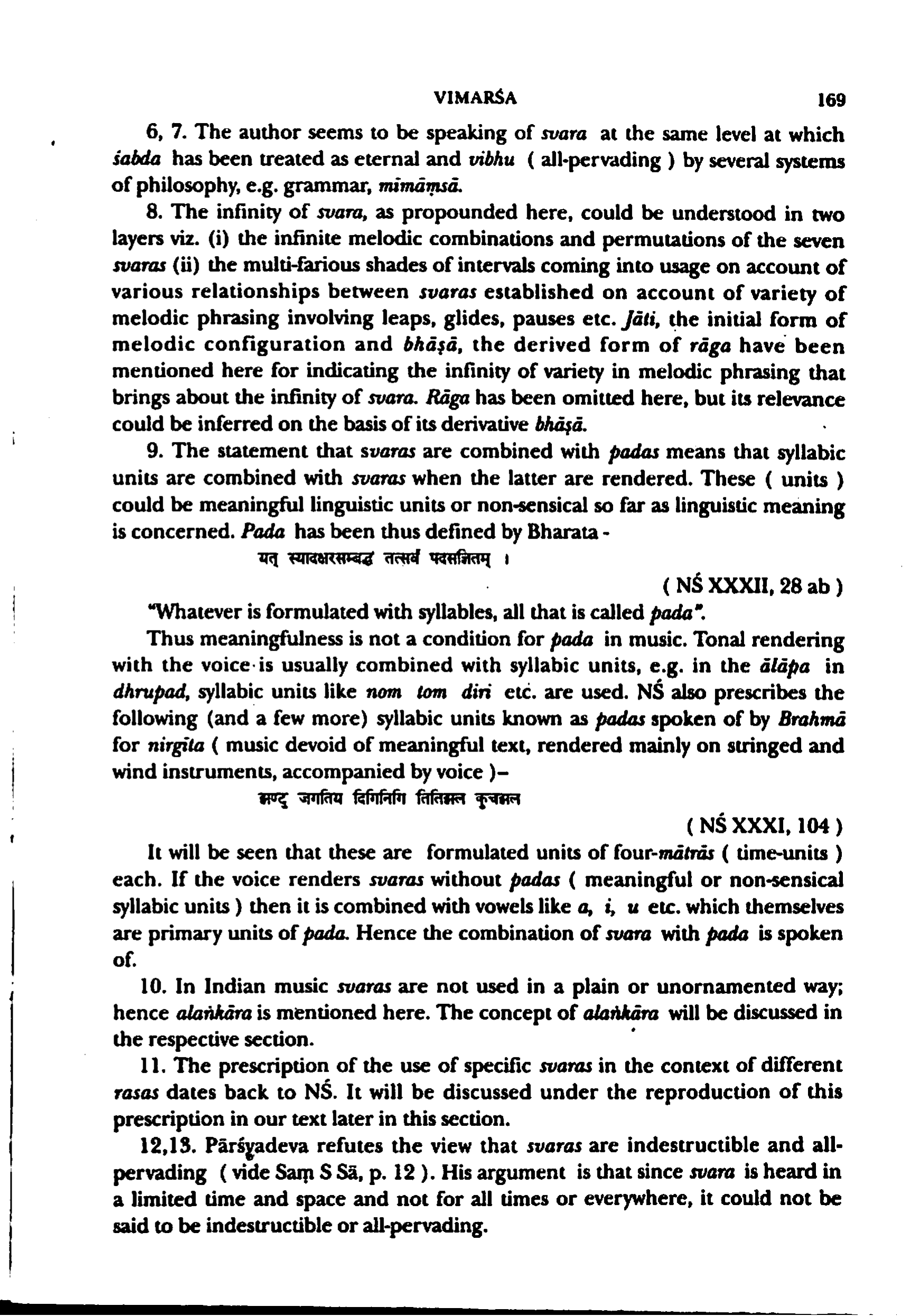
that were put in first would be the 'last' looking from the mouth of the bottle and vice versa. Coming back to the argument justifying the beginning of the śruti-maṇḍala of şadjagrāma from ṛṣabha, the purport seems to be that since ṣaḍja and madhyama are 'leaders' of the two grāmas they are placed 'first' in terms of space, the other svaras become their 'followers' in terms of time and their 'predecessors' in terms of space. K.C.D. Brahaspati was the first modern scholar to draw pointed attention towards the concept of grāmaņi on the basis of the one solitary statement of Matanga. (cf. Sangita Cintāmaņi, p. 99) 69. Śruti has been explained in terms of grāma both in NS and BrD. Śruti, svara and grāma are inseparably linked in the ancient system.
Section IV (Svara)
1. This etymology is similar to the one given by Patanjali. (cf. Mahābhāṣya on Pāṇini I. 2.29) 2. The word raga has been used here in the general sense of colourfulness or delight, which is spoken of in later texts as ranjakata (cf. SRI, 3.25 ab). Abhinavagupta has established anuranana (resonance) as the basis of rañjakatā-
घातशब्दस्यानुरणनशब्दे तीव्रत्वाभ्यधिकेऽतिरक्तता. साम्ये साम्यः वैपरीत्ये वैपरीत्यम् ।
(Abhi Bhā on NS XXVIII, 22, p. 13) When the anuranana sound is more in sharpness than the sound of attack, then there is excessive or maximum raktatā (the state of being rakta i.e. red or full of delight), when there is equality ( of the two, viz. attack and resonance ), (then there is) equality (medium state of raktata), when the situation is contrary i.e. the attack is more powerful than the anuranana then ( the degree of raktatā ) is contrary i.e. the ranjakatā is minimum. Note - 'Raga', 'ranjakata', 'raktata' — all are derived from the root ranj, meaning to colour, dye, redden, illuminate, affect, move, charm, delight, rejoice etc. (Also see note 61 under section III on śruti) 3, 4. The base in the process of sound production viz. nābhi or navel is figuratively mentioned as 'earth', the nadis ( tubular vessels ) as walls and the cerebral region as ākāśa (space, ether). The metaphor of an architectural structure is implied, beginning from the earth, going up through the walls and raising its head in the sky; this is a poetic description of air moving upwards in the body and thus producing sound gradually rising in pitch. 5. Rakta lit. means red; here it means that which is charming ( lit. charmed) or delightful (lit. delighted). (See also note 2 above)
English — Sharma (Vimarśa)
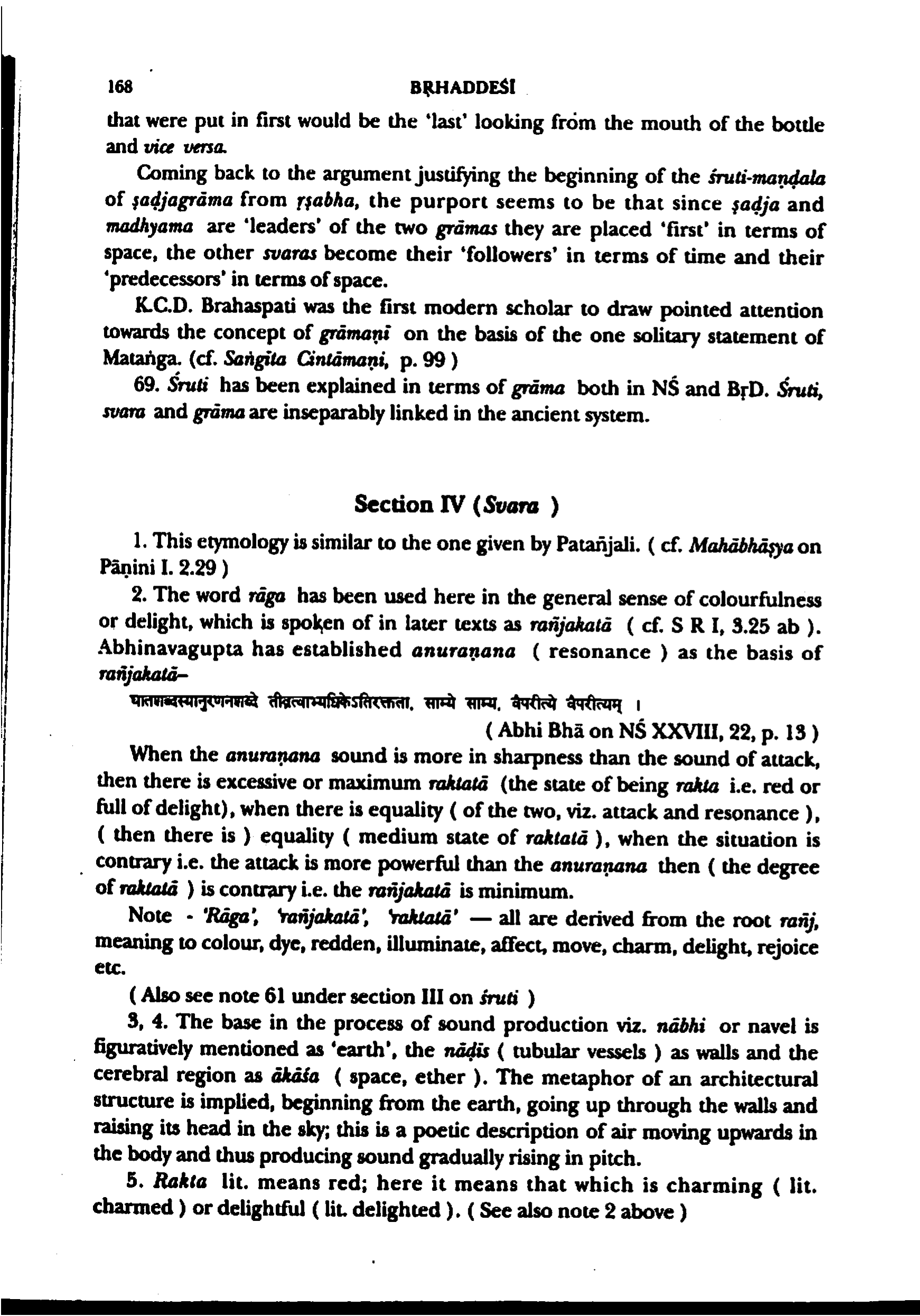
6, 7. The author seems to be speaking of svara at the same level at which sabda has been treated as eternal and vibhu (all-pervading) by several systems of philosophy, e.g. grammar, mimāmsā. 8. The infinity of svara, as propounded here, could be understood in two layers viz. (i) the infinite melodic combinations and permutations of the seven svaras (ii) the multi-farious shades of intervals coming into usage on account of various relationships between svaras established on account of variety of melodic phrasing involving leaps, glides, pauses etc. Jāti, the initial form of melodic configuration and bhāṣā, the derived form of rāga have been mentioned here for indicating the infinity of variety in melodic phrasing that brings about the infinity of svara. Raga has been omitted here, but its relevance could be inferred on the basis of its derivative bhāṣā. 9. The statement that svaras are combined with padas means that syllabic units are combined with svaras when the latter are rendered. These (units) could be meaningful linguistic units or non-sensical so far as linguistic meaning is concerned. Pada has been thus defined by Bharata -
यत् स्यादक्षरसम्बद्धं तत्सर्वं पदसन्नितम् ।
( NŚ XXXII, 28 ab ) "Whatever is formulated with syllables, all that is called pada". Thus meaningfulness is not a condition for pada in music. Tonal rendering with the voice is usually combined with syllabic units, e.g. in the ālāpa in dhrupad, syllabic units like nom tom diri etc. are used. NS also prescribes the following (and a few more) syllabic units known as padas spoken of by Brahmā for nirgita (music devoid of meaningful text, rendered mainly on stringed and wind instruments, accompanied by voice )- झण्दु जगतिय दिगिनिगि तितिझल कुचझल ( NŚ XXXI, 104 ) It will be seen that these are formulated units of four-matras (time-units) each. If the voice renders svaras without padas (meaningful or non-sensical syllabic units) then it is combined with vowels like a, i, u etc. which themselves are primary units of pada. Hence the combination of svara with pada is spoken of. 10. In Indian music svaras are not used in a plain or unornamented way; hence alankāra is mentioned here. The concept of alankāra will be discussed in the respective section. 11. The prescription of the use of specific svaras in the context of different rasas dates back to NS. It will be discussed under the reproduction of this prescription in our text later in this section. 12,13. Pāršyadeva refutes the view that svaras are indestructible and all- pervading (vide Sam S Sa, p. 12). His argument is that since svara is heard in a limited time and space and not for all times or everywhere, it could not be said to be indestructible or all-pervading.
1.[attribution]Abhinavagupta established anuranana (resonance) as the basis of rañjakatāAbhinavagupta has established anuranana (resonance) as the basis of rañjakatā
2.[attribution]Matanga made a solitary statement about the concept of grāmaņiK.C.D. Brahaspati was the first modern scholar to draw pointed attention towards the concept of grāmaņi on the basis of the one solitary statement of Matanga.
3.[attribution]Bharata defined pada as whatever is formulated with syllables in the NatyashastraPada has been thus defined by Bharata - यत् स्यादक्षरसम्बद्धं तत्सर्वं पदसन्नितम् । ( NŚ XXXII, 28 ab )
4.[attribution]Pāršyadeva refutes the view that svaras are indestructible and all-pervading, arguing they are limited in time and spacePāršyadeva refutes the view that svaras are indestructible and all- pervading (vide Sam S Sa, p. 12). His argument is that since svara is heard in a limited time and space
5.[citation]Abhinavagupta commented on Natyashastra XXVIII, 22 regarding anuranana and rañjakatā(Abhi Bhā on NS XXVIII, 22, p. 13)
6.[citation]Sangita Cintāmaņi is cited as a source for discussion of grāmaņi(cf. Sangita Cintāmaņi, p. 99)
7.[definition]rañjakatā is derived from the root ranj, meaning to colour, dye, redden, illuminate, affect, move, charm, delight, rejoice'Raga', 'ranjakata', 'raktata' — all are derived from the root ranj, meaning to colour, dye, redden, illuminate, affect, move, charm, delight, rejoice etc.
8.[definition]Rakta literally means red; in musical context it means that which is charming or delightfulRakta lit. means red; here it means that which is charming ( lit. charmed) or delightful (lit. delighted).
9.[relation]grāmaņi relates to the beginning of the śruti-maṇḍala, with ṣaḍja and madhyama functioning as leaders of two grāmassince ṣaḍja and madhyama are 'leaders' of the two grāmas they are placed 'first' in terms of space
10.[relation]Patanjali provided an etymology of svara similar to one discussed in BrihaddesiThis etymology is similar to the one given by Patanjali. (cf. Mahābhāṣya on Pāṇini I. 2.29)
11.[structural]The degree of rañjakatā depends on the relationship between the sharpness of anuranana sound and the sound of attackWhen the anuranana sound is more in sharpness than the sound of attack, then there is excessive or maximum raktatā
12.[structural]nadis (tubular vessels) are figuratively represented as walls in the body's sound production structurethe nadis ( tubular vessels ) as walls