Source scans · vol_I_p094
recto · open full
scan recto
verso · open full
scan verso
Bṛhaddeśī · Volume I
pp. 170–171folio 094
Bṛhaddeśī
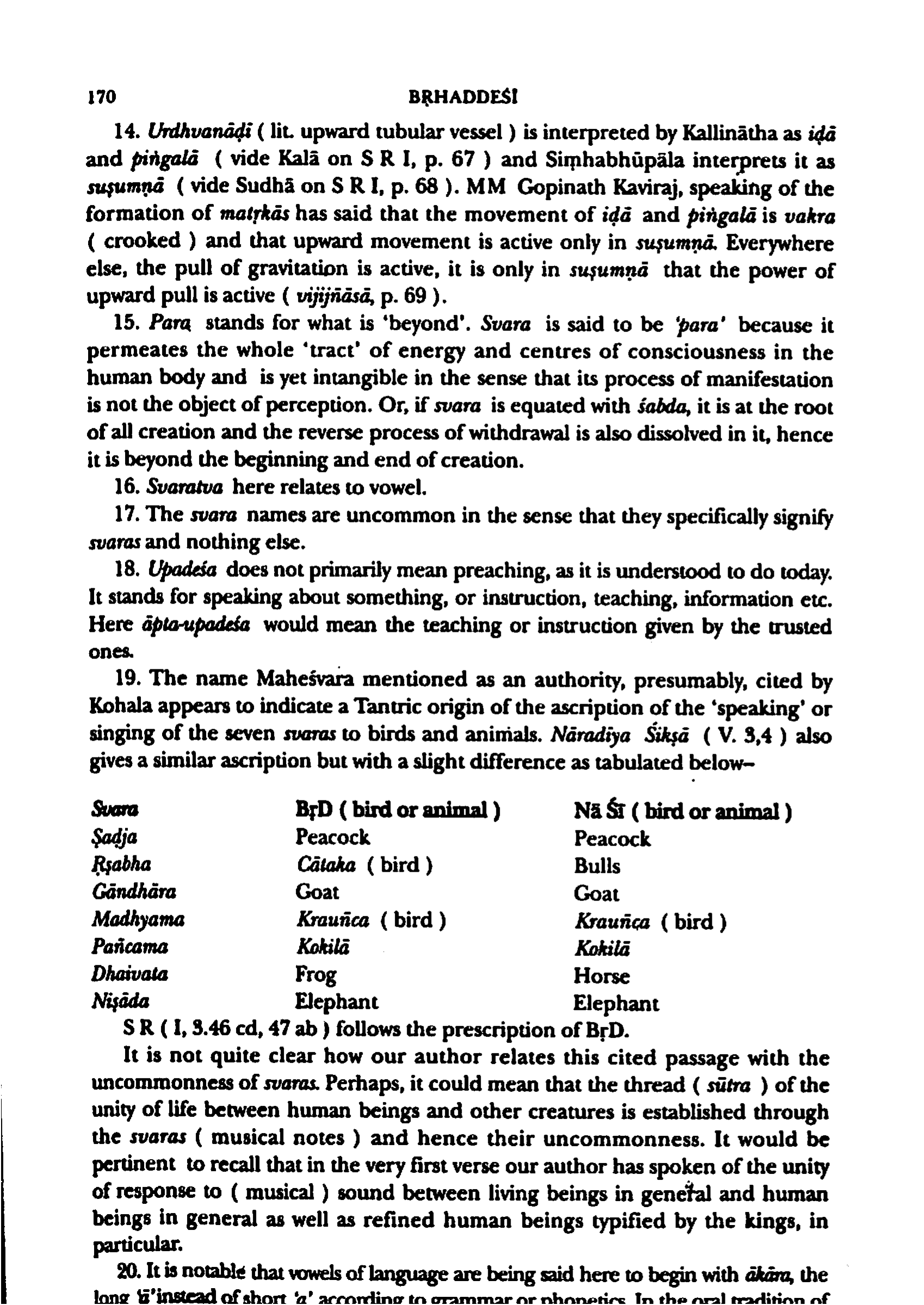
14. Urdhvanāḍī (lit. upward tubular vessel) is interpreted by Kallinātha as iḍā and pingalā (vide Kalā on S R I, p. 67) and Simhabhūpāla interprets it as suşumņā (vide Sudhā on SRI, p. 68). MM Gopinath Kaviraj, speaking of the formation of matrkās has said that the movement of ida and pingalā is vakra ( crooked ) and that upward movement is active only in susumnā. Everywhere else, the pull of gravitation is active, it is only in susumnā that the power of upward pull is active (vijijnāsā, p. 69). 15. Para stands for what is 'beyond'. Svara is said to be 'para' because it permeates the whole 'tract' of energy and centres of consciousness in the human body and is yet intangible in the sense that its process of manifestation is not the object of perception. Or, if svara is equated with śabda, it is at the root of all creation and the reverse process of withdrawal is also dissolved in it, hence it is beyond the beginning and end of creation. 16. Svaratva here relates to vowel. 17. The svara names are uncommon in the sense that they specifically signify svaras and nothing else. 18. Upadesa does not primarily mean preaching, as it is understood to do today. It stands for speaking about something, or instruction, teaching, information etc. Here apta-upadesa would mean the teaching or instruction given by the trusted ones. 19. The name Maheśvara mentioned as an authority, presumably, cited by Kohala appears to indicate a Tantric origin of the ascription of the 'speaking' or singing of the seven svaras to birds and animals. Nāradīya Šikṣā (V. 3,4) also gives a similar ascription but with a slight difference as tabulated below- BrD (bird or animal) Nā Šī (bird or animal) Suara Şadja Peacock Peacock Rsabha Cātaka (bird)5 Bulls Gāndhāra Goat Goat Madhyama Kraunīca (bird)6 Kraunca (bird) Pañcama Kokilā Kokilā4 Dhaivata Frog Horse Nişāda Elephant Elephant SR (I, 3.46 cd, 47 ab) follows the prescription of BrD. It is not quite clear how our author relates this cited passage with the uncommonness of svaras. Perhaps, it could mean that the thread ( sūtra ) of the unity of life between human beings and other creatures is established through the svaras (musical notes) and hence their uncommonness. It would be pertinent to recall that in the very first verse our author has spoken of the unity of response to (musical) sound between living beings in general and human beings in general as well as refined human beings typified by the kings, in particular. 20. It is notable that vowels of language are being said here to begin with akana, the long to instead of short 'a' according to grammar or phonetics. In the oral tradition of
Vimarśa
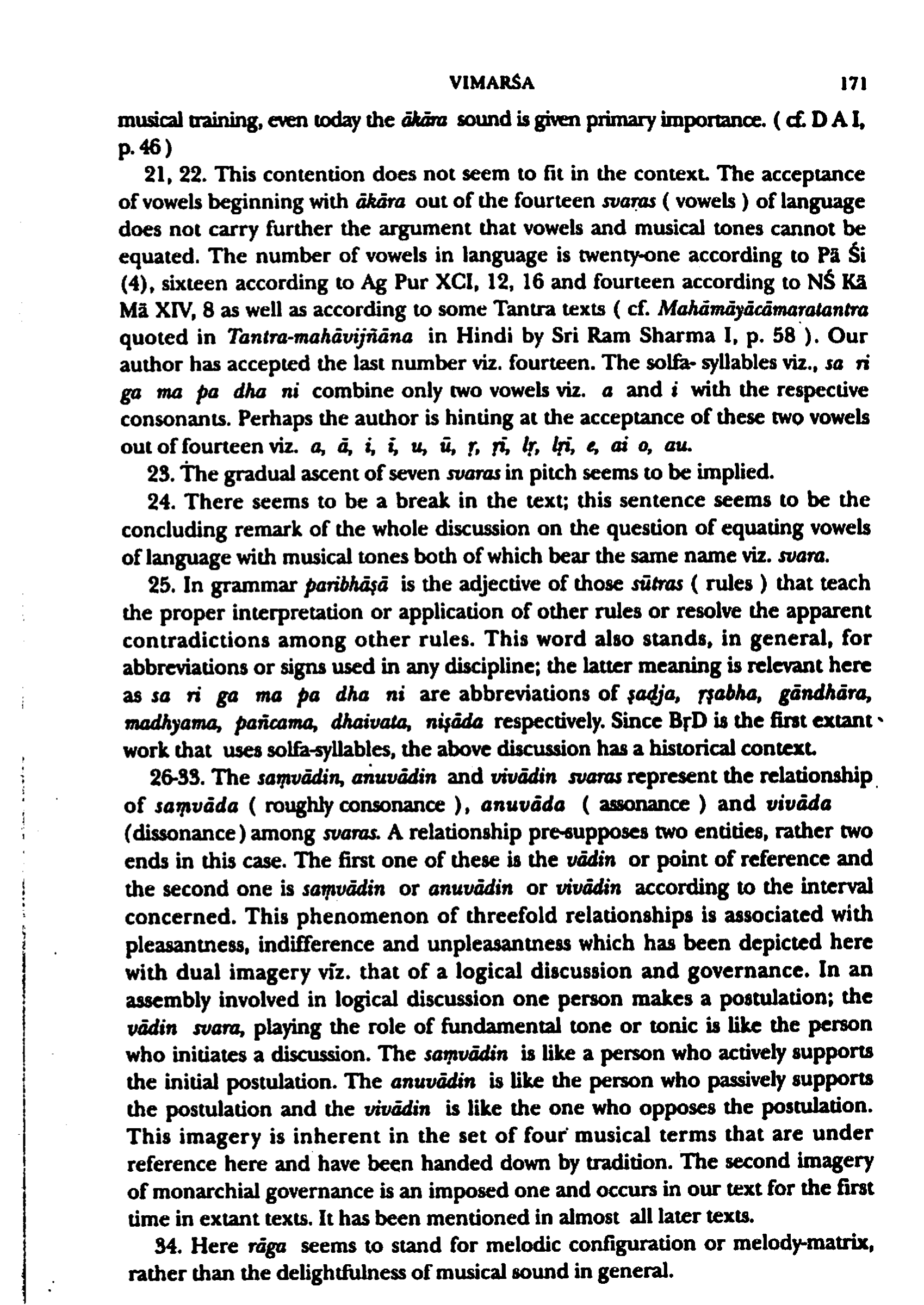
musical training, even today the ākāra sound is given primary importance. (cf. DAI, p. 46) 21, 22. This contention does not seem to fit in the context. The acceptance of vowels beginning with ākāra out of the fourteen svaras (vowels) of language does not carry further the argument that vowels and musical tones cannot be equated. The number of vowels in language is twenty-one according to Pa Si (4), sixteen according to Ag Pur XCI, 12, 16 and fourteen according to NŚ Kā Mā XIV, 8 as well as according to some Tantra texts (cf. Mahāmāyācāmaratantra quoted in Tantra-mahāvijāāna in Hindi by Sri Ram Sharma I, p. 58). Our author has accepted the last number viz. fourteen. The solfa-syllables viz., sa ri ga ma pa dha ni combine only two vowels viz. a and i with the respective consonants. Perhaps the author is hinting at the acceptance of these two vowels out of fourteen viz. a, ā, i, i, u, ū, r, rī, lr, lrī, e, ai o, au. 23. The gradual ascent of seven svaras in pitch seems to be implied. 24. There seems to be a break in the text; this sentence seems to be the concluding remark of the whole discussion on the question of equating vowels of language with musical tones both of which bear the same name viz. svara. 25. In grammar paribhāṣā is the adjective of those sūtras (rules) that teach the proper interpretation or application of other rules or resolve the apparent contradictions among other rules. This word also stands, in general, for abbreviations or signs used in any discipline; the latter meaning is relevant here as sa ri ga ma pa dha ni are abbreviations of şadja, rşabha, gāndhāra, madhyama, pañcama, dhaivata, nisāda respectively. Since BrD is the first extant . work that uses solfa-syllables, the above discussion has a historical context. 26-33. The samvādin, anuvādin and vivādin svaras represent the relationship of samvāda (roughly consonance), anuvāda (assonance) and vivāda (dissonance) among svaras. A relationship pre-supposes two entities, rather two ends in this case. The first one of these is the vādin or point of reference and the second one is samvādin or anuvādin or vivādin according to the interval concerned. This phenomenon of threefold relationships is associated with pleasantness, indifference and unpleasantness which has been depicted here with dual imagery viz. that of a logical discussion and governance. In an assembly involved in logical discussion one person makes a postulation; the vādin svara, playing the role of fundamental tone or tonic is like the person who initiates a discussion. The samvadin is like a person who actively supports the initial postulation. The anuvadin is like the person who passively supports the postulation and the vivadin is like the one who opposes the postulation. This imagery is inherent in the set of four musical terms that are under reference here and have been handed down by tradition. The second imagery of monarchial governance is an imposed one and occurs in our text for the first time in extant texts. It has been mentioned in almost all later texts. 34. Here raga seems to stand for melodic configuration or melody-matrix, rather than the delightfulness of musical sound in general.
ordered sequence list
fourteen vowels (svaras) enumerated out of context — §22, listing the fourteen vowels said to combine with only the consonants viz. a (and) i with the respective consonants
a
ā
i
ī
u
ū
e
a · i
o
a · u
— out of fourteen viz. a, ā, i, ī, u, ū, ṛ, ṝ, ḷ, ḹ, e, ai o, au.
ordered sequence list
abbreviations of the seven solfa-syllable (svara) names — §25, paribhāṣā: 'as sa ri ga ma pa dha ni are abbreviations of ṣaḍja, ṛṣabha, gāndhāra, madhyama, pañcama, dhaivata, niṣāda respectively'
s · a · · = · · ṣ · a · ḍ · j · a
r · i · · = · · ṛ · ṣ · a · b · h · a
g · a · · = · · g · ā · n · d · h · ā · r · a
m · a · · = · · m · a · d · h · y · a · m · a
p · a · · = · · p · a · ñ · c · a · m · a
d · h · a · · = · · d · h · a · i · v · a · t · a
n · i · · = · · n · i · ṣ · ā · d · a
— sa ri ga ma pa dha ni / ṣaḍja, ṛṣabha, gāndhāra, madhyama, pañcama, dhaivata, niṣāda
4.[enumeration] Kokilā (cuckoo bird) is ascribed to the svara Pañcama in both Brihaddesi and Nāradīya ŠikṣāPañcama Kokilā Kokilā
5.[enumeration] Cātaka bird is ascribed to the svara Rsabha in Nāradīya ŠikṣāRsabha Cātaka (bird)
6.[enumeration] Kraunīca bird is ascribed to the svara Madhyama in BrihaddesiMadhyama Kraunīca (bird)
1.[attribution]Urdhvanāḍī is interpreted by Kallinātha as iḍā and pingalāUrdhvanāḍī (lit. upward tubular vessel) is interpreted by Kallinātha as iḍā and pingalā
2.[attribution]Urdhvanāḍī is interpreted by Simhabhūpāla as suşumņāSimhabhūpāla interprets it as suşumņā
3.[definition]Paribhāṣā stands for abbreviations or signs used in a disciplineparibhāṣā is the adjective of those sūtras (rules) that teach the proper interpretation or application of other rules or resolve the apparent contradictions among other rules. This word also stands, in general, for abbreviations or signs used in any discipline
4.[enumeration]Kokilā (cuckoo bird) is ascribed to the svara Pañcama in both Brihaddesi and Nāradīya ŠikṣāPañcama Kokilā Kokilā
5.[enumeration]Cātaka bird is ascribed to the svara Rsabha in Nāradīya ŠikṣāRsabha Cātaka (bird)
6.[enumeration]Kraunīca bird is ascribed to the svara Madhyama in BrihaddesiMadhyama Kraunīca (bird)
7.[relation]Samvādin represents a relationship of samvāda (consonance) among svarasThe samvādin, anuvādin and vivādin svaras represent the relationship of samvāda (roughly consonance), anuvāda (assonance) and vivāda (dissonance) among svaras.
8.[relation]Anuvādin represents a relationship of anuvāda (assonance) among svarasThe samvādin, anuvādin and vivādin svaras represent the relationship of samvāda (roughly consonance), anuvāda (assonance) and vivāda (dissonance) among svaras.
9.[relation]Vivādin represents a relationship of vivāda (dissonance) among svarasThe samvādin, anuvādin and vivādin svaras represent the relationship of samvāda (roughly consonance), anuvāda (assonance) and vivāda (dissonance) among svaras.
10.[relation]Nāradīya Šikṣā gives an ascription of svaras to birds and animals similar to but with slight differences from BrihaddesiNāradīya Šikṣā (V. 3,4) also gives a similar ascription but with a slight difference
11.[structural]In suşumņā, the power of upward pull is active, unlike elsewhere where gravitation is activeit is only in susumnā that the power of upward pull is active
12.[structural]The movement of iḍā and pingalā in the formation of matrkās is vakra (crooked)speaking of the formation of matrkās has said that the movement of ida and pingalā is vakra ( crooked )
13.[structural]The vādin svara serves as the fundamental tone or tonic and initiates musical discoursethe vādin svara, playing the role of fundamental tone or tonic is like the person who initiates a discussion.
14.[structural]Samvāda (consonance) is associated with pleasantness in the relationship between svarasThis phenomenon of threefold relationships is associated with pleasantness, indifference and unpleasantness
15.[structural]Vivāda (dissonance) is associated with unpleasantness in the relationship between svarasThis phenomenon of threefold relationships is associated with pleasantness, indifference and unpleasantness