Source scans · vol_I_p103
recto · open full
scan recto
verso · open full
scan verso
Bṛhaddeśī · Volume I
pp. 3–189folio 103
Bṛhaddeśī
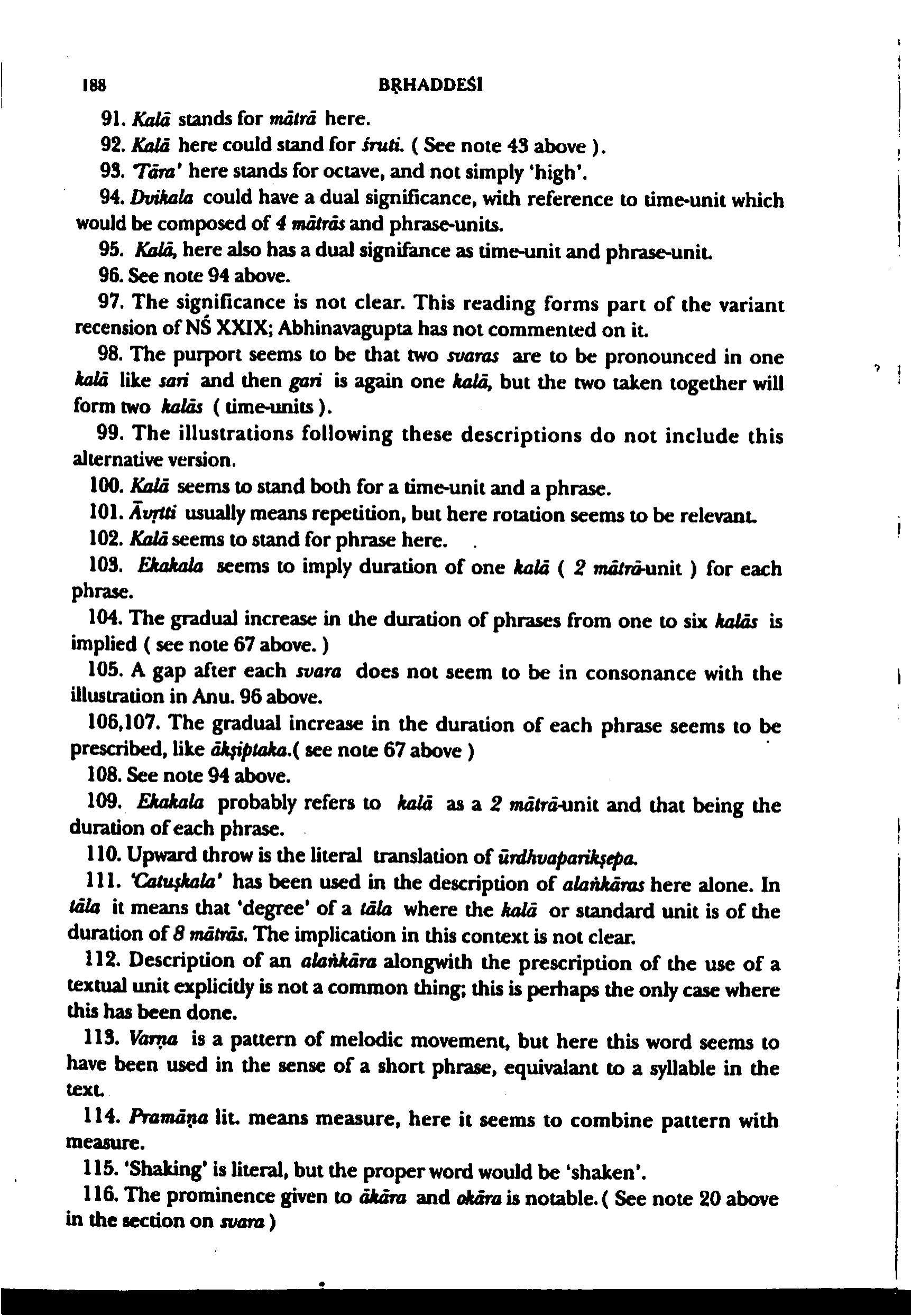
91. Kalā stands for mātrā here. 92. Kalā here could stand for śruti. (See note 43 above). 93. Tāra' here stands for octave, and not simply 'high'. 94. Dvikala could have a dual significance, with reference to time-unit which would be composed of 4 mātrās and phrase-units. 95. Kalā, here also has a dual signifance as time-unit and phrase-unit. 96. See note 94 above. 97. The significance is not clear. This reading forms part of the variant recension of NS XXIX; Abhinavagupta has not commented on it. 98. The purport seems to be that two svaras are to be pronounced in one kalā like sari and then gari is again one kalā, but the two taken together will form two kalās (time-units). 99. The illustrations following these descriptions do not include this alternative version. 100. Kalā seems to stand both for a time-unit and a phrase. 101. \overline{A}v\overline{\mu}ti usually means repetition, but here rotation seems to be relevant. 102. Kalā seems to stand for phrase here. 103. Ekakala seems to imply duration of one kalā ( 2 mātrā-unit ) for each phrase. 104. The gradual increase in the duration of phrases from one to six kalās is implied ( see note 67 above. ) 105. A gap after each svara does not seem to be in consonance with the illustration in Anu. 96 above. 106,107. The gradual increase in the duration of each phrase seems to be prescribed, like ākṣiptaka.( see note 67 above ) 108. See note 94 above. 109. Ekakala probably refers to kalā as a 2 mātrā-unit and that being the duration of each phrase. 110. Upward throw is the literal translation of ūrdhvaparikṣepa. 111. 'Catușkala' has been used in the description of alankāras here alone. In tāla it means that 'degree' of a tāla where the kalā or standard unit is of the duration of 8 mātrās. The implication in this context is not clear. 112. Description of an alankara alongwith the prescription of the use of a textual unit explicitly is not a common thing; this is perhaps the only case where this has been done. 113. Varņa is a pattern of melodic movement, but here this word seems to have been used in the sense of a short phrase, equivalant to a syllable in the text. 114. Pramāņa lit. means measure, here it seems to combine pattern with measure. 115. 'Shaking' is literal, but the proper word would be 'shaken'. 116. The prominence given to ākāra and okāra is notable. (See note 20 above in the section on svara)
Vimarśa
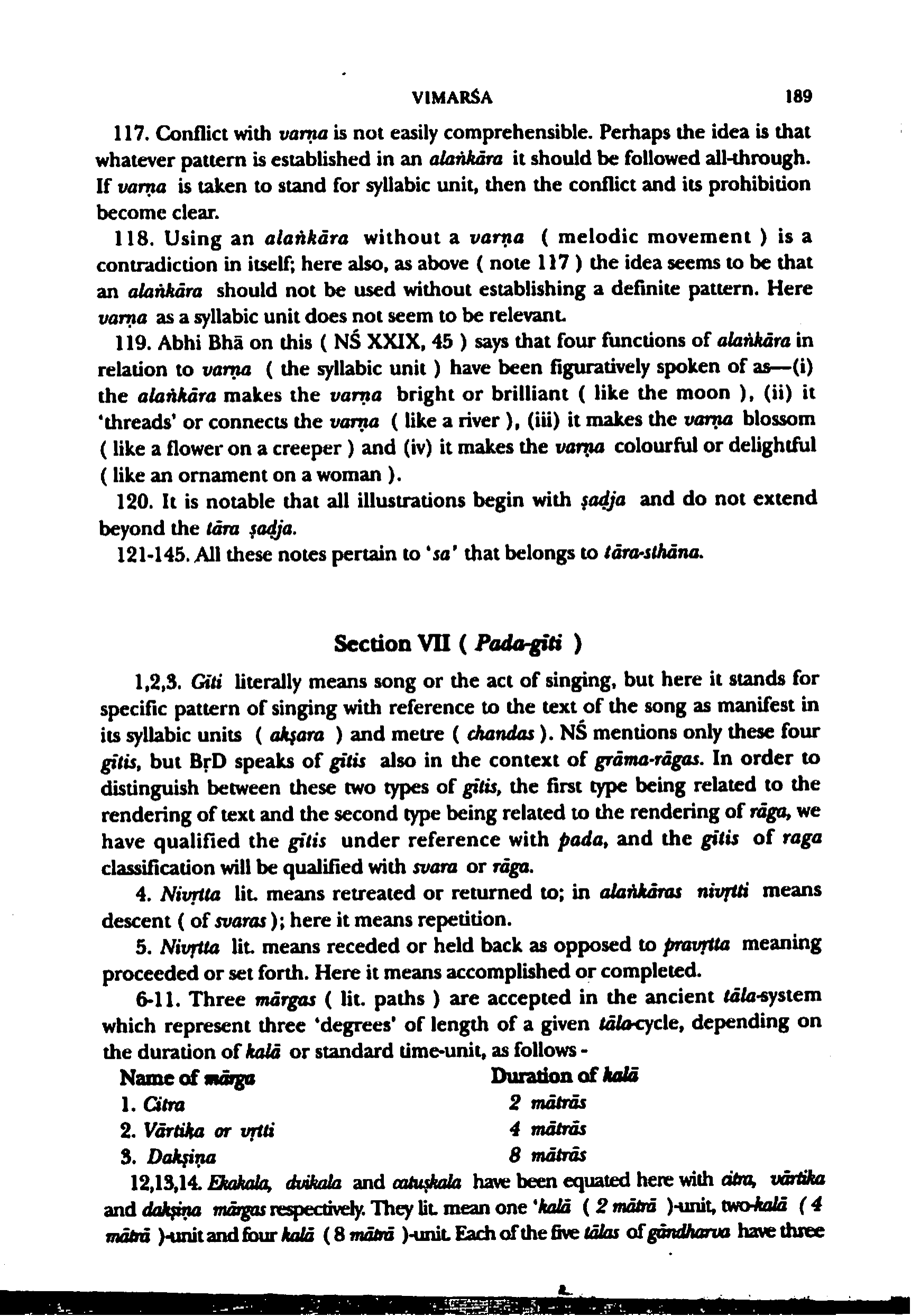
117. Conflict with varna is not easily comprehensible. Perhaps the idea is that whatever pattern is established in an alankāra it should be followed all-through. If varna is taken to stand for syllabic unit, then the conflict and its prohibition become clear. 118. Using an alankāra without a varņa ( melodic movement ) is a contradiction in itself; here also, as above (note 117) the idea seems to be that an alankāra should not be used without establishing a definite pattern. Here varna as a syllabic unit does not seem to be relevant. 119. Abhi Bhā on this ( NŚ XXIX, 45 ) says that four functions of alankāra in relation to varna (the syllabic unit) have been figuratively spoken of as—(i) the alankāra makes the varņa bright or brilliant ( like the moon ), (ii) it 'threads' or connects the varņa (like a river), (iii) it makes the varņa blossom (like a flower on a creeper) and (iv) it makes the varna colourful or delightful (like an ornament on a woman). 120. It is notable that all illustrations begin with sadja and do not extend beyond the tāra şadja. 121-145. All these notes pertain to 'sa' that belongs to tāra-sthāna.
Section VII ( Pada-giti )
1,2,3. Giti literally means song or the act of singing, but here it stands for specific pattern of singing with reference to the text of the song as manifest in its syllabic units (akşara) and metre (chandas). NŠ mentions only these four gītis, but BrD speaks of gītis also in the context of grāma-rāgas. In order to distinguish between these two types of gitis, the first type being related to the rendering of text and the second type being related to the rendering of raga, we have qualified the gitis under reference with pada, and the gitis of raga classification will be qualified with svara or raga. 4. Nivitta lit. means retreated or returned to; in alankāras nivitti means descent (of svaras); here it means repetition. 5. Nivitta lit. means receded or held back as opposed to pravitta meaning proceeded or set forth. Here it means accomplished or completed. 6-11. Three mārgas (lit. paths) are accepted in the ancient tāla-system which represent three 'degrees' of length of a given tāla-cycle, depending on the duration of kalā or standard time-unit, as follows -
table
mārga / kalā duration correspondence — Section VII (Pada-gīti), §6-11: three mārgas (lit. paths) accepted in ancient tāla-system, representing degrees of length of a given tāla-cycle depending on duration of kalā or standard time-unit
Name of mārgaDuration of kalā
1. Citra2 mātrās
2. Vārtika or vṛtti4 mātrās
3. Dakṣiṇa8 mātrās
— Name of mārga | Duration of kalā
12,13,14. Ekakala, dvikala and catuşkala have been equated here with citra, vārtika and dakṣiṇa mārgas respectively. They lit. mean one 'kalā (2 mātrā )-unit, two-kalā (4 mātrā)-unit and four kalā (8 mātrā)-unit. Each of the five tālas of gāndharva have three9 T 1
1.[attribution]Abhinavagupta has commented on the variant recension of NS XXIXThis reading forms part of the variant recension of NS XXIX; Abhinavagupta has not commented on it.
2.[attribution]Abhi Bhā explains four figurative functions of alaṅkāra in relation to varna on NŚ XXIX, 45Abhi Bhā on this ( NŚ XXIX, 45 ) says that four functions of alaṅkāra in relation to varna (the syllabic unit) have been figuratively spoken of
3.[definition]Upward throw is the literal translation of ūrdhvaparikṣepaUpward throw is the literal translation of ūrdhvaparikṣepa.
4.[definition]Pada-giti is a specific pattern of singing related to the text of the song as manifest in its syllabic units and metreGiti literally means song or the act of singing, but here it stands for specific pattern of singing with reference to the text of the song as manifest in its syllabic units (akşara) and metre (chandas).
5.[enumeration]Three mārgas are accepted in the ancient tāla-system representing three degrees of length of a given tāla-cycleThree mārgas (lit. paths) are accepted in the ancient tāla-system which represent three 'degrees' of length of a given tāla-cycle, depending on the duration of kalā or standard time-unit
6.[relation]The gradual increase in the duration of phrases from one to six kalās is implied, like ākṣiptakaThe gradual increase in the duration of each phrase seems to be prescribed, like ākṣiptaka.( see note 67 above )
7.[relation]BrD speaks of gītis in the context of grāma-rāgas, representing a second type of gitis related to the rendering of ragaNŠ mentions only these four gītis, but BrD speaks of gītis also in the context of grāma-rāgas.
8.[relation]Pada-giti is qualified with pada to distinguish it from gitis related to raga renderingIn order to distinguish between these two types of gitis, the first type being related to the rendering of text and the second type being related to the rendering of raga, we have qualified the gitis under reference with pada
9.[structural]Each of the five tālas of gāndharva have three mārgasEach of the five tālas of gāndharva have three
10.[structural]Citra is a marga with kalā duration of 2 mātrāsDuration of kalā Name of marga 2 mātrās 1. Citra
11.[structural]Vārtika (or vṛtti) is a marga with kalā duration of 4 mātrās4 mātrās 2. Vārtika or vṛtti