anuvāditva technical_term
Generative rules (1) ↗ filter all
R_1700_anuvaditva_definitiondefinition · 6 att.
Anuvāditva is the state of two svaras differing by one śruti; substitution between samvādin pairs preserves jāti/rāga
Pseudocode (DSL v1.1) ↗ full DSL (raw text)
RULE id: anuvāditva (cluster 1700)
SCOPE: technical_term family
STATUS: empirical
CONFIDENCE: empirical
PROTECT: false
Essence pseudocode — identity + RECORD. The page citations for each slot value are in the Grammar record table above (audit trail). The full DSL adds ASSERTIONS with verbatim quotes (see Affirmations below) and CITED_RULES (see Graph relations).
Graph relations
Outgoing (12)
--[structural]--> jāti (4)--[structural]--> rāga (4)--[structural]--> dhaivata (3)--[definition]--> anuvādin (2)--[structural]--> ṛṣabha (2)--[definition]--> svaras (2)--[structural]--> madhyama (2)--[structural]--> pañcama (1)--[definition]--> śrutis (1)--[definition]--> samvādin (1)--[definition]--> ragatva (1)--[structural]--> Şadja (1)
Incoming (2)
Affirmations (6)
Anuvāditva occurs when one svara is one śruti less than another svara in a pair
"Anuvāditva (the state of being anuvādin) occurs by the state of being one
śruti less (i.e. pairs of svaras where one of the constituents is less than the other
by one śruti are anuvādins)."
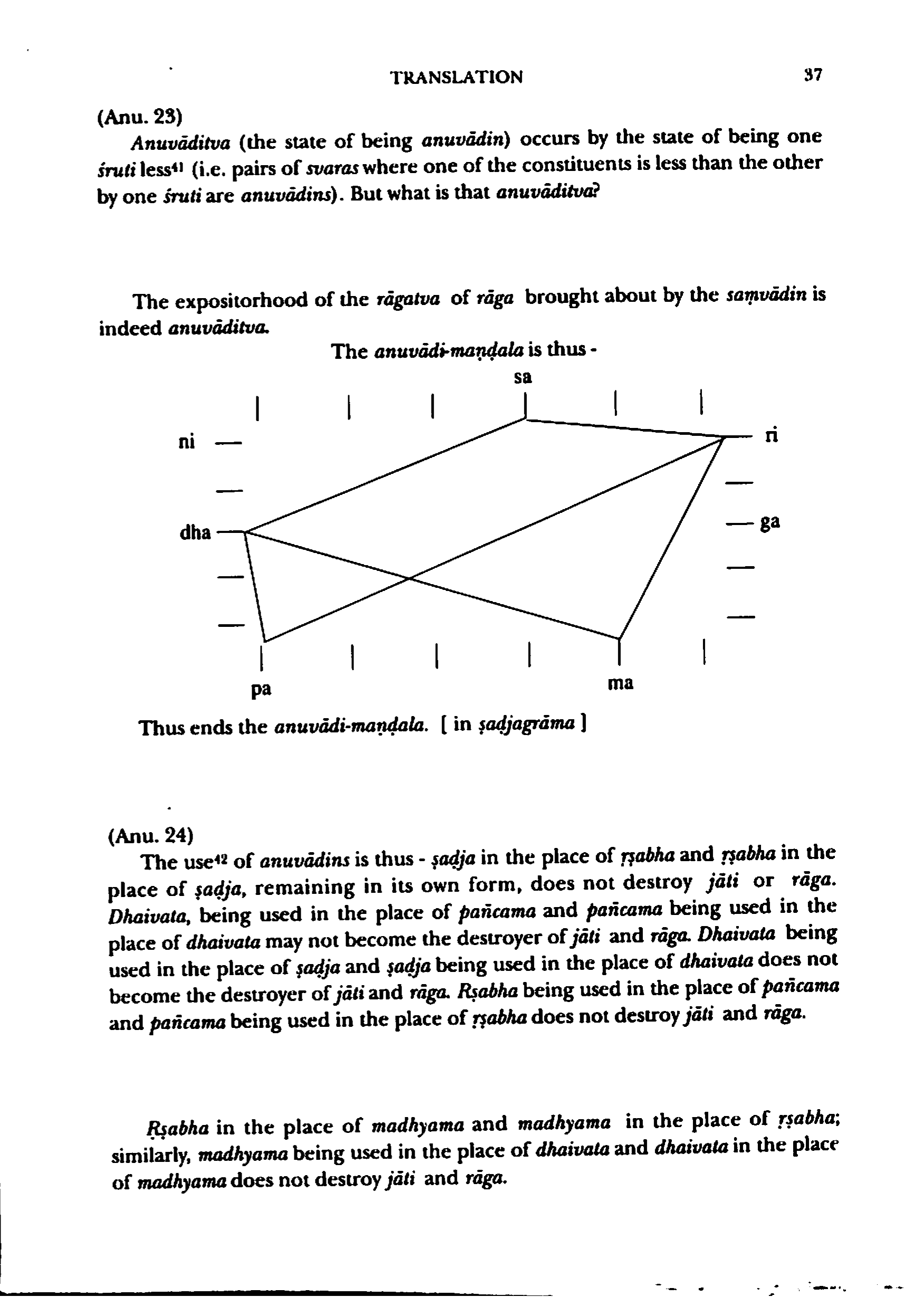
Anuvāditva is the expositorhood of the ragatva of raga brought about by the samvadin
"The expositorhood of the ragatva of raga brought about by the samvadin is
indeed anuvāditva."
When śadja substitutes for ṛṣabha and ṛṣabha for śadja while maintaining their own form, jāti and rāga are not destroyed
"şadja in the place of ṛṣabha and ṛṣabha in the
place of şadja, remaining in its own form, does not destroy jāti or rāga."
When dhaivata substitutes for pañcama and pañcama for dhaivata, jāti and rāga are not destroyed
"Dhaivata, being used in the place of pañcama and pañcama being used in the
place of dhaivata may not become the destroyer of jāti and rāga."
When ṛṣabha substitutes for madhyama and madhyama for ṛṣabha, jāti and rāga are not destroyed
"Ṛṣabha in the place of madhyama and madhyama in the place of ṛṣabha;
similarly, madhyama being used in the place of dhaivata and dhaivata in the place
of madhyama does not destroy jāti and rāga."
When madhyama substitutes for dhaivata and dhaivata for madhyama, jāti and rāga are not destroyed
"madhyama being used in the place of dhaivata and dhaivata in the place of
mādhyama does not destroy jāti and rāga."