Source scans · vol_II_p015
recto · open full
scan recto
verso · open full
scan verso
Bṛhaddeśī · Volume II
pp. 12–13folio 015
Devanāgarī (Bṛhaddeśī)
[अनु॰ १२०]
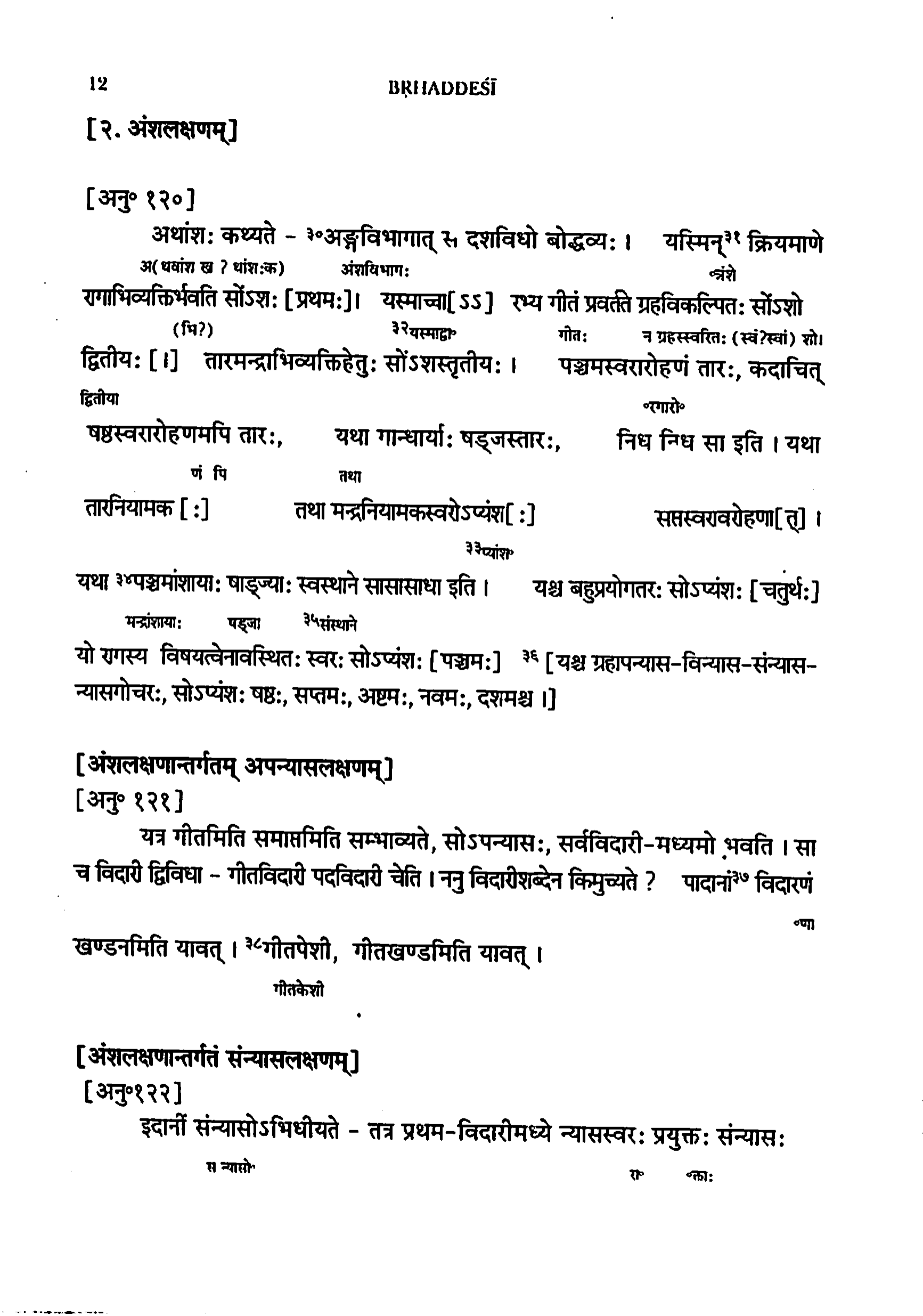
अथांश:अ(थवांश ख ? थांश:क) कथ्यते - ३०अङ्गविभागात् स दशविधो बोद्धव्य:12 । यस्मिन् ३१ क्रियमाणे अंशविभाग:न्त्रंशे गगाभिव्यक्तिर्भवति सोंऽश: [प्रथम:]। यस्माचा[ऽऽ] रभ्य गीतं प्रवर्तते ग्रहविकल्पित: सोंऽशो2 (পি?)३२यस्माद्वाः गीत:
न ग्रहस्स्वरित: (स्वं?स्वां) शो।
द्वितीय: [1] तारमन्द्राभिव्यक्तिहेतु: सोंऽशस्तृतीय:3 । पञ्चमस्वरारोहणं तार:, कदाचित् द्वितीया<b>॰रगारो</b>॰ षष्ठस्वरारोहणमपिणं पि तार:, यथातथा गान्धार्या: षड्जस्तार:, निध निध सा इति6 । यथा तारिनयामक [:] तथा मन्द्रनियामकस्वरोऽप्यंश[:] सप्तस्वरावरोहणा[तु]।9 ३३प्यांश>मन्द्रांशाया: यथा ३४पञ्चमांशाया: षाङ्ज्या: स्वस्थाने सासासाधा इति । यश्च बहुप्रयोगतर: सोऽप्यंश: [चतुर्थ:] ३५संस्थानेपड्जा यो रागस्य विषयत्वेनावस्थित: स्वर: सोऽप्यंश: [पञ्चम:]4 ३६ [यश्च ग्रहापन्यास-विन्यास-संन्यास- न्यासगोचरः, सोऽप्यंशः षष्ठः, सप्तमः, अष्टमः, नवमः, दशमश्च ।]
[अंशलक्षणान्तर्गतम् अपन्यासलक्षणम्]
[अनु॰ १२१]
यत्र गीतमिति समाप्तमिति सम्भाव्यते, सोऽपन्यासः8, सर्वविदारी-मध्यमो भवति11सा च विदारी द्विविधा - गीतविदारी पदविदारी चेति10 । ननु विदारीशब्देन किमुच्यते ? पादानां विदारणं॰णा
खण्डनमिति यावत् । ३८गीतपेशी,गीतकेशी गीतखण्डमिति यावत् ।
[अंशलक्षणान्तर्गतं संन्यासलक्षणम्]
[अनु॰१२२]
इदानीं संन्यासोऽभिधीयतेस न्यासोः - तत्र प्रथम-विदारीमध्ये न्यासस्वरःराष्ट्र प्रयुक्तः॰क्ताः संन्यासः The state of the same of
English — Sharma (translation)
[2. The definition of amsa]
[Anu. 120]
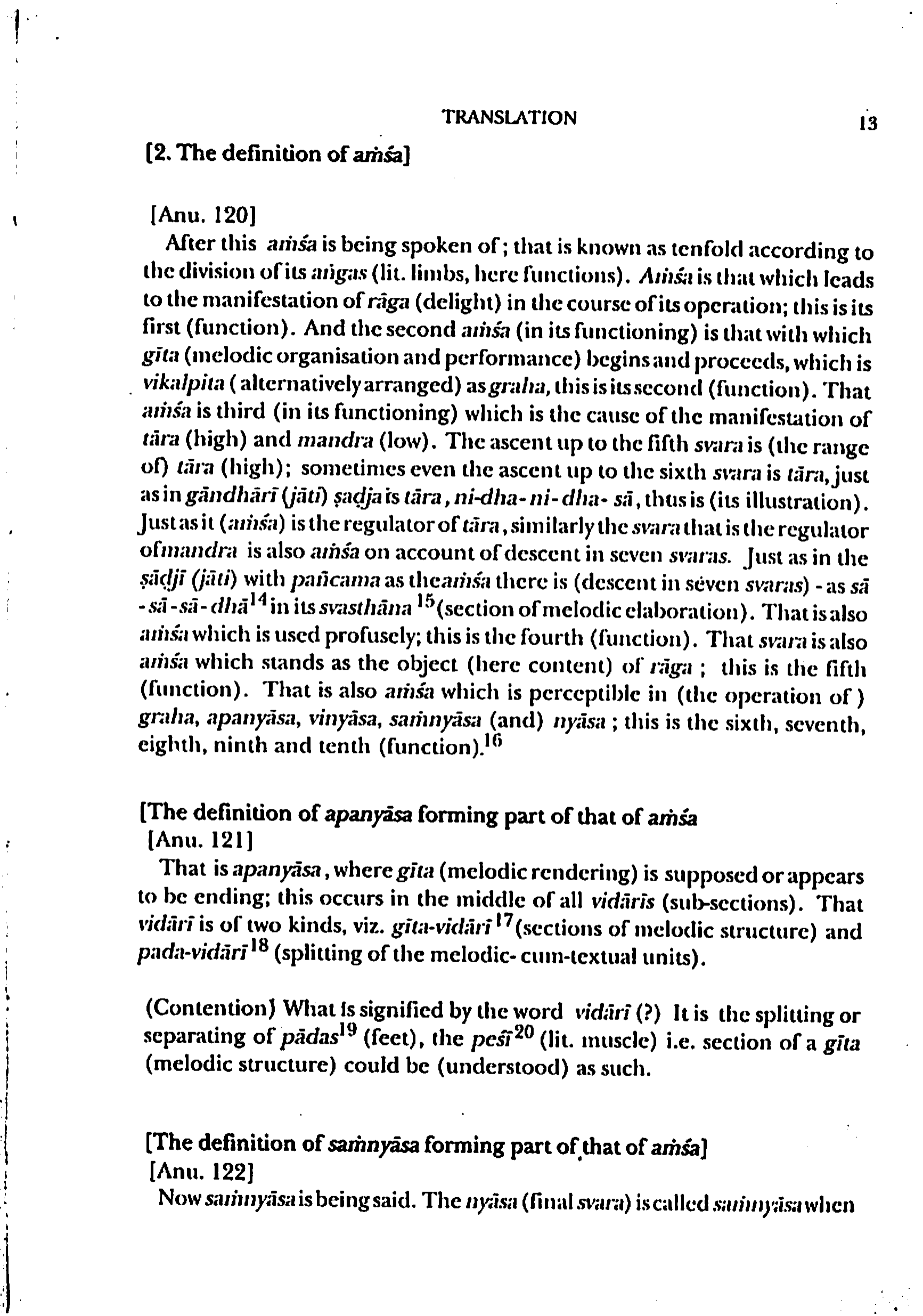
After this amsa is being spoken of; that is known as tenfold according to the division of its angas12 (lit. limbs, here functions). Anisa is that which leads to the manifestation of raga (delight) in the course of its operation; this is its first (function).1 And the second anisa (in its functioning) is that with which gīta (melodic organisation and performance) begins and proceeds, which is vikalpita (alternatively arranged) as graha, this is its second (function).2 That amsa is third (in its functioning) which is the cause of the manifestation of tāra (high) and mandra (low).3 The ascent up to the fifth svara is (the range of) tāra (high); sometimes even the ascent up to the sixth svara is tāra5, just as in gāndhārī (jāti) şadja is tāra, ni-dha-ni-dha-sā, thus is (its illustration).6 Just as it (amśa) is the regulator of tāra, similarly the svara that is the regulator . ofmandra is also amsa on account of descent in seven svaras. Just as in the ṣāḍjī (jāti) with pañcama as theamśa there is (descent in seven svaras) - as sā <math>-s\bar{a}</math> - <math>s\bar{a}</math> - <math>dh\bar{a}^{14}</math> in its svasthāna 15 (section of melodic elaboration). That is also amśa which is used profusely; this is the fourth (function). That svara is also amsa which stands as the object (here content) of raga; this is the fifth (function).4 That is also amsa which is perceptible in (the operation of) graha, apanyāsa, vinyāsa, samnyāsa (and) nyāsa; this is the sixth, seventh, eighth, ninth and tenth (function).16 [The definition of apanyasa forming part of that of amsa
[Anu. 121]
That is apanyāsa, where gīta (melodic rendering) is supposed or appears to be ending8; this occurs in the middle of all vidārīs (sub-sections).11 That vidārī is of two kinds, viz. gīta-vidārī 17 (sections of melodic structure) and pada-vidārī 18 (splitting of the melodic- cum-textual units).10 (Contention) What is signified by the word vidārī (?) It is the splitting or separating of <math>p\bar{a}das^{19}</math> (feet), the <math>pes\bar{i}^{20}</math> (lit. muscle) i.e. section of a <math>g\bar{i}ta</math> (melodic structure) could be (understood) as such.
[The definition of samnyāsa forming part of that of amśa]
[Anu. 122]
Now samnyāsa is being said. The nyāsa (final svara) is called samnyāsa when
1.[definition] Amsa in its first function leads to the manifestation of ragaअंशविभागः न्त्रंशे गगाभिव्यक्तिर्भवति सोंऽशः [प्रथमः]
2.[definition] Amsa in its second function is that with which gita begins and proceeds, arranged as grahaयस्माचा[ऽऽ] रभ्य गीतं प्रवर्तते ग्रहविकल्पितः सोंऽशो
3.[definition] Amsa in its third function is the cause of manifestation of tara (high) and mandra (low)तारमन्द्राभिव्यक्तिहेतुः सोंऽशस्तृतीयः
4.[definition] Amsa in its fifth function is the svara that stands as the object or content of ragaयो रागस्य विषयत्वेनावस्थितः स्वरः सोऽप्यंशः [पञ्चमः]
6.[definition] In gāndhārī jāti, sadja is tara with illustration ni-dha-ni-dha-sāयथा गान्धार्याः षड्जस्तारः, निध निध सा इति
8.[definition] Apanyasa is where gita is supposed or appears to be endingयत्र गीतमिति समाप्तमिति सम्भाव्यते, सोऽपन्यासः
9.[definition] Mandra is regulated by descent in seven svarasतथा मन्द्रनियामकस्वरोऽप्यंश[:] सप्तस्वरावरोहणा[तु]।
10.[enumeration] Vidari is of two kinds: gita-vidari and pada-vidariसा च विदारी द्विविधा - गीतविदारी पदविदारी चेति
11.[relation] Apanyasa occurs in the middle of all vidarisसर्वविदारी-मध्यमो भवति
12.[structural]Amsa is known as tenfold according to the division of its angas (functions)अथांशः कथ्यते - ३०अङ्गविभागात् स दशविधो बोद्धव्यः
1.[definition]Amsa in its first function leads to the manifestation of ragaAnisa is that which leads to the manifestation of raga (delight) in the course of its operation; this is its first (function).
2.[definition]Amsa in its second function is that with which gita begins and proceeds, arranged as grahaAnd the second anisa (in its functioning) is that with which gīta (melodic organisation and performance) begins and proceeds, which is vikalpita (alternatively arranged) as graha, this is its second (function).
3.[definition]Amsa in its third function is the cause of manifestation of tara (high) and mandra (low)That amsa is third (in its functioning) which is the cause of the manifestation of tāra (high) and mandra (low).
4.[definition]Amsa in its fifth function is the svara that stands as the object or content of ragaThat svara is also amsa which stands as the object (here content) of raga; this is the fifth (function).
5.[definition]Tara (high) is ascent up to the fifth svara, and sometimes even ascent up to the sixth svaraThe ascent up to the fifth svara is (the range of) tāra (high); sometimes even the ascent up to the sixth svara is tāra
6.[definition]In gāndhārī jāti, sadja is tara with illustration ni-dha-ni-dha-sājust as in gāndhārī (jāti) şadja is tāra, ni-dha-ni-dha-sā, thus is (its illustration).
7.[definition]Vidari signifies the splitting or separating of padas (feet)What is signified by the word vidārī (?) It is the splitting or separating of p\bar{a}das^{19} (feet)
8.[definition]Apanyasa is where gita is supposed or appears to be endingThat is apanyāsa, where gīta (melodic rendering) is supposed or appears to be ending
9.[definition]Mandra is regulated by descent in seven svarasJust as it (aṁśa) is the regulator of tāra, similarly the svara that is the regulator ofmandra is also amsa on account of descent in seven svaras.
10.[enumeration]Vidari is of two kinds: gita-vidari and pada-vidariThat vidārī is of two kinds, viz. gīta-vidārī 17 (sections of melodic structure) and pada-vidārī 18 (splitting of the melodic- cum-textual units).
11.[relation]Apanyasa occurs in the middle of all vidaristhis occurs in the middle of all vidārīs (sub-sections).
12.[structural] Amsa is known as tenfold according to the division of its angas (functions)After this amsa is being spoken of; that is known as tenfold according to the division of its angas