Source scans · vol_II_p014
recto · open full
scan recto
verso · open full
scan verso
Bṛhaddeśī · Volume II
pp. 1–11folio 014
Devanāgarī (Bṛhaddeśī)
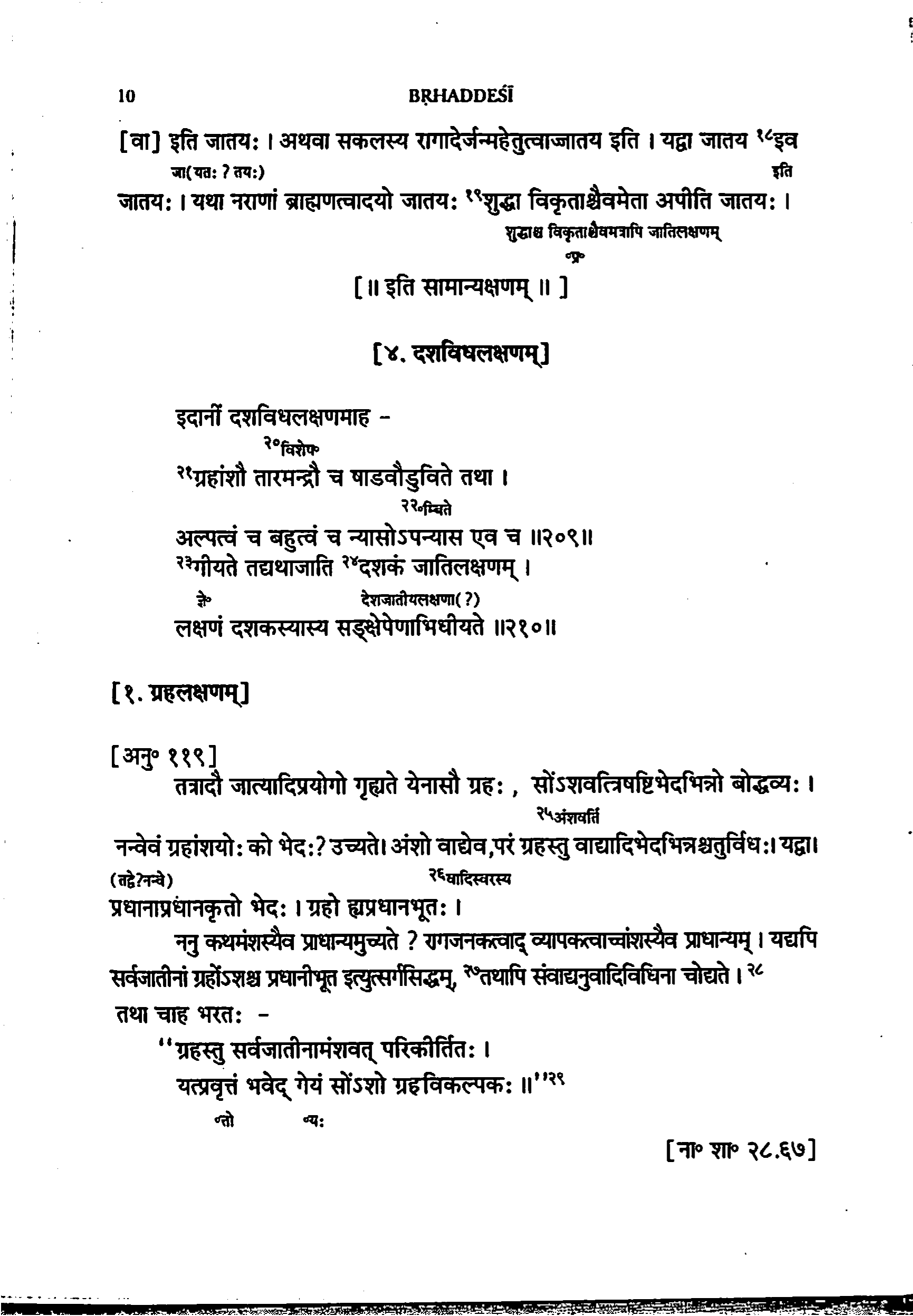
[वा] इति ज?ातयः । अथवा सकलस्य रागादेर्जन्महेतुत्वाज?्ज?ातय इति । यद्वा ज?ातय १८इव इति ज?ा(यतः ? तयः)
ज?ातयः । यथा नराणा ब्राह्मणत्वादयो ज?ातयः १९शुद्धा विकृताश्चैवमेता अपीति ज?ातयः ।
शुद्धाध विकृताधैवमत्रापि ज?ातिलक्षणम्
[॥ इति सामान्यक्षणम् ॥]
[४. दशविधलक्षणम्]
इदानी दशविधलक्षणमाह - २०विशेफ
२६ग्रहांशौ तारमन्द्रौ च षाडवौडुविते तथा ।
२२०ध्यिते अल्पत्वं च बहुत्वं च न्यासोऽपन्यास एव च ॥२०९॥
२३गीयते तद्यथाज?ाति २४दशकं ज?ातिलक्षणम् ।
देशजातीयलक्षणा(?) क्रे लक्षणं दशकस्यास्य सङ्क्षेपेणाभिधीयते ॥२१०॥
[१. ग्रहलक्षणम्]
[अनु॰ ११९]
तत्रादौ ज?ात्यादिप्रयोगो गृह्यते येनासौ ग्रहः3 , सोंऽशवत्त्रिषष्टिभेदभिन्नो बोद्धव्यः9
२५अंशवर्ति
नन्वेवं ग्रहांशयोः को भेदः? उच्यते। अंशो वाद्येव4,परं ग्रहस्तु वाद्यादिभेदभिन्नश्चतुर्विधः। यद्वा।
२६षादिस्वरस्य (तद्वे?नन्वे)
प्रधानाप्रधानकृतो भेदः । ग्रहो ह्यप्रधानभूतः7
न्नु कथमंशस्यैव प्राधान्यमुच्यते ? रागजनकत्वाद् व्यापकत्वाचांशस्यैव प्राधान्यम्1 । यद्यपि सर्वजातीना ग्रहोंऽशश्च प्रधानीभूत इत्युत्सर्गीसद्धम्, र॰तथापि संवाद्यनुवादिविधिना चोद्यते । २८ तथा चाह भरतः -
‘‘ग्रहस्तु सर्वजातीनामंशवत् परिकीर्तितः ।
यत्प्रवृत्तं भवेद् गेयं सोंऽशो ग्रहविकल्पकः2 ॥''२९ न्तो व्यः tip in the
English — Sharma (translation)
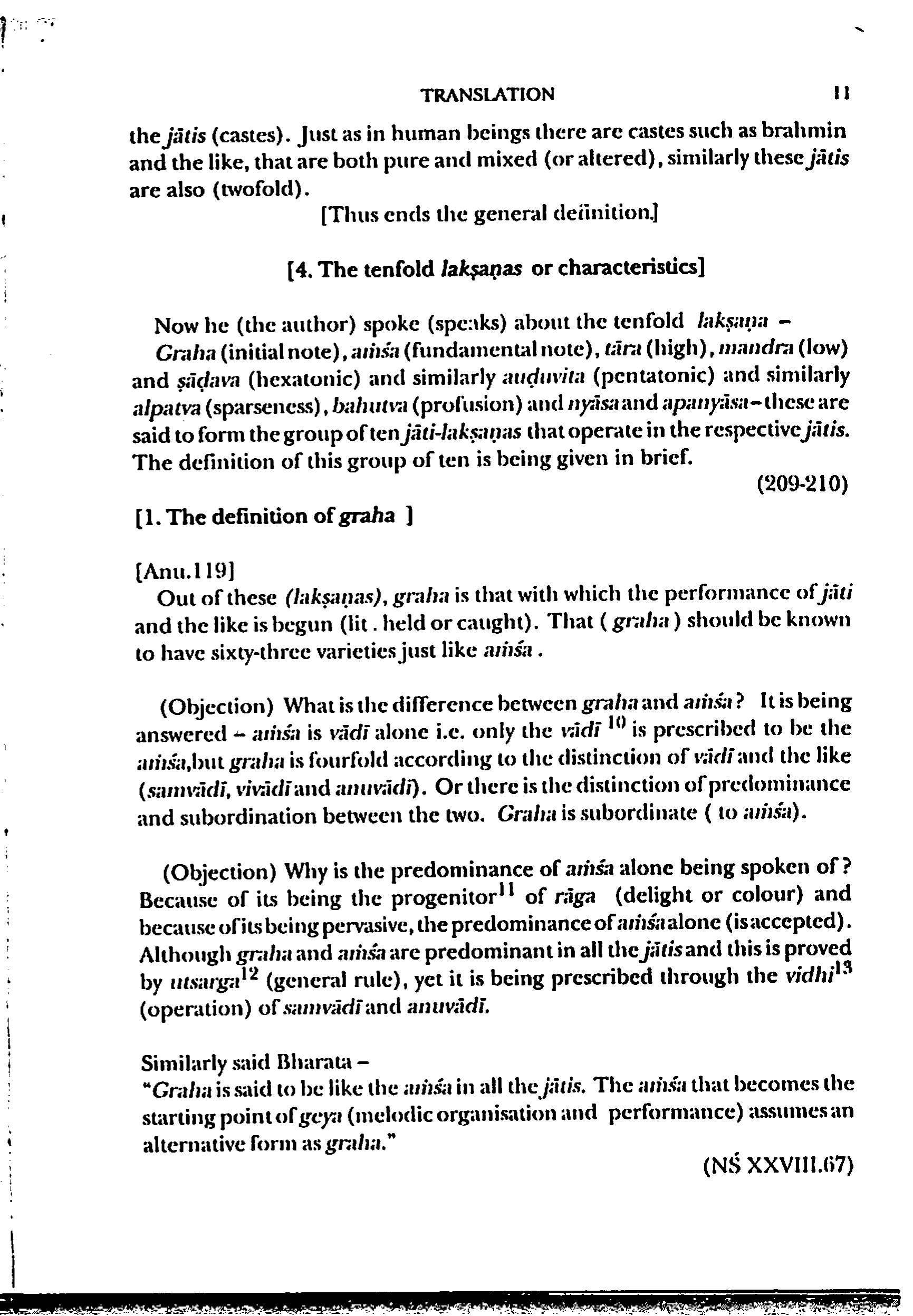
n er the jātis (castes). Just as in human beings there are castes such as brahmin and the like, that are both pure and mixed (or altered), similarly these jātis are also (twofold).8
[Thus ends the general definition.]
[4. The tenfold lakṣaṇas or characteristics]
Now he (the author) spoke (speaks) about the tenfold lakṣaṇa - Graha (initial note), amśa (fundamental note), tāra (high), mandra (low) and ṣāḍava (hexatonic) and similarly auḍuvita (pentatonic) and similarly alpatva (sparseness), bahutva (profusion) and nyāsa and apanyāsa - these are said to form the group of ten jāti-lakṣaṇas that operate in the respective jātis. The definition of this group of ten is being given in brief. <math>(209-210)</math>
[1. The definition of graha]
[Anu.119]
Out of these (lakṣaṇas), graha is that with which the performance of jāti and the like is begun (lit . held or caught).3 That ( graha ) should be known to have sixty-three varieties just like aniśa.9 (Objection) What is the difference between graha and anisa? It is being answered - amśa is vādī alone i.e. only the vādī 10 is prescribed to be the amsa,but graha is fourfold according to the distinction of vādī and the like (samvādī, vivādī and anuvādī). Or there is the distinction of predominance and subordination between the two. Graha is subordinate ( to amśa). ŧ (Objection) Why is the predominance of amsa alone being spoken of? Because of its being the progenitor 11 of raga (delight or colour) and because of its being pervasive, the predominance of anisa alone (is accepted).1 Although graha and anisa are predominant in all the jatis and this is proved by utsarga12 (general rule), yet it is being prescribed through the vidhi13 (operation) of samvādī and anuvādī. Similarly said Bharata"Graha is said to be like the amsa in all the jātis. The amsa that becomes the starting point of geya (melodic organisation and performance)5 assumes an alternative form as graha."2 (NŚ XXVIII.67)
1.[attribution] Aṁśa has predominance because it is the progenitor of rāga and pervasive in natureरागजनकत्वाद् व्यापकत्वाचांशस्यैव प्राधान्यम्
2.[attribution] Bharata stated that graha is said to be like the aṁśa in all jātis, with aṁśa becoming graha when serving as the starting point of geyaग्रहस्तु सर्वजातीनामंशवत् परिकीर्तितः । यत्प्रवृत्तं भवेद् गेयं सोंऽशो ग्रहविकल्पकः
3.[definition] Graha is the note with which the performance of jāti and the like is begun or initiatedज?ात्यादिप्रयोगो गृह्यते येनासौ ग्रहः
4.[definition] Aṁśa is the vādī alone, the principal note in a rāgaअंशो वाद्येव
5.[definition] Geya refers to melodic organisation and performance that begins with the aṁśaयत्प्रवृत्तं भवेद् गेयं सोंऽशो ग्रहविकल्पकः
7.[relation] The distinction between graha and aṁśa is that aṁśa is predominant while graha is subordinateप्रधानाप्रधानकृतो भेदः । ग्रहो ह्यप्रधानभूतः
9.[structural] Graha has sixty-three varieties, similar to aṁśaसोंऽशवत्त्रिषष्टिभेदभिन्नो बोद्धव्यः
10.[structural] The vādī is one of the four types of notes in a rāga (vādī, samvādī, vivādī, anuvādī)अंशो वाद्येव,परं ग्रहस्तु वाद्यादिभेदभिन्नश्चतुर्विधः
1.[attribution]Aṁśa has predominance because it is the progenitor of rāga and pervasive in natureBecause of its being the progenitor 11 of raga (delight or colour) and because of its being pervasive, the predominance of anisa alone (is accepted).
2.[attribution]Bharata stated that graha is said to be like the aṁśa in all jātis, with aṁśa becoming graha when serving as the starting point of geya"Graha is said to be like the amsa in all the jātis. The amsa that becomes the starting point of geya (melodic organisation and performance) assumes an alternative form as graha."
3.[definition]Graha is the note with which the performance of jāti and the like is begun or initiatedgraha is that with which the performance of jāti and the like is begun (lit . held or caught).
4.[definition]Aṁśa is the vādī alone, the principal note in a rāgaaṁśa is vādī alone i.e. only the vādī
5.[definition]Geya refers to melodic organisation and performance that begins with the aṁśaThe amsa that becomes the starting point of geya (melodic organisation and performance)
6.[enumeration]The ten characteristic lakṣaṇas of jāti are: graha, aṁśa, tāra, mandra, ṣāḍava, auḍuvita, alpatva, bahutva, nyāsa, and apanyāsaGraha (initial note), aṁśa (fundamental note), tāra (high), mandra (low) and ṣāḍava (hexatonic) and similarly auḍuvita (pentatonic) and similarly alpatva (sparseness), bahutva (profusion) and nyāsa and apanyāsa
7.[relation]The distinction between graha and aṁśa is that aṁśa is predominant while graha is subordinateOr there is the distinction of predominance and subordination between the two. Graha is subordinate ( to aṁśa).
8.[relation]Jātis in music are both pure and mixed or altered, analogous to castes in human societyJust as in human beings there are castes such as brahmin and the like, that are both pure and mixed (or altered), similarly these jātis are also (twofold).
9.[structural]Graha has sixty-three varieties, similar to aṁśaThat ( graha ) should be known to have sixty-three varieties just like aniśa.
10.[structural]The vādī is one of the four types of notes in a rāga (vādī, samvādī, vivādī, anuvādī)aṁśa is vādī alone i.e. only the vādī 10 is prescribed to be the 1 (samvādī, vivādī and anuvādī).