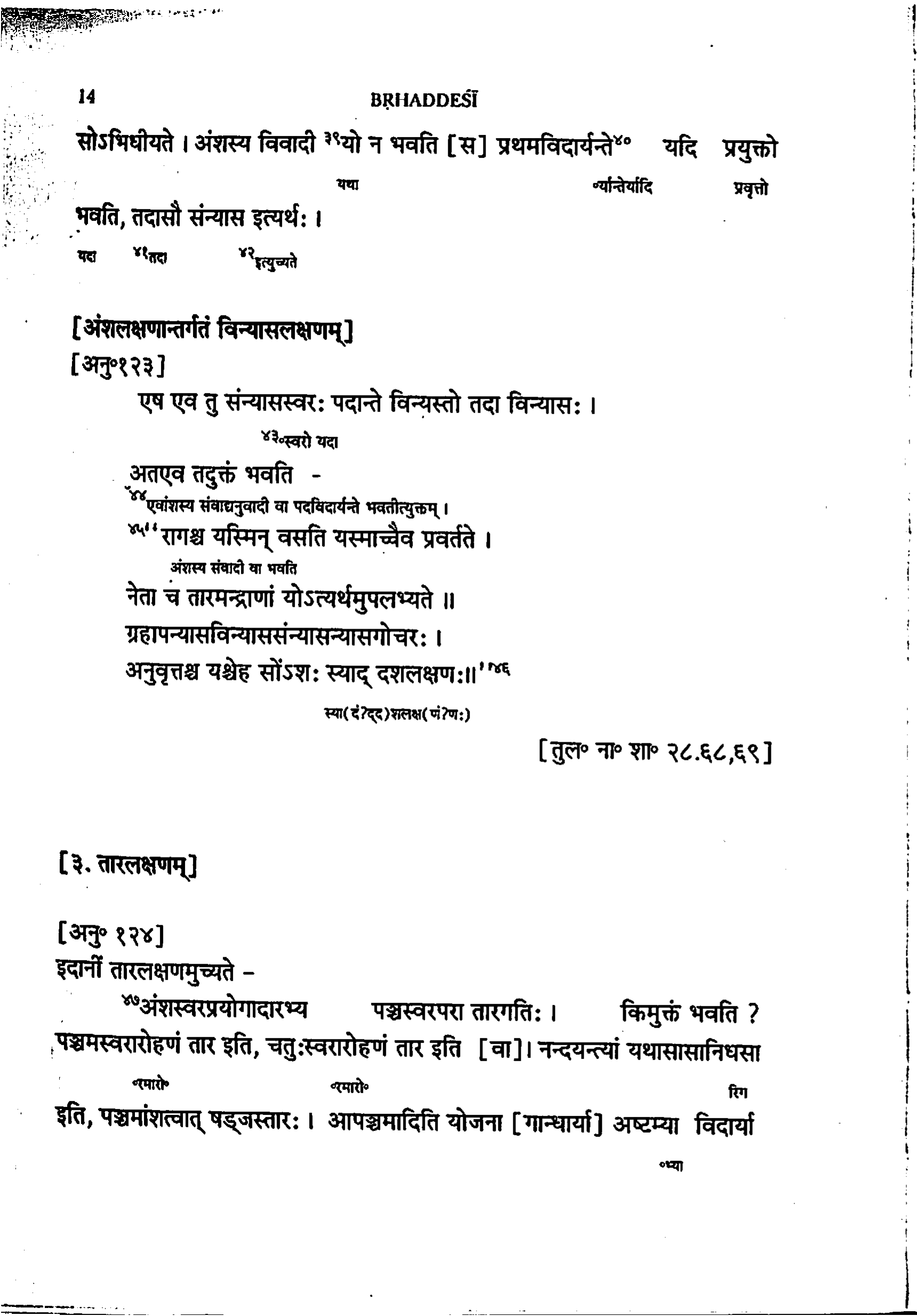
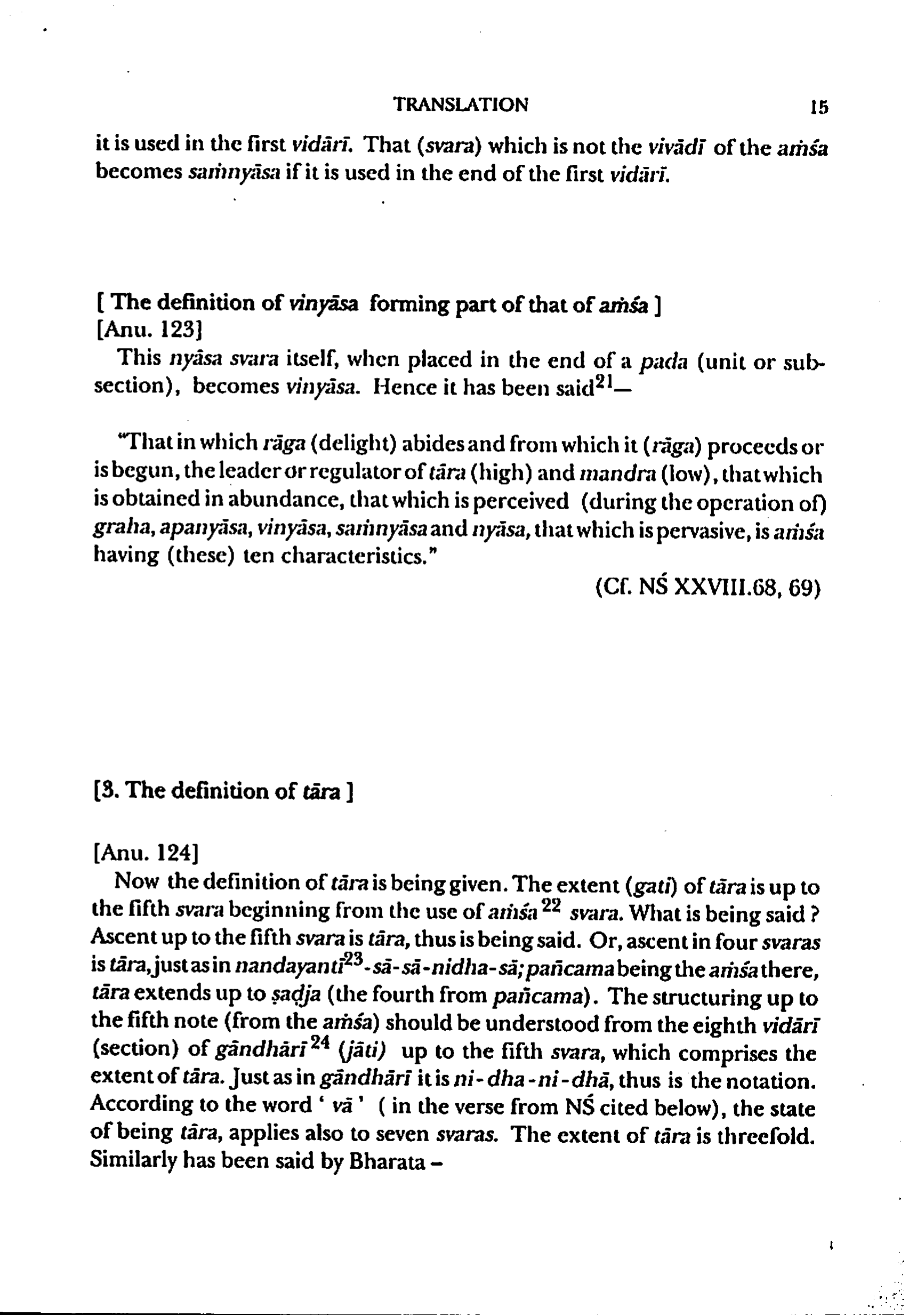
it is used in the first vidārī12. That (svara) which is not the vivādī of the amśa
becomes
samnyāsa if it is used in the end of the first vidārī.
[The definition of
vinyāsa forming part of that of amsa
]
[Anu. 123]
This nyāsa svara itself, when placed in the end of a pada (unit or sub-
section), becomes vinyāsa.4 Hence it has been said
21—
"That in which rāga (delight) abides and from which it (rāga) proceeds or
is begun, the leader or regulator of tara (high) and mandra (low), that which
is obtained in abundance,
that which is perceived (during the operation of)
graha, apanyāsa, vinyāsa, samnyāsa and nyāsa6, that which is pervasive, is amśa
having (these) ten characteristics."
(Cf.
NS XXVIII.68, 69)
[3. The definition of tara]
[Anu. 124]
Now the definition of tara is being given. The extent (gati) of tara is up to
the fifth svara beginning from the use of amsa 22 svara.5 What is being said?
Ascent up to the fifth svara is tāra, thus is being said. Or, ascent in four svaras
is tāra7, just as in
nandayantī23-sā-sā-nidha-sā;
pañcama being the amśa there,
tāra extends up to ṣadja (the fourth from
pañcama).
The structuring up to
the fifth note (from the amsa) should be understood from the eighth vidārī
(section) of gāndhārī24 (jāti)9 up to the fifth svara, which comprises the
extent of tāra. Just as in
gāndhārī it is ni-dha-ni-dhā, thus is the notation.
According to the word 'va' (in the verse from NS cited below), the state
of being tara, applies also to seven svaras.
The extent of tara is threefold.11
Similarly has been said by Bharata1 -
• • • • • • •