Source scans · vol_II_p049
recto · open full
scan recto
verso · open full
scan verso
Bṛhaddeśī · Volume II
pp. 80–81folio 049
Devanāgarī (Bṛhaddeśī)
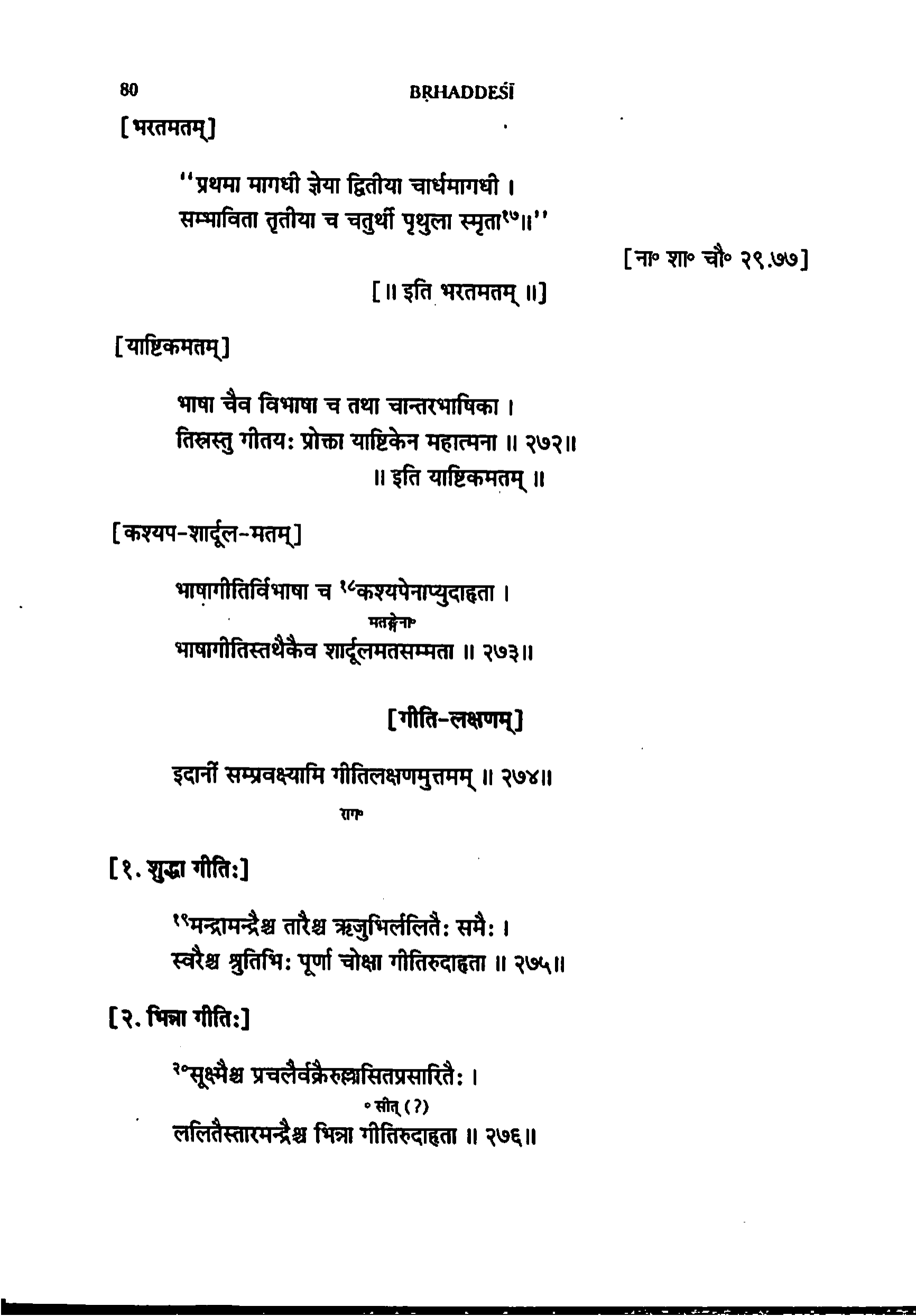
[भरतमतम्]
‘‘प्रथमा मागधी ज?्ञेया द्वितीया चार्धमागधी6
सम्भाविता तृतीया च7 चतुर्थी पृथुला स्मृता8 ।''
[ना॰ शा॰ चौ॰ २९.७७]
[॥ इति भरतमतम् ॥]
भाषा चैव विभाषा च तथा चान्तरभाषिका ।
तिस्रस्तु गीतयः प्रोक्ता याष्टिकेन महात्मना9 ॥२७२॥
भाषागीतिर्विभाषा च १८कश्यपेनाप्युदाहृता ।
मतङ्गेना भाषागीतिस्तथैकैव शार्दूलमतसम्मता ॥२७३॥
[गीति-लक्षणम्]
इदानी सम्प्रवक्ष्यामि गीतिलक्षणमुत्तमम्2 ॥२७४॥ साम
[१. शुद्धा गीतिः]
१९मन्द्रामन्द्रैश्च तारैश्च ऋजुभिर्ललितैः समैः ।
स्वरैश्च श्रुतिभिः पूर्णा चोक्षा गीतिरुदाहृता3 ॥२७५॥
[२. भिन्ना गीतिः]
२°सूक्ष्मैश्च प्रचलैर्वक्रैरुह्मासितप्रसारितैः11
॰ सीत् (?) लितैस्तारमन्द्रैश्च भित्रा गीतिरुदाहृता ॥२७६॥ しゅうし デストチー 知力 カン・コーニュー ニューニ ____ . . . . _
English — Sharma (translation)
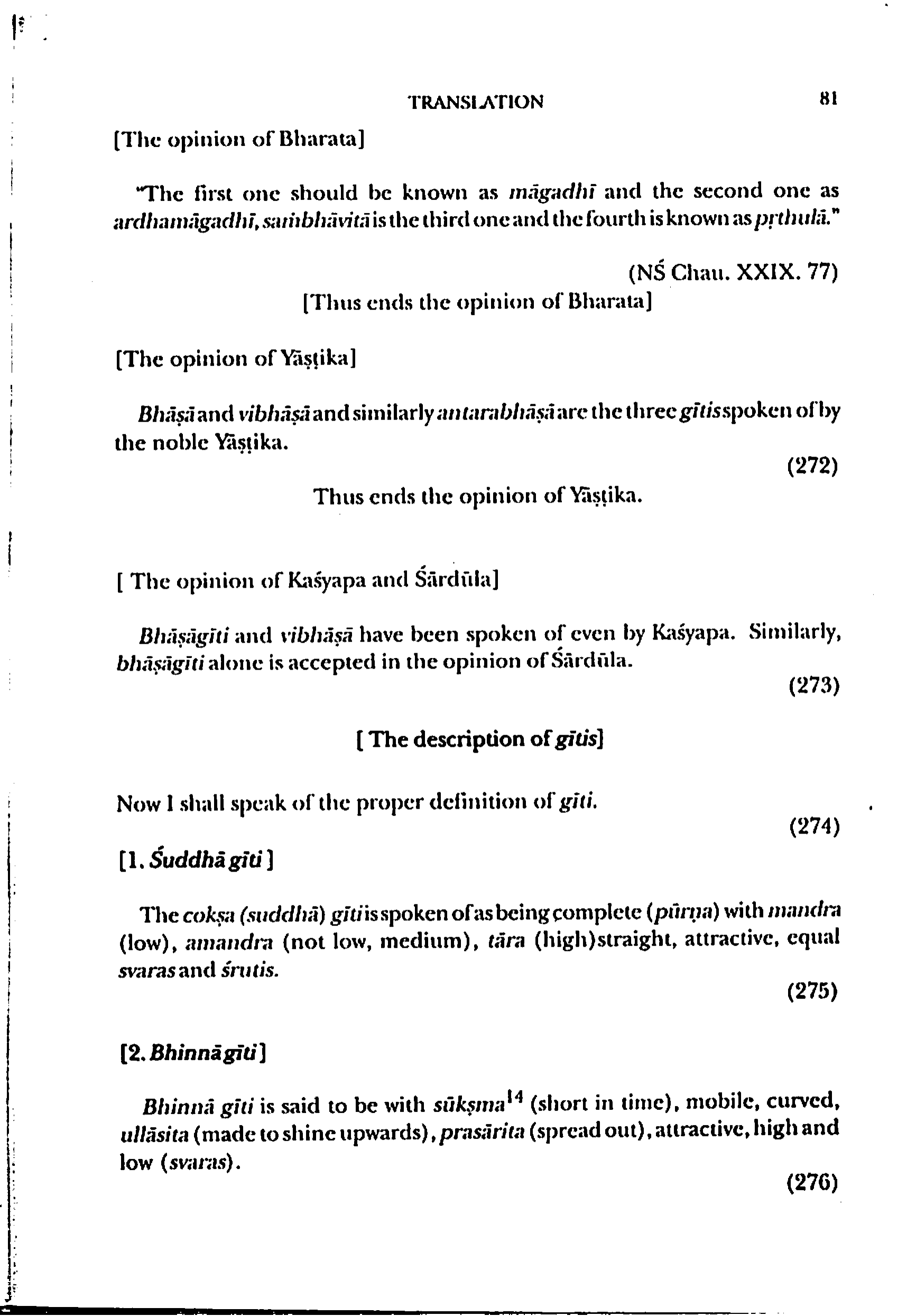
[The opinion of Bharata]
"The first one should be known as māgadhī5 and the second one as ardhamāgadhī6, sambhāvitā is the third one7 and the fourth is known as pṛthulā8." (NŚ Chau. XXIX. 77)
[Thus ends the opinion of Bharata]
[The opinion of Yāṣṭika]
Bhāṣā and vibhāṣā and similarly antarabhāṣā are the three gītis spoken of by the noble Yāstika.9
(272)
Thus ends the opinion of Yāṣṭika.
[The opinion of Kasyapa and Śārdūla]
Bhāṣāgīti and vibhāṣā have been spoken of even by Kaśyapa. Similarly, bhāṣāgīti alone is accepted in the opinion of Śārdūla.1
(273)
[The description of gītis]
Now I shall speak of the proper definition of giti.2
(274)
The cokṣa (suddhā) gīti is spoken of as being complete (pūrṇa) with mandra (low), amandra (not low, medium), tāra (high)10straight, attractive, equal svaras and śrutis.3
(275)
Bhinnā gīti is said to be with sūkṣma14 (short in time), mobile, curved, ullāsita (made to shine upwards), prasārita (spread out)11, attractive, high and low (svaras).4
(276)
2.[citation] Mātaṅga announces his intention to provide the proper definition of gītiइदानी सम्प्रवक्ष्यामि गीतिलक्षणमुत्तमम्
3.[definition] Suddhā gīti (also called cokṣa) is characterized by completeness with specific svara and śruti qualitiesमन्द्रामन्द्रैश्च तारैश्च ऋजुभिर्ललितैः समैः । स्वरैश्च श्रुतिभिः पूर्णा चोक्षा गीतिरुदाहृता
6.[enumeration] Ardhamāgadhī is the second category in Bharata's classificationद्वितीया चार्धमागधी
7.[enumeration] Sambhāvitā is the third category in Bharata's classificationसम्भाविता तृतीया च
8.[enumeration] Pṛthulā is the fourth category in Bharata's classificationचतुर्थी पृथुला स्मृता
9.[enumeration] Three gītis are identified: bhāṣā, vibhāṣā, and antarabhāṣā according to Yāṣṭikaभाषा चैव विभाषा च तथा चान्तरभाषिका । तिस्रस्तु गीतयः प्रोक्ता याष्टिकेन महात्मना
11.[structural] Bhinnā gīti exhibits qualities including brevity of time (sūkṣma), upward elevation (ullāsita), and expansion (prasārita)सूक्ष्मैश्च प्रचलैर्वक्रैरुह्मासितप्रसारितैः
1.[attribution]Bhāṣāgīti is recognized in both Kasyapa's and Śārdūla's doctrinesBhāṣāgīti and vibhāṣā have been spoken of even by Kaśyapa. Similarly, bhāṣāgīti alone is accepted in the opinion of Śārdūla.
2.[citation]Mātaṅga announces his intention to provide the proper definition of gītiNow I shall speak of the proper definition of giti.
3.[definition]Suddhā gīti (also called cokṣa) is characterized by completeness with specific svara and śruti qualitiesThe cokṣa (suddhā) gīti is spoken of as being complete (pūrṇa) with mandra (low), amandra (not low, medium), tāra (high)straight, attractive, equal svaras and śrutis.
4.[definition]Bhinnā gīti is characterized by subtle, mobile, curved, elevated, and spread-out qualitiesBhinnā gīti is said to be with sūkṣma (short in time), mobile, curved, ullāsita (made to shine upwards), prasārita (spread out), attractive, high and low (svaras).
5.[enumeration]Māgadhī is the first category in Bharata's classification schemeThe first one should be known as māgadhī
6.[enumeration]Ardhamāgadhī is the second category in Bharata's classificationthe second one as ardhamāgadhī
7.[enumeration]Sambhāvitā is the third category in Bharata's classificationsambhāvitā is the third one
8.[enumeration]Pṛthulā is the fourth category in Bharata's classificationthe fourth is known as pṛthulā
9.[enumeration]Three gītis are identified: bhāṣā, vibhāṣā, and antarabhāṣā according to YāṣṭikaBhāṣā and vibhāṣā and similarly antarabhāṣā are the three gītis spoken of by the noble Yāstika.
10.[structural]Suddhā gīti employs three registers of pitch: mandra (low), amandra (medium), and tāra (high)complete (pūrṇa) with mandra (low), amandra (not low, medium), tāra (high)
11.[structural]Bhinnā gīti exhibits qualities including brevity of time (sūkṣma), upward elevation (ullāsita), and expansion (prasārita)with sūkṣma14 (short in time), mobile, curved, ullāsita (made to shine upwards), prasārita (spread out)