Source scans · vol_II_p137
recto · open full
scan recto
verso · open full
scan verso
Bṛhaddeśī · Volume II
pp. 256–257folio 137
Devanāgarī (Bṛhaddeśī)
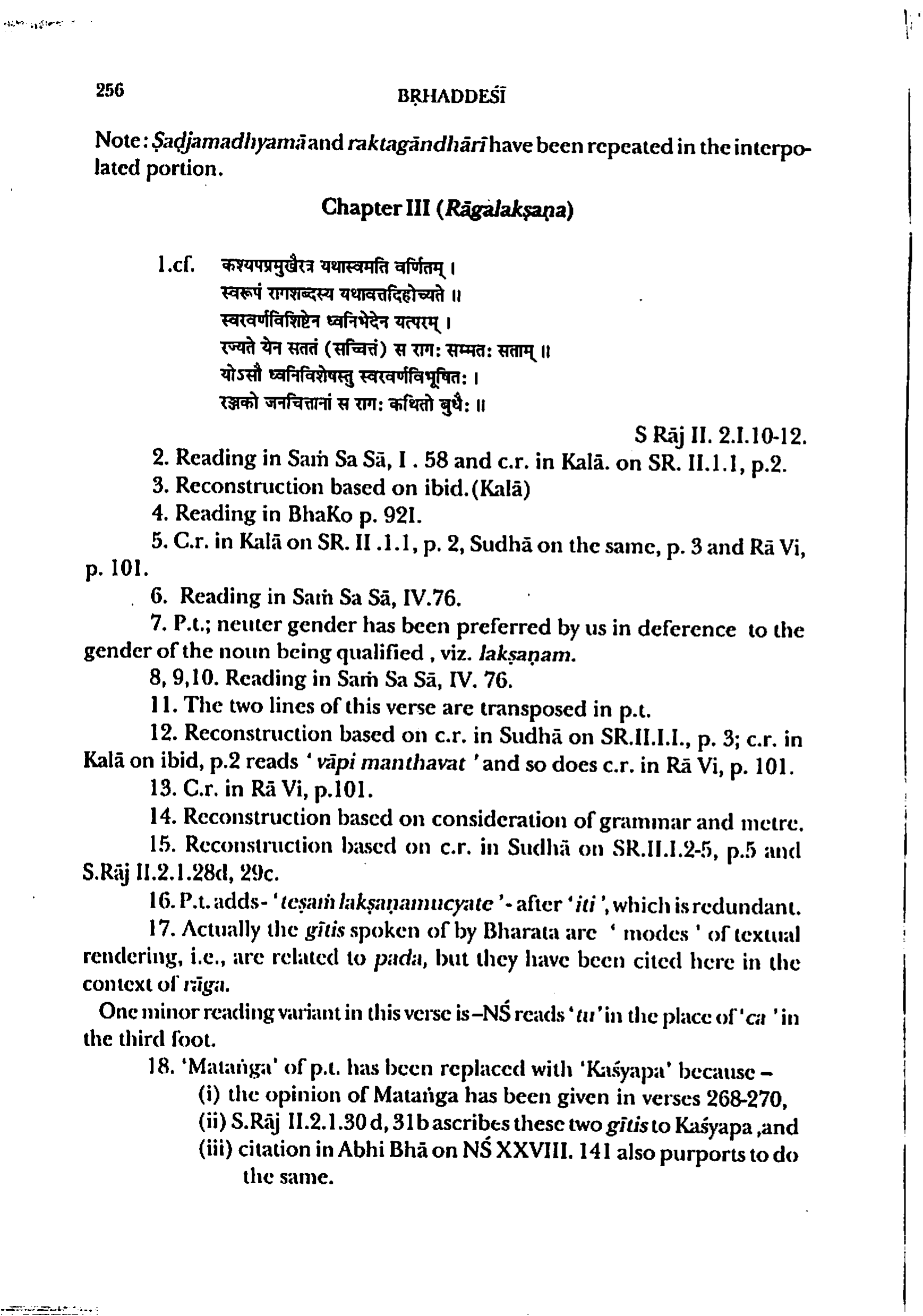
1, 1 (4) 90 公司的第三人 Note: Şadjamadhyamā and raktagāndhārī have been repeated in the interpo- lated portion.11 Chapter III (Rāgalakṣana)
कश्यपप्रमुखैरत्र यथास्वमति वर्णितम् ।
l.cf.
स्वरूपं रागशब्दस्य यथावत्तदिहोच्यते ॥
स्वरवर्णविशिष्टेन ध्वनिभेदेन यत्परम् ।
रज्यते येन सततं (सच्चित्तं) स राग: सम्मत: सताम् ॥
योऽसौ ध्वनिविशेषस्तु स्वरवर्णविभूषित:।
रञ्जको जनचित्तानां स राग: कथितो बुधै: ॥
S Rāj II. 2.I.10-12. 2. Reading in Sam Sa Sā, I. 58 and c.r. in Kalā. on SR. II.1.1, p.2. 3. Reconstruction based on ibid. (Kalā) 4. Reading in BhaKo p. 921. 5. C.r. in Kalā on SR. II .1.1, p. 2, Sudhā on the same, p. 3 and Rā Vi, p. 101. 6. Reading in Sam Sa Sā, IV.76. 7. P.t.; neuter gender has been preferred by us in deference to the gender of the noun being qualified, viz. lakṣaṇam. 8, 9,10. Reading in Sam Sa Sā, IV. 76. 11. The two lines of this verse are transposed in p.t. 12. Reconstruction based on c.r. in Sudhā on SR.II.I.I., p. 3; c.r. in Kalā on ibid, p.2 reads 'vāpi manthavat' and so does c.r. in Rā Vi, p. 101. 13. C.r. in Rā Vi, p.101. 14. Reconstruction based on consideration of grammar and metre. 15. Reconstruction based on c.r. in Sudhā on SR.II.I.2-5, p.5 and S.Rāj II.2.1.28d, 29c. 16. P.t. adds- 'teşam lakşanamucyate'- after 'iti', which is redundant. 17. Actually the gîtis spoken of by Bharata are 'modes' of textual rendering, i.e., are related to pada, but they have been cited here in the context of rāga. One minor reading variant in this verse is -NS reads 'tu' in the place of 'ca' in the third foot. 18. 'Matanga' of p.t. has been replaced with 'Kasyapa' because - (i) the opinion of Matanga has been given in verses 268-270, (ii) S.Rāj II.2.1.30 d, 31b ascribes these two gītis to Kasyapa, and (iii) citation in Abhi Bhā on NŚ XXVIII. 141 also purports to do the same. and the second second
English — Sharma
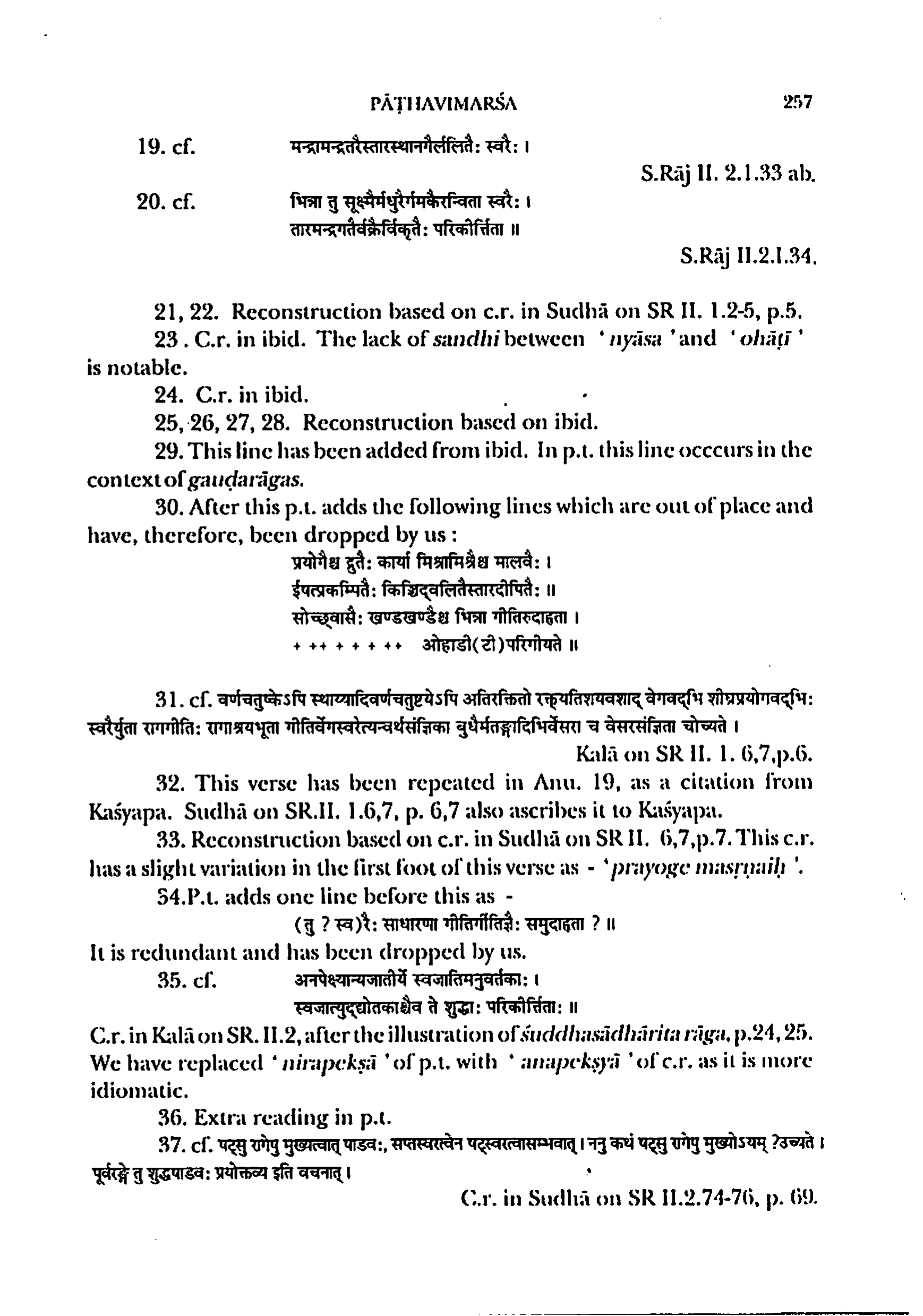
PÄŢHAVIMARŚA
मन्द्रामन्द्रतरैस्तारस्थानगैर्ललितैः स्वरैः ।
19. cf. S.Rāj 11. 2.1.33 ab.
भिन्ना तु सूक्ष्मैर्मधुरैर्गमकैरन्विता स्वरैः ।
20. cf.
तारमन्द्रगतैर्वक्रैर्विकृतैः परिकीर्त्तिता ॥
S.Rāj II.2.I.34. 21, 22. Reconstruction based on c.r. in Sudhā on SR II. 1.2-5, p.5. 23. C.r. in ibid. The lack of sandhi between 'nyāsa' and 'ohāṭī' is notable. 24. C.r. in ibid. 25, 26, 27, 28. Reconstruction based on ibid. 29. This line has been added from ibid. In p.t. this line occcurs in the context of gaudarāgas.12 30. After this p.t. adds the following lines which are out of place and have, therefore, been dropped by us:
प्रयोगेश्च दूतैः कार्या मिश्रामिश्रेश्च मालवैः ।
ईपत्प्रकम्पितैः किञ्चिद्वलितैस्तारदीपितैः ॥
सोच्छ्वासैः खण्डखण्डैश्च भित्रा गीतिरुदाहता ।
+ ++ + + + + + ओहाडी(टी)परिगीयते ॥
31. cf. वर्णचतुष्केऽपि स्थाय्यादिवर्णचतुष्टयेऽपि अतिरक्तितो रक्त्यतिशयवशाद् वेगवद्भि शीघ्रप्रयोगवद्भि
स्वरैर्युता रागगीतिः रागाश्रयभूता गीतिर्वेगस्वरेत्यन्वर्थसंज?्ञिका बुधैर्मतङ्गादिभिर्वेसरा च वेसरसंज?्ञिता चोच्यते ।
Kalā on SR II. 1. 6,7,p.6. 32. This verse has been repeated in Anu. 19, as a citation from Kaśyapa.6 Sudhā on SR.II. 1.6,7, p. 6,7 also ascribes it to Kaśyapa. 33. Reconstruction based on c.r. in Sudhā on SR II. 6,7,p.7. This c.r. has a slight variation in the first foot of this verse as - ‘prayoge masṛṇaiḥ ’. 54.P.t. adds one line before this as -
(तु ? स्व)रैः साधारणा गीतिर्गीतिज?्ञैः समुदाहता ? ॥
It is redundant and has been dropped by us.
अनपेक्ष्यान्यजातीर्ये स्वजातिमनुवर्तका ।
35. cf.
स्वजात्युद्द्योतकाश्चैव ते शुद्धा परिकीर्तिता ॥
C.r. in Kalā on SR. II.2, after the illustration of śuddhasādhārita rāga, p.24, 25.4 We have replaced 'nirapekṣā 'of p.t. with 'anapekṣyā 'of c.r. as it is more idiomatic. 36. Extra reading in p.t.
37. cf. पर्मु रागेषु मुख्यत्वात् पाडवः, सप्तस्वरत्वेन पर्स्वरत्वासम्भवात् । ननु कथं पर्मु रागेषु मुख्योऽयम् ?उच्यते ।
पूर्वरङ्गे तु शुद्धपाडवः प्रयोक्तव्य इति वचनात् ।
C.r. in Sudhā on SR 11.2.74-76, p. 69.
11.[structural] Raktagāndhārī has been repeated in the interpolated portion of the textNote: Şadjamadhyamā and raktagāndhārī have been repeated in the interpo- lated portion.
1.[attribution]Matanga's opinion on gītis is recorded in verses 268-270 of the Brihaddesi'Matanga' of p.t. has been replaced with 'Kasyapa' because - (i) the opinion of Matanga has been given in verses 268-270,
2.[citation]S.Rāj (Sangita Raja) is a treatise cited for comparative textual authority on rāga definitionsS Rāj II. 2.I.10-12.
3.[citation]Kalā is a commentary (c.r.) containing readings and critical apparatus on Sangita Raja II.1.1c.r. in Kalā. on SR. II.1.1, p.2.
4.[citation]Śuddhasādhārita rāga is a type of rāga for which illustrations appear in Kalā commentaryC.r. in Kalā on SR. II.2, after the illustration of śuddhasādhārita rāga, p.24, 25.
5.[citation]Abhi Bhā (Abhinavagupta's commentary) cites doctrines attributed to Kasyapa regarding gītiscitation in Abhi Bhā on NŚ XXVIII. 141 also purports to do the same.
6.[citation]Anu (Anudyota) repeats a verse as a citation from Kaśyapa on gīti classificationThis verse has been repeated in Anu. 19, as a citation from Kaśyapa.
7.[citation]Sudhā is a commentary providing critical readings and alternative interpretations on Sangita Raja passagesC.r. in Sudhā on SR.II.I.I., p. 3
8.[citation]Rā Vi is a commentary providing critical readings on Sangita Raja II.1.1 and related passagesC.r. in Rā Vi, p. 101.
9.[relation]The gītis discussed in this context are modes of textual rendering related to pada, but are cited in the context of rāgaActually the gîtis spoken of by Bharata are 'modes' of textual rendering, i.e., are related to pada, but they have been cited here in the context of rāga.
10.[structural]Rāgalakṣana is a chapter dealing with the nature and definition of rāgaChapter III (Rāgalakṣana) कश्यपप्रमुखैरत्र यथास्वमति वर्णितम् ।
11.[structural]Raktagāndhārī has been repeated in the interpolated portion of the textŞadjamadhyamā and raktagāndhārī have been repeated in the interpo- lated portion.
12.[structural]Gaudarāgas are a category of rāgas discussed separately in the context of gīti classificationIn p.t. this line occcurs in the context of gaudarāgas.