Source scans · vol_I_p007
recto · open full
scan recto
verso · open full
scan verso
Bṛhaddeśī · Volume I
pp. 3–89folio 007
Bṛhaddeśī
• • . . .
translation
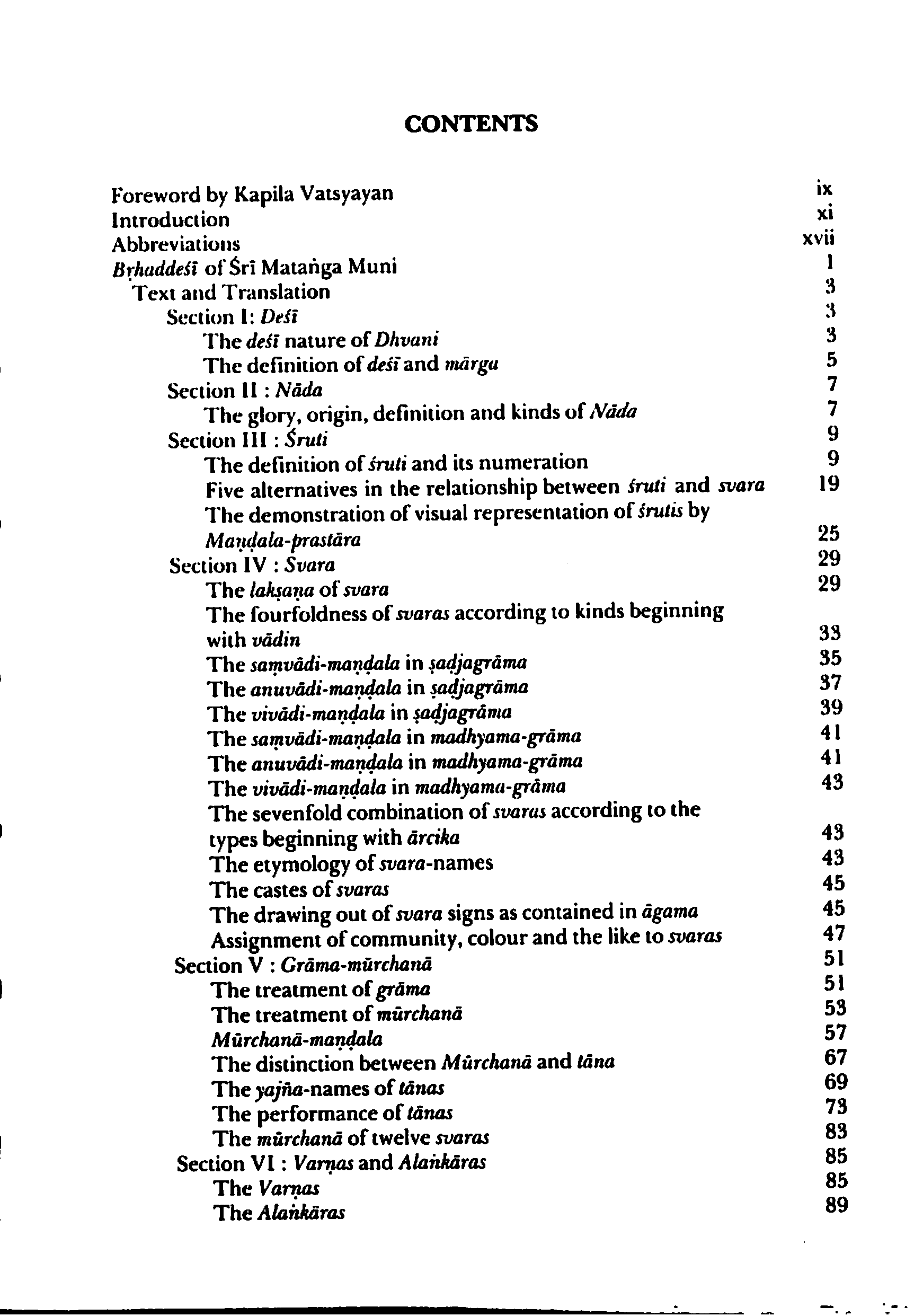
CONTENTS ix Foreword by Kapila Vatsyayan XI Introduction xvii Abbreviations Brhaddesi of Śri Matanga Muni Text and Translation Section I: Deśī The desi nature of Dhvani The definition of desi and marga Section II: Nāda The glory, origin, definition and kinds of Nāda Section III: Sruti The definition of śruti and its numeration Five alternatives in the relationship between sruti and svara The demonstration of visual representation of srutis by Mandala-prastāra 29 Section IV: Svara The laksana of svara The fourfoldness of svaras according to kinds beginning with vādin The samvādi-mandala in sadjagrāma The anuvādi-maṇḍala in ṣaḍjagrāma The vivādi-maṇḍala in ṣaḍjagrāma The saṃvādi-maṇḍala in madhyama-grāma The anuvādi-maṇḍala in madhyama-grāma The vivādi-maṇḍala in madhyama-grāma The sevenfold combination of svaras according to the types beginning with arcika The etymology of svara-names The castes of svaras The drawing out of svara signs as contained in agama Assignment of community, colour and the like to svaras Section V: Grāma-mūrchanā The treatment of grāma 53 The treatment of mūrchanā Mūrchanā-maṇḍala The distinction between Mürchanā and tāna The yajña-names of tanas 73 The performance of tanas The mūrchanā of twelve svaras Section VI: Varņas and Alankāras The Varnas The Alankaras

1.[enumeration]Svaras are characterized by fourfold classification types beginning with vādinThe fourfoldness of svaras according to kinds beginning with vādin
2.[enumeration]Arcika is one of the types in the sevenfold combination of svarasThe sevenfold combination of svaras according to the types beginning with arcika
3.[enumeration]Varņas and Alankāras are treated as distinct categories within the final sectionSection VI: Varņas and Alankāras The Varnas The Alankaras
4.[relation]Deśī is treated in relation to the nature of Dhvani and is defined alongside the concept of margaSection I: Deśī The desi nature of Dhvani The definition of desi and marga
5.[relation]Śruti is defined and enumerated in number, with visual representation demonstrated through Mandala-prastāraSection III: Sruti The definition of śruti and its numeration The demonstration of visual representation of srutis by Mandala-prastāra
6.[relation]Mūrchanā is distinguished from tāna and is presented with a Mūrchanā-maṇḍalaThe distinction between Mürchanā and tāna Mūrchanā-maṇḍala
7.[structural]Nāda has glory, origin, definition and kinds that are systematically treatedSection II: Nāda The glory, origin, definition and kinds of Nāda
8.[structural]A samvādi-maṇḍala is presented for the ṣaḍjagrāmaThe samvādi-mandala in sadjagrāma
9.[structural]The madhyama-grāma is treated with samvādi, anuvādi, and vivādi maṇḍalasThe saṃvādi-maṇḍala in madhyama-grāma The anuvādi-maṇḍala in madhyama-grāma The vivādi-maṇḍala in madhyama-grāma
10.[structural]Grāma-mūrchanā is a major section covering both grāma and mūrchanā treatmentSection V: Grāma-mūrchanā The treatment of grāma The treatment of mūrchanā
11.[structural]Tāna has yajña-names and performance methods that are systematically describedThe yajña-names of tanas The performance of tanas
12.[structural]The Brhaddesi is a treatise by Śri Matanga Muni organized into six main sections covering Deśī, Nāda, Śruti, Svara, Grāma-mūrchanā, and Varņas and AlankārasBrhaddesi of Śri Matanga Muni Text and Translation Section I: Deśī ... Section VI: Varņas and Alankāras