Source scans · vol_I_p027
recto · open full
scan recto
verso · open full
scan verso
Bṛhaddeśī · Volume I
pp. 4–37folio 027
Devanāgarī
[अनु. २३]
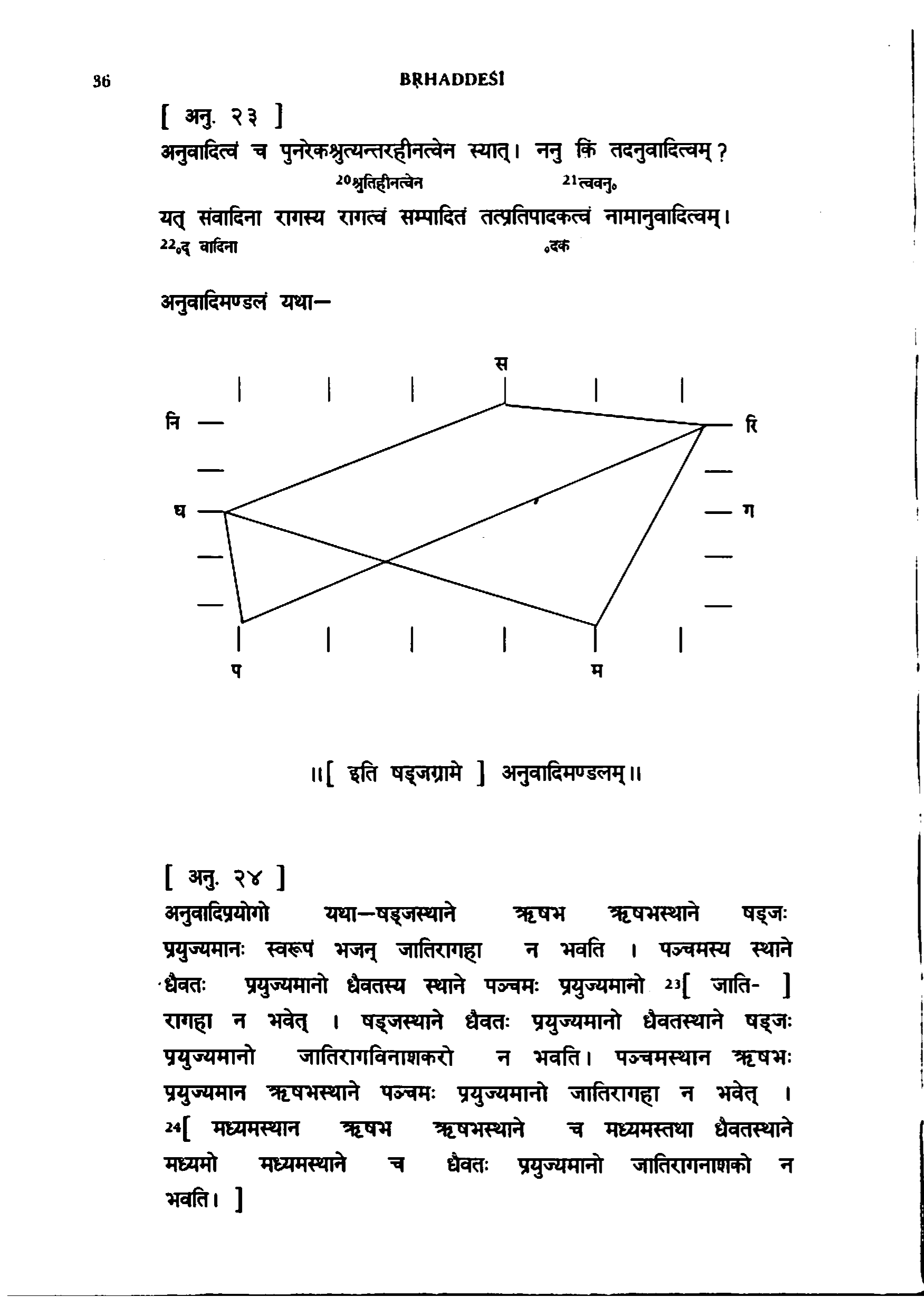
अनुवादित्वं च पुनरेकश्रुत्यन्तरहीनत्वेन स्यात्।1 ननु किं तदनुवादित्वम्? 20श्रुतिहीनत्वेन21त्ववनु यत् संवादिना22,द वादिना रागस्य रागत्वं सम्पादितं तत्प्रतिपादकत्वं₀दक नामानुवादित्वम्।532 अनुवादिमण्डलं यथा- नि रि
॥ इति षड्जग्रामे ] अनुवादिमण्डलम्॥
[अनु. २४]
अनुवादिप्रयोगो यथा—षड्जस्थाने ऋषभ ऋषभस्थानेषड्जः प्रयुज्यमानः स्वरूपं भजन् जातिरागहा न भवति । पञ्चमस्य स्थाने ॰धैवतः प्रयुज्यमानो धैवतस्य स्थाने पञ्चमः प्रयुज्यमानो २३[ जाति- ] रागहा न भवेत् । षड्जस्थाने धैवतः प्रयुज्यमानो धैवतस्थाने षड्जः प्रयुज्यमानो जातिरागविनाशकरो न भवति। पञ्चमस्थान ऋषभः
प्रयुज्यमान ऋषभस्थाने पञ्चमः प्रयुज्यमानो जातिरागहा न भवेत् ।
24 मध्यमस्थान ऋषभ ऋषभस्थाने च मध्यमस्तथा धैवतस्थाने मध्यमो मध्यमस्थाने च धैवतः प्रयुज्यमानो जातिरागनाशको न भवति।10
English — Sharma (translation)
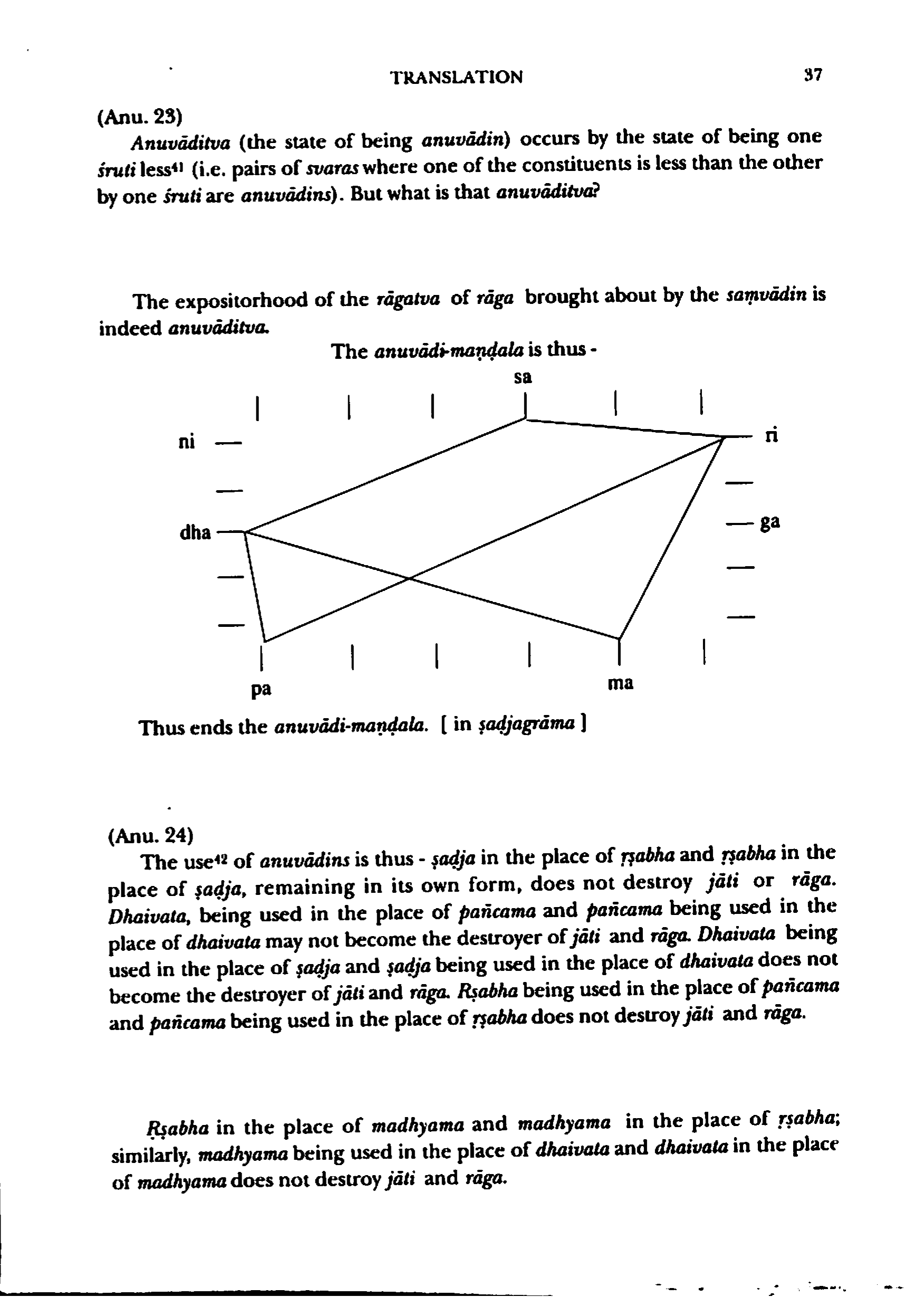
(Anu. 23) Anuvāditva (the state of being anuvādin) occurs by the state of being one śruti less41 (i.e. pairs of svaras where one of the constituents is less than the other by one śruti are anuvādins).1 But what is that anuvāditva? The expositorhood of the ragatva of raga brought about by the samvadin is indeed anuvāditva.532 The anuvādi-maņdala is thus - Sa Ň ni ga dha ma pa Thus ends the anuvādi-maṇḍala. [in ṣaḍjagrāma] (Anu. 24) The use42 of anuvadins is thus - şadja in the place of ṛṣabha and ṛṣabha in the place of şadja, remaining in its own form, does not destroy jāti or rāga.7 Dhaivata, being used in the place of pañcama and pañcama being used in the place of dhaivata may not become the destroyer of jāti and rāga.8 Dhaivata being used in the place of şadja and şadja being used in the place of dhaivata does not become the destroyer of jāti and rāga. Rṣabha being used in the place of pañcama and pañcama being used in the place of rṣabha does not destroy jāti and rāga. Rṣabha in the place of madhyama and madhyama in the place of ṛṣabha; similarly, madhyama being used in the place of dhaivata and dhaivata in the place of madhyama does not destroy jāti and rāga.
1.[definition] Anuvāditva occurs when one svara is one śruti less than another svara in a pairअनुवादित्वं च पुनरेकश्रुत्यन्तरहीनत्वेन स्यात्।
2.[definition] Anuvāditva is the expositorhood of the ragatva of raga brought about by the samvadinयत् संवादिना रागस्य रागत्वं सम्पादितं तत्प्रतिपादकत्वं नामानुवादित्वम्।
3.[definition] Ragatva is the quality or essence of raga that is brought about by samvadinयत् संवादिना रागस्य रागत्वं सम्पादितं तत्प्रतिपादकत्वं नामानुवादित्वम्।
5.[relation] Samvadin brings about the ragatva of raga, whose expositorhood constitutes anuvāditvaयत् संवादिना रागस्य रागत्वं सम्पादितं तत्प्रतिपादकत्वं नामानुवादित्वम्।
6.[relation] The anuvādi-maņdala belongs to the ṣaḍjagrāma system॥ इति षड्जग्रामे ] अनुवादिमण्डलम्॥
10.[structural] When madhyama substitutes for dhaivata and dhaivata for madhyama, jāti and rāga are not destroyedमध्यमस्थान ऋषभ ऋषभस्थाने च मध्यमस्तथा धैवतस्थाने मध्यमो मध्यमस्थाने च धैवतः प्रयुज?्यमानो ज?ातिरागनाशको न भवति।
1.[definition]Anuvāditva occurs when one svara is one śruti less than another svara in a pairAnuvāditva (the state of being anuvādin) occurs by the state of being one śruti less (i.e. pairs of svaras where one of the constituents is less than the other by one śruti are anuvādins).
2.[definition]Anuvāditva is the expositorhood of the ragatva of raga brought about by the samvadinThe expositorhood of the ragatva of raga brought about by the samvadin is indeed anuvāditva.
3.[definition]Ragatva is the quality or essence of raga that is brought about by samvadinThe expositorhood of the ragatva of raga brought about by the samvadin is indeed anuvāditva.
4.[enumeration]The anuvādi-maņdala in ṣaḍjagrāma contains the svaras: Sa, Ň, ni, ga, dha, ma, paThe anuvādi-maņdala is thus - Sa Ň ni ga dha ma pa Thus ends the anuvādi-maṇḍala. [in ṣaḍjagrāma]
5.[relation]Samvadin brings about the ragatva of raga, whose expositorhood constitutes anuvāditvaThe expositorhood of the ragatva of raga brought about by the samvadin is indeed anuvāditva.
6.[relation]The anuvādi-maņdala belongs to the ṣaḍjagrāma systemThus ends the anuvādi-maṇḍala. [in ṣaḍjagrāma]
7.[structural]When śadja substitutes for ṛṣabha and ṛṣabha for śadja while maintaining their own form, jāti and rāga are not destroyedşadja in the place of ṛṣabha and ṛṣabha in the place of şadja, remaining in its own form, does not destroy jāti or rāga.
8.[structural]When dhaivata substitutes for pañcama and pañcama for dhaivata, jāti and rāga are not destroyedDhaivata, being used in the place of pañcama and pañcama being used in the place of dhaivata may not become the destroyer of jāti and rāga.
9.[structural]When ṛṣabha substitutes for madhyama and madhyama for ṛṣabha, jāti and rāga are not destroyedṚṣabha in the place of madhyama and madhyama in the place of ṛṣabha; similarly, madhyama being used in the place of dhaivata and dhaivata in the place of madhyama does not destroy jāti and rāga.
10.[structural]When madhyama substitutes for dhaivata and dhaivata for madhyama, jāti and rāga are not destroyedmadhyama being used in the place of dhaivata and dhaivata in the place of mādhyama does not destroy jāti and rāga.