Source scans · vol_I_p064
recto · open full
scan recto
verso · open full
scan verso
Bṛhaddeśī · Volume I
pp. 110–111folio 064
Devanāgarī (Bṛhaddeśī)
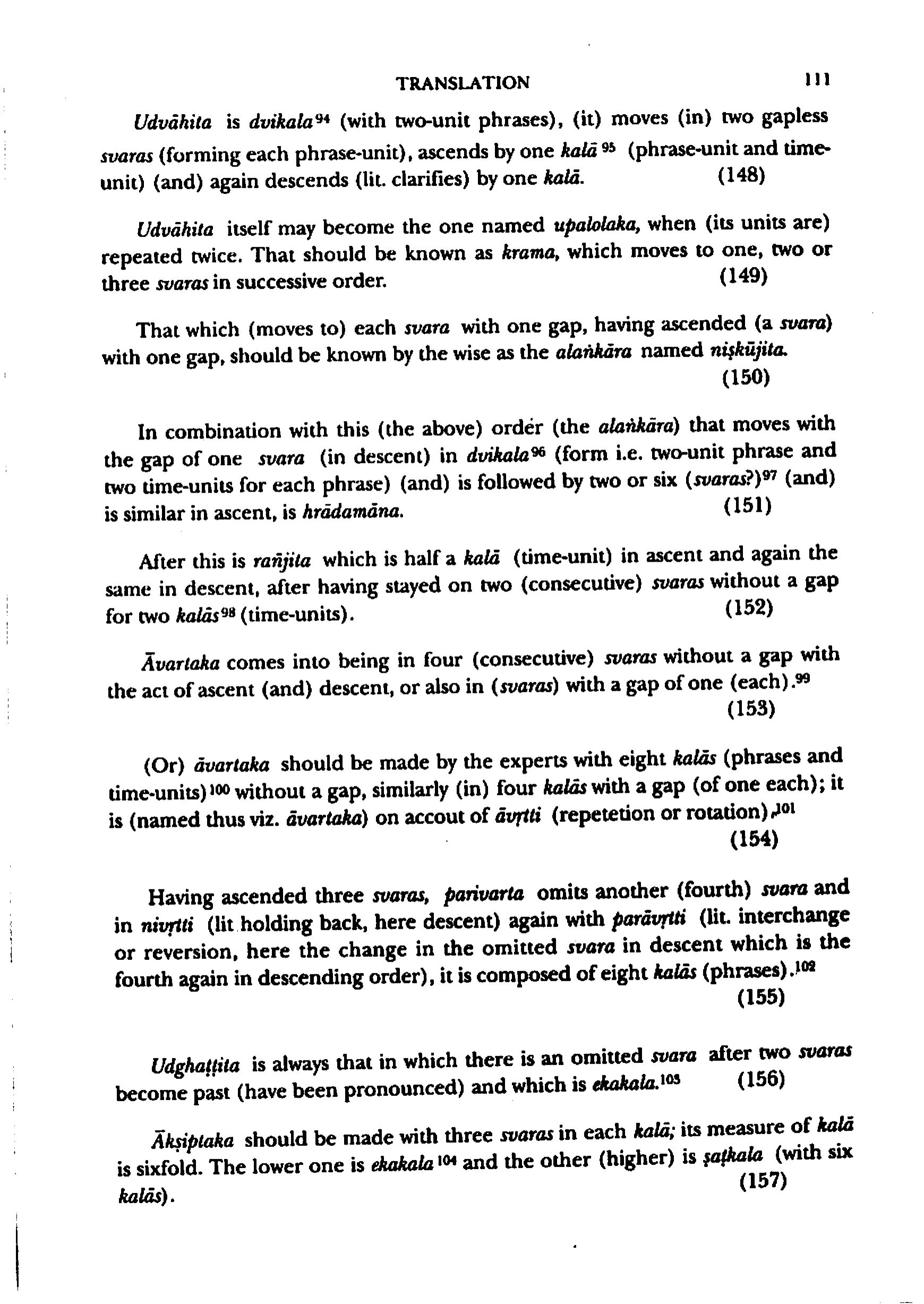
समनन्तरौ स्वरौ द्वौ विचरत्युद्वाहितो द्विकल एव ।3
आरोहत्येककलां पुनरेककलां प्रसादयति। ।१४८॥
50otto ++++
उद्वाहित एव स्यादुपलोलकसंज्ञको द्विरभ्यस्तः51सह्
एकं द्वौ त्रीन् गच्छन् स्वरान् क्रमेण [ स ] क्रमो ज्ञेयः ॥१४९॥ (डो १डे) त्रीणि ۰₹۵
एकान्तरमारुह्य प्रत्येकान्तरं स्वरं्र भी (?) यस्तु ।
निष्कृजितसंज्ञकोऽसौ ज्ञेयः सूरिभिरलङ्कारः ॥१५०॥
क्रमयोगेनानेन तु सञ्चार्येकान्तरस्वरो द्विकलः12<i>दे</i> (३)।
्नासी ज्ञेयः द्वचवरः षट्पर एवं ह्यारोही हादमानः स्यात् ॥१५१॥ ď त्रिकलत्वपरषड्जमेवमारोहि (?)
अथ रिक्षतस्तु समनन्तरस्वरे द्वे कले पुनः स्थित्वा6
अर्धकलामारोही पुनरेव।हि oतत् oचापको हि तथावरोही स्यात्52 ॥१५२॥ .4.
आवर्तकश्चतुर्षु स्वरेषु समनन्तरेषु सम्भवति ।
आरोहणावरोहणविधिना चैकान्तरेष्विप वा8 ॥१५३॥
ज्ञेयो निरन्तरकृतस्त्वष्टकलः सान्तरस्तथा कार्यः ।
,रुध्वंष्ट. तज्ज्ञैः कलाश्चतसस्त्वावृत्त्या [ ऽऽ ] वर्तको भवति ॥१५४॥ प्राज्ञेः अधिरुह्य च स्वरांस्त्रीन् स्वरान्तरं लङ्घयति च निवृत्तौ53से9 पुनरपि च परावृत्त्या परीवर्तकोऽष्टकलो•र्तेषु 54कलो ज्ञेयः ॥१५५॥
यस्यय: स्वरावतीतौ<b>.</b>पतितौ तथा परंपरस्त्व, ह्यन्तरस्वरो भवति ।
एककलश्च तथा भवेत् तदुद्घट्टितो नित्यम् ॥१५६॥ •द्वाहितोभव 55,त्या
आक्षिप्तकस्त्रिस्वरजः कर्तव्यः षड्विधः कलामानः ।
०रारजमा. प्रथगेककलात्रयकृतश्च (?) एककलस्त्वधरः स्यात् षट्कलिको वापरो ज्ञेयः ॥१५७॥
English — Sharma (translation)
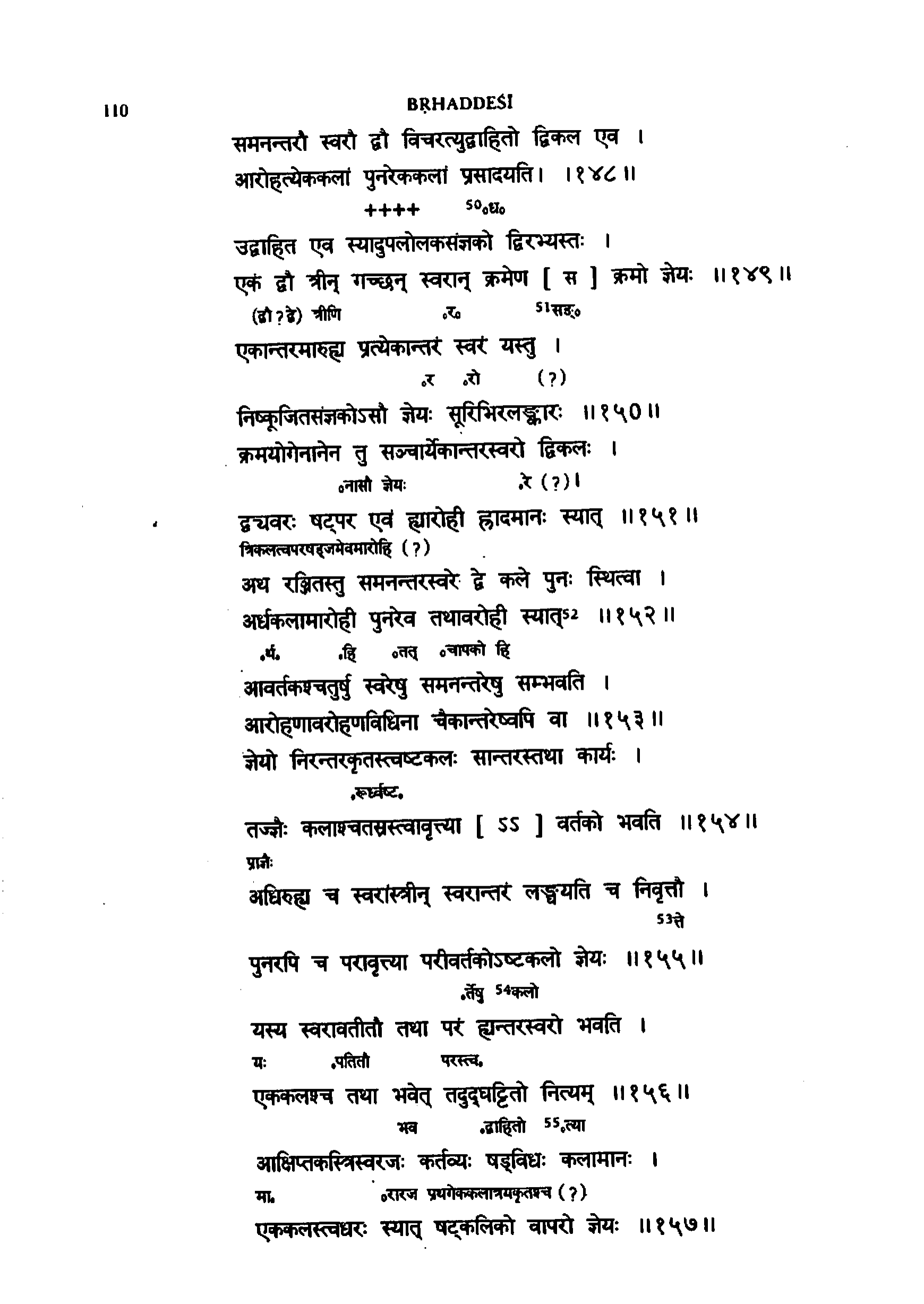
Udvāhita is dvikala94 (with two-unit phrases)3, (it) moves (in) two gapless svaras (forming each phrase-unit), ascends by one kalā 95 (phrase-unit and time-
(148)
unit) (and) again descends (lit. clarifies) by one kalā. Udvāhita itself may become the one named upalolaka, when (its units are) repeated twice.1 That should be known as krama, which moves to one, two or
(149)
three svaras in successive order.4
That which (moves to) each svara with one gap, having ascended (a svara) with one gap, should be known by the wise as the alankara named nişkūjita.2
(150)
In combination with this (the above) order (the alankara) that moves with the gap of one svara (in descent) in dvikala 96 (form i.e. two-unit phrase and two time-units for each phrase) (and) is followed by two or six (svaras?)97 (and)
(151)
is similar in ascent, is hrādamāna. After this is ranjita which is half a kalā (time-unit) in ascent and again the same in descent5, after having stayed on two (consecutive) svaras without a gap
(152)
for two kalās 98 (time-units).6
Avartaka comes into being in four (consecutive) svaras without a gap with the act of ascent (and) descent7, or also in (svaras) with a gap of one (each).899
(153)
(Or) āvartaka should be made by the experts with eight kalās (phrases and time-units) 100 without a gap, similarly (in) four kalās with a gap (of one each); it is (named thus viz. āvartaka) on accout of āvrtti (repetetion or rotation), 101
(154)
Having ascended three svaras, parivarta omits another (fourth) svara9 and in nivṛtti (lit holding back, here descent) again with parāvṛtti (lit. interchange or reversion, here the change in the omitted svara in descent which is the fourth again in descending order), it is composed of eight kalās (phrases).10 102
(155)
Udghattita is always that in which there is an omitted svara after two svaras
(156)
become past (have been pronounced) and which is ekakala.103 Ākṣiptaka should be made with three svaras in each kalā; its measure of kalā is sixfold. The lower one is ekakala 104 and the other (higher) is şaṭkala (with six
(157)
kalās).
3.[structural] Udvāhita is characterized by dvikala (two-unit phrases)समनन्तरौ स्वरौ द्वौ विचरत्युद्वाहितो द्विकल एव ।
6.[structural] Ranjita stays on two consecutive svaras without a gap for two kalās before ascending and descendingसमनन्तरस्वरे द्वे कले पुनः स्थित्वा
8.[structural] Āvartaka can also occur in svaras with a gap of one eachआरोहणावरोहणविधिना चैकान्तरेष्विप वा
9.[structural] Parivarta ascends three svaras and omits a fourth svaraअधिरुह्य च स्वरांस्त्रीन् स्वरान्तरं लङ्घयति च निवृत्तौ ।
12.[structural] Hrādamāna moves with the gap of one svara in dvikala form during descentक्रमयोगेनानेन तु सञ्चार्येकान्तरस्वरो द्विकलः
1.[definition]Upalolaka is a variant of udvāhita when its units are repeated twiceUdvāhita itself may become the one named upalolaka, when (its units are) repeated twice.
2.[definition]Nişkūjita moves to each svara with one gap, having ascended with one gapThat which (moves to) each svara with one gap, having ascended (a svara) with one gap, should be known by the wise as the alankara named nişkūjita.
3.[structural]Udvāhita is characterized by dvikala (two-unit phrases)Udvāhita is dvikala94 (with two-unit phrases)
4.[structural]Krama moves to one, two or three svaras in successive orderThat should be known as krama, which moves to one, two or (149) three svaras in successive order.
5.[structural]Ranjita is half a kalā in ascent and half a kalā in descentAfter this is ranjita which is half a kalā (time-unit) in ascent and again the same in descent
6.[structural]Ranjita stays on two consecutive svaras without a gap for two kalās before ascending and descendingafter having stayed on two (consecutive) svaras without a gap (152) for two kalās (time-units).
7.[structural]Āvartaka comes into being in four consecutive svaras without a gap with ascent and descentAvartaka comes into being in four (consecutive) svaras without a gap with the act of ascent (and) descent
8.[structural]Āvartaka can also occur in svaras with a gap of one eachor also in (svaras) with a gap of one (each).
9.[structural]Parivarta ascends three svaras and omits a fourth svaraHaving ascended three svaras, parivarta omits another (fourth) svara
10.[structural]Parivarta is composed of eight kalāswith parāvṛtti (lit. interchange or reversion, here the change in the omitted svara in descent which is the fourth again in descending order), it is composed of eight kalās (phrases).
11.[structural]Udvāhita moves in two gapless svaras, each forming a phrase-unitit moves (in) two gapless svaras (forming each phrase-unit)
12.[structural]Hrādamāna moves with the gap of one svara in dvikala form during descentthe (alankara) that moves with the gap of one svara (in descent) in dvikala 96 (form i.e. two-unit phrase and two time-units for each phrase)