Source scans · vol_I_p063
recto · open full
scan recto
verso · open full
scan verso
Bṛhaddeśī · Volume I
pp. 108–109folio 063
Devanāgarī
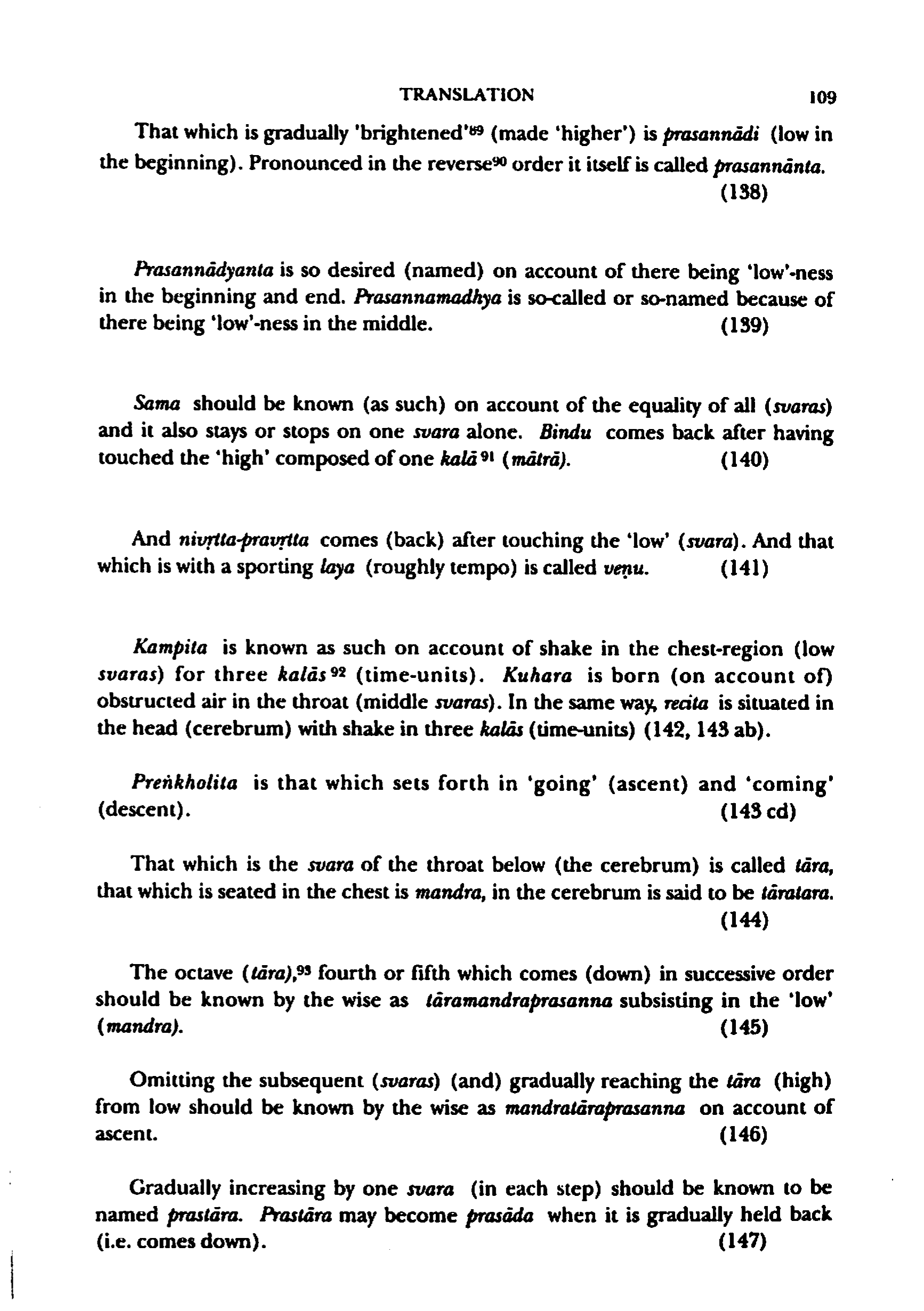
क्रमशो दीप्यते यस्तु प्रसन्नादिः स कथ्यते।
व्यस्तोच्चारित एवैष(मे?ए) प्रसन्नान्तोऽभिधीयते2 ॥१३८॥
आद्यन्तयोः प्रसन्नत्वात् प्रसन्नाद्यन्त इष्यते(मि?इ)
प्रसन्नमध्यो मध्ये तु प्रसन्नत्वादुदाहृतः4॥१३९॥
सर्वसाम्यात्oमाo समो,₀मा ७या ज्ञेयः स्थितश्चैकस्वरेऽपि हि।
बिन्दुरेककलं तारं स्पृष्ट्वा तु पुनरागतः9॥१४०॥
स्याद्रिवृत्तप्रवृत्तश्च₀त्तः मन्द्रं गत्वा समागतः।
৽ন্ম आक्रीडितलयो<b>.इनी.</b> (?) यस्तु स च वेणुः प्रकीर्तितः॥१४१॥ उरोगतः कम्पितः स्यात् कम्पनाच्च कलात्रयम्₀यः13 कण्ठे निरुद्धपवनः्दः ₀नो रु कुहरो नाम जायते॥१४२॥
त्रिकला [त्] कम्पना [त्] तद्वद्रेचिताख्यः शिरोगतः।
( ? ) হৈ ৹বা৹ गतागतप्रवृत्तो यः स प्रेङ्क्षोलित( मु?उ ) उच्यते7॥१४३॥ 48 यस्तु कण्ठस्वरोऽधस्तात् स तु तारः प्रकीर्तितः। उरोगतस्तथा मन्द्रो मूर्ध्नि तारतरः स्मृतः15॥१४४॥]
क्रमागतस्तु यस्तारश्चतुर्थःश्चेत् ततः पञ्चतु₀ पञ्चमोऽपि वा।
तारमन्द्रप्रसन्नस्तु ज्ञेयो मन्द्रगतो बुधैः ॥१४५॥ ৹রা৯
लङ्घयित्वा परान् मन्द्रात्ॳ (द?द)) क्रमात् तारगति गतः।
मन्द्रतारप्रसन्नस्तु ज्ञेयोविज्ञेयारोहणा ह्यारोहणाद् बुधैः ॥१४६॥
एकस्वराधिरूढः<b>०स्वा</b>७ क्रमशः प्रस्तारसंज्ञको( जि? ज ) ज्ञेयः।
49[ प्रस्तारस्तु निवृत्तः शनैः प्रसन्नः प्रसादः स्यात्।।१४७॥]
English — Sharma (translation)
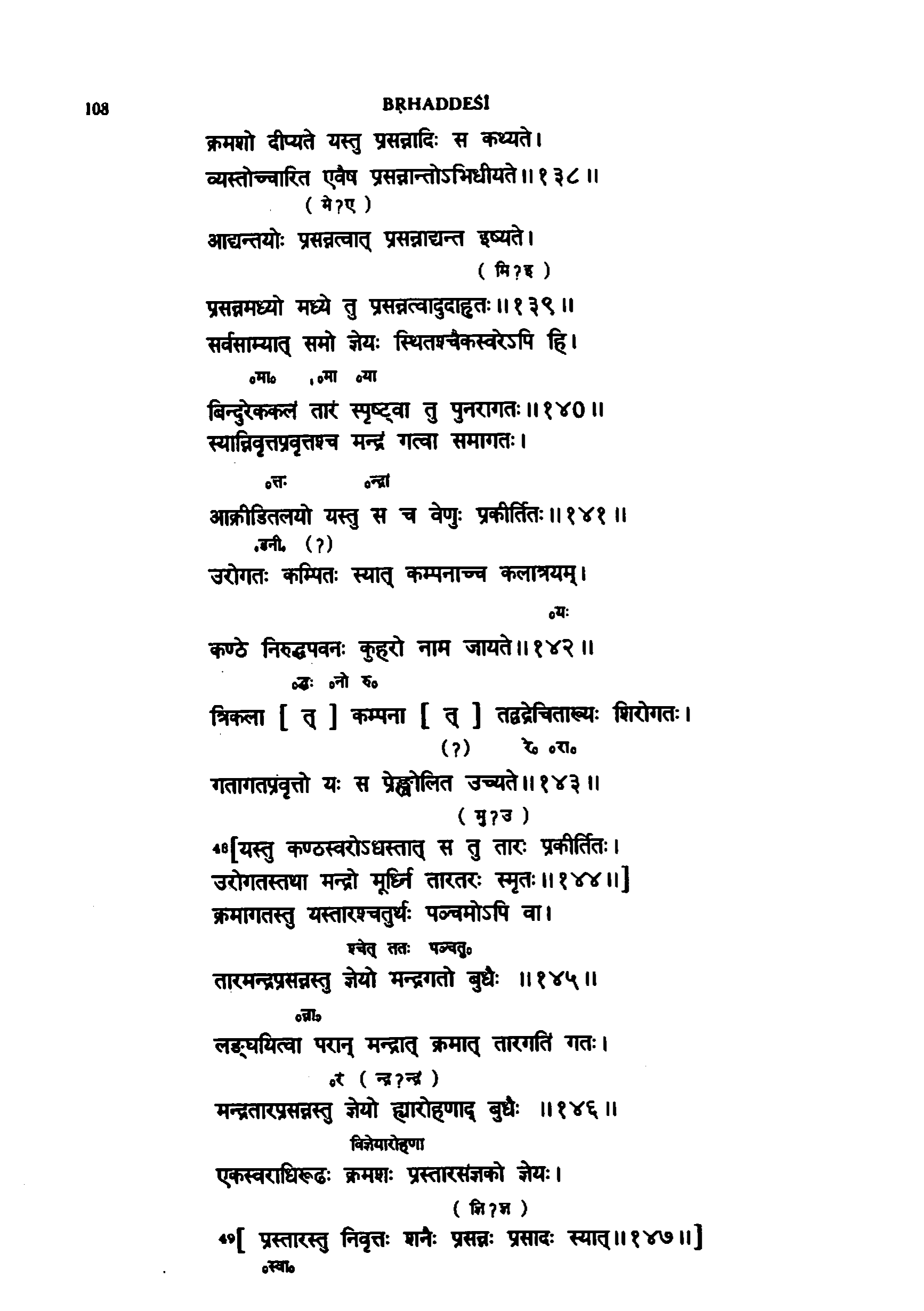
That which is gradually 'brightened' (made 'higher') is prasannādi (low in the beginning).1 Pronounced in the reverse90 order it itself is called prasannānta.2
(138)
Prasannādyanta is so desired (named) on account of there being 'low'-ness in the beginning and end.3 Prasannamadhya is so-called or so-named because of there being 'low'-ness in the middle.4
(139)
Sama should be known (as such) on account of the equality of all (svaras) and it also stays or stops on one svara alone.5 Bindu comes back after having touched the 'high' composed of one kalā9 91 (mātrā).
(140)
And nivitta-pravitta comes (back) after touching the 'low' (svara). And that which is with a sporting laya (roughly tempo) is called venu.
(141)
Kampita is known as such on account of shake in the chest-region (low svaras) for three kalās13 92 (time-units). Kuhara is born (on account of) obstructed air in the throat (middle svaras).6 In the same way, recita is situated in the head (cerebrum) with shake in three kalās (time-units)14 (142, 143 ab). Prenkholita is that which sets forth in 'going' (ascent) and 'coming' (descent).7 (143 \text{ cd}) That which is the svara of the throat below (the cerebrum) is called tara, that which is seated in the chest is mandra, in the cerebrum is said to be tāratara.15
(144)
The octave (tāra),93 fourth or fifth which comes (down) in successive order should be known by the wise as taramandraprasanna subsisting in the 'low' (mandra).10
(145)
Omitting the subsequent (svaras) (and) gradually reaching the tara (high) from low should be known by the wise as mandratāraprasanna on account of
(146)
ascent. Gradually increasing by one svara (in each step) should be known to be named prastāra.8 Prastāra may become prasāda when it is gradually held back (i.e. comes down).12
(147)
1.[definition] prasannādi is that which is gradually brightened or made higher, beginning in a low registerक्रमशो दीप्यते यस्तु प्रसन्नादि स कथ्यते।
2.[definition] prasannānta is prasannādi pronounced in reverse orderव्यस्तोच्चारित एवैष प्रसन्नान्तोऽभिधीयते
3.[definition] Prasannādyanta is characterized by lowness at both the beginning and endआद्यन्तयो प्रसन्नत्वात् प्रसन्नाद्यन्त इष्यते।
4.[definition] Prasannamadhya is characterized by lowness in the middle registerप्रसन्नमध्यो मध्ये तु प्रसन्नत्वादुदाहृतः
7.[definition] Prenkholita is characterized by movement in both ascending and descending directionsगतागतप्रवृत्तो यः स प्रेङ्क्षोलित उच्यते
9.[definition] Kalā is a time-unit used to measure the duration of articulation ornamentsबिन्दुरेककलं तारं स्पृष्ट्वा तु पुनरागतः
12.[relation] Prasāda is prastāra that is gradually held back or descendsप्रस्तारस्तु निवृत्तः शनै प्रसन्नः प्रसादः स्यात्।
13.[structural] Kampita is a shake occurring in the chest-region (low svaras) sustained for three kalāsउरोगतः कम्पितः स्यात् कम्पनाच्च कलात्रयम्।
15.[structural] Tara is the throat svara below the cerebrum; mandra is seated in the chest; tāratara is in the cerebrumयस्तु कण्ठस्वरोऽधस्तात् स तु तारः प्रकीर्तितः। उरोगतस्तथा मन्द्रो मूर्ध्नि तारतरः स्मृतः
1.[definition]prasannādi is that which is gradually brightened or made higher, beginning in a low registerThat which is gradually 'brightened' (made 'higher') is prasannādi (low in the beginning).
2.[definition]prasannānta is prasannādi pronounced in reverse orderPronounced in the reverse order it itself is called prasannānta.
3.[definition]Prasannādyanta is characterized by lowness at both the beginning and endPrasannādyanta is so desired (named) on account of there being 'low'-ness in the beginning and end.
4.[definition]Prasannamadhya is characterized by lowness in the middle registerPrasannamadhya is so-called or so-named because of there being 'low'-ness in the middle.
5.[definition]Sama is known as such on account of the equality of all svaras and remains on a single svaraSama should be known (as such) on account of the equality of all (svaras) and it also stays or stops on one svara alone.
6.[definition]Kuhara arises from obstructed air in the throat at the middle svara registerKuhara is born (on account of) obstructed air in the throat (middle svaras).
7.[definition]Prenkholita is characterized by movement in both ascending and descending directionsPrenkholita is that which sets forth in 'going' (ascent) and 'coming' (descent).
8.[definition]Prastāra is a gradual increase by one svara in each successive stepGradually increasing by one svara (in each step) should be known to be named prastāra.
9.[definition]Kalā is a time-unit used to measure the duration of articulation ornamentsBindu comes back after having touched the 'high' composed of one kalā
10.[definition]Taramandraprasanna is an octave, fourth, or fifth coming in successive order, subsisting in the low registerThe octave (tāra), fourth or fifth which comes (down) in successive order should be known by the wise as taramandraprasanna subsisting in the 'low' (mandra).
11.[definition]Mandratāraprasanna is characterized by gradual ascent from low to high svarasOmitting the subsequent (svaras) (and) gradually reaching the tara (high) from low should be known by the wise as mandratāraprasanna on account of ascent.
12.[relation]Prasāda is prastāra that is gradually held back or descendsPrastāra may become prasāda when it is gradually held back (i.e. comes down).
13.[structural]Kampita is a shake occurring in the chest-region (low svaras) sustained for three kalāsKampita is known as such on account of shake in the chest-region (low svaras) for three kalās
14.[structural]Recita is situated in the head with a shake sustained for three kalāsrecita is situated in the head (cerebrum) with shake in three kalās (time-units)
15.[structural]Tara is the throat svara below the cerebrum; mandra is seated in the chest; tāratara is in the cerebrumThat which is the svara of the throat below (the cerebrum) is called tara, that which is seated in the chest is mandra, in the cerebrum is said to be tāratara.