Source scans · vol_I_p069
recto · open full
scan recto
verso · open full
scan verso
Bṛhaddeśī · Volume I
pp. 120–121folio 069
Devanāgarī
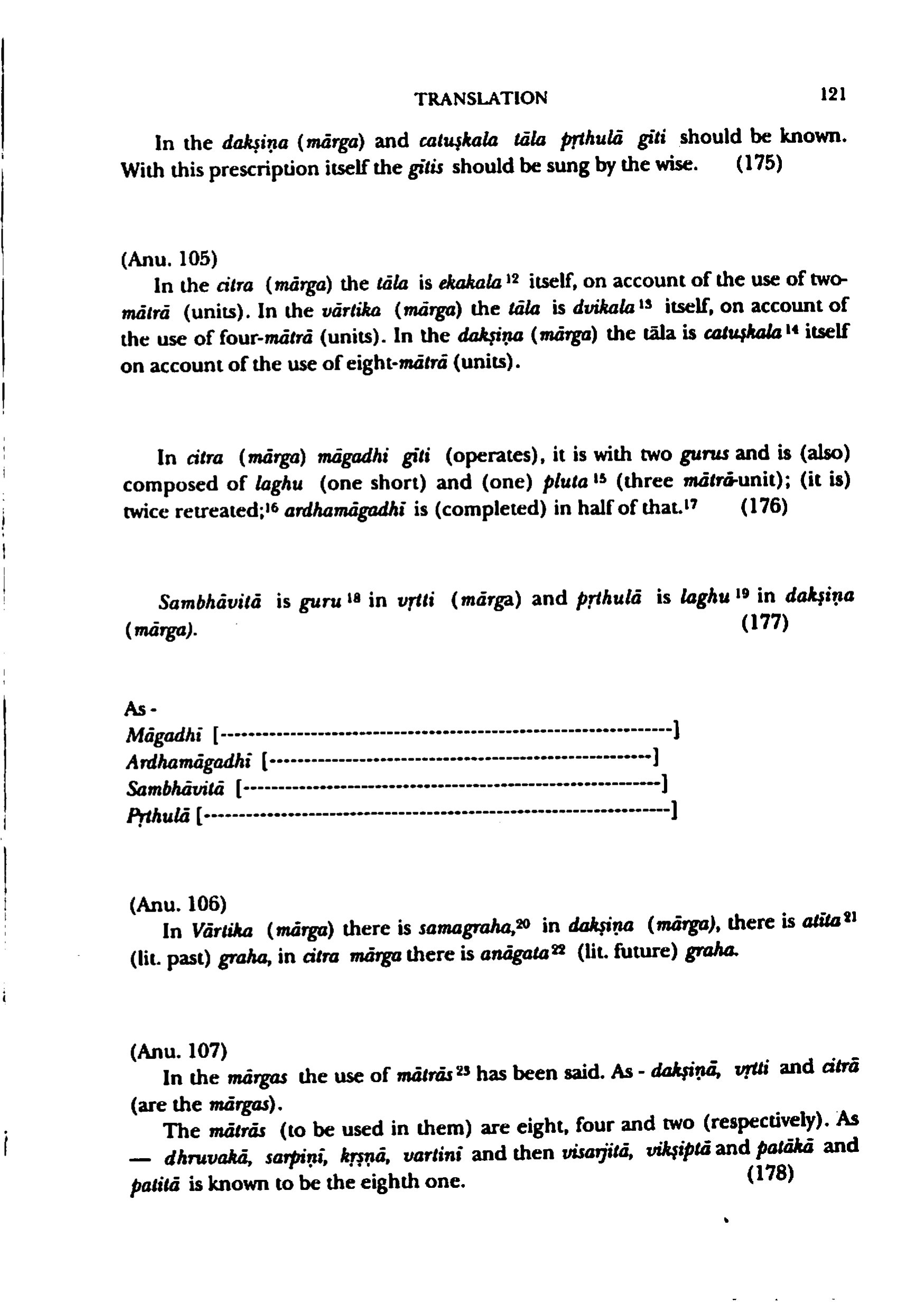
दक्षिणे(णो २ णे) पृथुला गीतिस्ताले ज्ञेया चतुष्कले5
.लेजें. अनेनैव विधानेन गातव्या गीतयो बुधैः ॥१७५॥
[अनु, १०५]
चित्रे चैककल,लं एव तालो द्विमात्रिकप्रयोगात्।7 वार्तिक द्विकल₀ला⁵ एव तालश्चतुर्मात्रिकप्रयोगाद्, दक्षिणे चतुष्कल.ले॰ एव तालोऽष्ट-₀लः अष्ट
्र मात्रिकप्रयोगात्।
(म.(. ?त्रिक) प्रयोगाद् (डि ? )
द्विगुरुर्द्विनिवृत्ता च चित्रे गीतिस्तु मागधी ।
រមែៈ .রি. .ন.
लघुप्लुतकृता चैव तदर्धे चार्धमागधीर3<u>,धिः</u> ।।१७६।।
सम्भाविता गुरुर्वृत्तौ पृथुला दक्षिणे लघु [ : ] ॥१७७॥ यथा— मागधी [ ... ... ... ] अर्धमागधी [ ... ... ] .प सम्भाविता [ ... ... ... ] Ð पृथुला [ ... ... ]
[अनु, १०६]
वार्तिक समग्रहो दक्षिणे अतीतः10 । अ[ना ] गतः ।2 .धी.संग्रहाद्
[अनु, १०७]
मात्राप्रयोगा मार्गाणां हि कथिताः । यथा—दक्षिणो वृत्तिश्चित्र. श्चेति त्रेति इति ।
जाति, वृतीनां चि ,तम् तथा मात्रा अष्टौ चतुर्देचतुचतुर्द्धि (?) क्रमेण11 । यथा—
ध्वका सर्पिणी कृष्णा श्वर्तिन्यथ विसर्जिता ।
(夏) •प्ट्या विक्षिप्ता च पताका च पतिता चाष्टमी स्मृता ॥१७८॥
table
Quatre gītis (Mārgī, Ardhamārgī, Sambhāvitā, Pṛthulā) — structures mātrā associées — Sous śloka 177 ('sambhāvitā gurvṛttau ca pṛthulā dakṣiṇe laghu'), énumération tabulaire à 4 lignes avec étiquette de gīti suivie d'une séquence entre crochets (contenu illisible/pointillés dans l'image)
gītiséquence
mārgī?
ardhamārgī?
sambhāvitā?
pṛthulā?
— mārgī [ ... ] / ardhamārgī [ ... ] / sambhāvitā [ ... ] / pṛthulā [ ... ]
English — Sharma (translation)
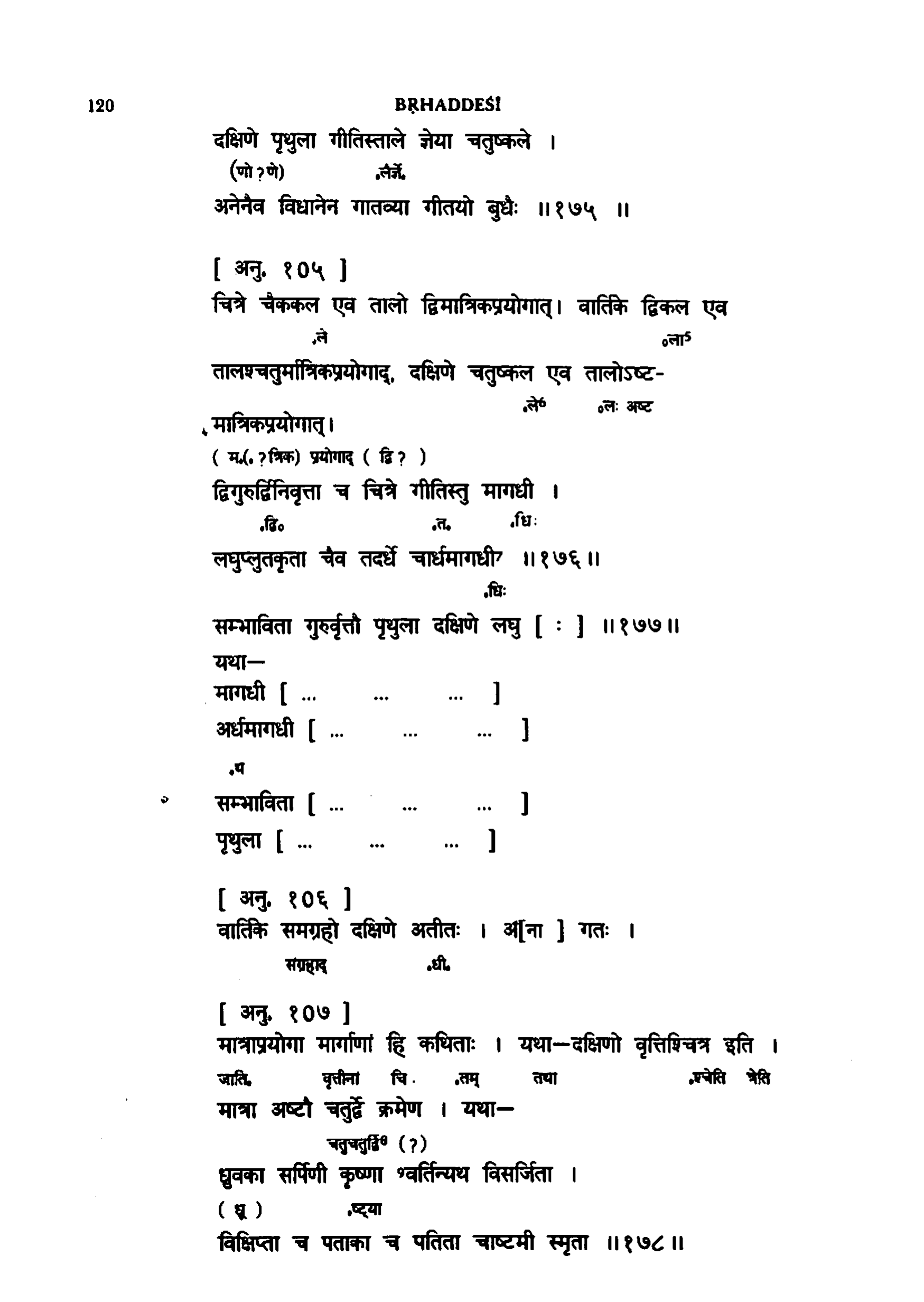
In the dakṣiṇa (mārga) and catuṣkala tāla pṛthulā giti should be known.5 With this prescription itself the gitis should be sung by the wise.
(175)
(Anu. 105) In the citra (mārga) the tāla is ekakala 12 itself, on account of the use of two- mātrā (units).7 In the vārtika (mārga) the tāla is dvikala 13 itself, on account of the use of four-mātrā (units).8 In the dakṣiṇa (mārga) the tāla is catuṣkala 14 itself on account of the use of eight-mātrā (units).6 In citra (mārga) māgadhi gīti (operates), it is with two gurus and is (also) composed of laghu (one short) and (one) pluta 15 (three mātrā-unit)9; (it is) twice retreated;16 ardhamāgadhī is (completed) in half of that.317
(176)
Sambhāvitā is guru 18 in vṛtti (mārga) and pṛthulā is laghu 19 in dakṣiṇa
(177)
(mārga). As - Māgadhī [-----] Ardhamāgadhī [-----] Sambhāvitā [-----] Pythulā [-----] (Anu. 106) In Vārtika (mārga) there is samagraha,2010 in dakṣiṇa (mārga), there is atīta 21 (lit. past) graha, in citra mārga there is anāgata22 (lit. future) graha. (Anu. 107) In the mārgas the use of mātrās 23 has been said. As - dakṣiṇā, vṛtti and citrā (are the margas). The mātrās (to be used in them) are eight, four and two (respectively).11 As — dhruvakā, sarpiņī, kṛṣṇā, vartinī and then visarjitā, vikṣiptā and patākā and (178) patitā is known to be the eighth one.1
diagram
Relative duration/extent of the four gītis (Māgadhī, Ardhamāgadhī, Sambhāvitā, Pṛthulā) shown as horizontal length-bars — Translation, p.121, following verse 177 (Sambhāvitā is guru in vṛtti (mārga) and pṛthulā is laghu in dakṣiṇa (mārga)). Introduced by the label 'As -'.
Four horizontal bracketed length-bars, one per gīti, each rendered as 'Name [----------]'. The bars appear to be drawn at comparable visual lengths in this typeset rendering (no numeric scale printed); the diagram is associated with the preceding verses that contrast guru/laghu and vṛtti/dakṣiṇa mārga treatments of the gītis. Order top→bottom: Māgadhī, Ardhamāgadhī, Sambhāvitā, Pṛthulā.
Nodes: magadhi (), ardhamagadhi (), sambhavita (), prthula ()
Total śrutis: 4
— As -
2.[enumeration] Three types of graha are differentiated across mārgas: samagraha in vārtika, atīta in dakṣiṇa, and anāgata in citraवार्तिक समग्रहो दक्षिणे अतीतः । अ[ना ] गतः ।
3.[relation] ardhamāgadhī is completed in half of māgadhi gītiतदर्धे चार्धमागधीर
4.[relation]māgadhi gīti is characterized by two gurus, laghu and pluta; ardhamāgadhī represents half this measureद्विगुरुर्द्विनिवृत्ता च चित्रे गीतिस्तु मागधी । लघुप्लुतकृता चैव तदर्धे चार्धमागधीर
5.[structural]pṛthulā giti should be known in the dakṣiṇa mārga with catuṣkala tālaदक्षिणे पृथुला गीतिस्ताले ज?्ञेया चतुष्कले
7.[structural] In citra mārga, the tāla is ekakala on account of the use of two-mātrā unitsचित्रे चैककल एव तालो द्विमात्रिकप्रयोगात्।
10.[structural] In vārtika mārga, samagraha is employedवार्तिक समग्रहो दक्षिणे अतीतः
11.[structural] The mātrās to be used in dakṣiṇā, vṛtti and citrā mārgas are eight, four and two respectivelyमात्रा अष्टौ चतुर्दे क्रमेण
1.[enumeration]dhruvakā, sarpiņī, kṛṣṇā, vartinī and then visarjitā are enumerated as rhythmic units with specific mātrā countsdhruvakā, sarpiņī, kṛṣṇā, vartinī and then visarjitā, vikṣiptā and patākā and (178) patitā is known to be the eighth one.
2.[enumeration]Three types of graha are differentiated across mārgas: samagraha in vārtika, atīta in dakṣiṇa, and anāgata in citraIn Vārtika (mārga) there is samagraha,20 in dakṣiṇa (mārga), there is atīta 21 (lit. past) graha, in citra mārga there is anāgata22 (lit. future) graha.
3.[relation]ardhamāgadhī is completed in half of māgadhi gītiardhamāgadhī is (completed) in half of that.
5.[structural] pṛthulā giti should be known in the dakṣiṇa mārga with catuṣkala tālaIn the dakṣiṇa (mārga) and catuṣkala tāla pṛthulā giti should be known.
6.[structural]In dakṣiṇa mārga, catuṣkala tāla operates on account of the use of eight-mātrā unitsIn the dakṣiṇa (mārga) the tāla is catuṣkala 14 itself on account of the use of eight-mātrā (units).
7.[structural]In citra mārga, the tāla is ekakala on account of the use of two-mātrā unitsIn the citra (mārga) the tāla is ekakala 12 itself, on account of the use of two- mātrā (units).
8.[structural]In vārtika mārga, the tāla is dvikala on account of the use of four-mātrā unitsIn the vārtika (mārga) the tāla is dvikala 13 itself, on account of the use of four-mātrā (units).
9.[structural]In citra mārga, māgadhi gīti operates with two gurus and is composed of laghu and plutaIn citra (mārga) māgadhi gīti (operates), it is with two gurus and is (also) composed of laghu (one short) and (one) pluta 15 (three mātrā-unit)
10.[structural]In vārtika mārga, samagraha is employedIn Vārtika (mārga) there is samagraha,20
11.[structural]The mātrās to be used in dakṣiṇā, vṛtti and citrā mārgas are eight, four and two respectivelyThe mātrās (to be used in them) are eight, four and two (respectively).