Source scans · vol_II_p017
recto · open full
scan recto
verso · open full
scan verso
Bṛhaddeśī · Volume II
pp. 14–17folio 017
Devanāgarī (Bṛhaddeśī)
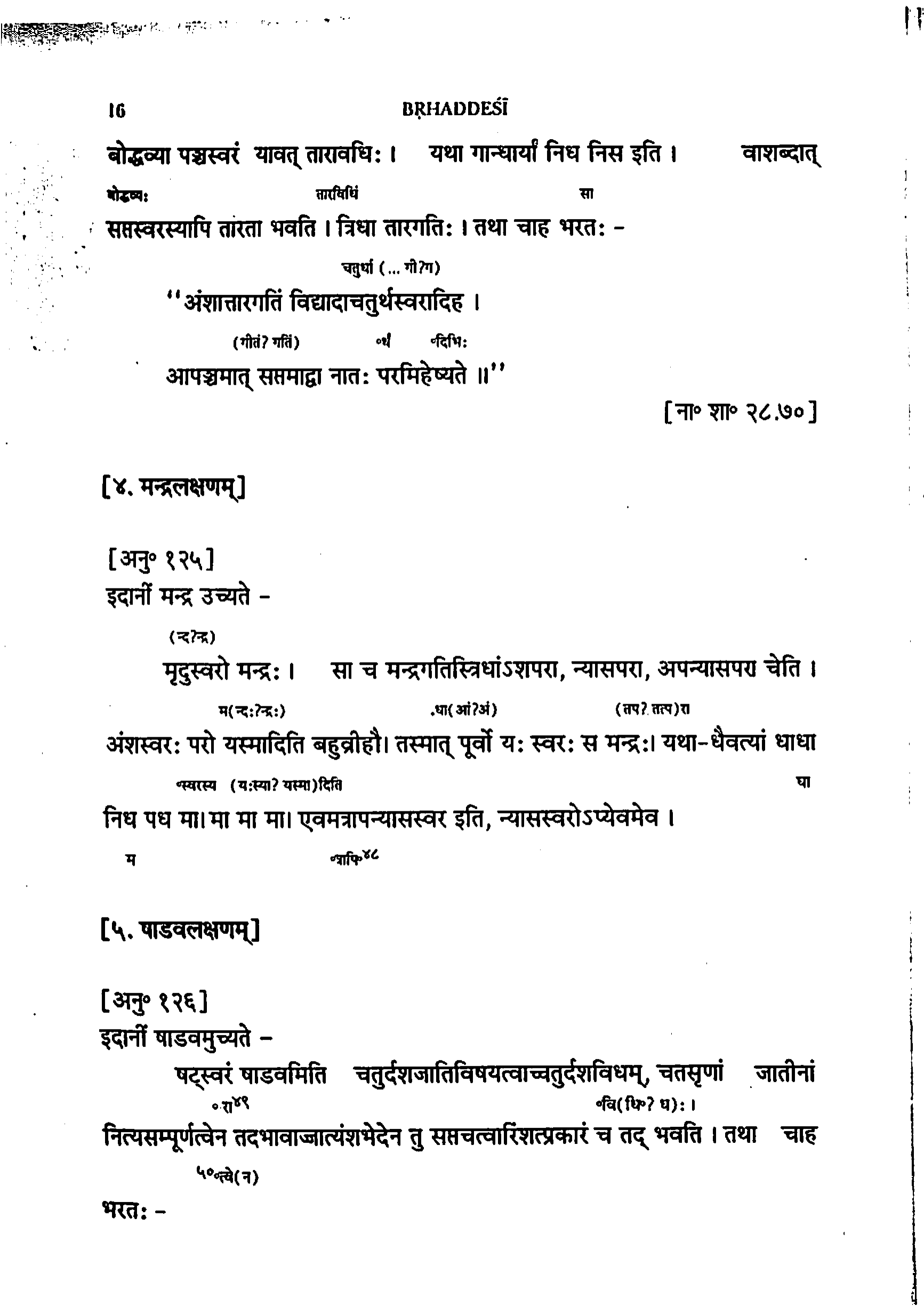
A TOPE STORY OF THE STORY बोद्धव्या पञ्चस्वरं यावत् तारावधिः। यथा गान्धार्यां निध निस इति ।ZZANNZZWE0__ZZANNZZWS0__ तारिवधिंबोड्ज:सा सप्तस्वरस्यापि तारता भवति । त्रिधाचतुर्धा (... गी?ग) तारगति: । तथा चाह भरत: -1
‘‘अंशात्तारगतिं विद्यादाचतुर्थस्वरादिह ।
न्दिभि: (गीतं? गतिं) વ્ય आपञ्चमात् सप्तमाद्वा नातः परिमहेष्यते ॥'' [ना॰ शा॰ २८.७०]2
[४. मन्द्रलक्षणम्]
[अनु॰ १२५]
इदानीं मन्द्र उच्यते - (ন?র) मृदुस्वरो मन्द्रः।4 सा च मन्द्रगतिस्त्रिधांऽशपरा,.धा(आं?अं) न्यासपरा, अपन्यासपरा चेति ।5 (तप?म(न्द:?न्द्र:) तत्प)रा अंशस्वर: परो यस्मादिति बहुव्रीहौ।10 तस्मात् पूर्वो य: स्वर: स मन्द्र:।6 यथा-धैवत्यां धाधाघा श्स्वरस्य (य:स्या? यस्मा)दिति
निध पध मा। मा मा। एवमत्रापन्यासस्वर इति, न्यासस्वरोऽप्येवमेव ।
ज्यांकि
[५. षाडवलक्षणम्]
[अनु॰ १२६]
इदानीं षाडवमुच्यते - षट्स्वरं॰ रा४९ षाडवमिति3 चतुर्दशजातिविषयत्वाच्चतुर्दशविधम्7,<b>॰वि(धि॰? ঘ):।</b> चतसृणांजातीनां नित्यसम्पूर्णत्वेन तदभावाज्जात्यंशभेदेन तु सप्तचत्वारिंशत्प्रकारं च तद् भवति ।8 तथाचाह ५०लचे(न) भरत: -
English — Sharma
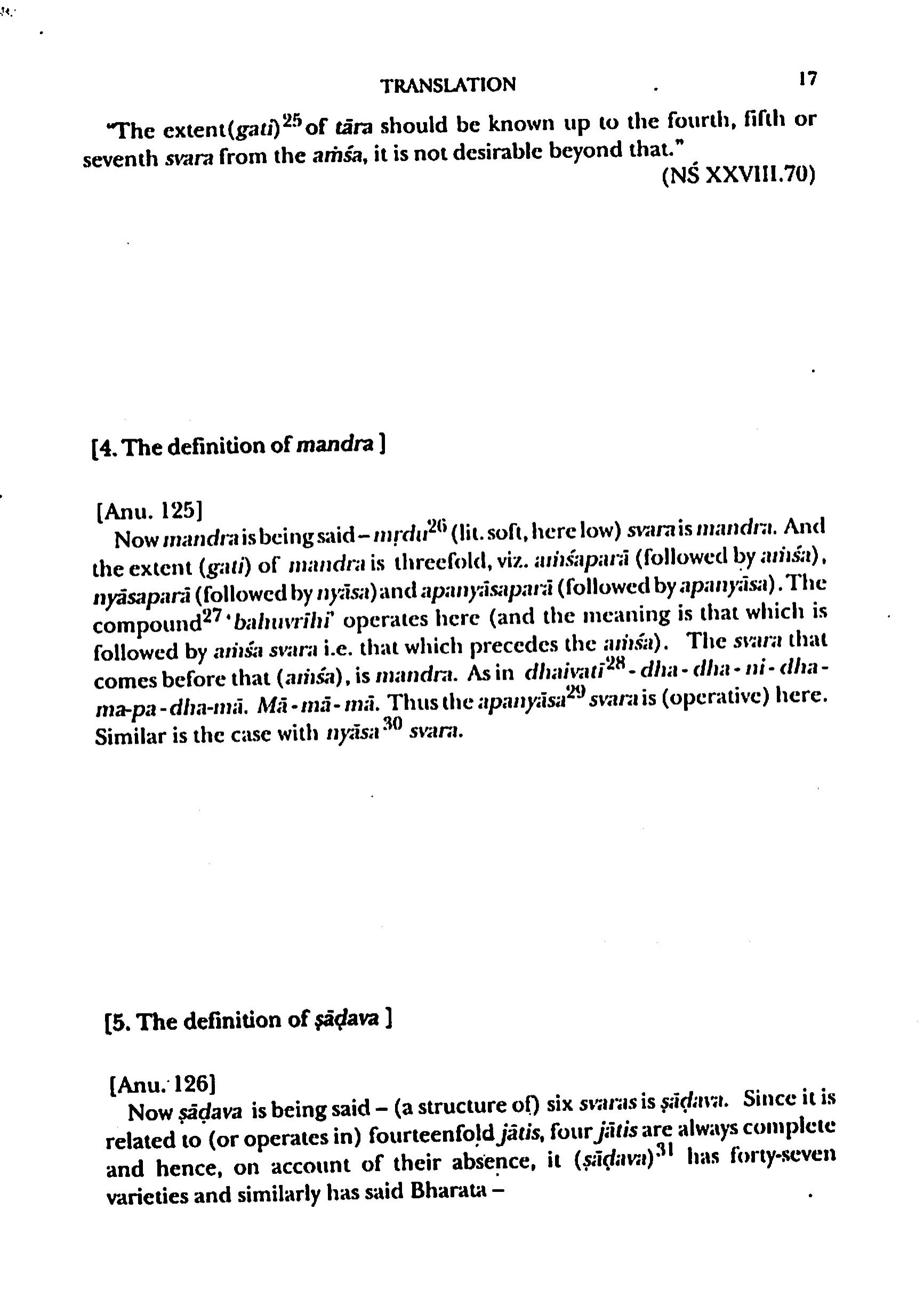
The extent(gati)25 of tāra should be known up to the fourth, fifth or seventh svara from the amśa, it is not desirable beyond that." (NŚ XXVIII.70)
[4. The definition of mandra]
[Anu. 125]
Now mandra is being said - mṛdu26 (lit. soft, here low) svara is mandra. And the extent (gati) of mandra is threefold, viz. amśaparā (followed by amśa), nyāsaparā (followed by nyāsa) and apanyāsaparā (followed by apanyāsa). The compound27 bahuvrihi operates here (and the meaning is that which is followed by amśa svara i.e. that which precedes the amśa). The svara that comes before that (amśa), is mandra. As in dhaivatī28 - dha - dha - ni - dha - ma-pa-dha-mā. Mā-mā-mā. Thus the apanyāsa29 svara is (operative) here. Similar is the case with nyāsa 30 svara.
[5. The definition of sadava]
[Anu. 126]
Now şādava is being said - (a structure of) six svaras is şādava.3 Since it is related to (or operates in) fourteenfold jatis,7 four jatis are always complete and hence, on account of their absence, it (sādava)31 has forty-seven varieties8 and similarly has said Bharata -
1.[attribution] Bharata is cited as an authority on the nature of tāra gati and şādavaतथा चाह भरतः -
2.[citation] The extent of tāra gati is cited from Nāṭya Śāstra chapter 28, verse 70[ना॰ शा॰ २८.७०]
3.[definition] Şādava is defined as a structure of six svarasषट्स्वरं षाडवमिति
4.[definition] Mandra is defined as soft or low svaraमृदुस्वरो मन्द्रः।
5.[enumeration] The extent of mandra is threefold: amśaparā, nyāsaparā, and apanyāsaparāसा च मन्द्रगतिस्त्रिधांऽशपरा, न्यासपरा, अपन्यासपरा चेति ।
6.[relation] The svara that comes before aṁśa is mandraतस्मात् पूर्वो यः स्वरः स मन्द्रः।
7.[relation] Şādava operates in relation to fourteenfold jatisचतुर्दशजातिविषयत्वाच्चतुर्दशविधम्
8.[structural] Şādava has forty-seven varieties due to the absence of four always-complete jatisनित्यसम्पूर्णत्वेन तदभावाज?्ज?ात्यंशभेदेन तु सप्तचत्वारिंशत्प्रकारं च तद् भवति ।
9.[structural] The extent of tāra should be known up to the fourth, fifth or seventh svara from the aṁśaबोद्धव्या पञ्चस्वरं यावत् तारावधि।
10.[structural] The compound bahuvrihi operates in the context of mandra definition, meaning that which precedes the aṁśa svaraअंशस्वरः परो यस्मादिति बहुव्रीहौ।
1.[attribution]Bharata is cited as an authority on the nature of tāra gati and şādavaSimilarly has said Bharata -
2.[citation]The extent of tāra gati is cited from Nāṭya Śāstra chapter 28, verse 70(NŚ XXVIII.70)
3.[definition]Şādava is defined as a structure of six svaras(a structure of) six svaras is şādava.
4.[definition]Mandra is defined as soft or low svaramṛdu26 (lit. soft, here low) svara is mandra.
5.[enumeration]The extent of mandra is threefold: amśaparā, nyāsaparā, and apanyāsaparāthe extent (gati) of mandra is threefold, viz. amśaparā (followed by aṁśa), nyāsaparā (followed by nyāsa) and apanyāsaparā (followed by apanyāsa).
6.[relation]The svara that comes before aṁśa is mandraThe svara that comes before that (aṁśa), is mandra.
7.[relation]Şādava operates in relation to fourteenfold jatisSince it is related to (or operates in) fourteenfold jatis,
8.[structural]Şādava has forty-seven varieties due to the absence of four always-complete jatison account of their absence, it (sādava)31 has forty-seven varieties
9.[structural]The extent of tāra should be known up to the fourth, fifth or seventh svara from the aṁśaThe extent(gati)25 of tāra should be known up to the fourth, fifth or seventh svara from the aṁśa, it is not desirable beyond that.
10.[structural]The compound bahuvrihi operates in the context of mandra definition, meaning that which precedes the aṁśa svaraThe compound27 bahuvrihi operates here (and the meaning is that which is followed by aṁśa svara i.e. that which precedes the aṁśa).