Source scans · vol_II_p100
recto · open full
scan recto
verso · open full
scan verso
Bṛhaddeśī · Volume II
pp. 4–183folio 100
Devanāgarī
BARRION POR
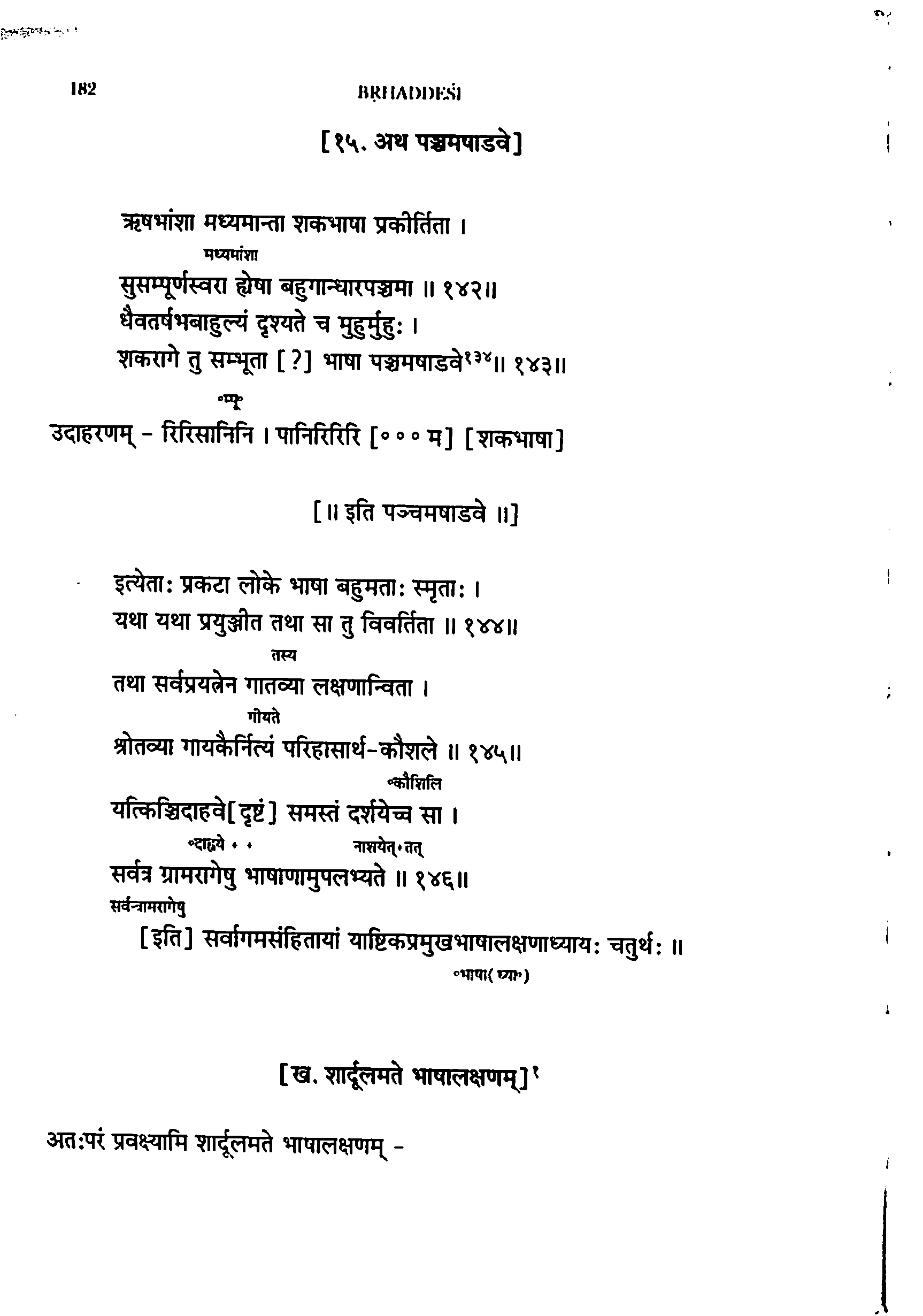
[१५. अथ पञ्चमपाडवे]
ऋषभांशा मध्यमान्तामध्यमांशा शकभाषा प्रकीर्तिता5
सुसम्पूर्णस्वरा होषा बहुगान्धारपञ्चमा ॥१४२॥
धैवतर्षभबाहुल्यं॰प्पृ दृश्यते च मुहुर्मुहु:7
शकरागे तु सम्भूता [?] भाषा पञ्चमषाडवे3१३४॥१४३॥ उदाहरणम् - रिरिसानिनि । पानिरिरिरि [००० म] [शकभाषा]
[॥ इति पञ्चमषाडवे ॥]
इत्येताः प्रकटा लोके भाषा बहुमताः स्मृताः।
यथा यथा प्रयुञ्जीत तथातस्य सा तु विवर्तिता11 ॥१४४॥
तथा सर्वप्रयत्नेन गातव्यागीयते लक्षणान्विता8
श्रोतव्या गायकैर्नित्यं॰दाह्यये + + परिहासार्थ-कौशले<b>॰कौशिलि</b> ॥१४५॥
यत्किञ्चिदाहवे[दृष्टं] समस्तं दर्शयेच्च सा ।
नाशयेत्•तत्
सर्वत्रसर्वन्त्रामरागेषु ग्रामरागेषु भाषाणामुपलभ्यते4१४६॰भाषा(ध्या॰)
[इति] सर्वागमसंहितायां याष्टिकप्रमुख9भाषालक्षणाध्याय: चतुर्थ:1
[ख. शार्दूलमते भाषालक्षणम्] र अतः परं प्रवक्ष्यामि शार्दूलमते भाषालक्षणम्2 -
English — Sharma
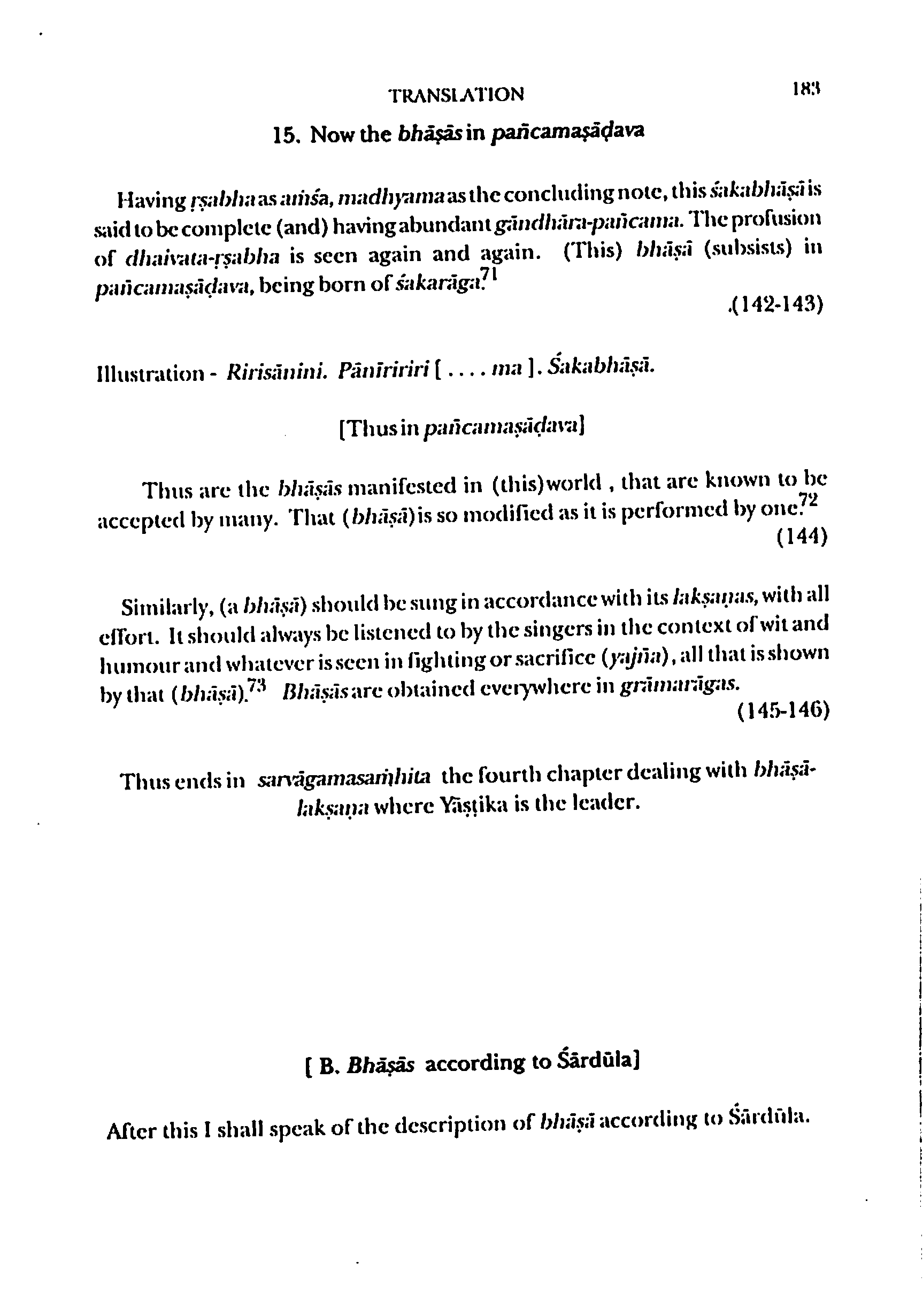
15. Now the bhāṣās in pañcamaṣāḍava Having ṛṣabha as amśa, madhyama as the concluding note, this śakabhāṣā is said to be complete (and) having abundant gändhära-pañcama.6 The profusion of dhaivata-ṛṣabha is seen again and again.7 (This) bhāṣā (subsists) in pancamaṣāḍava, being born of śakarāga.3 71 (142-143) Illustration - Ririsānini. Pānīririri [ . . . ma ]. Šakabhāṣā. Thus are the bhāṣās manifested in (this)world, that are known to be accepted by many. That <math>(bh\bar{a}s\bar{a})</math> is so modified as it is performed by one.72
(144)
Similarly, (a bhāṣā) should be sung in accordance with its lakṣaṇas, with all effort.8 It should always be listened to by the singers in the context of wit and humour and whatever is seen in fighting or sacrifice (yajña)10, all that is shown by that (bhāṣā). Bhāṣās are obtained everywhere in grāmarāgas.4 <math>(145-146)</math> Thus ends in sarvāgamasamhita the fourth chapter dealing with bhāṣā- lakṣaṇa1 where Yāṣṭika is the leader.9
[B. Bhāṣās according to Śārdūla]
After this I shall speak of the description of bhāṣā according to Śārdūla.2
1.[attribution] The fourth chapter dealing with bhāṣā-lakṣaṇa is attributed to sarvāgamasamhitaसर्वागमसंहिताया याष्टिकप्रमुखभाषालक्षणाध्यायः चतुर्थः
2.[attribution] Śārdūla presents an alternative description of bhāṣā-lakṣaṇaअतः परं प्रवक्ष्यामि शार्दूलमते भाषालक्षणम्
3.[relation] Śakabhāṣā is born of śakarāga in the context of pañcamaṣāḍavaशकरागे तु सम्भूता [?] भाषा पञ्चमषाडवे
4.[relation] Bhāṣās are obtained everywhere in grāmarāgasसर्वत्र ग्रामरागेषु भाषाणामुपलभ्यते
5.[structural] Śakabhāṣā is characterized by having ṛṣabha as aṁśa and madhyama as the concluding noteऋषभांशा मध्यमान्ता शकभाषा प्रकीर्तिता
6.[structural] Śakabhāṣā is characterized by abundant gändhära-pañcamaशकभाषा प्रकीर्तिता । मध्यमांशा सुसम्पूर्णस्वरा होषा बहुगान्धारपञ्चमा
7.[structural] The profusion of dhaivata-ṛṣabha is seen repeatedly in śakabhāṣāधैवतर्षभबाहुल्यं दृश्यते च मुहुर्मुहुः
8.[structural] A bhāṣā should be sung in accordance with its lakṣaṇas with all effortतथा सर्वप्रयत्नेन गातव्या लक्षणान्विता
9.[structural] Yāṣṭika is identified as the leader in the bhāṣā-lakṣaṇa chapterयाष्टिकप्रमुख
11.[structural] Bhāṣās are modified according to how they are performedयथा यथा प्रयुञ्ज?ीत तथा सा तु विवर्तिता
1.[attribution]The fourth chapter dealing with bhāṣā-lakṣaṇa is attributed to sarvāgamasamhitaThus ends in sarvāgamasamhita the fourth chapter dealing with bhāṣā- lakṣaṇa
2.[attribution]Śārdūla presents an alternative description of bhāṣā-lakṣaṇaAfter this I shall speak of the description of bhāṣā according to Śārdūla.
3.[relation]Śakabhāṣā is born of śakarāga in the context of pañcamaṣāḍava(This) bhāṣā (subsists) in pancamaṣāḍava, being born of śakarāga.
4.[relation]Bhāṣās are obtained everywhere in grāmarāgasBhāṣās are obtained everywhere in grāmarāgas.
5.[structural]Śakabhāṣā is characterized by having ṛṣabha as aṁśa and madhyama as the concluding noteHaving ṛṣabha as aṁśa, madhyama as the concluding note, this śakabhāṣā is said to be complete
6.[structural]Śakabhāṣā is characterized by abundant gändhära-pañcamathis śakabhāṣā is said to be complete (and) having abundant gändhära-pañcama.
7.[structural]The profusion of dhaivata-ṛṣabha is seen repeatedly in śakabhāṣāThe profusion of dhaivata-ṛṣabha is seen again and again.
8.[structural]A bhāṣā should be sung in accordance with its lakṣaṇas with all effortSimilarly, (a bhāṣā) should be sung in accordance with its lakṣaṇas, with all effort.
9.[structural]Yāṣṭika is identified as the leader in the bhāṣā-lakṣaṇa chapterwhere Yāṣṭika is the leader.
10.[structural]Bhāṣās should be listened to by singers in the context of wit, humour, fighting, and sacrificeIt should always be listened to by the singers in the context of wit and humour and whatever is seen in fighting or sacrifice (yajña)
11.[structural]Bhāṣās are modified according to how they are performedThat (bhāṣā) is so modified as it is performed by one.