Source scans · vol_II_p109
recto · open full
scan recto
verso · open full
scan verso
Bṛhaddeśī · Volume II
p. 10folio 109
Devanāgarī
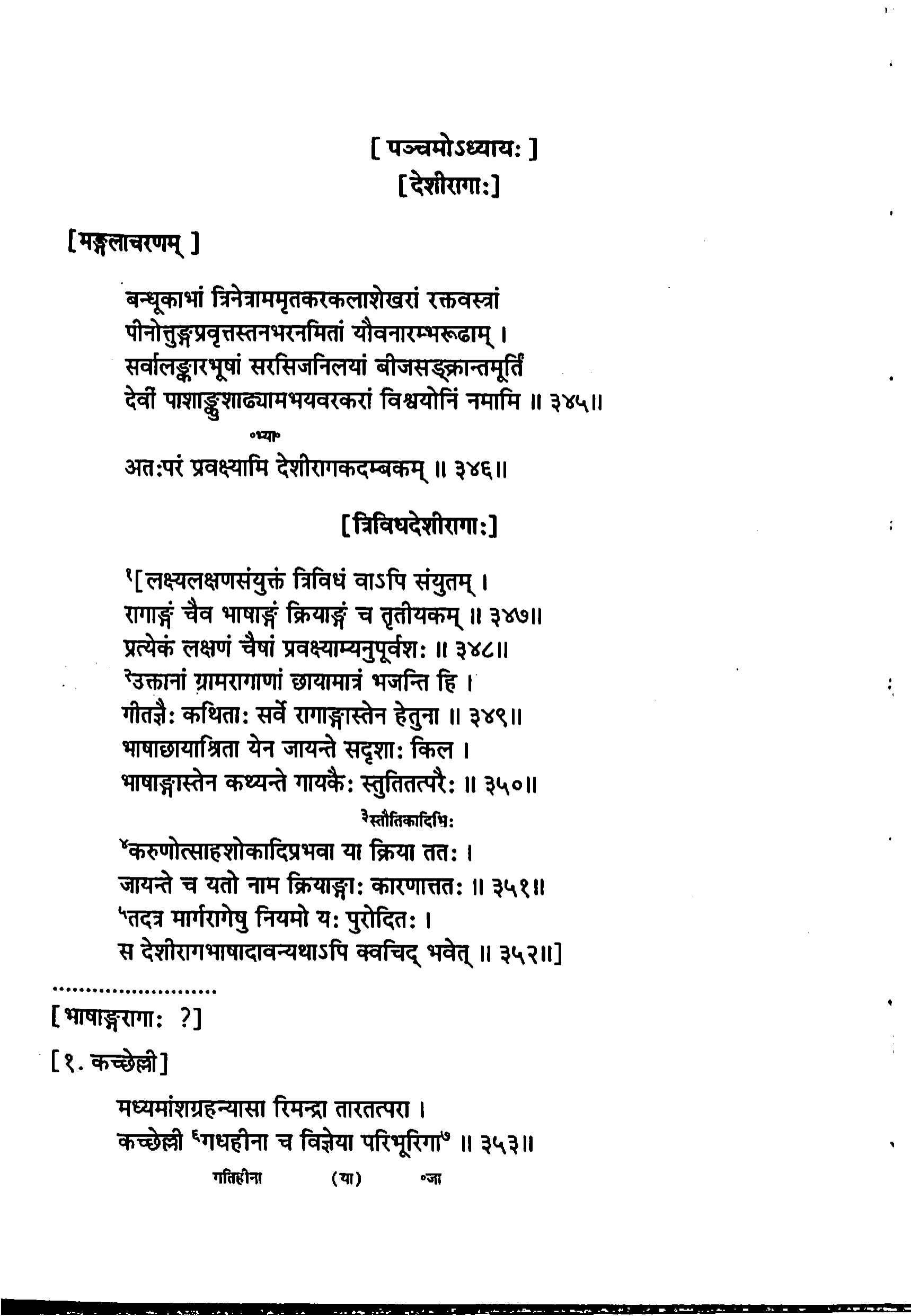
[पञ्चमोऽध्याय:]
[देशीरागाः]
[मङ्गलाचरणम्]
बन्धूकाभां त्रिनेत्राममृतकरकलाशेखरां रक्तवस्त्रां
पीनोत्तुङ्गप्रवृत्तस्तनभरनिमतां यौवनारम्भरूढाम् ।
सर्वालङ्कारभूषां सरसिजनिलयां बीजसङ्क्रान्तमूर्ति देवीं पाशाङ्कशाढ्यामभयवरकरां विश्वयोनिं नमामि ॥३४५॥ अत:परं प्रवक्ष्यामि देशीरागकदम्बकम् ॥३४६॥
[त्रिविधदेशीरागा:]
ै[लक्ष्यलक्षणसंयुक्तं त्रिविधं वाऽपि संयुतम् ।
रागाङ्गं चैव भाषाङ्गं क्रियाङ्गं च तृतीयकम् ॥३४७॥ प्रत्येकं लक्षणं चैषां प्रवक्ष्याम्यनुपूर्वश: ॥३४८॥ रेउक्तानां ग्रामरागाणां छायामात्रं भजन्ति हि ।6 गीतज्ञै: कथिता: सर्वे रागाङ्गास्तेन हेतुना83 ॥३४९॥ भाषाछायाश्रिता येन जायन्ते सदृशा: किल । भाषाङ्गास्तेन कथ्यन्ते गायकै: स्तुतितत्परै:4३स्तौतिकादिभि: ॥३५०॥
करुणोत्साहशोकादिप्रभवा या क्रिया तत: ।
जायन्ते च यतो नाम क्रियाङ्गाः कारणात्ततः ॥३५१॥तदत्र मार्गरागेषु नियमो य: पुरोदित: । स देशीरागभाषादावन्यथाऽपि क्वचिद् भवेत्7 ॥३५२॥]
[भाषाङ्गरागा: ?]
मध्यमांशग्रहन्यासा रिमन्द्रा तारतत्परा ।
कच्छेल्ली गधहीनागतिसीनाविज्ञेया(या) परिभूरिगा॰जा ॥३५३॥ مروره هم و العرب العرب العربي و العرب العرب العرب العرب العرب العرب العرب العرب العرب العرب العرب العرب العرب ا
English — Sharma
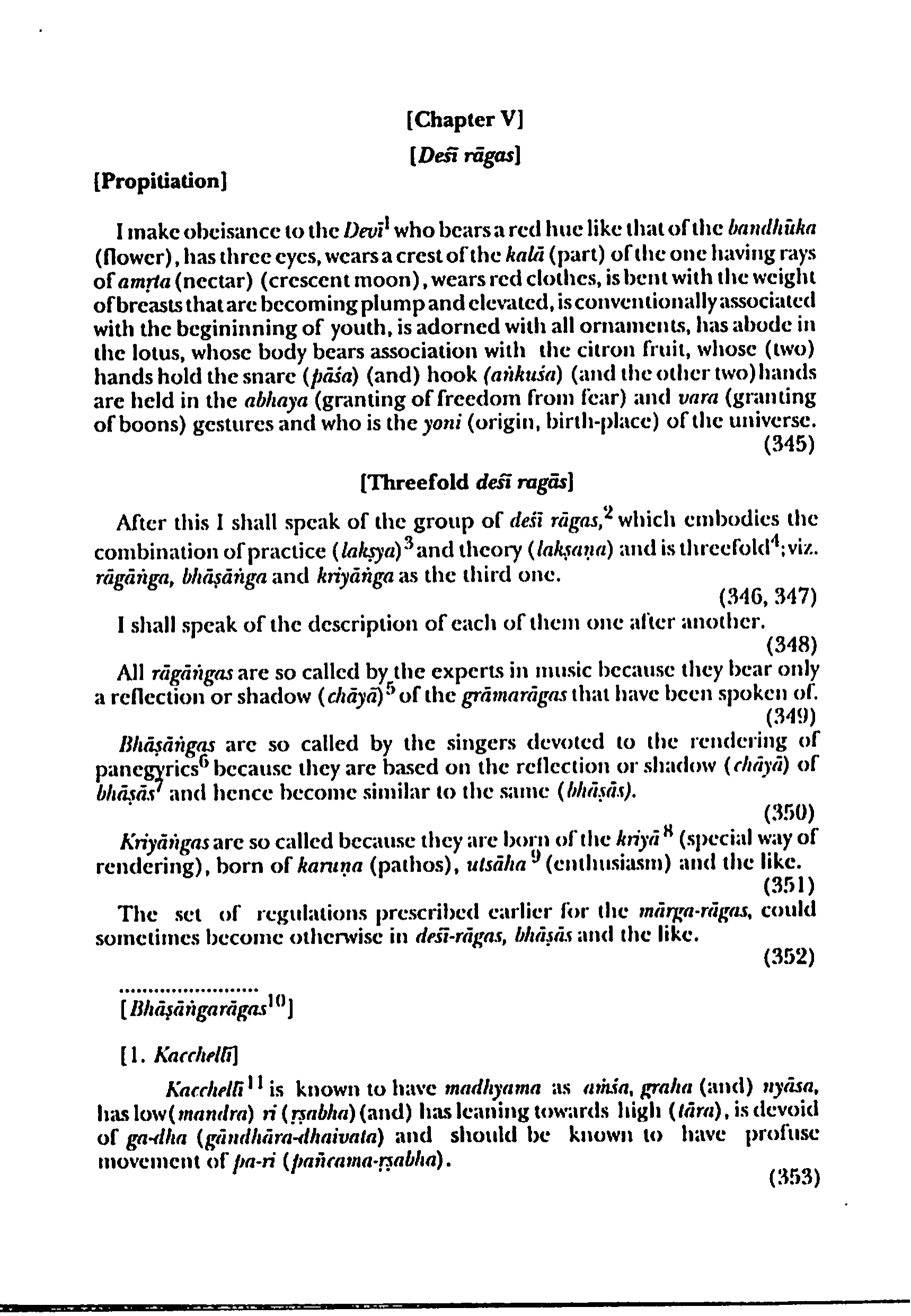
[Chapter V]
[Desī rāgas]
[Propitiation]
I make obeisance to the Devīl who bears a red hue like that of the bandhūka (flower), has three eyes, wears a crest of the kalā (part) of the one having rays of ampta (nectar) (crescent moon), wears red clothes, is bent with the weight of breasts that are becoming plump and elevated, is conventionally associated with the begininning of youth, is adorned with all ornaments, has abode in the lotus, whose body bears association with the citron fruit, whose (two) hands hold the snare (pāśa) (and) hook (ankuśa) (and the other two) hands are held in the abhaya (granting of freedom from fear) and vara (granting of boons) gestures and who is the yoni (origin, birth-place) of the universe.
(345)
[Threefold desi ragās]
After this I shall speak of the group of desī rāgas, which embodies the combination of practice (laksya) and theory (laksana) and is threefold104; viz. rāgānga, bhāṣānga and kriyānga as the third one.2 (346, 347) I shall speak of the description of each of them one after another.
(348)
All rāgāngas are so called by the experts in music because they bear only a reflection or shadow (chāyā) of the grāmarāgas83 that have been spoken of.6
(349)
Bhāṣāṅgas are so called by the singers devoted to the rendering of panegyrics because they are based on the reflection or shadow (châyā) of bhāṣās7 and hence become similar to the same (bhāṣās).4
(350)
Kriyāngas are so called because they are born of the kriyā<math>^8</math> (special way of rendering), born of karuna (pathos), utsāha 9 (enthusiasm) and the like.
(351)
The set of regulations prescribed earlier for the mārga-rāgas, could sometimes become otherwise in desī-rāgas, bhāṣās and the like.7
(352)
Kacchelli 11 is known to have madhyama as amsa, graha (and) nyāsa, has low(mandra) ri (rṣabha) (and) has leaning towards high (tāra), is devoid of ga-dha (gāndhāra-dhaivata) and should be known to have profuse movement of pa-ri (pañcama-ṛṣabha).
(353)
1.[enumeration] Kacchelli is classified as a Bhāṣāṅgarāga[भाषाङ्गरागाः ?] [१. कच्छेल्ली]
2.[enumeration]Deśī rāgas are threefold in classification, comprising rāgānga, bhāṣānga, and kriyāngaलक्ष्यलक्ष्यणसंयुक्तं त्रिविधं वाऽपि संयुतम् । रागाङ्गं चैव भाषाङ्गं क्रियाङ्गं च तृतीयकम्
3.[relation] Rāgāngas bear only a reflection or shadow of the grāmarāgasगीतज्ञैः कथिताः सर्वे रागाङ्गास्तेन हेतुना
4.[relation] Bhāṣāngas are based on the reflection or shadow of bhāṣās and become similar to themभाषाछायाश्रिता येन ज?ायन्ते सदृशाः किल । भाषाङ्गास्तेन कथ्यन्ते गायकैः स्तुतितत्परैः
5.[relation] Kriyāngas are born of kriyā (special way of rendering) which originates from pathos, enthusiasm and similar emotional statesकरुणोत्साहशोकादिप्रभवा या क्रिया ततः । ज?ायन्ते च यतो नाम क्रियाङ्गा कारणात्ततः
6.[relation]Grāmarāgas are distinguished from rāgāngas by the latter bearing only a shadow reflection of themरेउक्ताना ग्रामरागाणा छायामात्रं भजन्ति हि ।
7.[relation] The set of regulations prescribed for mārga-rāgas could sometimes become otherwise in deśī-rāgas and bhāṣāsतदत्र मार्गरागेषु नियमो यः पुरोदितः । स देशीरागभाषादावन्यथाऽपि क्वचिद् भवेत्
8.[relation] Chāyā (reflection/shadow) is the distinguishing characteristic between deśī-rāgas and their parent mārga-rāgasगीतज्ञैः कथिताः सर्वे रागाङ्गास्तेन हेतुना
1.[enumeration]Kacchelli is classified as a Bhāṣāṅgarāga[Bhāṣāṅgarāgas10] [1. Kacchelli]
2.[enumeration] Deśī rāgas are threefold in classification, comprising rāgānga, bhāṣānga, and kriyāngawhich embodies the combination of practice (laksya) and theory (laksana) and is threefold4; viz. rāgānga, bhāṣānga and kriyānga as the third one.
3.[relation]Rāgāngas bear only a reflection or shadow of the grāmarāgasAll rāgāngas are so called by the experts in music because they bear only a reflection or shadow (chāyā) of the grāmarāgas
4.[relation]Bhāṣāngas are based on the reflection or shadow of bhāṣās and become similar to themBhāṣāṅgas are so called by the singers devoted to the rendering of panegyrics because they are based on the reflection or shadow (châyā) of bhāṣās and hence become similar to the same (bhāṣās).
5.[relation]Kriyāngas are born of kriyā (special way of rendering) which originates from pathos, enthusiasm and similar emotional statesKriyāngas are so called because they are born of the kriyā^8 (special way of rendering), born of karuna (pathos), utsāha 9 (enthusiasm) and the like.
6.[relation] Grāmarāgas are distinguished from rāgāngas by the latter bearing only a shadow reflection of themAll rāgāngas are so called by the experts in music because they bear only a reflection or shadow (chāyā) of the grāmarāgas that have been spoken of.
7.[relation]The set of regulations prescribed for mārga-rāgas could sometimes become otherwise in deśī-rāgas and bhāṣāsThe set of regulations prescribed earlier for the mārga-rāgas, could sometimes become otherwise in desī-rāgas, bhāṣās and the like.
8.[relation]Chāyā (reflection/shadow) is the distinguishing characteristic between deśī-rāgas and their parent mārga-rāgasAll rāgāngas are so called by the experts in music because they bear only a reflection or shadow (chāyā) of the grāmarāgas
9.[structural]Kacchelli has madhyama as amsa, graha and nyāsa, has low ṛṣabha, leans towards high register, is devoid of gāndhāra-dhaivata, and has profuse pañcama-ṛṣabha movementKacchelli 11 is known to have madhyama as amsa, graha (and) nyāsa, has low(mandra) ri (ṛṣabha) (and) has leaning towards high (tāra), is devoid of ga-dha (gāndhāra-dhaivata) and should be known to have profuse movement of pa-ri (pañcama-ṛṣabha).
10.[structural]Deśī rāgas embody the combination of practice (laksya) and theory (laksana)which embodies the combination of practice (laksya) and theory (laksana) and is threefold