Source scans · vol_II_p160
recto · open full
scan recto
verso · open full
scan verso
Bṛhaddeśī · Volume II
pp. 302–303folio 160
Bṛhaddeśī
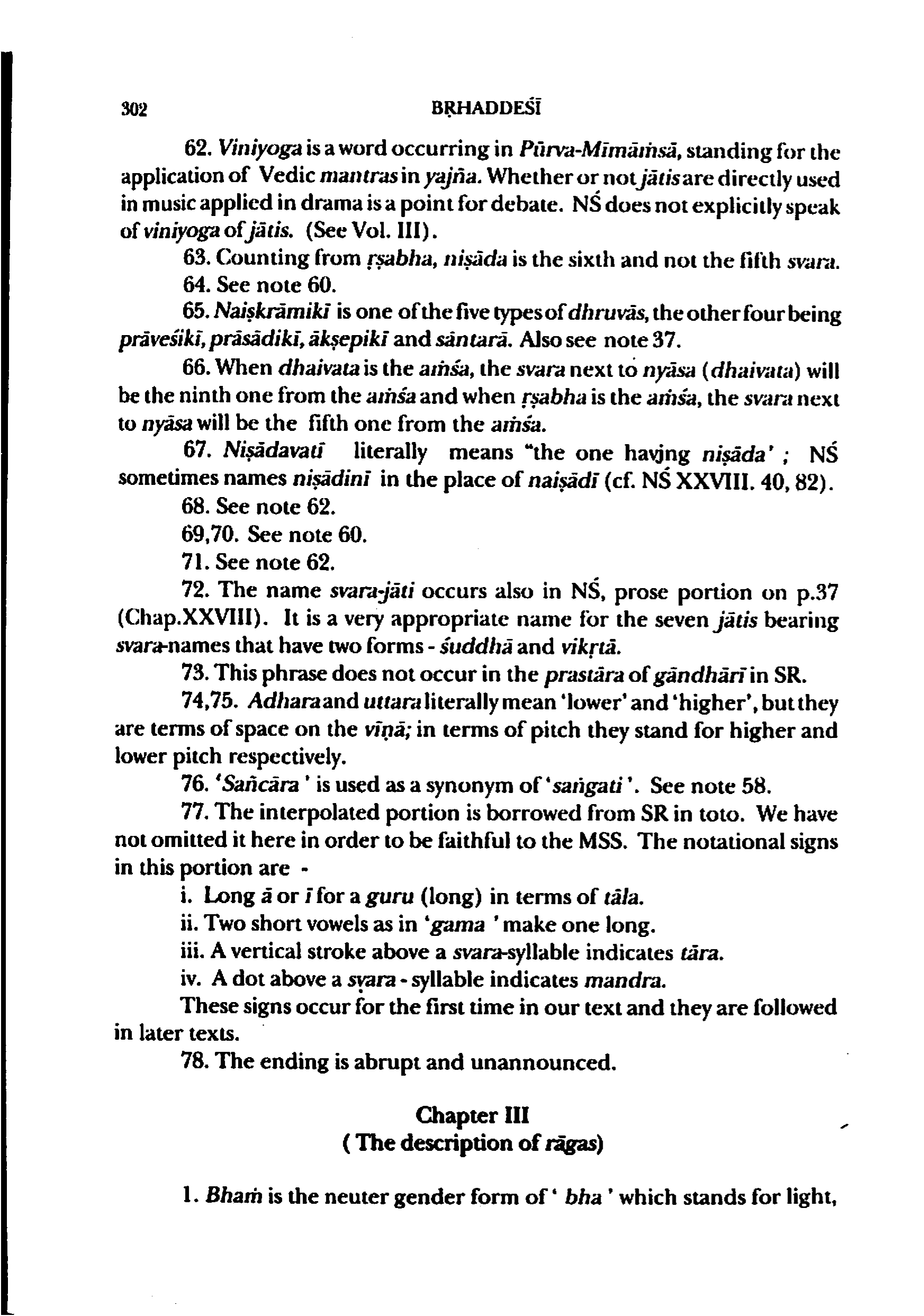
62. Viniyoga is a word occurring in Pūrva-Mīmāmsā, standing for the application of Vedic mantras in yajña. Whether or not jātis are directly used in music applied in drama is a point for debate. NS does not explicitly speak of viniyoga of jātis. (See Vol. III). 63. Counting from ṛṣabha, niṣāda is the sixth and not the fifth svara. 64. See note 60. 65. Naiskrāmikī is one of the five types of dhruvās, the other four being prāveśikī, prāsādikī, ākṣepikī and sāntarā. Also see note 37. 66. When dhaivata is the aṁśa, the svara next to nyāsa (dhaivata) will be the ninth one from the aṁśa and when ṛṣabha is the aṁśa, the svara next to nyāsa will be the fifth one from the aṁśa. 67. Niṣādavatī literally means "the one havjng niṣāda'; NŚ sometimes names niṣādinī in the place of naiṣādī (cf. NŠ XXVIII. 40, 82). 68. See note 62. 69,70. See note 60. 71. See note 62. 72. The name svara-jāti occurs also in NS, prose portion on p.37 (Chap.XXVIII). It is a very appropriate name for the seven jātis bearing svara-names that have two forms - śuddhā and vikṛtā. 73. This phrase does not occur in the prastāra of gāndhārī in SR. 74,75. Adhara and uttara literally mean 'lower' and 'higher', but they are terms of space on the viņā; in terms of pitch they stand for higher and lower pitch respectively. 76. 'Sañcāra' is used as a synonym of 'saṅgati'. See note 58. 77. The interpolated portion is borrowed from SR in toto. We have not omitted it here in order to be faithful to the MSS. The notational signs in this portion are - i. Long ā or ī for a guru (long) in terms of tāla. ii. Two short vowels as in 'gama' make one long. iii. A vertical stroke above a svara-syllable indicates tāra. iv. A dot above a syara - syllable indicates mandra. These signs occur for the first time in our text and they are followed in later texts. 78. The ending is abrupt and unannounced.
Chapter III - (The description of ragas)
1. Bham is the neuter gender form of 'bha' which stands for light,
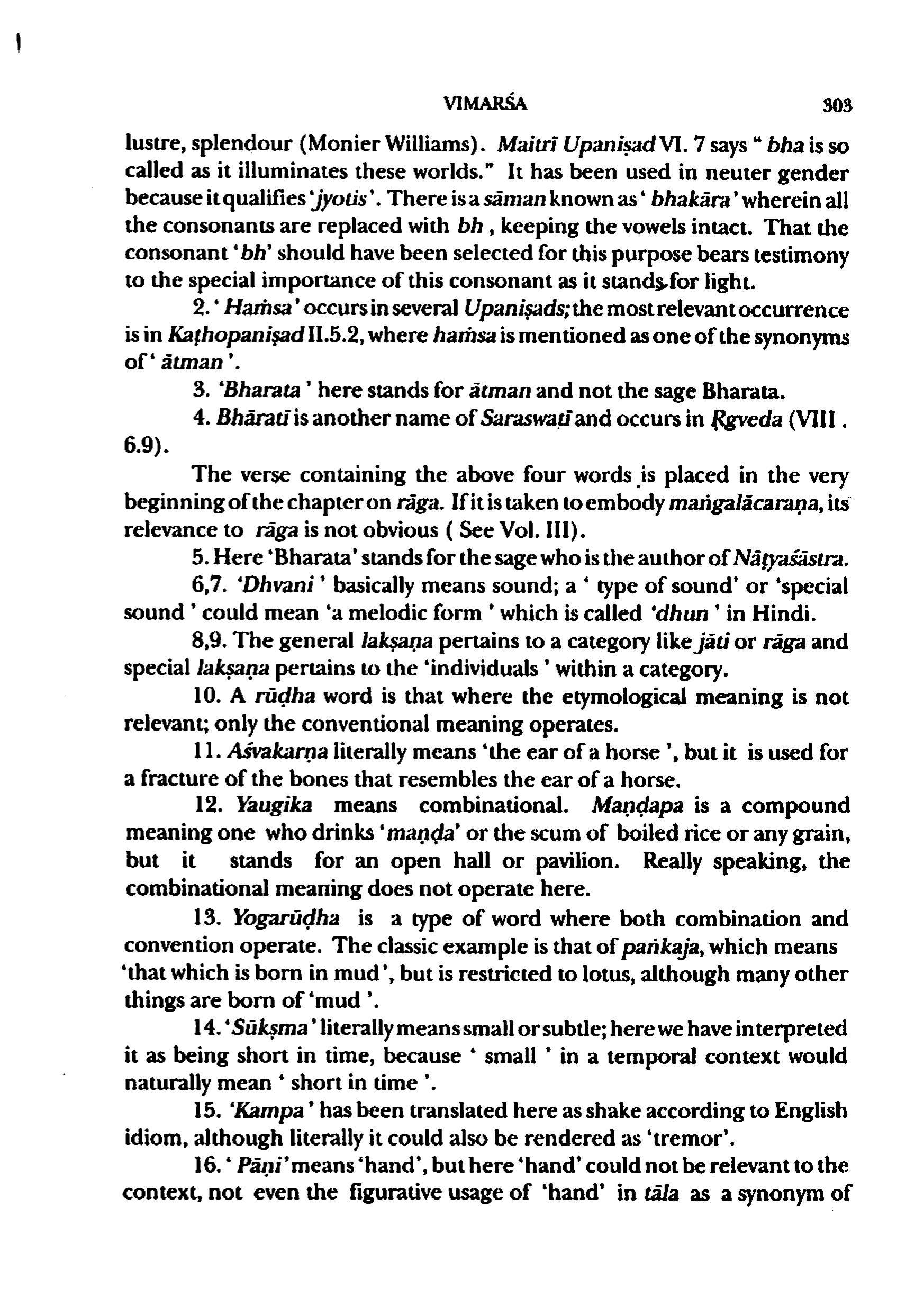
Vimarśa
lustre, splendour (Monier Williams). Maitrī Upaniṣad VI. 7 says "bha is so called as it illuminates these worlds." It has been used in neuter gender because it qualifies 'jyotis'. There is a sāman known as 'bhakāra' wherein all the consonants are replaced with bh, keeping the vowels intact.5 That the consonant 'bh' should have been selected for this purpose bears testimony to the special importance of this consonant as it stands for light. 2. 'Hamsa' occurs in several Upanișads; the most relevant occurrence is in Kathopanişad II.5.2, where hamsa is mentioned as one of the synonyms of 'ātman'. 3. 'Bharata' here stands for ātman and not the sage Bharata. 4. Bhāratī is another name of Saraswatī and occurs in Rgveda (VIII. 6.9). The verse containing the above four words is placed in the very beginning of the chapter on raga. If it is taken to embody mangalacarana, its relevance to rāga is not obvious (See Vol. III). 5. Here 'Bharata' stands for the sage who is the author of Nāṭyaśāstra. 6,7. 'Dhvani' basically means sound; a 'type of sound' or 'special sound 'could mean 'a melodic form 'which is called 'dhun' in Hindi. 8,9. The general lakṣaṇa pertains to a category like jāti or rāga and special lakṣaṇa pertains to the 'individuals' within a category. 10. A rūdha word is that where the etymological meaning is not relevant; only the conventional meaning operates. 11. Aśvakarņa literally means 'the ear of a horse', but it is used for a fracture of the bones that resembles the ear of a horse. 12. Yaugika means combinational. Mandapa is a compound meaning one who drinks 'manda' or the scum of boiled rice or any grain, stands for an open hall or pavilion. Really speaking, the but it combinational meaning does not operate here. 13. Yogarūdha is a type of word where both combination and convention operate. The classic example is that of pankaja, which means 'that which is born in mud', but is restricted to lotus, although many other things are born of 'mud'. 14. 'Sūkṣma' literally means small or subtle; here we have interpreted it as being short in time, because 'small' in a temporal context would naturally mean 'short in time'. 15. 'Kampa' has been translated here as shake according to English idiom, although literally it could also be rendered as 'tremor'. 16. ' Pāṇi' means 'hand', but here 'hand' could not be relevant to the context, not even the figurative usage of 'hand' in tāla as a synonym of
1.[citation]Hamsa occurs in several Upaniṣads and is mentioned in Kathopanişad as a synonym of ātman'Hamsa' occurs in several Upaniṣads; the most relevant occurrence is in Kathopanişad II.5.2, where hamsa is mentioned as one of the synonyms of 'ātman'.
2.[definition]Viniyoga is a term from Pūrva-Mīmāmsā referring to the application of Vedic mantras in ritual sacrificeViniyoga is a word occurring in Pūrva-Mīmāmsā, standing for the application of Vedic mantras in yajña.
3.[definition]A rūdha word is one where etymological meaning is not relevant and only conventional meaning operatesA rūdha word is that where the etymological meaning is not relevant; only the conventional meaning operates.
4.[definition]Yogarūdha is a type of word where both combinational and conventional meanings operateYogarūdha is a type of word where both combination and convention operate.
5.[definition]Bhakāra is a sāman where all consonants are replaced with bh while keeping vowels intactThere is a sāman known as 'bhakāra' wherein all the consonants are replaced with bh, keeping the vowels intact.
6.[enumeration]Dhruvās comprises five types: prāveśikī, prāsādikī, ākṣepikī, sāntarā, and NaiskrāmikīNaiskrāmikī is one of the five types of dhruvās, the other four being prāveśikī, prāsādikī, ākṣepikī and sāntarā.
7.[relation]Pankaja exemplifies yogarūdha: it means 'that which is born in mud' but is restricted to lotusThe classic example is that of pankaja, which means 'that which is born in mud', but is restricted to lotus
8.[relation]Nāṭyaśāstra does not explicitly discuss viniyoga of jātis in dramatic musicNS does not explicitly speak of viniyoga of jātis.
9.[structural]Svara-jāti refers to seven jātis bearing svara-names that have two forms: śuddhā and vikṛtāThe seven jātis bearing svara-names that have two forms - śuddhā and vikṛtā.