Source scans · vol_II_p159
recto · open full
scan recto
verso · open full
scan verso
Bṛhaddeśī · Volume II
pp. 1–301folio 159
Bṛhaddeśī
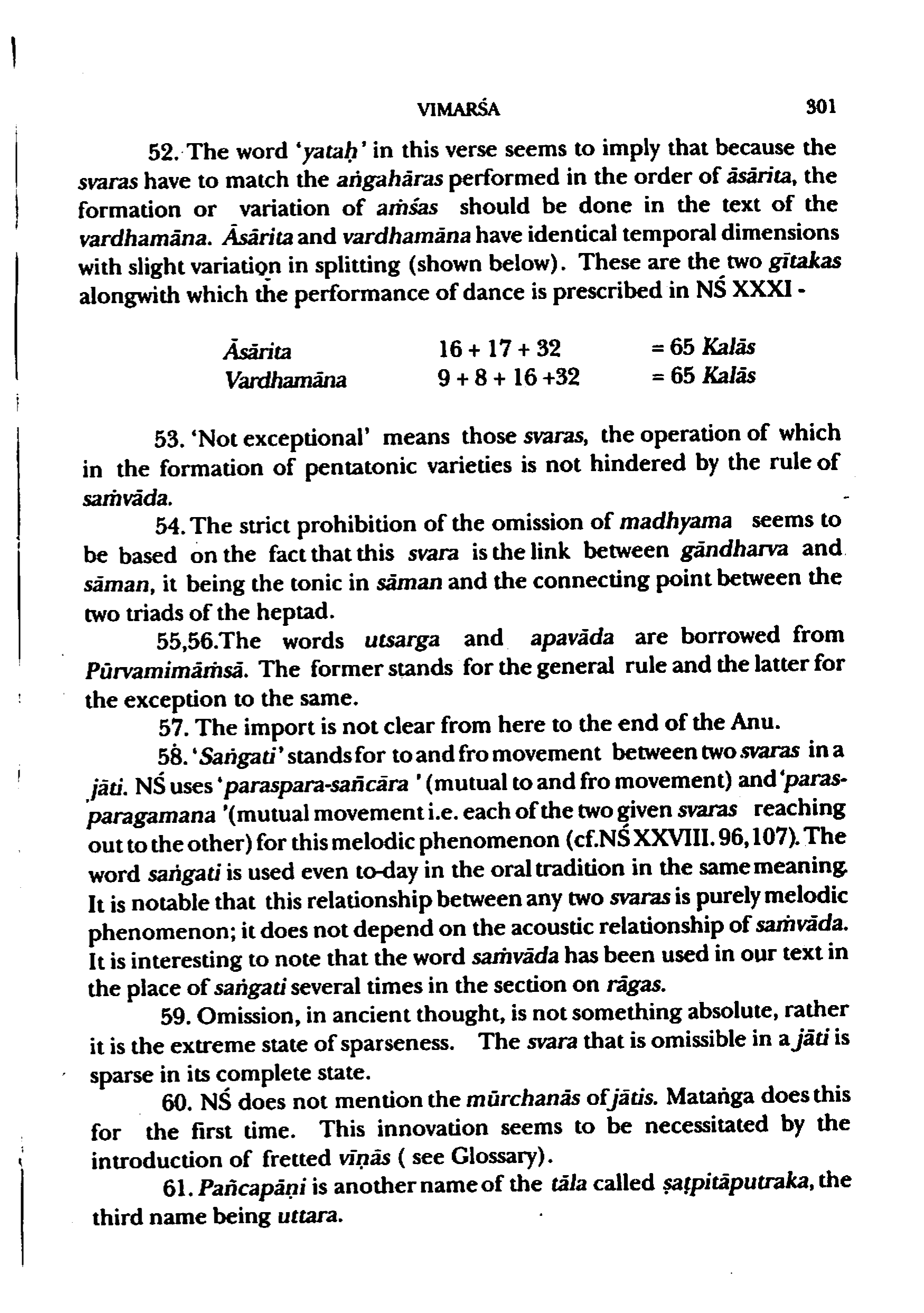
40. Our author has retained the number ten of the characteristics of jātis, in accordance with NS. Šārngadeva enhances this number to thirteen, by including samnyāsa, vinyāsa and antaramārga which do find a place in both NS and BrD, but are not counted independently there. 41. The identity of grāma depends solely on the interval of pañcama being comprised of four or three śrutis. 42. The number three is not literally applicable in all groups (gaṇas) of jātis, this has been mentioned in Anu.133. This number seems to have been accepted as a standard one under the influence of syllabic groups (gaṇas) composed of three syllables each, accepted in prosody as codes for describing the order of longs and shorts (guru-laghu) in a given metre. These syllabic ganas are eight as follows - Yagaṇa-ISS; Magaṇa-SSS; Tagaṇa-SSI; Ragaṇa-SIS; Jagaṇa-ISI; Bhagana-SII; Nagana-III and Sagana-IIS. 43. This sentence is notable since it explains the general statement that jātis are the progenitors of grāmarāgas. Since aṁśa is the regulator of intervallic formation in a melodic configuration, jātis could be said to provide the intervallic bases for grāmarāgas. A question could arise here and that is this. Intervallic formation is accomplished basically by mürchanā; jāti is formed by giving a melodic form to the intervallic formation provided by a mūrchanā. The answer could perhaps be that jāti not only provides the intervallic formation through amsas, but also lends to grāmarāgas cues to melodic formulation which also is regulated by aṁśa. 44,45. Yugma or even and ayugma or odd stand for the tālas named caccatpuța comprised of four kalās and cācapuța comprised of three kalās respectively. 46. See Vol. I, section VII. 47,48. Āsārita and pāṇikā are types of gītaka (lit.song), as described in NS XXXI. 49. The plural number in āsāritas refers to the three types of āsārita viz.jyeştha, madhya and kaniştha. 50. Angahāras are cumulative dance movements composed of more than one karanas described in NS IV. Since the performance of dance is prescribed alongwith asarita and vardhamana, angahara has been mentioned here. 51. The implication is that the melodic component of vardhamāna is provided by jāti. Since the melody of a vocal composition takes shape in terms of the phrases of the given text, pada or text has been specifically mentioned here.
Vimarśa
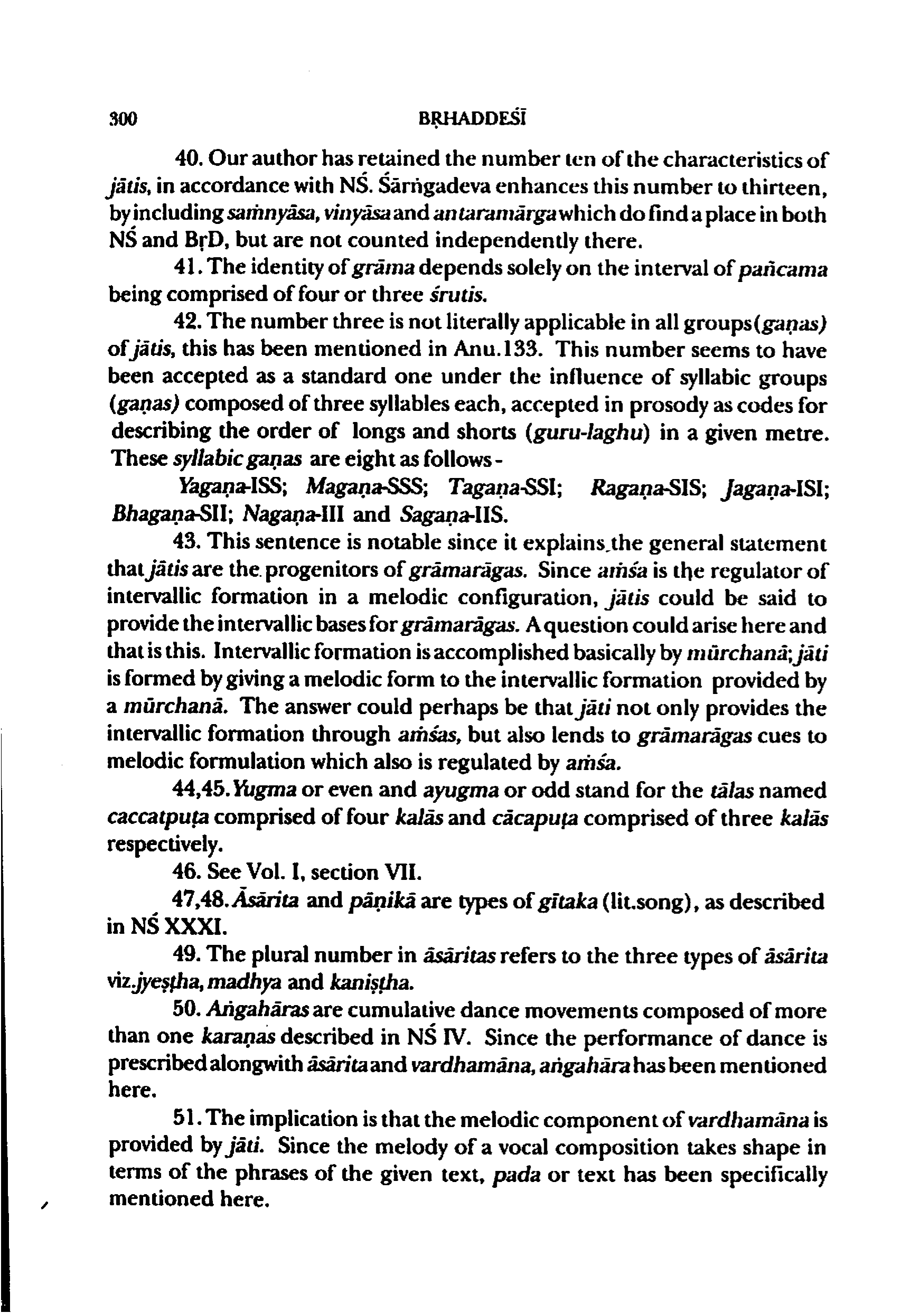
52. The word 'yatah' in this verse seems to imply that because the svaras have to match the angahāras performed in the order of āsārita, the formation or variation of amsas should be done in the text of the vardhamāna. Āsārita and vardhamāna have identical temporal dimensions with slight variation in splitting (shown below). These are the two gītakas alongwith which the performance of dance is prescribed in NS XXXI - <math>16 + 17 + 32 = 65 \text{ Kalās}</math> Asārita <math>9 + 8 + 16 + 32 = 65 \text{ Kalās}</math> Vardhamāna 53. 'Not exceptional' means those svaras, the operation of which in the formation of pentatonic varieties is not hindered by the rule of samvāda. 54. The strict prohibition of the omission of madhyama seems to be based on the fact that this svara is the link between gandharva and sāman, it being the tonic in sāman and the connecting point between the two triads of the heptad.11 55,56.The words utsarga and apavada are borrowed from Pūrvamimāmsā. The former stands for the general rule and the latter for the exception to the same.4 57. The import is not clear from here to the end of the Anu. 58. 'Sangati' stands for to and fro movement between two svaras in a jāti. NŚ uses 'paraspara-sañcāra' (mutual to and fro movement) and 'paras- paragamana '(mutual movement i.e. each of the two given svaras reaching out to the other) for this melodic phenomenon (cf.NŚ XXVIII. 96, 107). The word sangati is used even to-day in the oral tradition in the same meaning. It is notable that this relationship between any two svaras is purely melodic phenomenon; it does not depend on the acoustic relationship of samvāda. It is interesting to note that the word samvada has been used in our text in the place of sangati several times in the section on ragas. 59. Omission, in ancient thought, is not something absolute, rather it is the extreme state of sparseness. The svara that is omissible in a jāti is sparse in its complete state. 60. NŚ does not mention the mūrchanās of jātis. Matanga does this the first time. This innovation seems to be necessitated by the for introduction of fretted viņās (see Glossary). 61. Pañcapāṇi is another name of the tāla called ṣaṭpitāputraka, the third name being uttara.
1.[attribution]Śārngadeva includes samnyāsa, vinyāsa, and antaramārga as independent characteristics of jātis, increasing their count from ten to thirteenŠārngadeva enhances this number to thirteen, by including samnyāsa, vinyāsa and antaramārga
2.[attribution]Matanga is the first to mention the mūrchanās of jātis, an innovation necessitated by the introduction of fretted viņāsNŚ does not mention the mūrchanās of jātis. Matanga does this for the first time. This innovation seems to be necessitated by the introduction of fretted viņās
3.[definition]aṁśa is the regulator of intervallic formation in melodic configurationaṁśa is the regulator of intervallic formation in a melodic configuration
4.[definition]utsarga and apavada are terms borrowed from Pūrvamimāmsā meaning general rule and exception respectivelyThe words utsarga and apavada are borrowed from Pūrvamimāmsā. The former stands for the general rule and the latter for the exception to the same.
5.[definition]Sangati refers to to-and-fro movement between two svaras in a jāti and is a purely melodic phenomenon'Sangati' stands for to and fro movement between two svaras in a jāti. [...] It is notable that this relationship between any two svaras is purely melodic phenomenon; it does not depend on the acoustic relationship of samvāda.
6.[definition]Angahāras are cumulative dance movements composed of more than one karaṇaĀngahāras are cumulative dance movements composed of more than one karanas described in NS IV.
7.[enumeration]Āsārita has three types: jyeṣṭha, madhya, and kaniṣṭhaThe plural number in āsāritas refers to the three types of āsārita viz.jyeştha, madhya and kaniştha.
8.[enumeration]Eight syllabic gaṇas are used in prosody as codes for describing the order of longs and shorts in a given metreThese syllabic ganas are eight as follows - Yagaṇa-ISS; Magaṇa-SSS; Tagaṇa-SSI; Ragaṇa-SIS; Jagaṇa-ISI; Bhagana-SII; Nagana-III and Sagana-IIS.
9.[relation]jātis are the progenitors of grāmarāgas, providing intervallic bases through aṁśajātis are the progenitors of grāmarāgas. Since aṁśa is the regulator of intervallic formation in a melodic configuration, jātis could be said to provide the intervallic bases for grāmarāgas.
10.[relation]The identity of grāma depends solely on whether pañcama comprises four or three śrutisThe identity of grāma depends solely on the interval of pañcama being comprised of four or three śrutis.
11.[relation]madhyama is strictly required and serves as a link between gandharva and sāman, being the tonic in sāmanThe strict prohibition of the omission of madhyama seems to be based on the fact that this svara is the link between gandharva and sāman, it being the tonic in sāman and the connecting point between the two triads of the heptad.
12.[relation]Intervallic formation is accomplished basically by mūrchanā, while jāti provides melodic form to intervallic formationsIntervallic formation is accomplished basically by mürchanā; jāti is formed by giving a melodic form to the intervallic formation provided by a mūrchanā.
13.[structural]Āsārita and vardhamāna have identical temporal dimensions of 65 kalās with different internal divisionsĀsārita and vardhamāna have identical temporal dimensions with slight variation in splitting (shown below). These are the two gītakas alongwith which the performance of dance is prescribed in NS XXXI - 16 + 17 + 32 = 65 Kalās Asārita 9 + 8 + 16 + 32 = 65 Kalās Vardhamāna