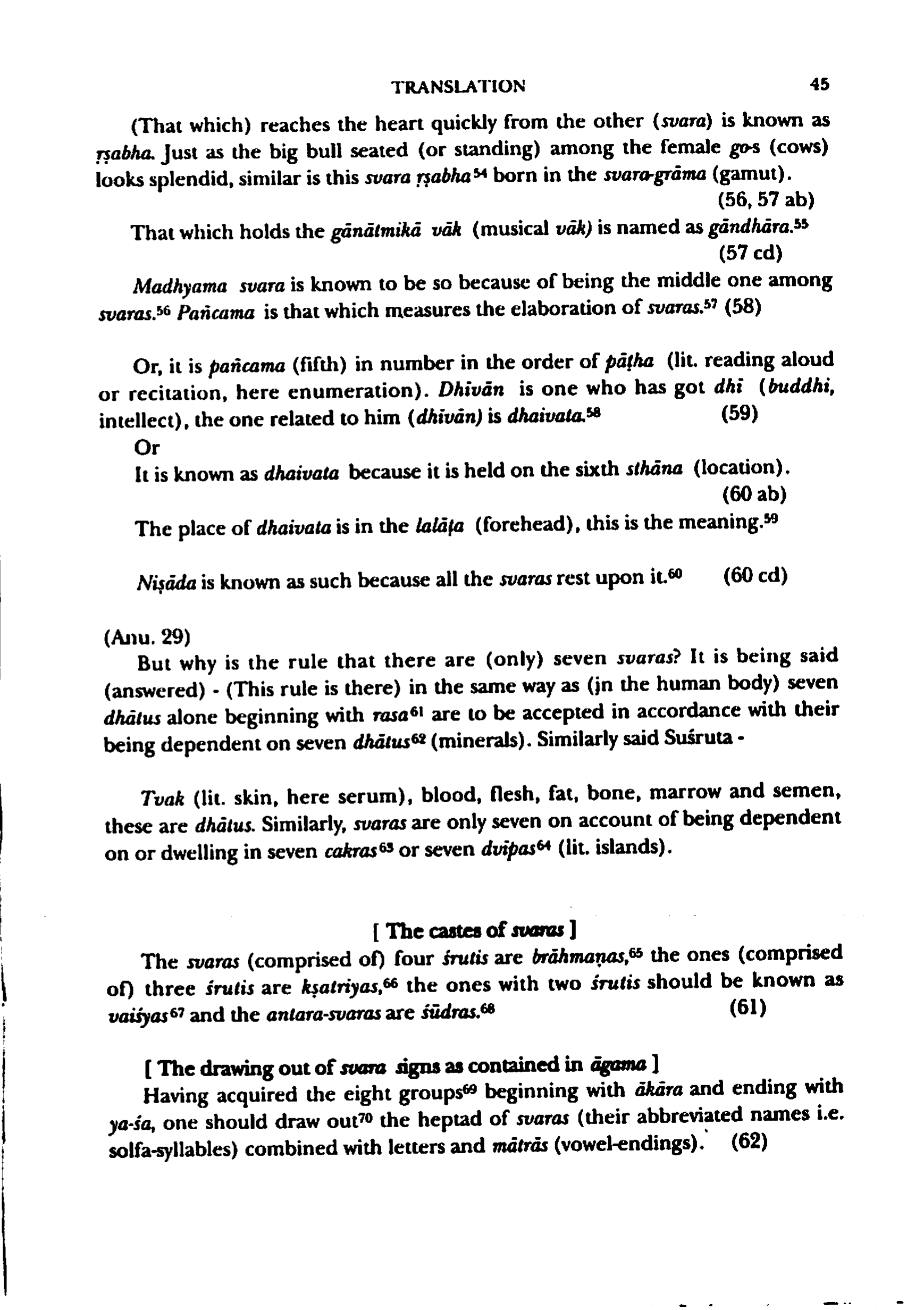
Source scans · vol_I_p031
recto · open full
scan recto
verso · open full
scan verso
Bṛhaddeśī · Volume I
pp. 44–45folio 031
Devanāgarī
प्राप्नोति हृदयं शीघ्रमन्यस्मादृषभः स्मृतः।
स्त्रीगवीषु यथा तिष्ठन् विभाति ऋषभो महान्।।
स्वरग्रामे समुत्पन्नः स्वरोऽयमृषभस्तथा6 ॥५६॥ वाचं गानात्मिकां धत्त इति गान्धारसंज्ञकः।2
स्वराणां मध्यमत्वाच्च मध्यमः स्वर इष्यते।।५७॥
स्वरान्तराणां विस्तारं यो मिमीते स पञ्चमः।
पाठक्रमेण गणने संख्यया पञ्चमोऽथवा।।५८।।
धीरस्यास्तीतियद्वा धीमांस्तत्सम्बन्धी धैवतः स्मृतः ।
२१षष्ठस्थानेपञ्चमेन धृतो यस्मात्तेनासौ30•त्ततोऽसी धैवतो मतः3॥५९॥
ललाटे धैवत इत्यर्थः।
निषीदन्ति स्वराः सर्वे निषादस्तेन कथ्यते।।६०॥
[स्वराणां सप्तसंख्यानियमः]
[अनु. २९]
31 ननु कथं सप्त स्वरा इति नियमः ? उच्यते— यथा सप्तधात्वाश्रितत्वेन सप्तैव धातवो रसादयो जेयाः । तथा चाह सुश्रुतः —
'त्वगसृङ्मांसमेदोऽस्थिमज्जाशुक्राणि धातवः4'1
इति। तथा सप्तचक्राश्रितत्वेन सप्तद्वीपाश्रितत्वेन वा सप्तैव स्वरा इति।87 स्वरजातयः ] चतुःश्रुतिस्वरा विप्रास्त्रिश्रुती क्षत्रियौ मतौ।
वैश्यौ द्विश्वतिकौ5 ज्ञेयौ शूद्रौ चान्तरकौ स्वरौ9 ३२।।६१।।
[आगमस्थः स्वरोद्धारः]
वर्गाष्टकं तु सम्प्राप्य अकारादियशान्तकम्।
वर्णमात्राः अन्समायुक्तमुद्धरेत् स्वरसप्तकम् ॥६२॥
English — Sharma (translation)
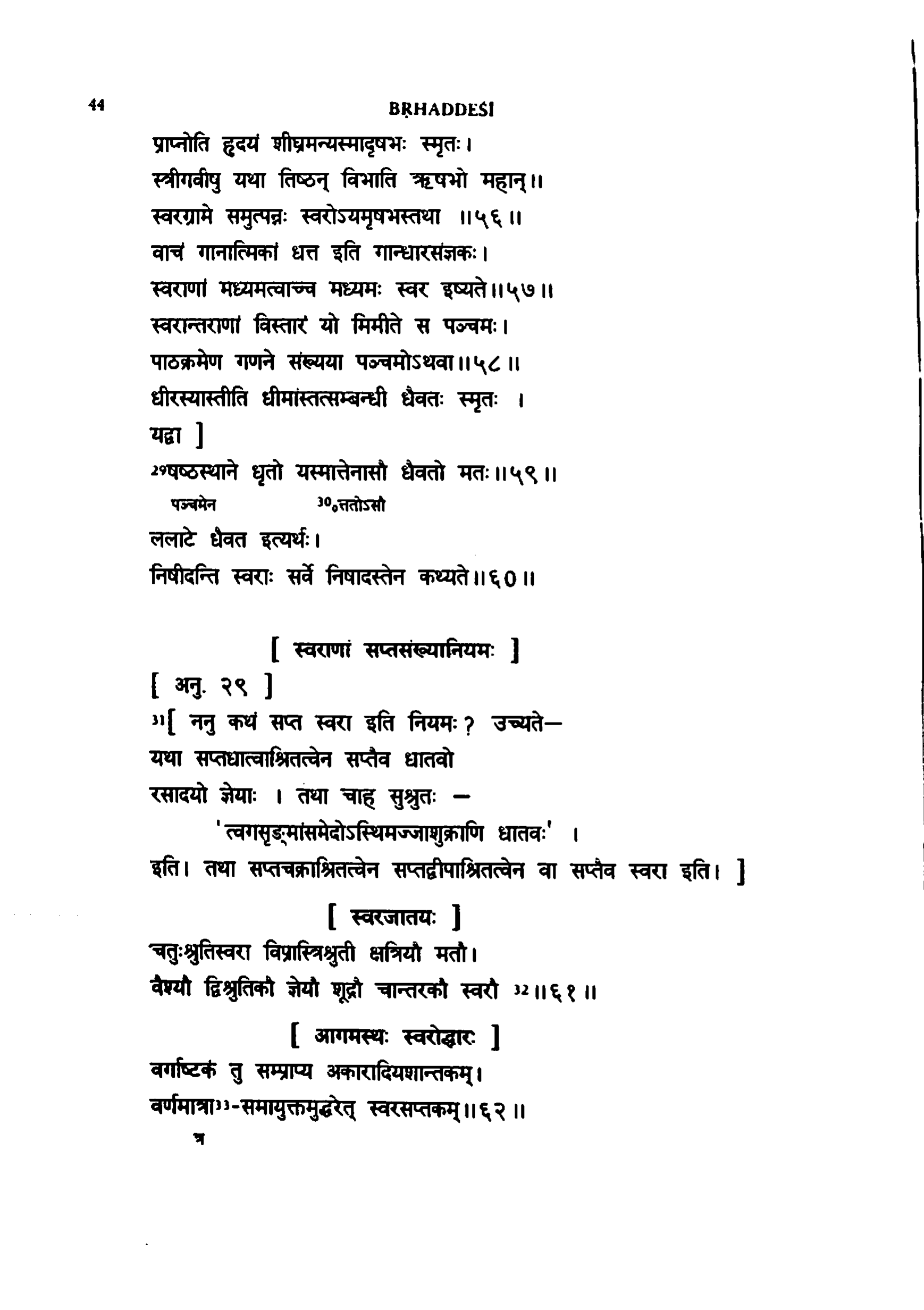
(That which) reaches the heart quickly from the other (svara) is known as rṣabha. Just as the big bull seated (or standing) among the female gos (cows) looks splendid, similar is this svara ṛṣabha 54 born in the svara-grāma (gamut)6. (56, 57 ab) That which holds the ganatmika vak (musical vak) is named as gandhara2.55 <math>(57 \text{ cd})</math> Madhyama svara is known to be so because of being the middle one among svaras.56 Pañcama is that which measures the elaboration of svaras.57 (58) Or, it is pañcama (fifth) in number in the order of pāṭha (lit. reading aloud or recitation, here enumeration). Dhīvān is one who has got dhī (buddhi, intellect), the one related to him (dhivan) is dhaivata.58
(59)
Or It is known as dhaivata because it is held on the sixth sthana (location)3. (60 ab) The place of dhaivata is in the lalāţa (forehead), this is the meaning.59 Niṣāda is known as such because all the svaras rest upon it.60 <math>(60 \text{ cd})</math> (Anu. 29) But why is the rule that there are (only) seven svaras? It is being said (answered) - (This rule is there) in the same way as (in the human body) seven dhātus alone beginning with rasa61 are to be accepted in accordance with their being dependent on seven dhātus62 (minerals). Similarly said Suśruta - Tvak (lit. skin, here serum), blood, flesh, fat, bone, marrow and semen, these are dhātus41. Similarly, svaras are only seven on account of being dependent on or dwelling in seven cakras 63 or seven dvipas 64 (lit. islands).
[The castes of sveres]
The svaras (comprised of) four śrutis are brāhmaņas,65 the ones (comprised of) three śrutis are kṣatriyas,66 the ones with two śrutis should be known as
(61)
vaisyas 67 and the antara-svaras are śūdras9.68
[The drawing out of svara signs as contained in agama]
Having acquired the eight groups beginning with akara and ending with ya-śa, one should draw out70 the heptad of svaras (their abbreviated names i.e. solfa-syllables) combined with letters and mātrās (vowel-endings).
(62)
1.[citation]Suśruta is cited as an authority for the doctrine of seven dhātusतथा चाह सुश्रुतः — 'त्वगसृङ्मांसमेदोऽस्थिमज्ज?ाशुक्राणि धातवः'
2.[definition]Gandhara svara is that which holds the ganatmika vak (musical vak)वाचं गानात्मिका धत्त इति गान्धारसंज?्ञकः।
3.[definition]Dhaivata svara is known as such because it is held on the sixth sthana (location)षष्ठस्थाने धृतो यस्मात्तेनासौ धैवतो मतः
4.[enumeration]The seven dhātus are: skin/serum, blood, flesh, fat, bone, marrow, and semenत्वगसृङ्मांसमेदोऽस्थिमज्ज?ाशुक्राणि धातवः
5.[enumeration]Svaras are classified by the number of śrutis they comprise: four śrutis (brāhmaņas), three śrutis (kṣatriyas), two śrutis (vaisyas)चतुःश्रुतिस्वरा विप्रास्त्रिश्रुती क्षत्रियौ मतौ। वैश्यौ द्विश्वतिकौ
6.[relation]ṛṣabha svara is born in the svara-grāma (gamut)स्वरग्रामे समुत्पन्नः स्वरोऽयमृषभस्तथा
7.[relation]Svaras are seven in number on account of being dependent on or dwelling in seven cakrasतथा सप्तचक्राश्रितत्वेन सप्तद्वीपाश्रितत्वेन वा सप्तैव स्वरा इति।
8.[relation]Svaras are seven in number on account of being dependent on or dwelling in seven dvipas (islands)तथा सप्तचक्राश्रितत्वेन सप्तद्वीपाश्रितत्वेन वा सप्तैव स्वरा इति।
9.[relation]Antara-svaras are classified as śūdras in the caste hierarchy of svara typesशूद्रौ चान्तरकौ स्वरौ
10.[relation]There are seven dhātus beginning with rasa that constitute the basis for seven svarasयथा सप्तधात्वाश्रितत्वेन सप्तैव धातवो रसादयो ज?्ञेया
1.[citation] Suśruta is cited as an authority for the doctrine of seven dhātusSimilarly said Suśruta - Tvak (lit. skin, here serum), blood, flesh, fat, bone, marrow and semen, these are dhātus
2.[definition] Gandhara svara is that which holds the ganatmika vak (musical vak)That which holds the ganatmika vak (musical vak) is named as gandhara
3.[definition] Dhaivata svara is known as such because it is held on the sixth sthana (location)It is known as dhaivata because it is held on the sixth sthana (location)
4.[enumeration] The seven dhātus are: skin/serum, blood, flesh, fat, bone, marrow, and semenTvak (lit. skin, here serum), blood, flesh, fat, bone, marrow and semen, these are dhātus
6.[relation] ṛṣabha svara is born in the svara-grāma (gamut)born in the svara-grāma (gamut)
9.[relation] Antara-svaras are classified as śūdras in the caste hierarchy of svara typesthe antara-svaras are śūdras