Source scans · vol_I_p032
recto · open full
scan recto
verso · open full
scan verso
Bṛhaddeśī · Volume I
pp. 46–47folio 032
Devanāgarī (Bṛhaddeśī)
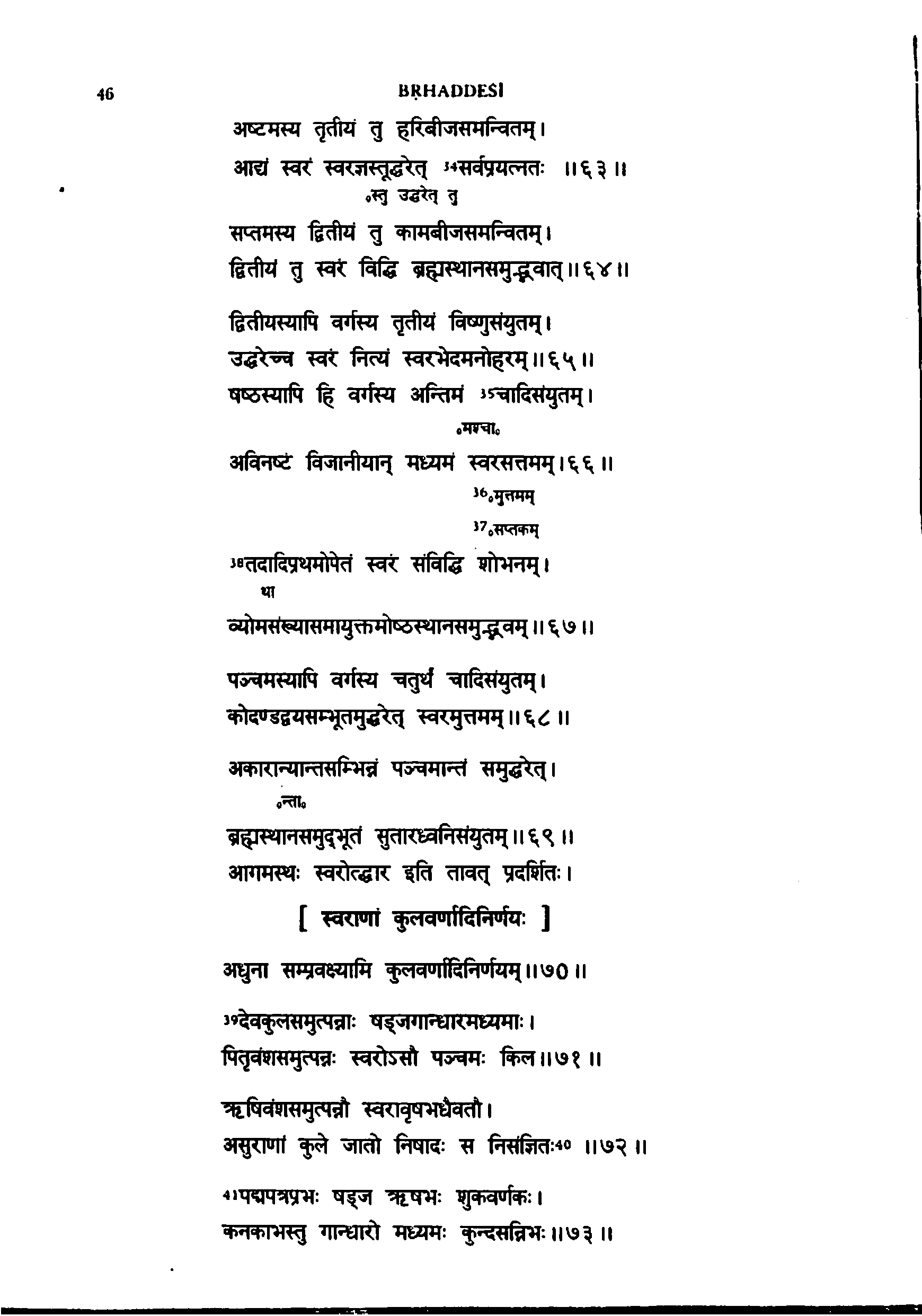
अष्टमस्य तृतीयं तु हरिबीजसमन्वितम्।
आद्यं स्वरं6 स्वरज्ञस्तूद्धरेत्•स्तु उद्धरेत् तु उभ्सर्वप्रयत्नतः ।।६३।।
सप्तमस्य द्वितीयं तु कामबीजसमन्वितम्। द्वितीयं तु स्वरं विद्धि7 ब्रह्मस्थानसमुद्भवात्॥६४॥10 द्वितीयस्यापि वर्गस्य तृतीयं विष्णुसंयुतम्। उद्धरेच्च स्वरं नित्यं8 स्वरभेदमनोहरम्॥६५॥
षष्ठस्यापि हि वर्गस्य अन्तिमं अन्तिमं•मग्चाः अन्तिसंयुतम्।
अविनष्टं विजानीयान् मध्यमं स्वरसत्तमम्36₀मुत्तमम्37॰सप्तकम्।६६॥
म्बतदादिप्रथमोपेतंथा स्वरं संविद्धि शोभनम्। व्योमसंख्यासमायुक्तमोष्ठस्थानसमुद्भवम् ॥६७॥2
पञ्चमस्यापि वर्गस्य चतुर्थं चादिसंयुतम्।
कोदण्डद्वयसम्भूतमुद्धरेत् स्वरमुत्तमम्।।६८॥
अकारान्यान्तसम्भिन्नंुन्ताः, पञ्चमान्तं समुद्धरेत्।
ब्रह्मस्थानसमुद्भूतं सुतारध्वनिसंयुतम् ॥६९॥ आगमस्थः स्वरोत्द्वार इति तावत् प्रदर्शितः।31
[स्वराणां कुलवर्णादिनिर्णयः]
अधुना सम्प्रवक्ष्यामि कुलवर्णादिनिर्णयम्।।७०।।12
५९देवकुलसमुत्पन्नाः षड्जगान्धारमध्यमाः।
पितृवंशसमुत्पन्नः स्वरोऽसौ पञ्चमः किल।।७१।।9 ऋषिवंशसमुत्पन्नौ स्वरावृषभधेवतौ।4 असुराणां कुले जातो निषादः स निसंज्ञितः ।। ७२ ॥13
4)पद्मपत्रप्रभः षड्ज ऋषभः शुकवर्णकः।
कनकाभस्तु गान्धारो मध्यमः कुन्दसन्निभः॥७३॥ - . . . . .
English — Sharma (translation)
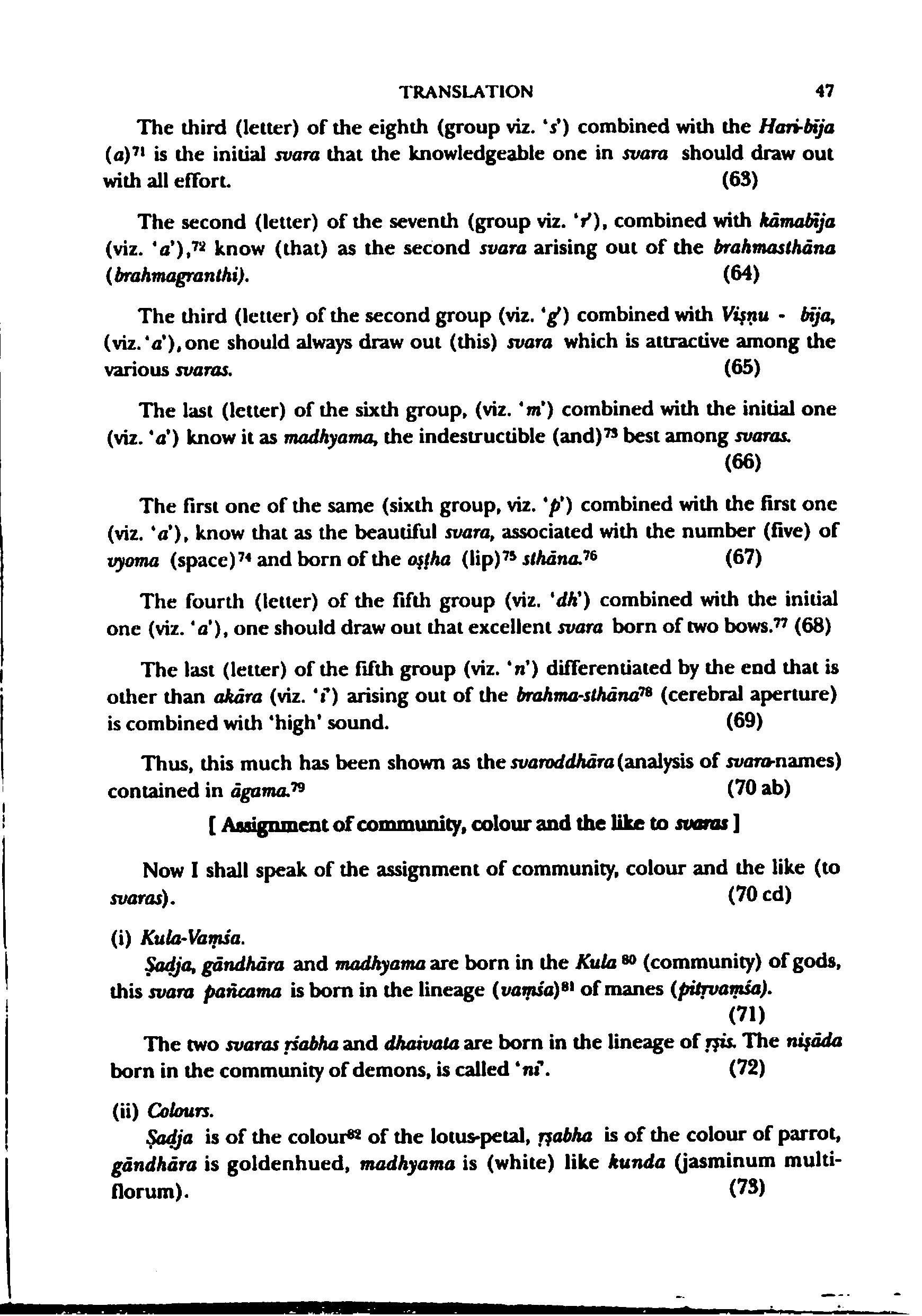
The third (letter) of the eighth (group viz. 's') combined with the Hari-bija <math>(a)^{71}</math> is the initial svara that the knowledgeable one in svara should draw out with all effort.
(63)
The second (letter) of the seventh (group viz. 'r'), combined with kāmabīja (viz. 'a'),72 know (that) as the second svara7 arising out of the brahmasthāna
(64)
(brahmagranthi). The third (letter) of the second group (viz. 'g') combined with Viṣṇu - bīja, (viz. 'a'), one should always draw out (this) svara8 which is attractive among the
(65)
various svaras. The last (letter) of the sixth group, (viz. 'm') combined with the initial one (viz. 'a') know it as madhyama, the indestructible (and)73 best among svaras.
(66)
The first one of the same (sixth group, viz. 'p') combined with the first one (viz. 'a'), know that as the beautiful svara, associated with the number (five) of
(67)
vyoma (space)74 and born of the ostha (lip)75 sthāna.76 The fourth (letter) of the fifth group (viz. 'dh') combined with the initial one (viz. 'a'), one should draw out that excellent svara born of two bows.77 (68) The last (letter) of the fifth group (viz. 'n') differentiated by the end that is other than akāra (viz. 'i') arising out of the brahma-sthāna78 (cerebral aperture) is combined with 'high' sound.
(69)
Thus, this much has been shown as the svaroddhāra (analysis of svara-names) (70 ab) contained in agama.79
[Assignment of community, colour and the like to svaras]
Now I shall speak of the assignment of community, colour and the like (to <math>(70 \text{ cd})</math> svaras). (i) Kula-Vamśa. Şadja, gāndhāra and madhyama are born in the Kula 80 (community) of gods, this svara pañcama is born in the lineage (vaṃśa)81 of manes (pitṛvaṃśa).9
(71)
The two svaras ršabha and dhaivata are born in the lineage of rsis.4 The niṣāda
(72)
born in the community of demons, is called 'ni'. (ii) Colours. Ṣadja is of the colour of the lotus-petal, ṛṣabha is of the colour of parrot, gāndhāra is goldenhued, madhyama is (white) like kunda (jasminum multi-
(73)
florum).
1.[citation] Agama is the textual source containing the svaroddhāra teachingsआगमस्थः स्वरोत्द्वार इति तावत् प्रदर्शितः।
2.[definition] Sthāna is the place of articulation from which a svara is producedव्योमसंख्यासमायुक्तमोष्ठस्थानसमुद्भवम् ॥६७॥
3.[definition] Svaroddhāra is the analysis or extraction of svara-names contained in agamaआगमस्थः स्वरोत्द्वार इति तावत् प्रदर्शितः।
4.[enumeration] Ṛṣabha and dhaivata are born in the vaṃśa (lineage) of ṛṣis (sages)ऋषिवंशसमुत्पन्नौ स्वरावृषभधेवतौ।
5.[enumeration] Ṣadja, gāndhāra and madhyama are born in the divine Kula (community)देवकुलसमुत्पन्ना षड्जगान्धारमध्यमा।
6.[relation] Hari-bija is combined with the third letter of the eighth group to form the initial svaraअष्टमस्य तृतीयं तु हरिबीजसमन्वितम्। आद्यं स्वरं
7.[relation] Kāmabīja is combined with the second letter of the seventh group to form the second svaraसप्तमस्य द्वितीयं तु कामबीजसमन्वितम्। द्वितीयं तु स्वरं विद्धि
8.[relation] Viṣṇu-bīja is combined with the third letter of the second group to form a svaraद्वितीयस्यापि वर्गस्य तृतीयं विष्णुसंयुतम्। उद्धरेच्च स्वरं नित्यं
9.[relation] Pañcama svara is born in the pitṛvaṃśa (lineage of manes)पितृवंशसमुत्पन्नः स्वरोऽसौ पञ्चमः किल।।७१।।
10.[relation] Brahmasthāna is the point of origin for the second svaraद्वितीयं तु स्वरं विद्धि ब्रह्मस्थानसमुद्भवात्॥६४॥
12.[relation] Kula (divine community) and vaṃśa (lineage) are assigned as attributes to svarasअधुना सम्प्रवक्ष्यामि कुलवर्णादिनिर्णयम्।।७०।।
13.[relation] Niṣāda is born in the community of demons (asuras)असुराणा कुले ज?ातो निषादः स निसंज?्ञितः ।। ७२ ॥
1.[citation]Agama is the textual source containing the svaroddhāra teachingsthe svaroddhāra (analysis of svara-names) contained in agama.79
2.[definition]Sthāna is the place of articulation from which a svara is producedknow that as the beautiful svara, associated with the number (five) of vyoma (space)74 and born of the ostha (lip)75 sthāna.
3.[definition]Svaroddhāra is the analysis or extraction of svara-names contained in agamaThus, this much has been shown as the svaroddhāra (analysis of svara-names) contained in agama.
4.[enumeration]Ṛṣabha and dhaivata are born in the vaṃśa (lineage) of ṛṣis (sages)The two svaras ršabha and dhaivata are born in the lineage of rsis.
5.[enumeration]Ṣadja, gāndhāra and madhyama are born in the divine Kula (community)Şadja, gāndhāra and madhyama are born in the Kula80 (community) of gods,
6.[relation]Hari-bija is combined with the third letter of the eighth group to form the initial svaraThe third (letter) of the eighth (group viz. 's') combined with the Hari-bija (a)^{71} is the initial svara
7.[relation]Kāmabīja is combined with the second letter of the seventh group to form the second svaraThe second (letter) of the seventh (group viz. 'r'), combined with kāmabīja (viz. 'a'),72 know (that) as the second svara
8.[relation]Viṣṇu-bīja is combined with the third letter of the second group to form a svaraThe third (letter) of the second group (viz. 'g') combined with Viṣṇu - bīja, (viz. 'a'), one should always draw out (this) svara
9.[relation]Pañcama svara is born in the pitṛvaṃśa (lineage of manes)this svara pañcama is born in the lineage (vaṃśa)81 of manes (pitṛvaṃśa).
10.[relation]Brahmasthāna is the point of origin for the second svaraknow (that) as the second svara arising out of the brahmasthāna (brahmagranthi).
11.[relation]Ostha (lips) is a sthāna (articulation place) for the pañcama svaraborn of the ostha (lip)75 sthāna.
12.[relation]Kula (divine community) and vaṃśa (lineage) are assigned as attributes to svarasNow I shall speak of the assignment of community, colour and the like (to svaras).
13.[relation]Niṣāda is born in the community of demons (asuras)The niṣāda born in the community of demons, is called 'ni'.
14.[structural]Vyoma has the numerical association of five (pañcama svara)associated with the number (five) of vyoma (space)74