Source scans · vol_I_p033
recto · open full
scan recto
verso · open full
scan verso
Bṛhaddeśī · Volume I
pp. 48–49folio 033
Devanāgarī (Bṛhaddeśī)
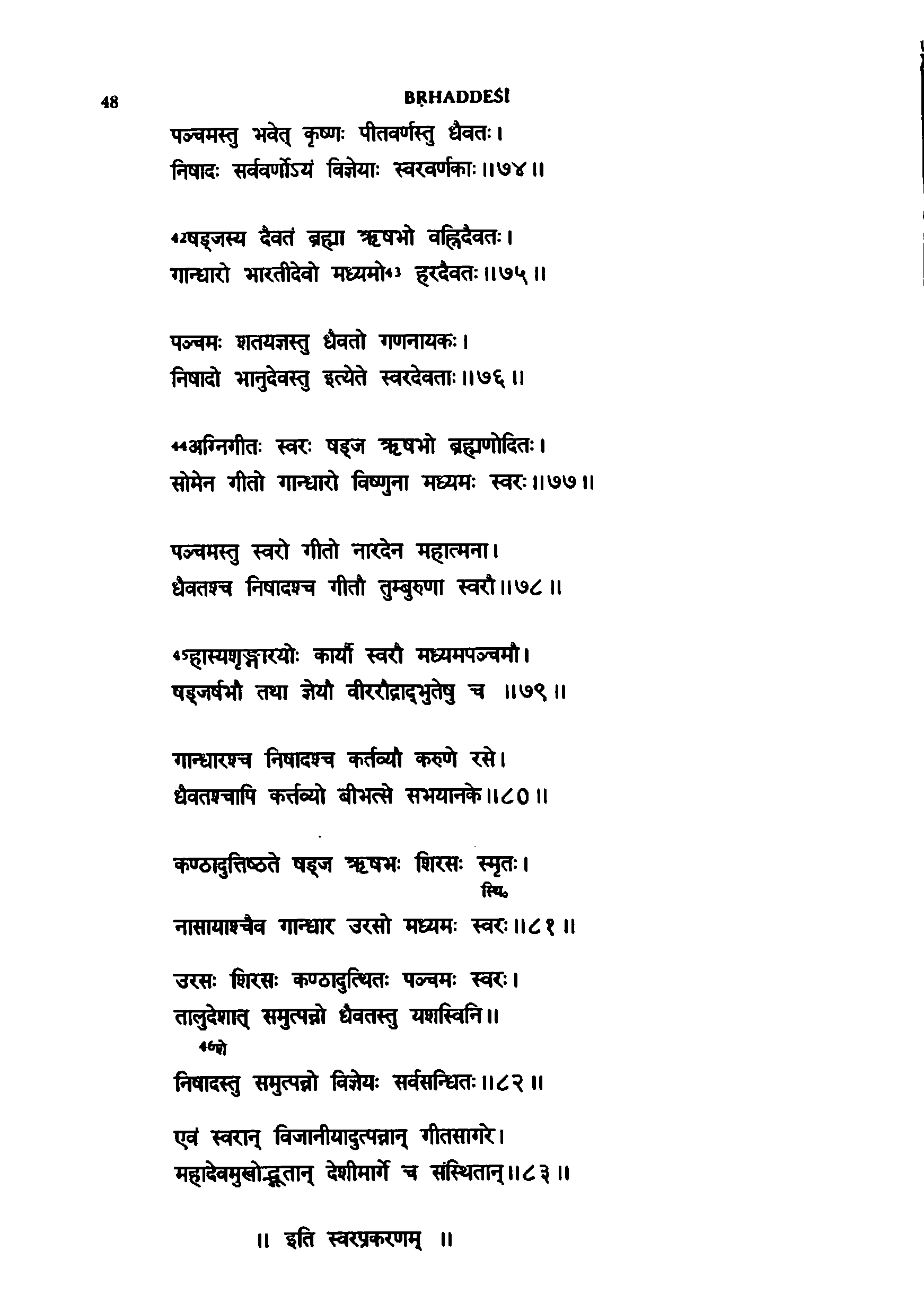
पञ्चमस्तु भवेत् कृष्णः पीतवर्णस्तु धैवतः।
निषादः सर्ववर्णोऽयं विज्ञेयाः स्वरवर्णकाः॥७४॥
यड्जस्य दैवतं ब्रह्मा ऋषभो वह्निदैवतः।
गान्धारो भारतीदेवो मध्यमोभ् हरदैवतः॥७५॥
पञ्चमः शतयज्ञस्तु धैवतो गणनायकः।
निषादो भानुदेवस्तु इत्येते स्वरदेवताः॥७६॥ 44अग्निगीतः स्वरः षड्ज ऋषभो ब्रह्मणोदितः। सोमेन गीतो गान्धारो विष्णुना मध्यमः स्वरः॥७७॥ पञ्चमस्तु स्वरो गीतो नारदेन महात्मना।51 धैवतश्च निषादश्च गीतौ तुम्बुरुणा स्वरौ।2।७८।।4
व्हास्यशृङ्गारयोः कार्यौ स्वरौ मध्यमपञ्चमौ।
षड्जर्षभौ तथा ज्ञेयौ वीररौद्राद्भुतेषु च ॥७९॥
गान्धारइच निषादइच कर्तव्यौ करुणे रसे।
धैवतश्चापि कर्त्तव्यो बीभत्से सभयानके।।८०॥
कण्ठादुत्तिष्ठते षड्ज ऋषभः शिरसः स्मृतःस्यि
नासायाश्चैव गान्धार उरसो मध्यमः स्वरः॥८१॥
उरसः शिरसः कण्ठादुत्थितः पञ्चमः स्वरः।
तालुदेशात्46हो समुत्पन्नो धैवतस्तु यशस्विनि।।
निषादस्तु समुत्पन्नो विज्ञेयः सर्वसन्धितः ॥८२॥
एवं स्वरान् विजानीयादुत्पन्नान् गीतसागरे।
महादेवमुखोद्भतान् देशीमार्गे च संस्थितान्।।८३।।
॥ इति स्वरप्रकरणम् ॥
English — Sharma (translation)
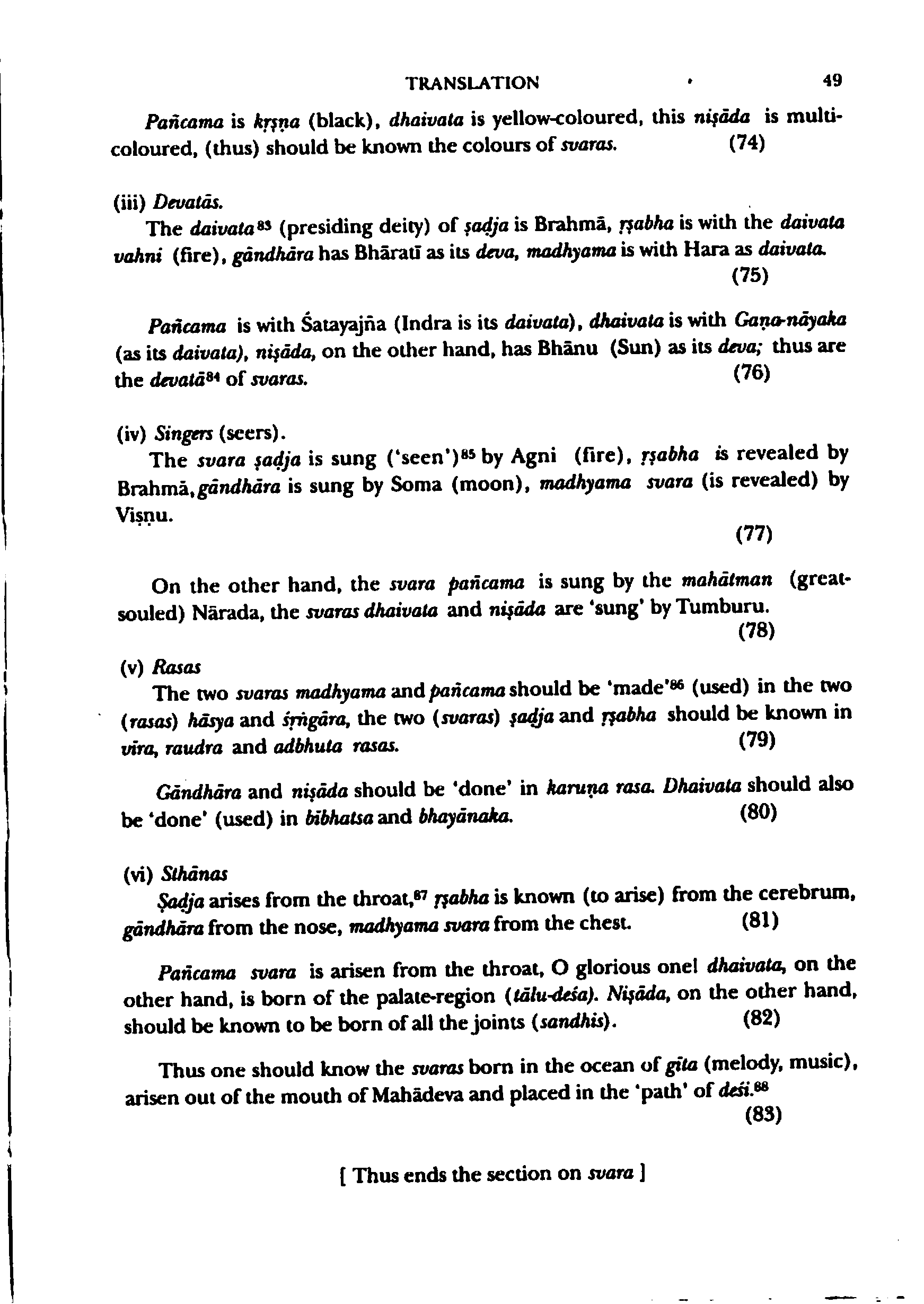
Pañcama is kṛṣṇa (black), dhaivata is yellow-coloured, this niṣāda is multi- coloured, (thus) should be known the colours of svaras.
(74)
(iii) Devatās. The daivata 83 (presiding deity) of şadja is Brahmā, ṛṣabha is with the daivata vahni (fire), gandhara has Bharati as its deva, madhyama is with Hara as daivata.
(75)
Pañcama is with Satayajña (Indra is its daivata)3, dhaivata is with Gaṇa-nāyaka (as its daivata), niṣāda, on the other hand, has Bhānu (Sun) as its deva; thus are
(76)
the devatā84 of svaras. (iv) Singers (seers). The svara şadja is sung ('seen')85 by Agni (fire), ṛṣabha is revealed by Brahmā, gāndhāra is sung by Soma (moon), madhyama svara (is revealed) by Vișnu.
(77)
On the other hand, the svara pancama is sung by the mahatman (great- souled) Nārada51, the svaras dhaivata and niṣāda are 'sung' by Tumburu.42
(78)
(v) Rasas The two svaras madhyama and pañcama should be 'made'86 (used) in the two (rasas) hāsya and śṛṅgāra, the two (svaras) şadja and ṛṣabha should be known in
(79)
vira, raudra and adbhuta rasas. Gāndhāra and niṣāda should be 'done' in karuņa rasa. Dhaivata should also
(80)
be 'done' (used) in bibhatsa and bhayānaka. (vi) Sthānas Ṣadja arises from the throat, 67 rṣabha is known (to arise) from the cerebrum, gāndhāra from the nose, madhyama svara from the chest.
(81)
Pañcama svara is arisen from the throat, O glorious onel dhaivata, on the other hand, is born of the palate-region (tālu-deśa). Niṣāda, on the other hand, should be known to be born of all the joints (sandhis).
(82)
Thus one should know the svaras born in the ocean of gita (melody, music), arisen out of the mouth of Mahadeva and placed in the 'path' of desi.68
(83)
[Thus ends the section on svara]
1.[relation] Nārada is the singer (seer) associated with the svara pañcamaपञ्चमस्तु स्वरो गीतो नारदेन महात्मना।
2.[relation] Tumburu is the singer (seer) associated with the svaras dhaivata and niṣādaधैवतश्च निषादश्च गीतौ तुम्बुरुणा स्वरौ।
4.[relation]Tumburu sings both dhaivata and niṣāda svaras togetherधैवतश्च निषादश्च गीतौ तुम्बुरुणा स्वरौ।।७८।।
5.[structural] Nārada is characterized as mahatman (great-souled)पञ्चमस्तु स्वरो गीतो नारदेन महात्मना।
1.[relation]Nārada is the singer (seer) associated with the svara pañcamathe svara pancama is sung by the mahatman (great- souled) Nārada
2.[relation]Tumburu is the singer (seer) associated with the svaras dhaivata and niṣādathe svaras dhaivata and niṣāda are 'sung' by Tumburu.
3.[relation]Satayajña (identified with Indra) is the presiding deity of the svara pañcamaPañcama is with Satayajña (Indra is its daivata)
4.[relation] Tumburu sings both dhaivata and niṣāda svaras togetherthe svaras dhaivata and niṣāda are 'sung' by Tumburu.
5.[structural]Nārada is characterized as mahatman (great-souled)the mahatman (great- souled) Nārada