Source scans · vol_I_p034
recto · open full
scan recto
verso · open full
scan verso
Bṛhaddeśī · Volume I
pp. 0–51folio 034
Devanāgarī (Bṛhaddeśī)
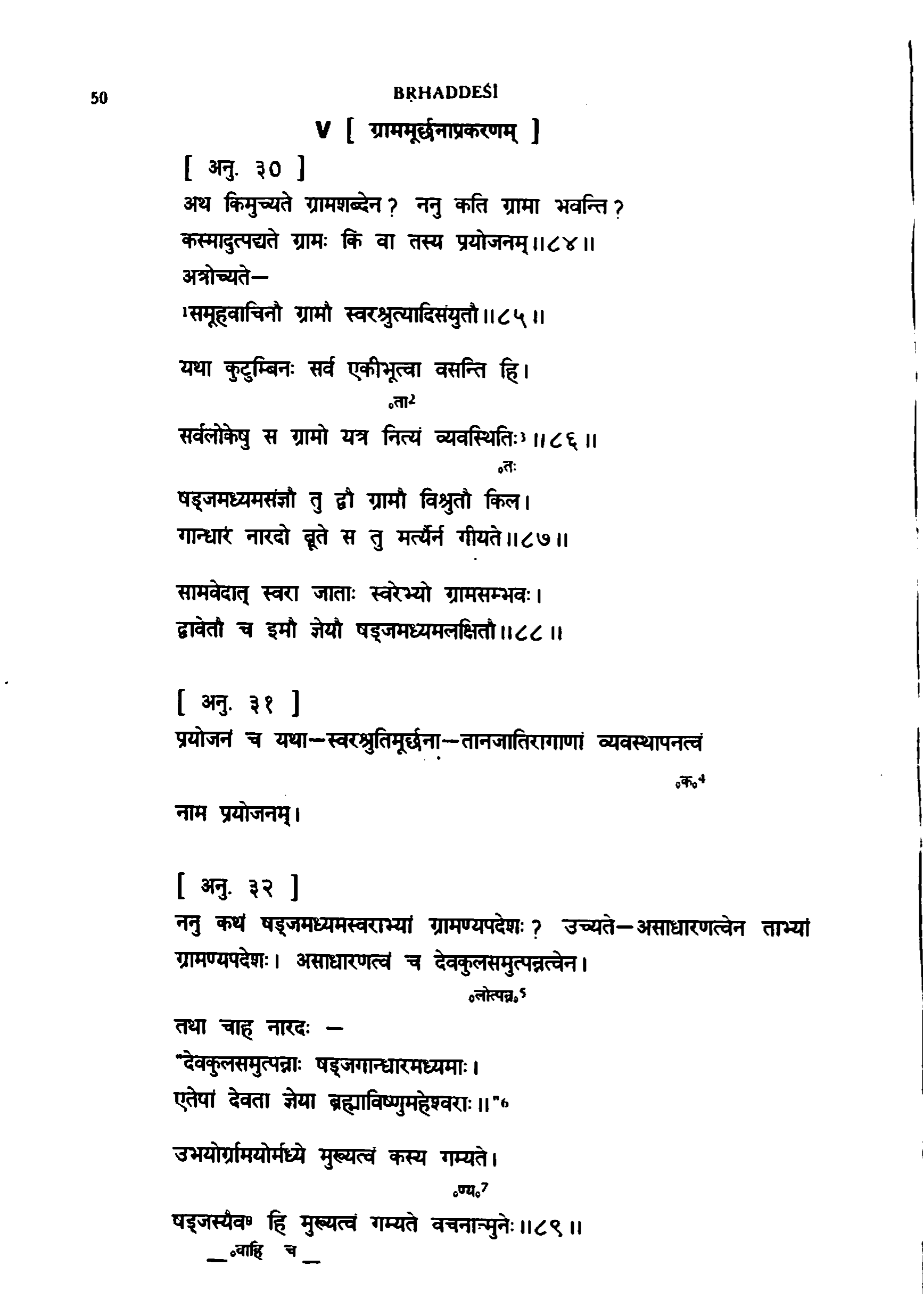
V [ ग्राममूर्छनाप्रकरणम् ]
[अनु. ३०]
अथ किमुच्यते ग्रामशब्देन ? ननु कति ग्रामा भवन्ति ?
कस्मादुत्पद्यते ग्रामः कि वा तस्य प्रयोजनम्।।८४॥
अश्रोच्यते— म्समूहवाचिनौ ग्रामौ स्वरश्रुत्यादिसंयुतौ4 ॥८५॥
यथा कुटुम्बिनः सर्व एकीभूत्वा₀ता² वसन्ति हि।
सर्वलोकेषु स ग्रामो यत्र नित्यं व्यवस्थिति5₄तः ।।८६॥
षड्जमध्यमसंज्ञौ तु द्वौ ग्रामौ विश्रुतौ किल6
गान्धारं नारदो बूते स तु मर्त्यैर्न गीयते7॥८७॥
सामवेदात् स्वरा जाताः स्वरभ्यो ग्रामसम्भवः।
द्वावेतौ च इमौ ज्ञेयौ षड्जमध्यमलक्षितौ॥८८॥
[अनु. ३१]
प्रयोजनं च यथा—स्वरश्रुतिमूर्छना—तानजातिरागाणां व्यवस्थापनत्वं o404
नाम प्रयोजनम्।
[अनु. ३२]
ननु कथं षड्जमध्यमस्वराभ्यां ग्रामण्यपदेशः ? उच्यते—असाधारणत्वेन ताभ्यां
ग्रामण्यपदेशः। असाधारणत्वं च देवकुलसमुत्पन्नत्वेन9₀लोत्पन्न,5
तथा चाह नारदः –
"देवकुलसमुत्पन्नाः षड्जगान्धारमध्यमाः।
एतेपां देवता जेया ब्रह्माविष्णुमहेश्वरा2ः॥ "6
उभयोग्रामियोर्मध्ये मुख्यत्वं कस्य गम्यतेुण्युः
षड्जस्यैव हि मुख्यत्वं गम्यते वचनान्भुनेः॥८९॥ __ु•वाह्रि च __
English — Sharma
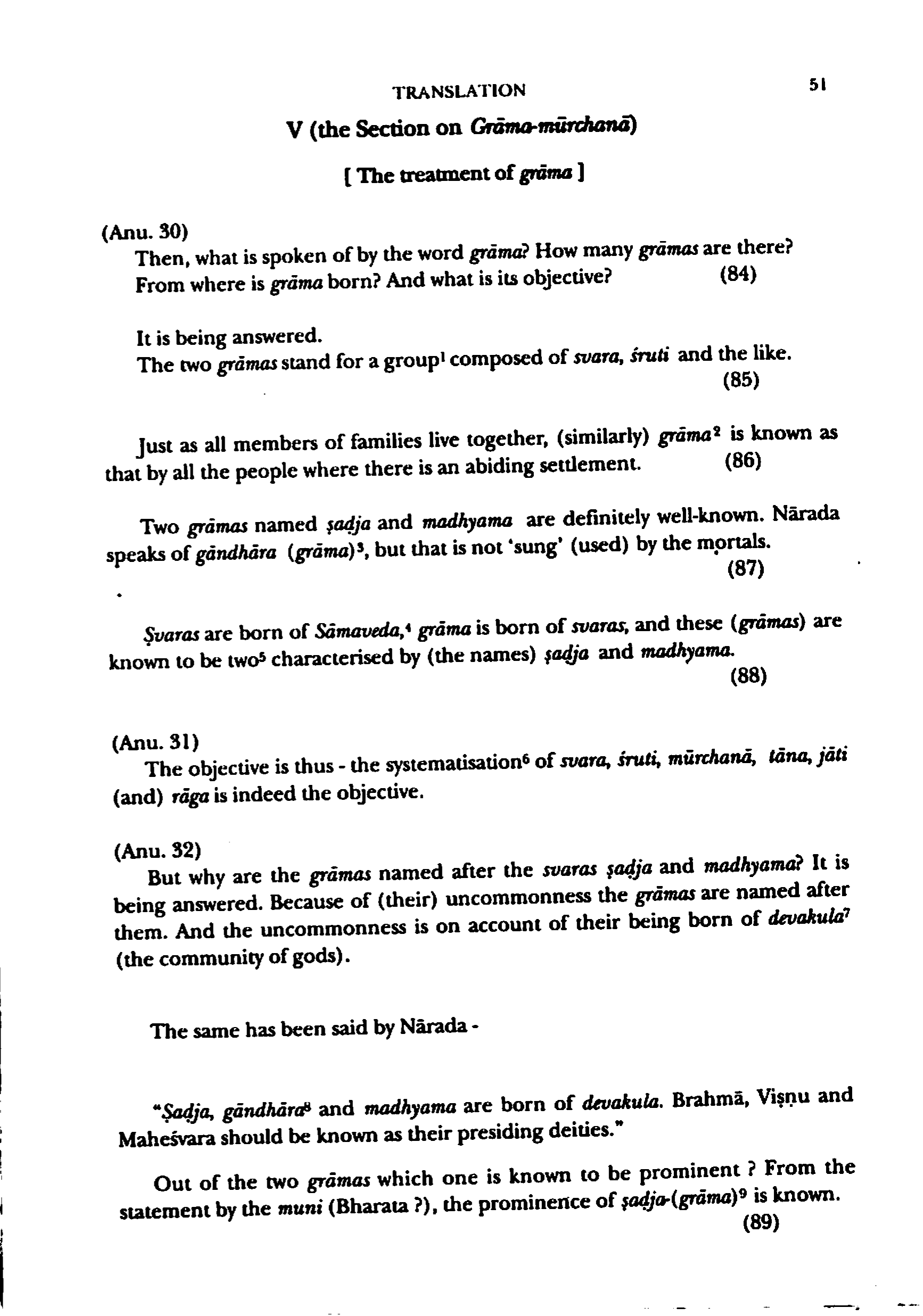
V (the Section on Grāma-mūrchanā)
[The treatment of grama]
(Anu. 30) Then, what is spoken of by the word grāma? How many grāmas are there? From where is grāma born? And what is its objective?
(84)
It is being answered. The two grāmas stand for a group! composed of svara, śruti and the like.4
(85)
Just as all members of families live together, (similarly) grāma? is known as (86) that by all the people where there is an abiding settlement.5 Two grāmas named şadja and madhyama are definitely well-known.6 Nārada speaks of gandhara (grama)3, but that is not 'sung' (used) by the mortals.7
(87)
Şvaras are born of Sāmaveda, grāma is born of svaras8, and these (grāmas) are known to be two5 characterised by (the names) şadja and madhyama.
(88)
(Anu. 31) The objective is thus - the systematisation6 of svara, śruti, mūrchanā, tāna, jāti (and) rāga1110 is indeed the objective. (Anu. 32) But why are the gramas named after the svaras sadja and madhyama? It is being answered. Because of (their) uncommonness the grāmas are named after them. And the uncommonness is on account of their being born of devakula?9 (the community of gods). The same has been said by Nārada - "Ṣadja, gāndhāra" and madhyama are born of devakula. Brahmā, Viṣṇu and Maheśvara should be known as their presiding deities."2 Out of the two grāmas which one is known to be prominent? From the statement by the muni (Bharata?), the prominence of şadja-(grāma)9 is known.12
(89)
1.[attribution] Ṣadja, Gāndhāra and Madhyama svaras are born of devakula (divine community)देवकुलसमुत्पन्ना षड्जगान्धारमध्यमा
2.[attribution] Brahmā, Viṣṇu and Maheśvara are the presiding deities of Ṣadja, Gāndhāra and Madhyamaएतेपा देवता ज?ेया ब्रह्माविष्णुमहेश्वरा
3.[citation]This section concerns the treatment of grāma-mūrchanāV [ ग्राममूर्छनाप्रकरणम् ] [ अनु. ३० ]
4.[definition] Grāma is composed of svara, śruti and related elements functioning as a groupम्समूहवाचिनौ ग्रामौ स्वरश्रुत्यादिसंयुतौ
5.[definition] Grāma is that which has an abiding settlement known among all peopleसर्वलोकेषु स ग्रामो यत्र नित्यं व्यवस्थिति
6.[enumeration] Two grāmas named Ṣadja and Madhyama are well-knownषड्जमध्यमसंज?्ञौ तु द्वौ ग्रामौ विश्रुतौ किल
7.[relation] Gandhāra grāma is mentioned by Nārada but is not used by mortalsगान्धारं नारदो बूते स तु मर्त्यैर्न गीयते
8.[relation] Svaras are born of Sāmavedaसामवेदात् स्वरा ज?ाता स्वरभ्यो ग्रामसम्भवः
9.[relation] Grāmas are named Ṣadja and Madhyama because of their uncommonness arising from being born of devakulaअसाधारणत्वेन ताभ्या ग्रामण्यपदेशः। असाधारणत्वं च देवकुलसमुत्पन्नत्वेन
12.[structural] Ṣadja grāma is prominent over Madhyama grāma according to the muniषड्जस्यैव हि मुख्यत्वं गम्यते वचनान्भुने॥८९॥
1.[attribution]Ṣadja, Gāndhāra and Madhyama svaras are born of devakula (divine community)"Ṣaḍja, gāndhāra" and madhyama are born of devakula.
2.[attribution]Brahmā, Viṣṇu and Maheśvara are the presiding deities of Ṣadja, Gāndhāra and MadhyamaBrahmā, Viṣṇu and Maheśvara should be known as their presiding deities."
4.[definition]Grāma is composed of svara, śruti and related elements functioning as a groupThe two grāmas stand for a group! composed of svara, śruti and the like.
5.[definition]Grāma is that which has an abiding settlement known among all peoplegrāma? is known as (86) that by all the people where there is an abiding settlement.
6.[enumeration]Two grāmas named Ṣadja and Madhyama are well-knownTwo grāmas named şadja and madhyama are definitely well-known.
7.[relation]Gandhāra grāma is mentioned by Nārada but is not used by mortalsNārada speaks of gandhara (grama)3, but that is not 'sung' (used) by the mortals.
8.[relation]Svaras are born of SāmavedaŞvaras are born of Sāmaveda, grāma is born of svaras
9.[relation]Grāmas are named Ṣadja and Madhyama because of their uncommonness arising from being born of devakulaBecause of (their) uncommonness the grāmas are named after them. And the uncommonness is on account of their being born of devakula?
10.[relation]Mūrchanā is among the elements systematized by grāmaThe objective is thus - the systematisation of svara, śruti, mūrchanā, tāna, jāti (and) rāga
11.[relation]Tāna is among the elements systematized by grāmaThe objective is thus - the systematisation of svara, śruti, mūrchanā, tāna, jāti (and) rāga
12.[structural]Ṣadja grāma is prominent over Madhyama grāma according to the muniFrom the statement by the muni (Bharata?), the prominence of şadja-(grāma)9 is known.