Source scans · vol_I_p035
recto · open full
scan recto
verso · open full
scan verso
Bṛhaddeśī · Volume I
pp. 52–53folio 035
Devanāgarī (Bṛhaddeśī)
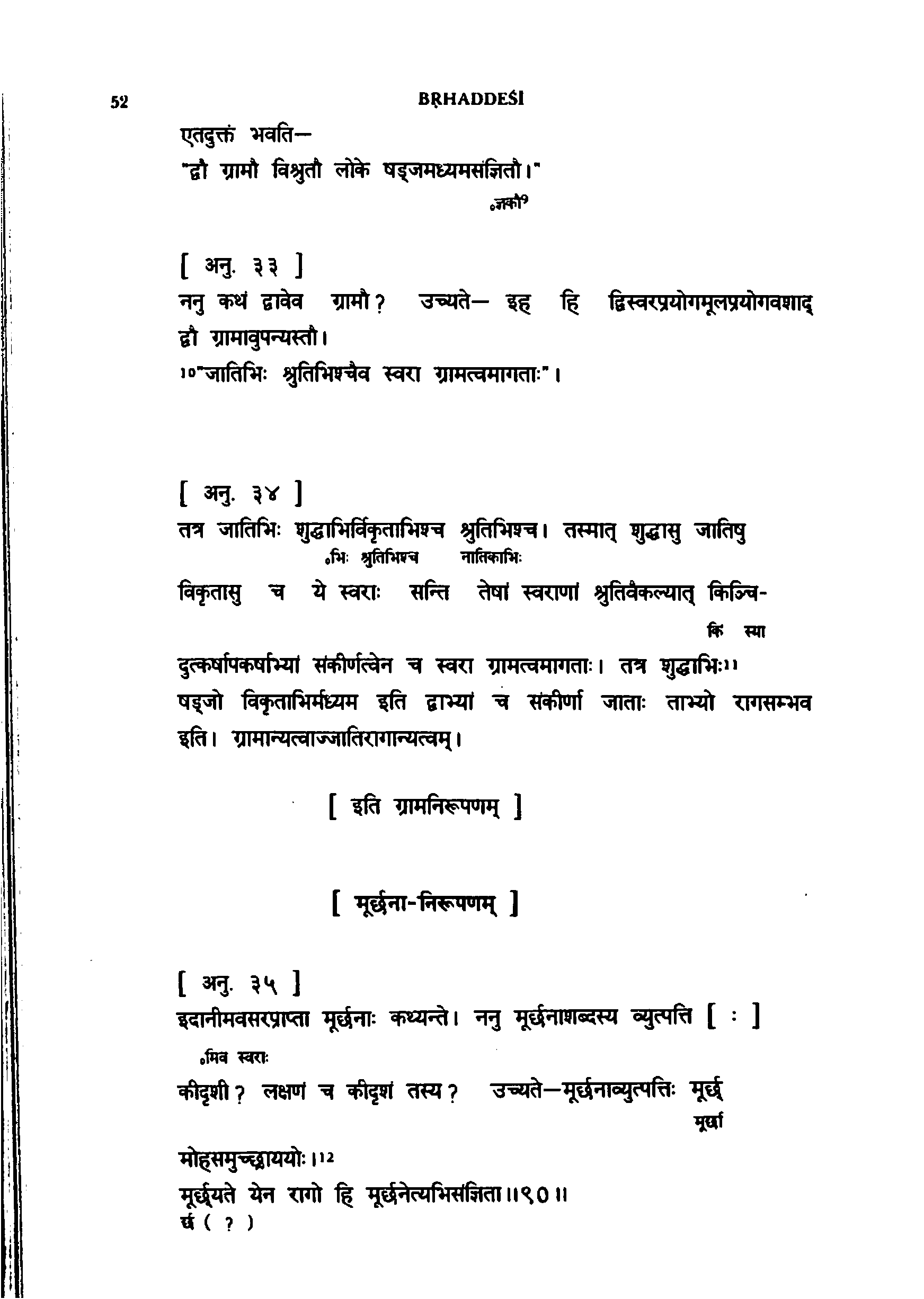
एतदुक्तं भवति— "द्वौ ग्रामौ विश्रुतौ लोके षड्जमध्यमसंज्ञितौ•जकी?।"5
[अनु. ३३]
ननु कथं द्वावेव ग्रामौ ? उच्यते— इह हि द्विस्वरप्रयोगमूलप्रयोगवशाद्12 द्वौ ग्रामावुपन्यस्तौ।6
गण्णातिभः श्रुतिभिष्टचैव स्वरा ग्रामत्वमागताः”।
[अनु. ३४]
तत्र जातिभिः शुद्धाभिर्विकृताभिष्टच श्रुतिभिष्टच। तस्मात् शुद्धासु जातिषु ंभिः श्रुतिभिष्टच नातिकाभिः विकृतासु च ये स्वराः सन्ति तेषां स्वराणां श्रुतिवैकल्यात् किञ्च-9स्या 怀
दुत्कर्षापकर्षाभ्यां संकीर्णत्वेन च स्वरा ग्रामत्वमागताः। तत्र शुद्धाभिः।।
षड्जो विकृताभिर्मध्यम इति द्वाभ्यां च संकीर्णा जाता8ताभ्यो रागसम्भव इति। ग्रामान्यत्वाज्जातिरागान्यत्वम्।10
[इति ग्रामनिरूपणम्]
[ंमिव स्वराः मूर्छना-निरूपणम् ]
[अनु. ३५]
इदानीमवसरप्राप्ता मूर्छनाः कथ्यन्ते। ननु मूर्छनाशब्दस्य व्युत्पत्ति [ : ] कीदृशी ? लक्षणं च कीदृशं तस्य ? उच्यते — मूर्छनाव्युत्पत्तिः मूर्छ्मूर्खा मोहसमुच्छ्राययोः।12
मूर्छ्यतेर्घ (?) येन रागो हि मूर्छनेत्यभिसंज्ञिता।।९०॥
English — Sharma
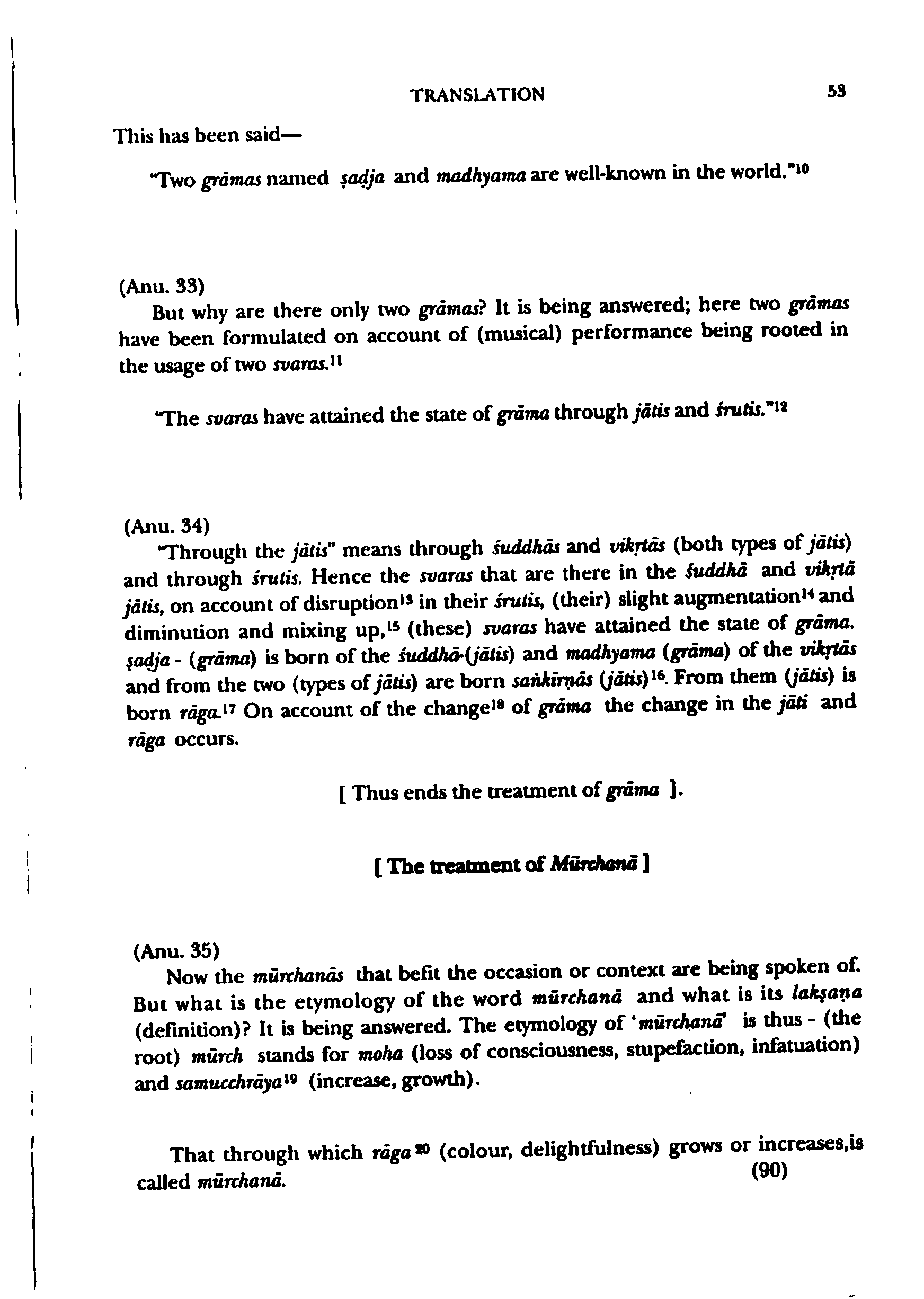
This has been said— "Two grāmas named şadja and madhyama are well-known in the world.5"10 (Anu. 33) But why are there only two grāmas? It is being answered; here two grāmas have been formulated on account of (musical) performance being rooted in the usage of two svaras12.611 "The svaras have attained the state of grāma through jātis and śrutis."12 (Anu. 34) "Through the jātis" means through śuddhās and vikṛtās (both types of jātis) and through śrutis.7 Hence the svaras that are there in the śuddhā and vikṛtā jātis, on account of disruption13 in their śrutis, (their) slight augmentation14 and diminution and mixing up,15 (these) svaras have attained the state of grāma. ṣaḍja - (grāma) is born of the śuddhā-(jātis) and madhyama (grāma) of the vikṛtās and from the two (types of jātis) are born sankīrņās (jātis)816. From them (jātis) is born rāga.17 On account of the change 18 of grāma the change in the jāti and rāga occurs. [ Thus ends the treatment of grāma ].
[The treatment of Mürchanā]
(Anu. 35) Now the murchanas that befit the occasion or context are being spoken of.1 But what is the etymology of the word murchana and what is its lakşana (definition)? It is being answered. The etymology of 'mūrchanā' is thus - (the root) mūrch stands for moha (loss of consciousness, stupefaction, infatuation) and samucchrāya 19 (increase, growth).32 That through which raga 20 (colour, delightfulness) grows or increases, is
(90)
called mūrchanā.
1.[definition] Murchana is the context or occasion when particular musical forms are articulatedइदानीमवसरप्राप्ता मूर्छना कथ्यन्ते।
2.[definition] Samucchrāya means increase or growth in the etymology of mūrchanāमोहसमुच्छ्राययो।
5.[enumeration] Two grāmas are well-known in the world: śadja and madhyama"द्वौ ग्रामौ विश्रुतौ लोके षड्जमध्यमसंज?्ञितौ।"
6.[relation]Two grāmas are formulated on account of musical performance being rooted in the usage of two svarasइह हि द्विस्वरप्रयोगमूलप्रयोगवशाद् द्वौ ग्रामावुपन्यस्तौ।
7.[relation]Svaras attain the state of grāma through both śuddhā and vikṛtā jātisतत्र ज?ातिभि शुद्धाभिर्विकृताभिष्टच श्रुतिभिष्टच।
8.[relation]Śadja grāma is born of śuddhā jātis and madhyama grāma of vikṛtāsषड्ज?ो विकृताभिर्मध्यम इति द्वाभ्या च संकीर्णा ज?ाता
9.[relation]Svaras attain the state of grāma on account of disruption in their śrutisतेषा स्वराणा श्रुतिवैकल्यात् किञ्च-
10.[relation]Sankīrņā jātis are born from the two types of jātis (śuddhā and vikṛtā)ताभ्यो रागसम्भव इति। ग्रामान्यत्वाज?्ज?ातिरागान्यत्वम्।
11.[relation]Svaras that undergo mixing up and slight augmentation and diminution attain the state of grāmaकिञ्च- स्या दुत्कर्षापकर्षाभ्या संकीर्णत्वेन च स्वरा ग्रामत्वमागता।
12.[structural]Musical performance is rooted in the usage of two svaras as the fundamental basisद्विस्वरप्रयोगमूलप्रयोगवशाद्
1.[definition]Murchana is the context or occasion when particular musical forms are articulatedNow the murchanas that befit the occasion or context are being spoken of.
2.[definition]Samucchrāya means increase or growth in the etymology of mūrchanāsamucchrāya 19 (increase, growth).
3.[definition]Mūrchanā is etymologically derived from the root mūrch meaning infatuation and samucchrāya meaning growthThe etymology of 'mūrchanā' is thus - (the root) mūrch stands for moha (loss of consciousness, stupefaction, infatuation) and samucchrāya 19 (increase, growth).
4.[definition]That through which rāga grows or increases is called mūrchanāThat through which raga (colour, delightfulness) grows or increases, is called mūrchanā.
5.[enumeration]Two grāmas are well-known in the world: śadja and madhyamaTwo grāmas named şadja and madhyama are well-known in the world.
6.[relation] Two grāmas are formulated on account of musical performance being rooted in the usage of two svarashere two grāmas have been formulated on account of (musical) performance being rooted in the usage of two svaras.
7.[relation] Svaras attain the state of grāma through both śuddhā and vikṛtā jātis"Through the jātis" means through śuddhās and vikṛtās (both types of jātis) and through śrutis.
8.[relation] Śadja grāma is born of śuddhā jātis and madhyama grāma of vikṛtāsṣaḍja - (grāma) is born of the śuddhā-(jātis) and madhyama (grāma) of the vikṛtās and from the two (types of jātis) are born sankīrņās (jātis)
12.[structural] Musical performance is rooted in the usage of two svaras as the fundamental basis(musical) performance being rooted in the usage of two svaras