Source scans · vol_I_p036
recto · open full
scan recto
verso · open full
scan verso
Bṛhaddeśī · Volume I
pp. 54–55folio 036
Devanāgarī
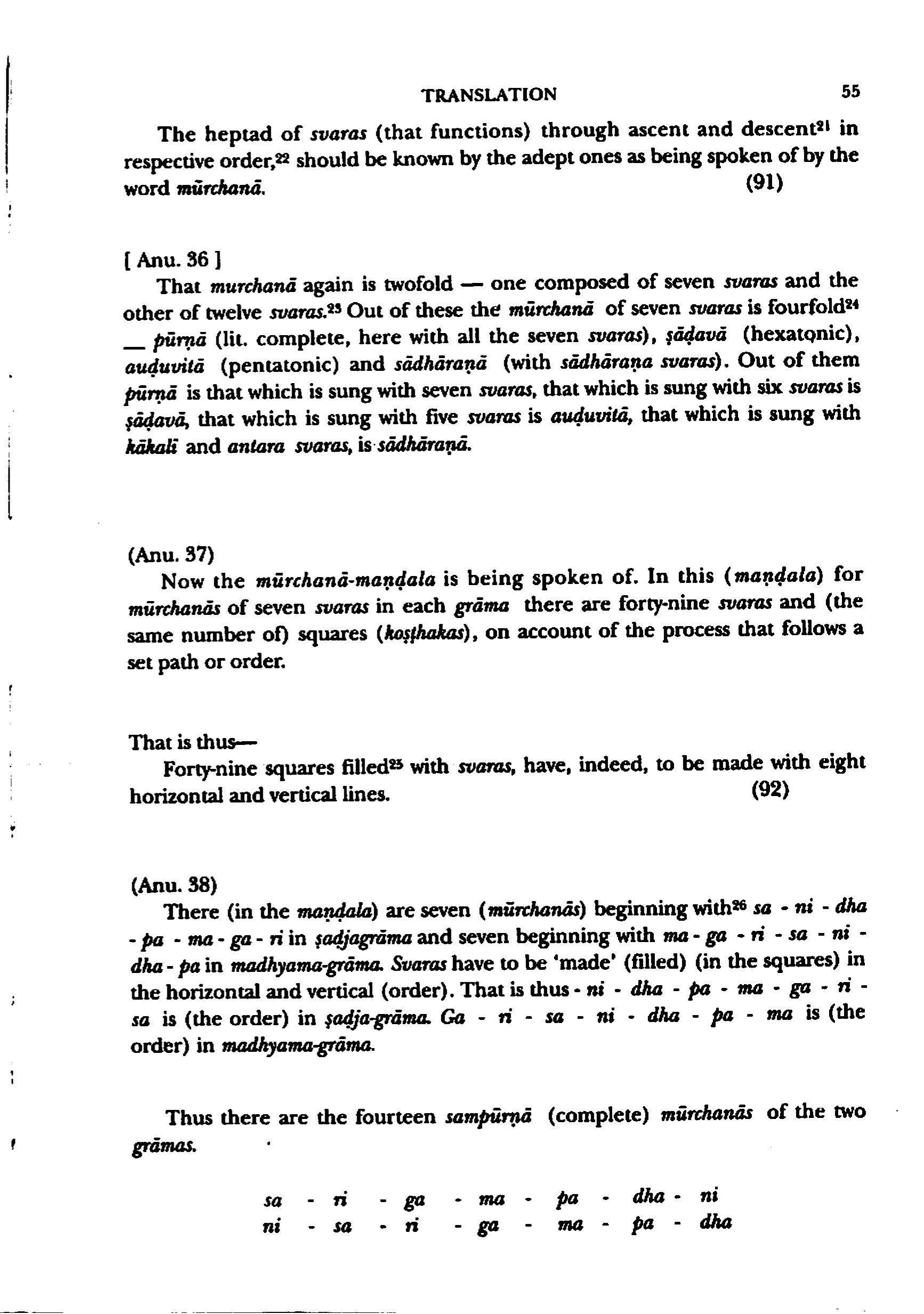
आरोहणावरोहणक्रमेण स्वरसप्तकम्।
मूर्छनाशब्दवाच्यं हि विज्ञेयं तद् विचक्षणैः ॥९१॥ अनु. ३६ सा च मूर्छना द्विविधा-सप्तस्वरमूर्छना द्वादशस्वरमूर्छना चेति।7 तत्र सप्तस्वरमूर्छना चतुर्विधा- पूर्णा, षाडवा, औडुविता, साधारणा चेति।8 तत्र सप्तभिः स्वरैर्या गीयते सा पूर्णा। षड्भिः स्वरैर्या गीयते सा षाडवा। पञ्चिभः स्वरैर्या गीयते सा औडुविता।3 काकल्यन्तरस्वरैर्या 13:56
गीयते सा साधारणा।
,पी14
[अनु. ३७]
ii<br>L इदानीं मूर्छनामण्डलमुच्यते। तत्र परिपाट्याहितत्वेन प्रवृत्तत्वात्
सप्तस्वराणां मूर्छनानां प्रतिग्राममेकोनपञ्चाशत् स्वराः कोष्ठाश्च भवन्ति।
तद्यथा—
एकोनाः खलु पञ्चाशत्₀ण्डू ( ? ) कर्तव्याः स्वरसंयुताः।
तिर्यगृध्वं च रेखाभिरष्टभिश्चैव कोष्ठकाः ॥९२॥
[अनु. ३८]
तत्र स-नि-ध-प-म-ग-रीत्याद्याः सप्त षड्जग्रामे।
म-ग-रि-स-नि-ध-पाद्याः सप्त मध्यमग्रामे।
तिर्यगृर्ध्वगा अपि स्वरा:15 कार्या:1 तद्यथा— नि-ध-प-म-ग-रि-सा इति षड्जग्रामे।13
ग-रि-सं-नि-ध-प-मा16 इति 17मध्यमग्रामे॥
एवं तावदुभयग्रामिक्यश्चतुर्दशस-रि-ग-म-प-ध-नि मूर्छनाः संपूर्णाः।
नि-स-रि-ग-म-प-ध
English — Sharma (translation)
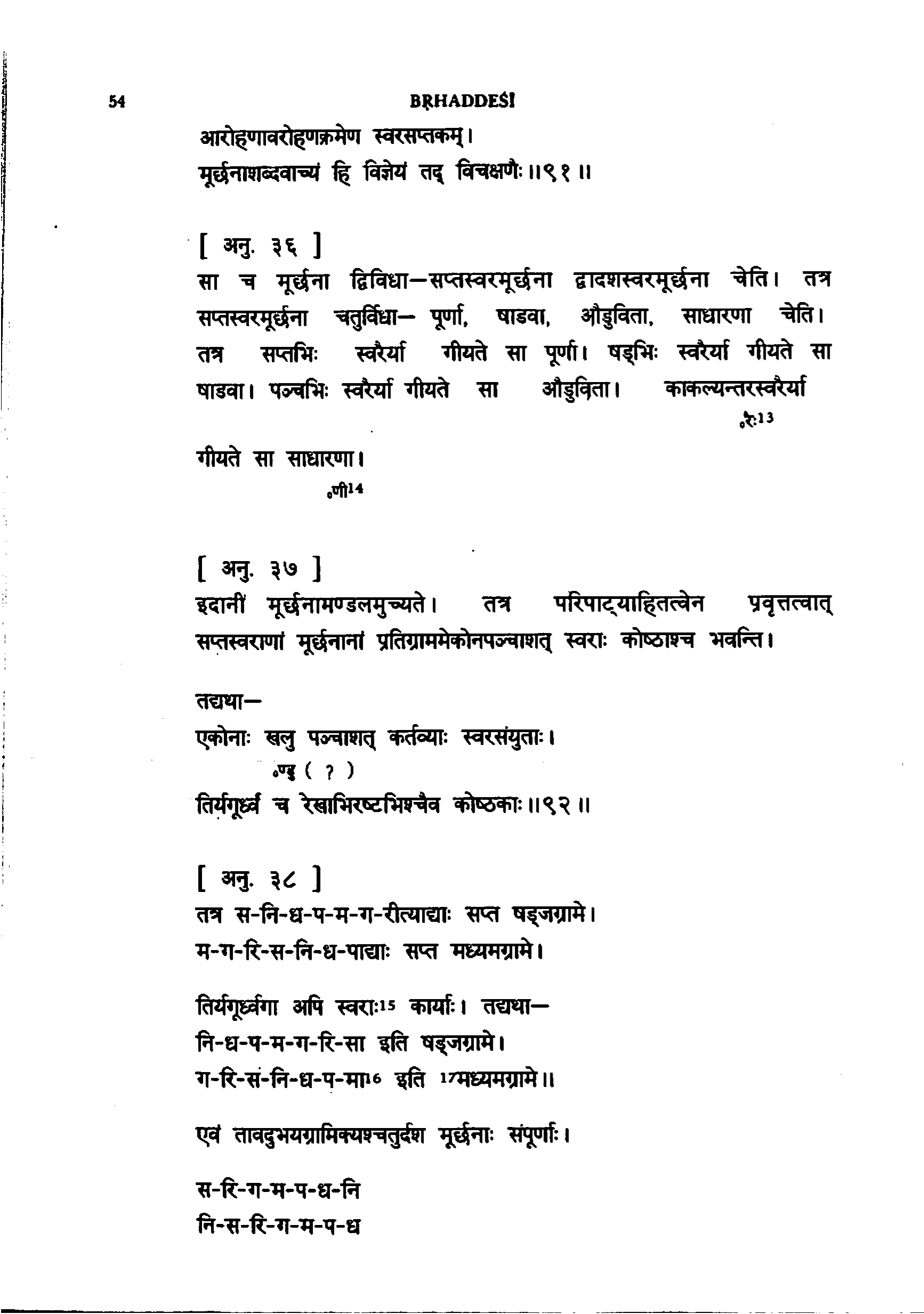
The heptad of svaras (that functions) through ascent and descent21 in respective order,22 should be known by the adept ones as being spoken of by the
(91)
word mürchanā.
[Anu. 36]
That murchanā again is twofold — one composed of seven svaras and the other of twelve svaras.725 Out of these the murchana of seven svaras is fourfold24 __ pūrņā (lit. complete, here with all the seven svaras), ṣāḍavā (hexatonic), auduvitā (pentatonic) and sādhāraņā (with sādhāraņa svaras).8 Out of them pūrņā is that which is sung with seven svaras1, that which is sung with six svaras is ṣāḍavā2, that which is sung with five svaras is auduvitā3, that which is sung with kākalī and antara svaras, is sādhāraņā.4 (Anu. 37) Now the mūrchanā-maṇḍala is being spoken of. In this (maṇḍala) for mūrchanās of seven svaras in each grāma there are forty-nine svaras and (the same number of) squares (kosthakas), on account of the process that follows a set path or order.11 That is thus— Forty-nine squares filled25 with svaras, have, indeed, to be made with eight (92) horizontal and vertical lines.125 (Anu. 38) There (in the maṇḍala) are seven (mūrchanās) beginning with 26 sa - ni - dha - pa - ma - ga - ri in sadjagrāma and seven beginning with ma - ga - ri - sa - ni - dha - pa in madhyama-grāma.9 Svaras have to be 'made' (filled) (in the squares) in the horizontal and vertical (order). That is thus - ni - dha - pa - ma - ga - ni - į sa is (the order) in şadja-grāma.13 Ga - ni - sa - ni - dha - pa - ma is (the order) in madhyama-grāma.14 Thus there are the fourteen sampūrņā (complete) mūrchanās of the two grāmas.10 sa - ri - ga - ma - pa - dha - ni<br>ni - sa - ri - ga - ma - pa - dha
1.[definition] Purna is that which is sung with seven svarasतत्र सप्तभि स्वरैर्या गीयते सा पूर्णा।
2.[definition] Shadava is that which is sung with six svarasषड्भि स्वरैर्या गीयते सा षाडवा।
3.[definition] Auduvita is that which is sung with five svarasपञ्चिभः स्वरैर्या गीयते सा औडुविता।
7.[enumeration] Murchana is twofold: composed of seven svaras or twelve svarasसा च मूर्छना द्विविधा-सप्तस्वरमूर्छना द्वादशस्वरमूर्छना चेति।
8.[enumeration] Seven-svara murchana is fourfold: purna, shadava, auduvita, and sadhranaतत्र सप्तस्वरमूर्छना चतुर्विधा- पूर्णा, षाडवा, औडुविता, साधारणा चेति।
9.[enumeration] There are two gramas: sadjagrāma and madhyama-grāma, each with seven murchanasतत्र स-नि-ध-प-म-ग-रीत्याद्या सप्त षड्जग्रामे। म-ग-रि-स-नि-ध-पाद्या सप्त मध्यमग्रामे।
10.[relation] Together, the two gramas contain fourteen complete (sampurna) murchanasएवं तावदुभयग्रामिक्यश्चतुर्दश मूर्छना संपूर्णा
11.[structural] In the murchana-mandala, for murchanas of seven svaras in each grama there are forty-nine svaras and the same number of squaresसप्तस्वराणा मूर्छनाना प्रतिग्राममेकोनपञ्चाशत् स्वरा कोष्ठाश्च भवन्ति।
13.[structural] In sadjagrāma, one murchana begins with sa-ni-dha-pa-ma-ga-ri and vertical svaras are ordered as ni-dha-pa-ma-ga-ri-saनि-ध-प-म-ग-रि-सा इति षड्जग्रामे।
1.[definition]Purna is that which is sung with seven svaraspūrņā is that which is sung with seven svaras
2.[definition]Shadava is that which is sung with six svarasthat which is sung with six svaras is ṣāḍavā
3.[definition]Auduvita is that which is sung with five svarasthat which is sung with five svaras is auduvitā
4.[definition]Sadhrana is that which is sung with kakali and antara svarasthat which is sung with kākalī and antara svaras, is sādhāraņā.
5.[definition]Kosthakas are squares in the murchana-mandala filled with svarasForty-nine squares filled25 with svaras, have, indeed, to be made with eight (92) horizontal and vertical lines.
6.[definition]Murchana is a heptad of svaras functioning through ascent and descent in respective orderThe heptad of svaras (that functions) through ascent and descent in respective order,22 should be known by the adept ones as being spoken of by the word mürchanā.
7.[enumeration]Murchana is twofold: composed of seven svaras or twelve svarasThat murchanā again is twofold — one composed of seven svaras and the other of twelve svaras.
8.[enumeration]Seven-svara murchana is fourfold: purna, shadava, auduvita, and sadhranaOut of these the murchana of seven svaras is fourfold24 __ pūrņā (lit. complete, here with all the seven svaras), ṣāḍavā (hexatonic), auduvitā (pentatonic) and sādhāraņā (with sādhāraņa svaras).
9.[enumeration]There are two gramas: sadjagrāma and madhyama-grāma, each with seven murchanasThere (in the maṇḍala) are seven (mūrchanās) beginning with 26 sa - ni - dha - pa - ma - ga - ri in sadjagrāma and seven beginning with ma - ga - ri - sa - ni - dha - pa in madhyama-grāma.
10.[relation]Together, the two gramas contain fourteen complete (sampurna) murchanasThus there are the fourteen sampūrņā (complete) mūrchanās of the two grāmas.
11.[structural]In the murchana-mandala, for murchanas of seven svaras in each grama there are forty-nine svaras and the same number of squaresIn this (maṇḍala) for mūrchanās of seven svaras in each grāma there are forty-nine svaras and (the same number of) squares (kosthakas), on account of the process that follows a set path or order.
12.[structural]The murchana-mandala is constructed with eight horizontal and vertical lines forming squaresForty-nine squares filled25 with svaras, have, indeed, to be made with eight (92) horizontal and vertical lines.
13.[structural]In sadjagrāma, one murchana begins with sa-ni-dha-pa-ma-ga-ri and vertical svaras are ordered as ni-dha-pa-ma-ga-ri-sani - dha - pa - ma - ga - ni - į sa is (the order) in şadja-grāma.
14.[structural]In madhyama-grāma, one murchana begins with ma-ga-ri-sa-ni-dha-pa and vertical svaras are ordered as ga-ri-sa-ni-dha-pa-maGa - ni - sa - ni - dha - pa - ma is (the order) in madhyama-grāma.