Source scans · vol_I_p046
recto · open full
scan recto
verso · open full
scan verso
Bṛhaddeśī · Volume I
pp. 74–75folio 046
Devanāgarī (Bṛhaddeśī)
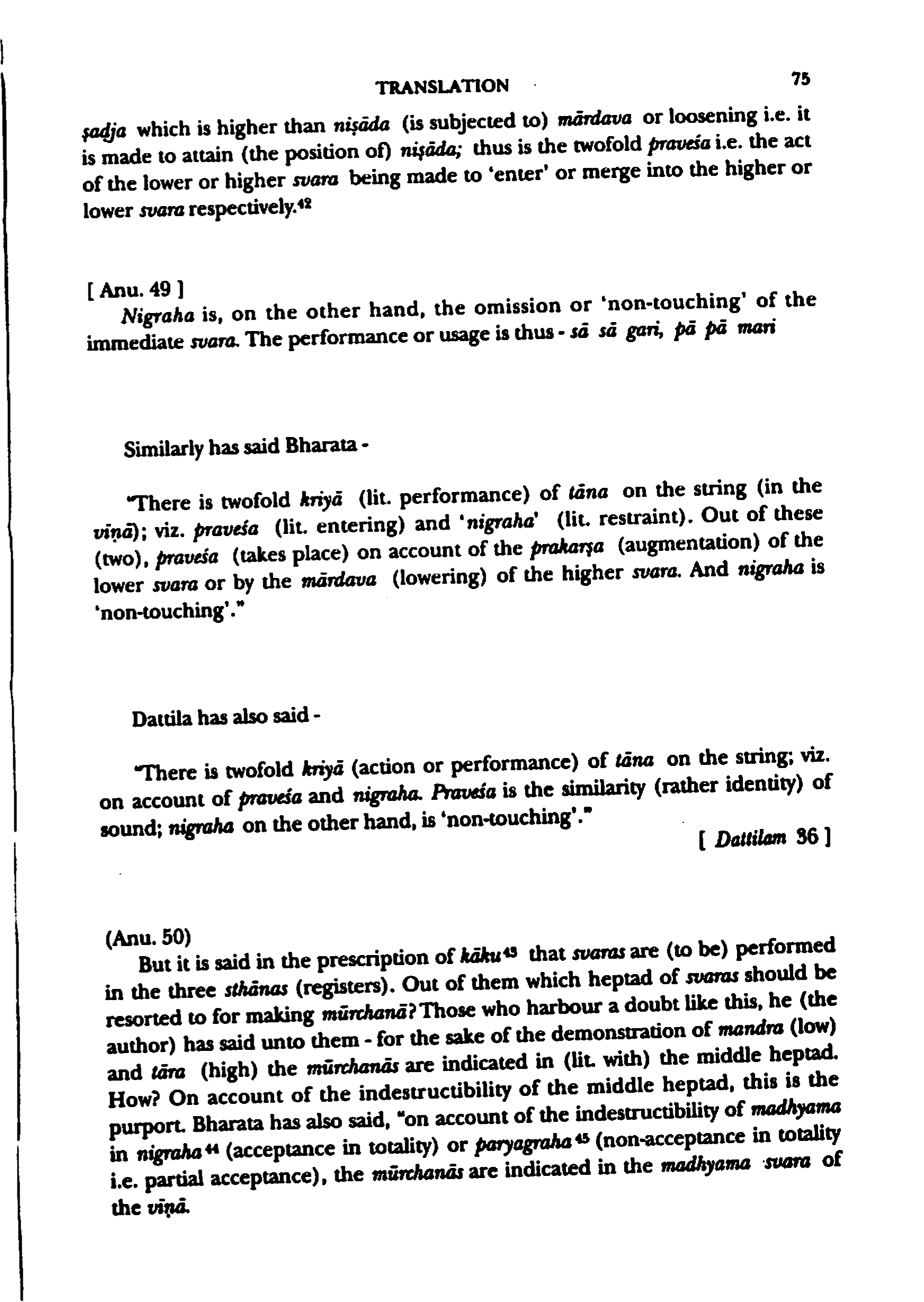
इति विप्रकर्षेण प्रवेशनम्-धेन ७५।
मार्ववेन66नाय यथा- तस्यैव षड्जस्य निषादापेक्षया उत्तरीभूतस्य मार्दवं5
शिथिलीकरणं निषादापादनम् इति द्विविधं प्रवेशनम्।
्द ब्दाः 67यावत्। इति द्विविधः प्रवेशः
[अनु॰ ४९]
निग्रहस्त्वनन्तरस्वरपरित्यागोऽसंस्पर्शनम्।
०रः स्वपरित्यागास्पदं दर्शनम्
प्रयोगस्तुतथा चाह भरतः - यथा—सा सा ग रि, पा पा मा रि।
69 द्विविधा तानक्रिया तन्त्र्यां.याः प्रवेशनं निग्रहस्तथा8। तत्र प्रवेशनमधर- स्वरप्रकर्षादुत्तरस्वरमार्दवाद्वा3निग्रहश्चासंस्पर्शः4•श्चाह ∙स।" दत्तिलेनाप्युक्तम् -
"तानक्रिया द्विधा तन्त्र्या प्रवेशान्निग्रहात्तथा।
प्रवेशो ध्वनिसादृश्यमसंस्पर्शस्तु निग्रहः6।" 70तत्र प्रध्यन्येक्यमः [दत्तिलम् ३६]
[अनु₀ ५0]
ननु त्रिषु स्थानेषु स्वरप्रयोग इत्युक्तं काकुविधाने7। तत्र कतमं स्वर— 71。代 保。 सप्तकमवलम्ब्य मूर्छना कार्येति ये संशेरते तान् प्रत्याह - मध्यम- 72。红石。 सप्तकेन मूर्जनानिर्देशो भवति∘शः 73कार्यो74साव ( ? ) मन्द्रतारसंसिद्ध्यर्थम्। कुतः ? मध्यम- सप्तकस्याविनाशित्वादित्यर्थः। भरतेनाप्युक्तम् - 75"मध्यमस्वरेण [ वैणेन ] मूर्छना-निर्देशो भवत्यविनाशित्वान्मध्यमस्य CANADA STREET, STREET, STREET, STREET, STREET, STREET, STREET, STREET, STREET, STREET, STREET, STREET, STREET, STREET, STREET, STREET, STREET, STREET, STREET, STREET, STREET, STREET, STREET, STREET, STREET, STREET, STREET, निग्रहे पर्यग्रहेंदि वा।10"
English — Sharma
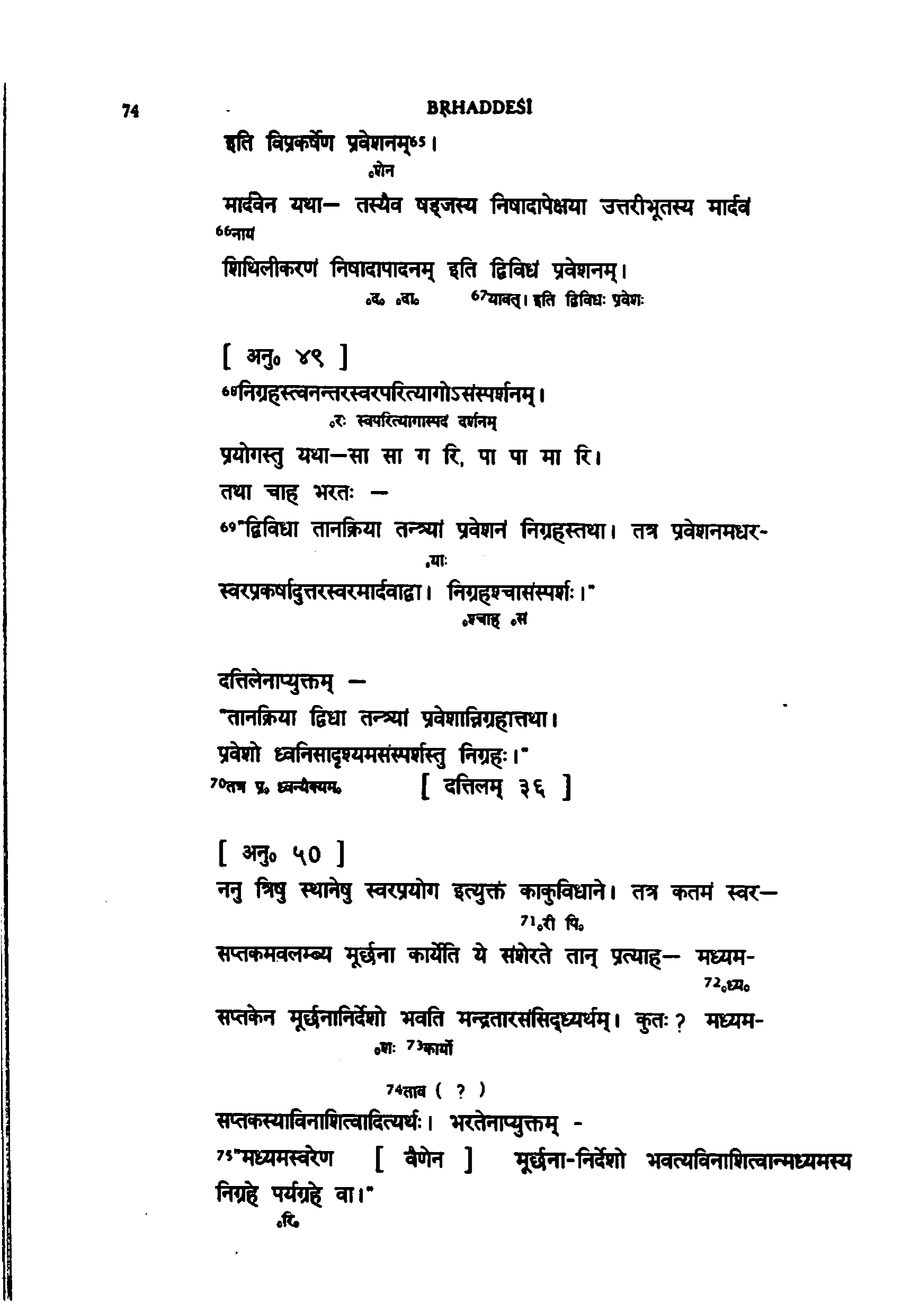
TRANSLATION - șadja which is higher than nișāda (is subjected to) mārdava or loosening5 i.e. it is made to attain (the position of) niṣāda; thus is the twofold pravesa i.e. the act of the lower or higher svara being made to 'enter' or merge into the higher or lower svara respectively.342
[Anu. 49]
Nigraha is, on the other hand, the omission or 'non-touching' of the immediate svara.4 The performance or usage is thus - sā sā gari, pā pā mari Similarly has said Bharata - "There is twofold kriyā (lit. performance) of tana on the string (in the viņā); viz. praveša (lit. entering) and 'nigraha' (lit. restraint).1 Out of these (two), pravesa (takes place) on account of the prakarşa (augmentation) of the lower svara or by the mārdava (lowering) of the higher svara.9 And nigraha is 'non-touching'." Dattila has also said - There is twofold kniyā (action or performance) of tāna on the string; viz. on account of pravesa and nigraha.2 Pravesa is the similarity (rather identity) of sound; nigraha on the other hand, is 'non-touching'.6" (Anu. 50) But it is said in the prescription of kāku45 that svaras are (to be) performed in the three sthanas (registers).7 Out of them which heptad of svaras should be resorted to for making murchana? Those who harbour a doubt like this, he (the author) has said unto them - for the sake of the demonstration of mandra (low) and tara (high) the murchanas are indicated in (lit. with) the middle heptad.11 How? On account of the indestructibility of the middle heptad, this is the purport. Bharata has also said, "on account of the indestructibility of madhyama in nigraha 44 (acceptance in totality) or paryagraha 45 (non-acceptance in totality i.e. partial acceptance), the murchanas are indicated in the madhyama svara of the vina.
3.[definition] Pravesa is the act of a lower or higher svara being made to enter or merge into the higher or lower svara respectivelyस्वरप्रकर्षादुत्तरस्वरमार्दवाद्वा
4.[definition] Nigraha is the omission or non-touching of the immediate svaraनिग्रहश्चासंस्पर्शः
5.[definition] Mārdava means loosening or lowering of the higher svaraषड्जस्य निषादापेक्षया उत्तरीभूतस्य मार्दवं
6.[definition] Nigraha is non-touchingप्रवेशो ध्वनिसादृश्यमसंस्पर्शस्तु निग्रहः
7.[definition] Kāku is a prescription stating that svaras are to be performed in three sthanas (registers)ननु त्रिषु स्थानेषु स्वरप्रयोग इत्युक्तं काकुविधाने
8.[enumeration] Pravesa and nigraha are the two types of kriyā (performance) of tana on the string of the viņāद्विविधा तानक्रिया तन्त्र्या प्रवेशनं निग्रहस्तथा
10.[relation] Murchanas are indicated in the madhyama svara of the viņā on account of the indestructibility of the middle heptadमध्यमस्वरेण [ वैणेन ] मूर्छना-निर्देशो भवत्यविनाशित्वान्मध्यमस्य निग्रहे पर्यग्रहे वा।
1.[attribution]Bharata is attributed the statement on twofold kriyā of tana comprising pravesa and nigrahaSimilarly has said Bharata - "There is twofold kriyā (lit. performance) of tana on the string (in the viņā); viz. praveša (lit. entering) and 'nigraha' (lit. restraint).
2.[attribution]Dattila is attributed a statement on twofold kriyā of tana on the string comprising pravesa and nigrahaDattila has also said - There is twofold kniyā (action or performance) of tāna on the string; viz. on account of pravesa and nigraha.
3.[definition]Pravesa is the act of a lower or higher svara being made to enter or merge into the higher or lower svara respectivelythe act of the lower or higher svara being made to 'enter' or merge into the higher or lower svara respectively.
4.[definition]Nigraha is the omission or non-touching of the immediate svaraNigraha is, on the other hand, the omission or 'non-touching' of the immediate svara.
5.[definition]Mārdava means loosening or lowering of the higher svarașadja which is higher than nișāda (is subjected to) mārdava or loosening
6.[definition]Nigraha is non-touchingPravesa is the similarity (rather identity) of sound; nigraha on the other hand, is 'non-touching'.
7.[definition]Kāku is a prescription stating that svaras are to be performed in three sthanas (registers)But it is said in the prescription of kāku45 that svaras are (to be) performed in the three sthanas (registers).
8.[enumeration]Pravesa and nigraha are the two types of kriyā (performance) of tana on the string of the viņāThere is twofold kriyā (lit. performance) of tana on the string (in the viņā); viz. praveša (lit. entering) and 'nigraha' (lit. restraint).
9.[relation]Pravesa takes place on account of the prakarşa (augmentation) of the lower svara or by the mārdava (lowering) of the higher svarapravesa (takes place) on account of the prakarşa (augmentation) of the lower svara or by the mārdava (lowering) of the higher svara.
10.[relation]Murchanas are indicated in the madhyama svara of the viņā on account of the indestructibility of the middle heptadOn account of the indestructibility of madhyama in nigraha 44 (acceptance in totality) or paryagraha 45 (non-acceptance in totality i.e. partial acceptance), the murchanas are indicated in the madhyama svara of the vina.
11.[structural]Murchanas are indicated in the middle heptad of svaras for the sake of demonstrating mandra (low) and tara (high)for the sake of the demonstration of mandra (low) and tara (high) the murchanas are indicated in (lit. with) the middle heptad.