Source scans · vol_I_p045
recto · open full
scan recto
verso · open full
scan verso
Bṛhaddeśī · Volume I
pp. 72–73folio 045
Devanāgarī
BRHADDES!
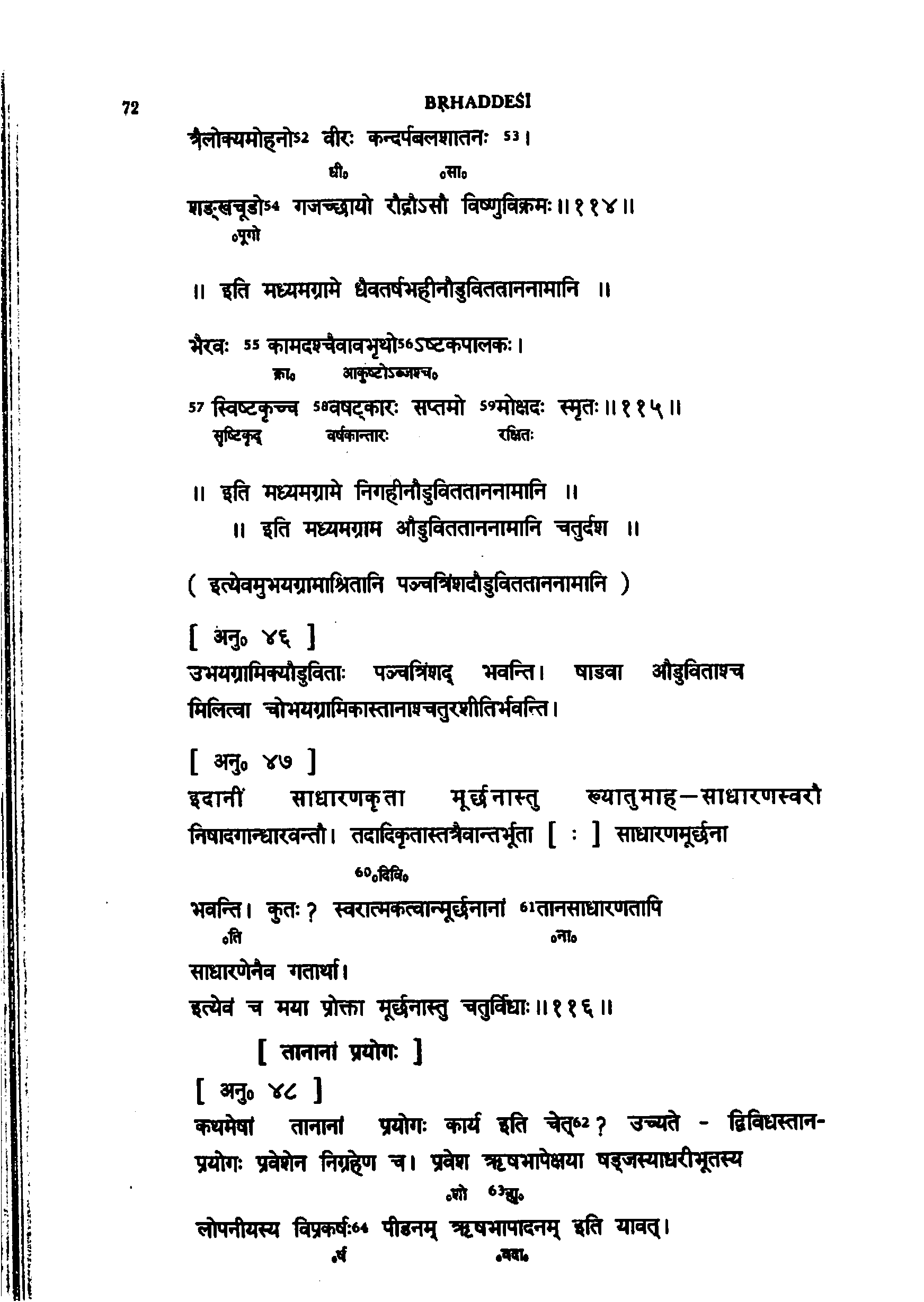
त्रैलोक्यमोहनोऽ२ वीरः कन्दर्पबलशातनः 53।
धी oसाo शङ्खचूडोऽ४ गजच्छायो रौद्रौऽसौ विष्णुविक्रमः॥११४॥ oपुगो
॥ इति मध्यमग्रामे धैवतर्षभहीनौडुवितताननामानि ॥
भैरवः 55 कामदश्चैवावभृथोऽ6ऽष्टकपालकः।
आकृष्टोऽब्जश्च० 那個 57 स्विष्टकृच्च 58वषट्कारः सप्तमो 59मोक्षदः स्मृतः10 ॥११५॥ वर्षकान्तारः रक्षितः सृष्टिकृद्
।। इति मध्यमग्रामे निगहीनौडुवितताननामानि ।।
इति मध्यमग्राम औडुवितताननामानि चतुर्दश7
( इत्येवमुभयग्रामाश्रितानि पञ्चित्रंशदौडुवितताननामानि )
[अनु॰ ४६]
उभयग्रामिक्यौडुविता पञ्चित्रंशद् भवन्ति8षाडवा औडुविताश्च
मिलित्वा चोभयग्रामिकास्तानाश्चतुरशीतिर्भवन्ति9
[अनु, ४७]
इदानी साधारणकृता मूर्छनास्तु स्यातुमाह—साधारणस्वरौ निषादगान्धारवन्तौ2। तदादिकृतास्तत्रैवान्तर्भूता [:] साधारणमूर्छना 60 दिवि भवन्ति। कुतः ? स्वरात्मकत्वान्मूर्छनाना ६१तानसाधारणतापि •ति 0ना
साधारणेनैव गतार्था।
इत्येवं च मया प्रोक्ता मूर्छनास्तु चतुर्विधा॥११६॥
[तानाना प्रयोगः]
[अनु॰ ४८]
कथमेषा तानाना प्रयोगः कार्य इति चेत्62 ? उच्यते - द्विविधस्तान- प्रयोगः प्रवेशेन निग्रहेण च। प्रवेश ऋषभापेक्षया षड्जस्याधरीभूतस्य ंशो 63ह्य
लोपनीयस्य विप्रकर्षः पीडनम् ऋषभापादनम्1 इति यावत्।
•ৰ .वरा.
English — Sharma (translation)
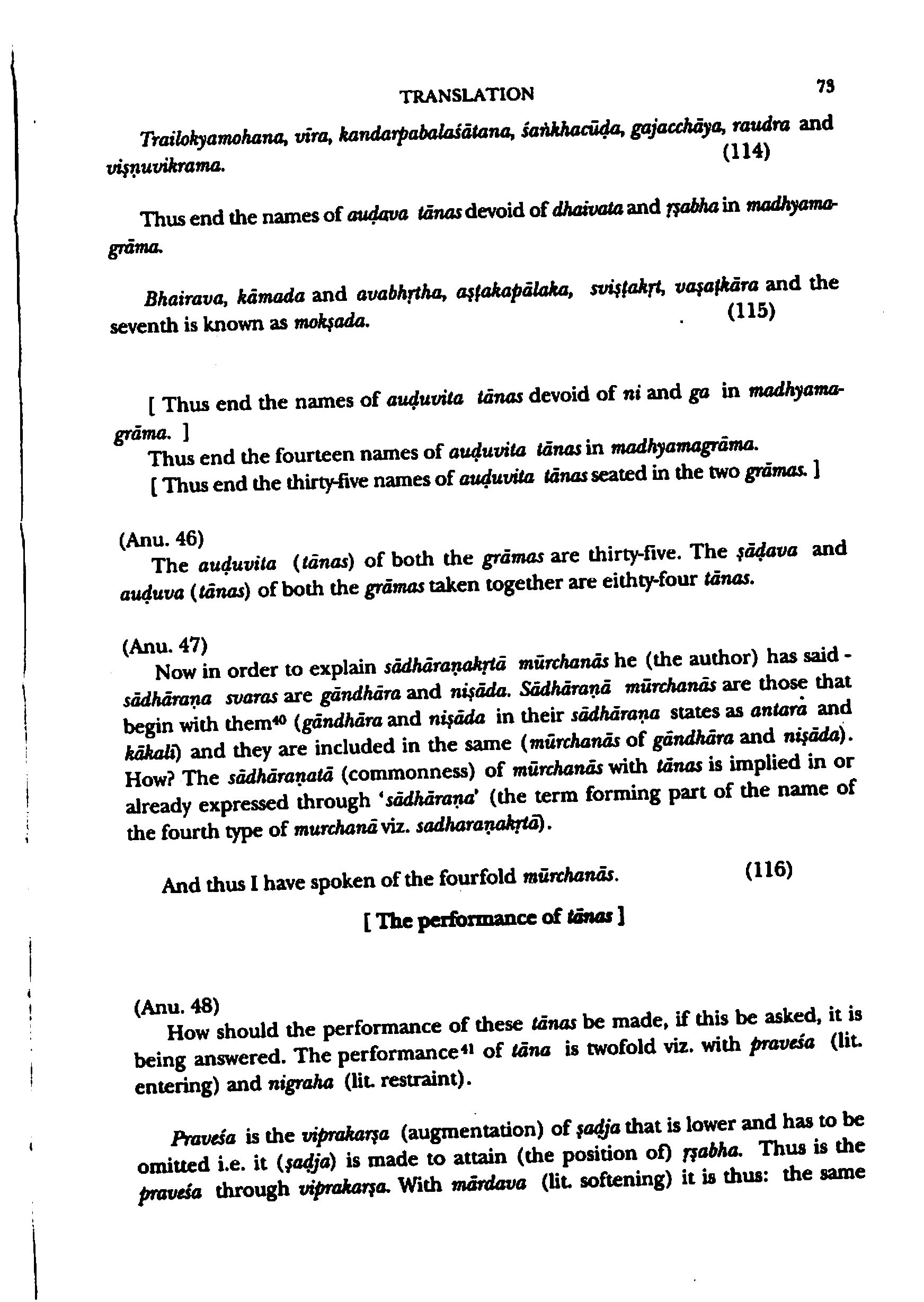
Trailokyamohana, vīra, kandarpabalašātana, šankhacūda, gajacchāya, raudra and
(114)
vișnuvikrama. Thus end the names of audava tanas devoid of dhaivata and rabha in madhyama- grāma. Bhairava, kāmada and avabhṛtha, aṣṭakapālaka, sviṣṭakṛt, vaṣaṭkāra and the
(115)
seventh is known as mokşada. [ Thus end the names of auduvita tanas devoid of ni and ga in madhyama- grāma.] Thus end the fourteen names of auduvita tānas in madhyamagrāma.7
[Thus end the thirty-five names of auduvita tanas seated in the two gramas.]
(Anu. 46) The auduvita (tānas) of both the grāmas are thirty-five.8 The sādava and auduva (tānas) of both the grāmas taken together are eithty-four tānas.9 (Anu. 47) Now in order to explain sādhāraņakṛtā mūrchanās he (the author) has said - sādhāraņa svaras are gāndhāra and niṣāda.2 Sādhāraņā mūrchanās are those that begin with them540 (gāndhāra and niṣāda in their sādhāraņa states as antara and kākalī) and they are included in the same (mūrchanās of gāndhāra and niṣāda). How? The sādhāraṇatā (commonness) of mūrchanās with tānas is implied in or already expressed through 'sādhāraṇa' (the term forming part of the name of the fourth type of murchanā viz. sadharaņakṛtā).
(116)
And thus I have spoken of the fourfold mūrchanās.
[The performance of tanas]
(Anu. 48) How should the performance of these tanas be made, if this be asked, it is being answered. The performance 41 of tana is twofold viz. with pravesa (lit. entering) and nigraha (lit. restraint).6 Pravesa is the viprakarşa (augmentation) of şadja that is lower and has to be omitted1 i.e. it (şadja) is made to attain (the position of) rşabha. Thus is the pravesa through viprakarşa. With mārdava (lit. softening) it is thus: the same
1.[definition] Pravesa is the augmentation (viprakarşa) of şadja that is lower and has to be omittedविप्रकर्षः पीडनम् ऋषभापादनम्
2.[definition] Sādhāraņa svaras are gāndhāra and niṣādaसाधारणस्वरौ निषादगान्धारवन्तौ
5.[relation] Sādhāraņa svaras (gāndhāra and niṣāda) are the basis for sādhāraņakṛtā mūrchanāsसाधारणस्वरौ निषादगान्धारवन्तौ। तदादिकृतास्तत्रैवान्तर्भूता
7.[structural] Auduvita tanas devoid of dhaivata and rishabha exist in madhyama-grama and have fourteen namesइति मध्यमग्राम औडुवितताननामानि चतुर्दश
8.[structural] Auduvita tanas of both gramas total thirty-five varietiesउभयग्रामिक्यौडुविता पञ्चित्रंशद् भवन्ति
9.[structural] Auduvita and sādava tanas of both gramas together total eighty-four tanasषाडवा औडुविताश्च मिलित्वा चोभयग्रामिकास्तानाश्चतुरशीतिर्भवन्ति
10.[structural] Mokşada is the seventh name of auduvita tanas devoid of ni and gaसप्तमो 59मोक्षदः स्मृतः
1.[definition]Pravesa is the augmentation (viprakarşa) of şadja that is lower and has to be omittedPravesa is the viprakarşa (augmentation) of şadja that is lower and has to be omitted
2.[definition]Sādhāraņa svaras are gāndhāra and niṣādasādhāraņa svaras are gāndhāra and niṣāda.
3.[enumeration]These are names of auduvita tanas devoid of dhaivata and rishabha in madhyama-gramaTrailokyamohana, vīra, kandarpabalašātana, šankhacūda, gajacchāya, raudra and vișnuvikrama. Thus end the names of audava tanas devoid of dhaivata and rabha in madhyama- grāma.
4.[enumeration]Bhairava is a name of auduvita tana devoid of ni and ga in madhyama-gramaBhairava, kāmada and avabhṛtha, aṣṭakapālaka, sviṣṭakṛt, vaṣaṭkāra and the seventh is known as mokşada. [ Thus end the names of auduvita tanas devoid of ni and ga in madhyama- grāma.]
5.[relation]Sādhāraņa svaras (gāndhāra and niṣāda) are the basis for sādhāraņakṛtā mūrchanāssādhāraņa svaras are gāndhāra and niṣāda. Sādhāraņā mūrchanās are those that begin with them
6.[relation]Nigraha is one of two twofold methods for the performance of tanas, alongside pravesaThe performance of tana is twofold viz. with pravesa (lit. entering) and nigraha (lit. restraint).
7.[structural]Auduvita tanas devoid of dhaivata and rishabha exist in madhyama-grama and have fourteen namesThus end the fourteen names of auduvita tānas in madhyamagrāma.
8.[structural]Auduvita tanas of both gramas total thirty-five varietiesThe auduvita (tānas) of both the grāmas are thirty-five.
9.[structural]Auduvita and sādava tanas of both gramas together total eighty-four tanasThe sādava and auduva (tānas) of both the grāmas taken together are eithty-four tānas.
10.[structural]Mokşada is the seventh name of auduvita tanas devoid of ni and gathe seventh is known as mokşada