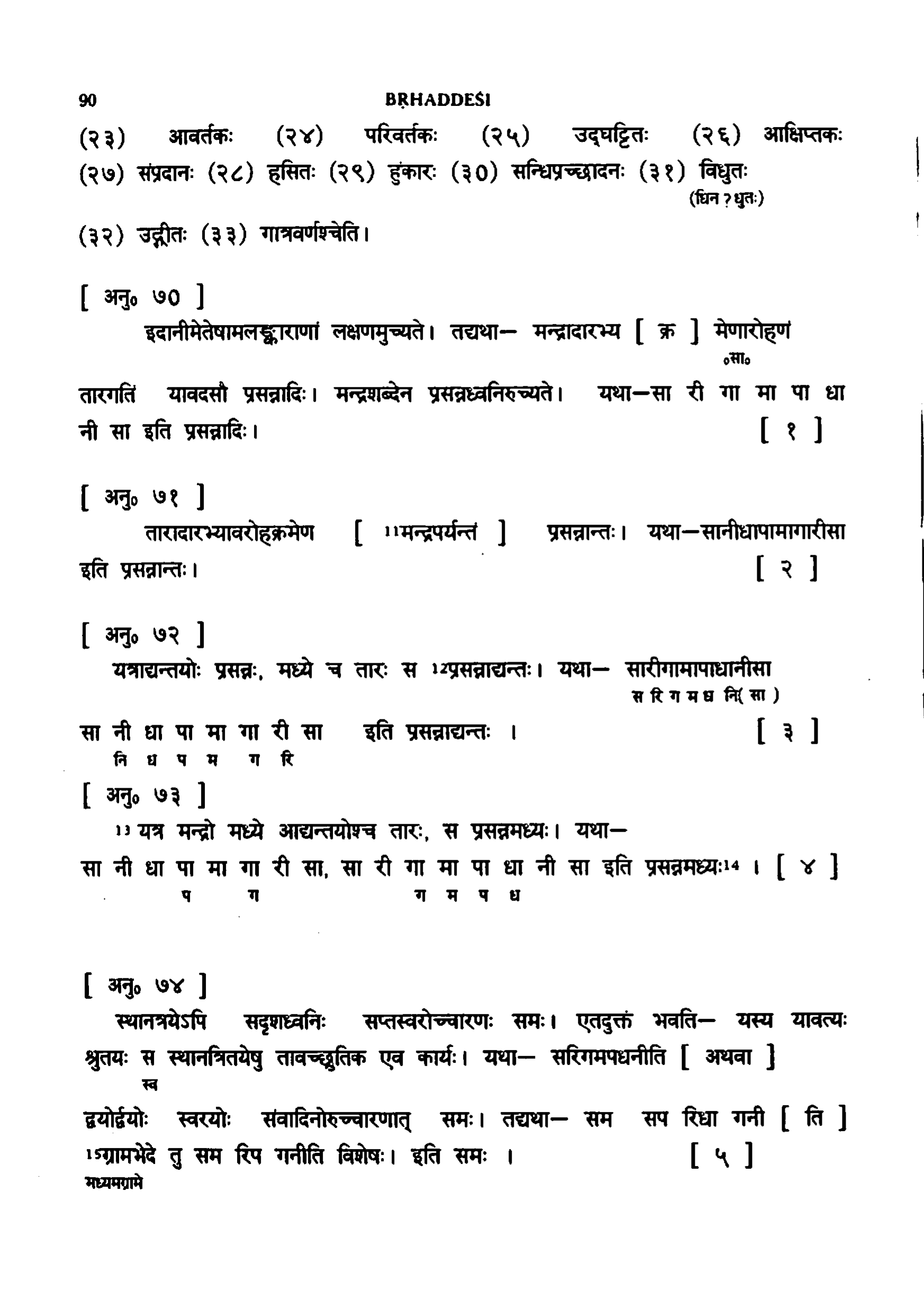
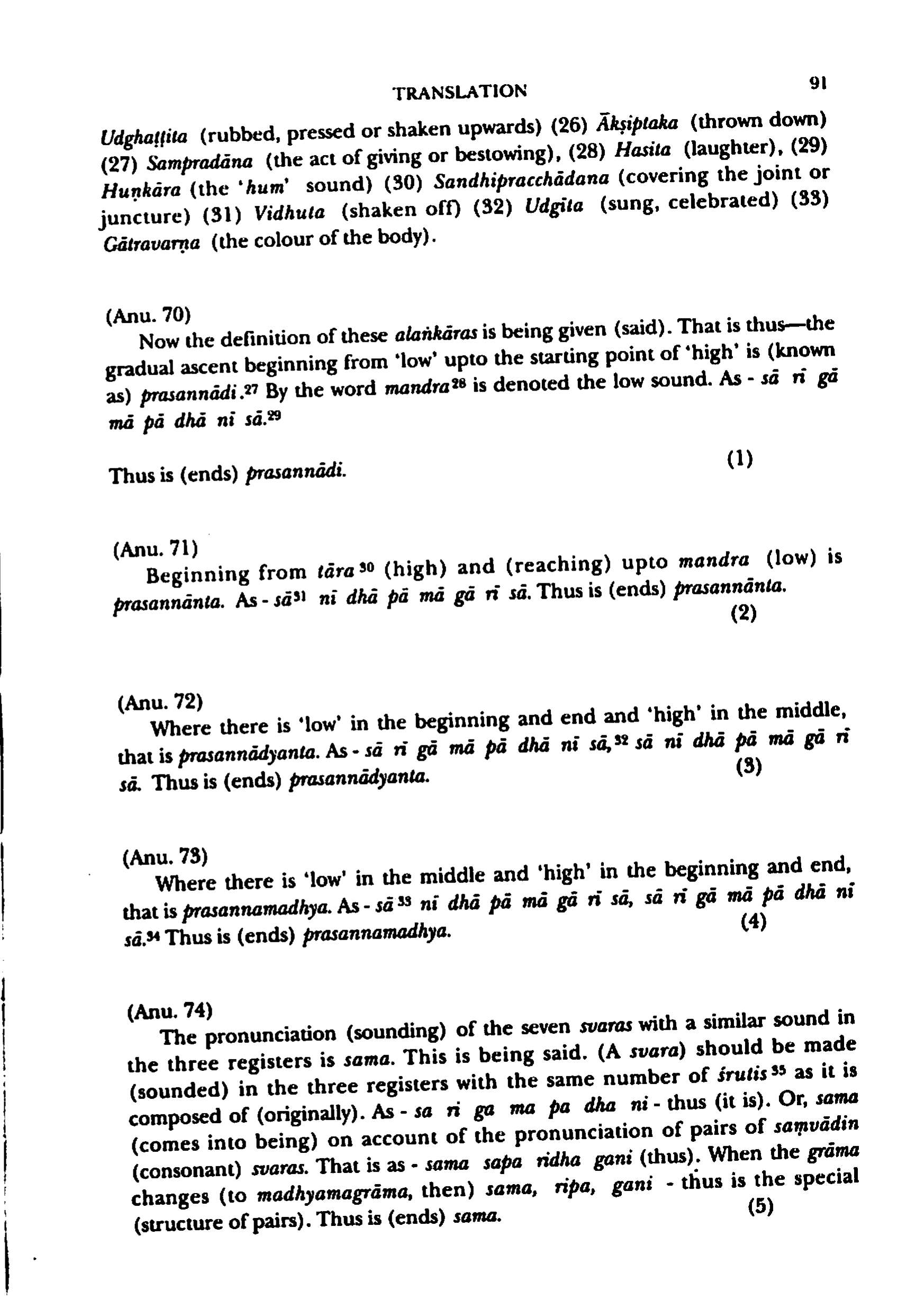
Udghaisita (rubbed, pressed or shaken upwards) (26)
Ākṣiptaka (thrown down)
(27)
Sampradāna (the act of giving or bestowing), (28) Hasita (laughter), (29)
Hunkāra (the 'hum' sound) (30)
Sandhipracchādana (covering the joint or
juncture) (31) Vidhuta (shaken off) (32) Udgita (sung, celebrated) (33)
Gātravarṇa (the colour of the body).
(Anu. 70)
Now the definition of these alankāras is being given (said).5 That is thus—
the
gradual ascent beginning from 'low' upto the starting point of 'high' is (known
as) prasannādi.127 By the word mandra28 is denoted the low sound. As - sā nī gā
mā pā dhā nī sā.29
(1)
Thus is (ends)
prasannādi.
(Anu. 71)
Beginning from tara 30 (high) and (reaching) upto mandra (low) is
prasannānta.2 As - sā
31 nī dhā pā mā gā nī sā. Thus is (ends)
prasannānta.
(2)
(Anu. 72)
Where there is 'low' in the beginning and end and 'high' in the middle,
that is prasannādyanta.8 As - sā rī gā mā pā dhā nī sā, 52 sā nī dhā pā mā gā rī
(3)
sā. Thus is (ends)
prasannādyanta.
(Anu. 73)
Where there is 'low' in the middle and 'high' in the beginning and end,
that is prasannamadhya.9 As - sā 33 ní dhā pā mā gā rī sā, sā rī gā mā pā dhā ni
(4)
sā.34 Thus is (ends)
prasannamadhya.
(Anu. 74)
The pronunciation (sounding) of the seven svaras with a similar sound in
the three registers is sama.3 This is being said.
(A svara) should be made
(sounded) in the three registers with the same number of śrutis 35 as it is
composed of (originally).10 As - sa ri ga ma pa dha ni - thus (it is). Or,
sama
(comes into being) on account of the pronunciation of pairs of samvādin
(consonant) svaras.6 That is as - sama sapa ridha gani (thus). When the grāma
changes (to
madhyamagrāma, then) sama, ripa, gani - thus is the special
(5)
(structure of pairs). Thus is (ends) sama.