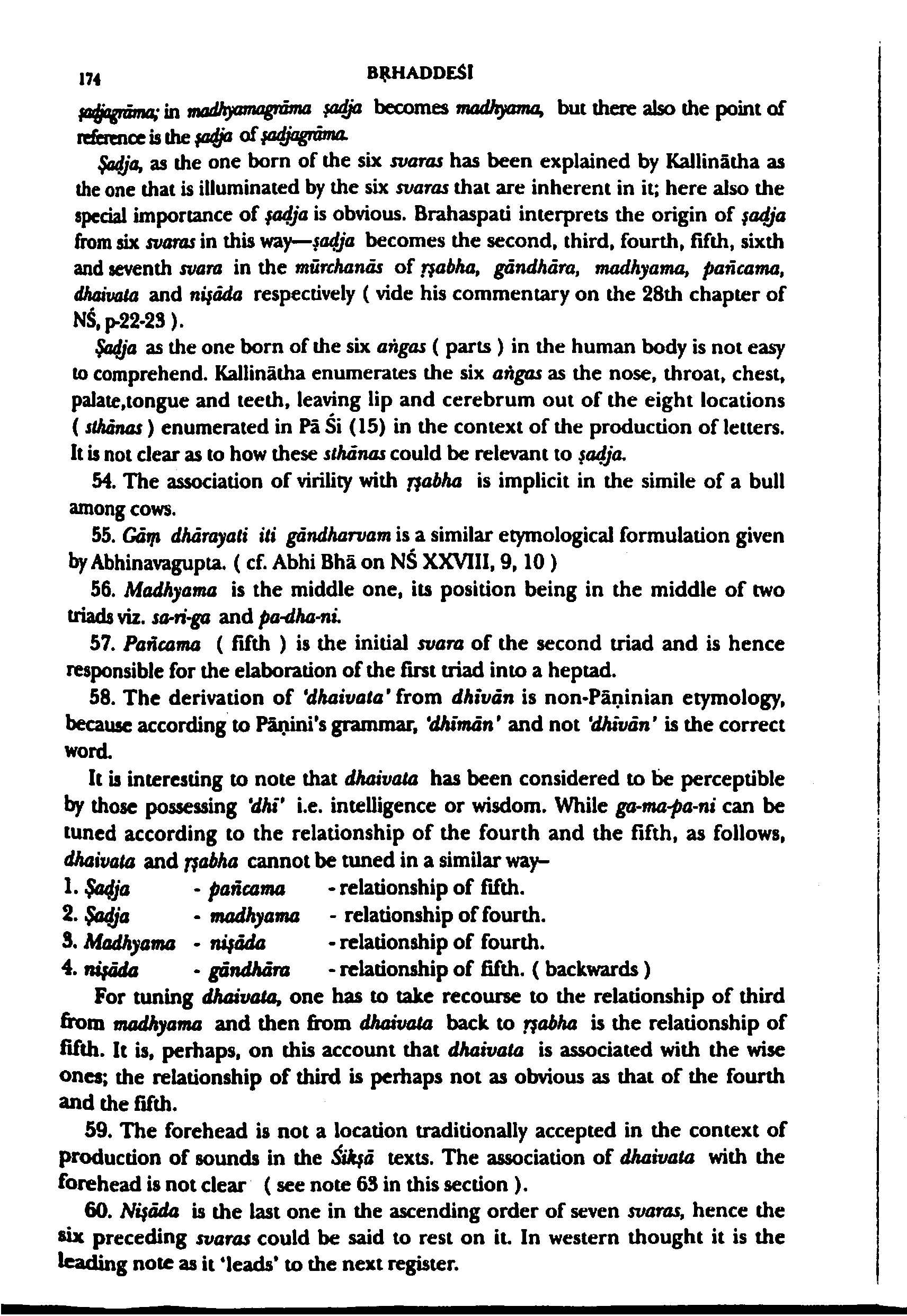
sadjagrāma; in
madhyamagrāma sadja becomes
madhyama, but there also the point of
reference is the şadja of
şadjagrāma.
Sadja, as the one born of the six svaras has been explained by
Kallinātha as
the one that is illuminated by the six svaras that are inherent in it; here also the
special importance of şadja is obvious.
Brahaspati interprets the origin of şadja
from six svaras in this way—şadja becomes the second, third, fourth, fifth, sixth
and seventh svara in the
murchanas of rsabha,
gandhara,
madhyama, pancama,
dhaivata and nişāda respectively (vide his commentary on the 28th chapter of
NS, p-22-23).
Şadja as the one born of the six angas (parts) in the human body is not easy
to comprehend.
Kallinātha enumerates the six angas as the nose, throat, chest,
palate, tongue and teeth, leaving lip and cerebrum out of the eight locations
(sthanas) enumerated in Pa Si (15) in the context of the production of letters.
It is not clear as to how these sthanas could be relevant to sadja.
54. The association of virility with pabha is implicit in the simile of a bull
among cows.
55. Gām dhārayati iti gāndharvam is a similar etymological formulation given
by
Abhinavagupta. (cf.
Abhi Bhā on NŚ XXVIII, 9, 10)
56.
Madhyama is the middle one, its position being in the middle of two
triads viz. sa-ni-ga and pa-dha-ni.
57.
Pañcama (fifth) is the initial svara of the second triad and is hence
responsible for the elaboration of the first triad into a heptad.
58. The derivation of '
dhaivata' from dhivan is non-Paninian etymology,
because according to Pāṇini's grammar, 'dhīmān' and not 'dhīvān' is the correct
word.
It is interesting to note that
dhaivata has been considered to be perceptible
by those possessing 'dhi' i.e. intelligence or wisdom. While ga-ma-pa-ni can be
tuned according to the relationship of the fourth and the fifth, as follows,
dhaivata and rsabha cannot be tuned in a similar way-
-
pañcama - relationship of fifth.
1. Şadja
2. Şadja -
madhyama - relationship of fourth.
3.
Madhyama - niṣāda - relationship of fourth.
-
gāndhāra - relationship of fifth. (backwards)
4. niṣāda
For tuning
dhaivata, one has to take recourse to the relationship of third
from
madhyama and then from
dhaivata back to reabha is the relationship of
fifth. It is, perhaps, on this account that
dhaivata is associated with the wise
ones; the relationship of third is perhaps not as obvious as that of the fourth
and the fifth.
59. The forehead is not a location traditionally accepted in the context of
production of sounds in the Siksā texts. The association of
dhaivata with the
forehead is not clear ( see note 63 in this section ).
60. Niṣāda is the last one in the ascending order of seven svaras, hence the
six preceding svaras could be said to rest on it. In western thought it is the
leading note as it 'leads' to the next register.