35, 36. Rāgatva, the state of being rāga (melody-matrix) could combine
both the structural and aesthetic aspects of raga, the melodic configuration.
37. Amsa is one of the ten characteristics of a melodic configuration which
bears the name jāti in a generic state and the name rāga in a specific state. NŠ
(XXVII, p. 15) also identifies vādin and amsa by stating—"that (svara) which is
amía in a particular melodic situation is the vādin at that time".
38. The condition of equal interval of the two svaras concerned in terms of
śrutis for the accomplishment of
samvāda (roughly consonance) has not been
explicitly stated in NS, although it is implicitly followed there. BrD makes the
first explicit statement in this regard. The fact that the pair of
madhyama-nişāda
has not been included in the
samvādin-pair enumerated in NŠ (XXVIII, p. 15)
is evidence of the implicit adherence to the condition of equal interval of the
two svaras concerned for the establishment of
samvada-relationship. The
underlying idea is that
samvada is not conceived as an exclusively acoustic
phenomenon; it is rather a combination of acoustic and melodic phenomena.
Acoustically
madhyama-niṣāda have an interval of 13-srutis which is
samvādin,
but
madhyama has a four-śruti interval from
gāndhāra and niṣāda has a two-śruti
interval from
dhaivata and hence the structuring of exactly reciprocal melodic
phrases with these two svaras is not possible. They are not, therefore, accepted
as a
samvādin pair.
Abhi Bhā on the prose portion of
NŚ XXVIII, p. 15 ( Abhi
Bhā, ibid., p. 17) elucidates and illustrates this point. This concept of equal
number of śrutis in
samvādin pairs has far reaching implications because it
affects the omission of pairs in jātis and
grāma-rāgas.
39. The structure of a raga rests on the acoustic-cum-melodic support
accorded by the
samvadin to the vadin.
40.
Mūrchanā is basically a scale derived from grāma ( see next section on grāma-
murchana). Here it appears to stand for tuning on a fretted viņā. (see glossary)
41. BrD is the first text to explicitly define the
anuvadin. NS (p. 15) and
Dattilam (19) simply state that those that are neither
samvādin nor
vivādin are
anuvādins. But our text has defined the phenomenon of
anuvāda in clear-cut
terms. This description, however, holds good only with reference to svaras with
four and three sruti - intervals and not to those with three and two
śruti - intervals. ( see note 43 below )
42. This description embodies an analysis of melodic structuring. (see glossary)
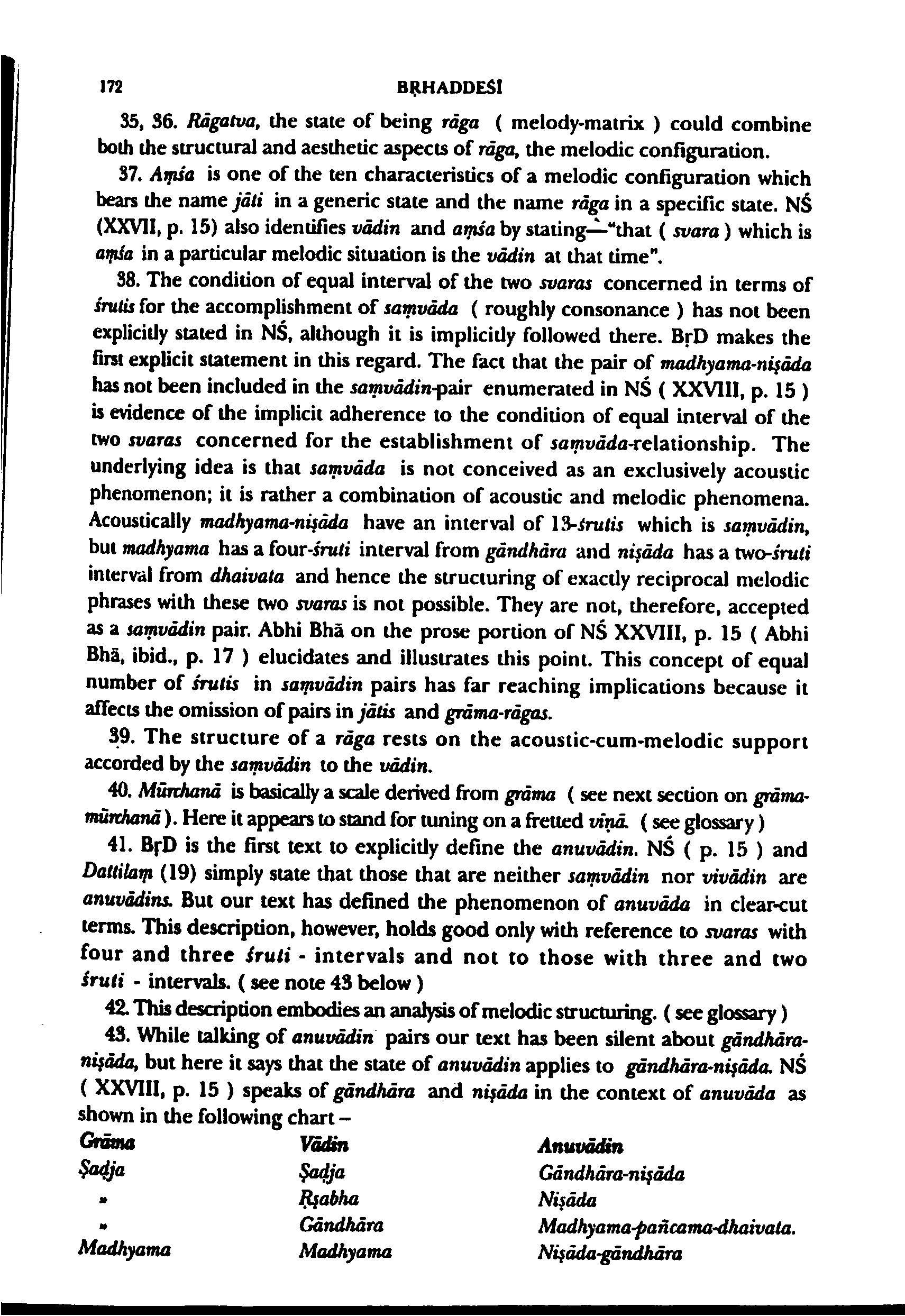
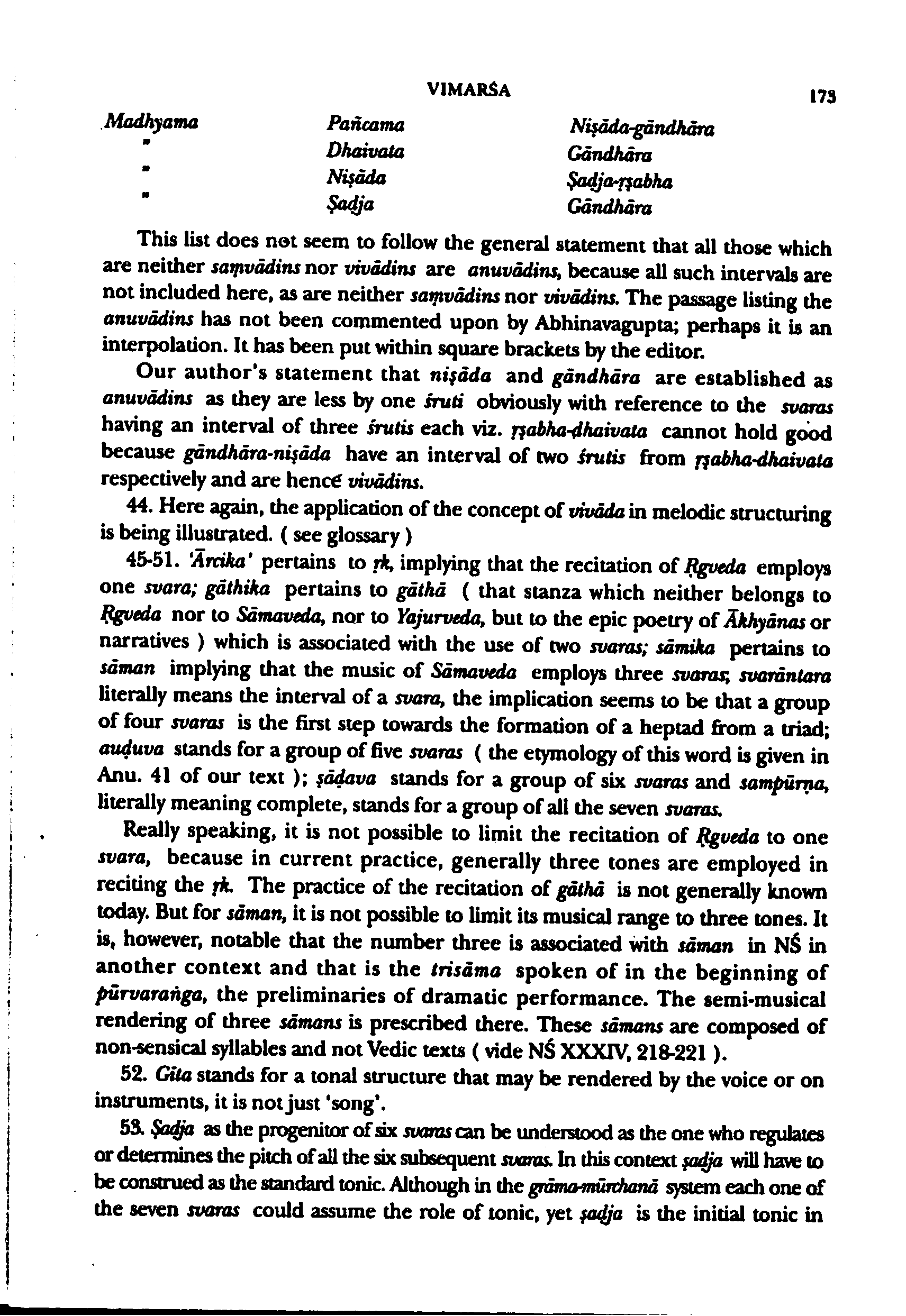
43. While talking of
anuvādin pairs our text has been silent about
gāndhāra-
niṣāda, but here it says that the state of
anuvādin applies to
gāndhāra-niṣāda. NS
(XXVIII, p. 15) speaks of
gāndhāra and niṣāda in the context of
anuvāda as
shown in the following chart -
Grāma
Vādin
Anuvādin
Şadja
Şadja
Gāndhāra-niṣāda
Rşabha
Niṣāda
*
Gāndhāra
Madhyama-
pañcama-
dhaivata.
*
Madhyama
Madhyama
Niṣāda-
gāndhāra