Source scans · vol_II_p019
recto · open full
scan recto
verso · open full
scan verso
Bṛhaddeśī · Volume II
pp. 20–21folio 019
Devanāgarī (Bṛhaddeśī)
化二溴磺基基 医动物
[७. अल्पत्व-लक्षणम्]
[अनु॰ १२८]
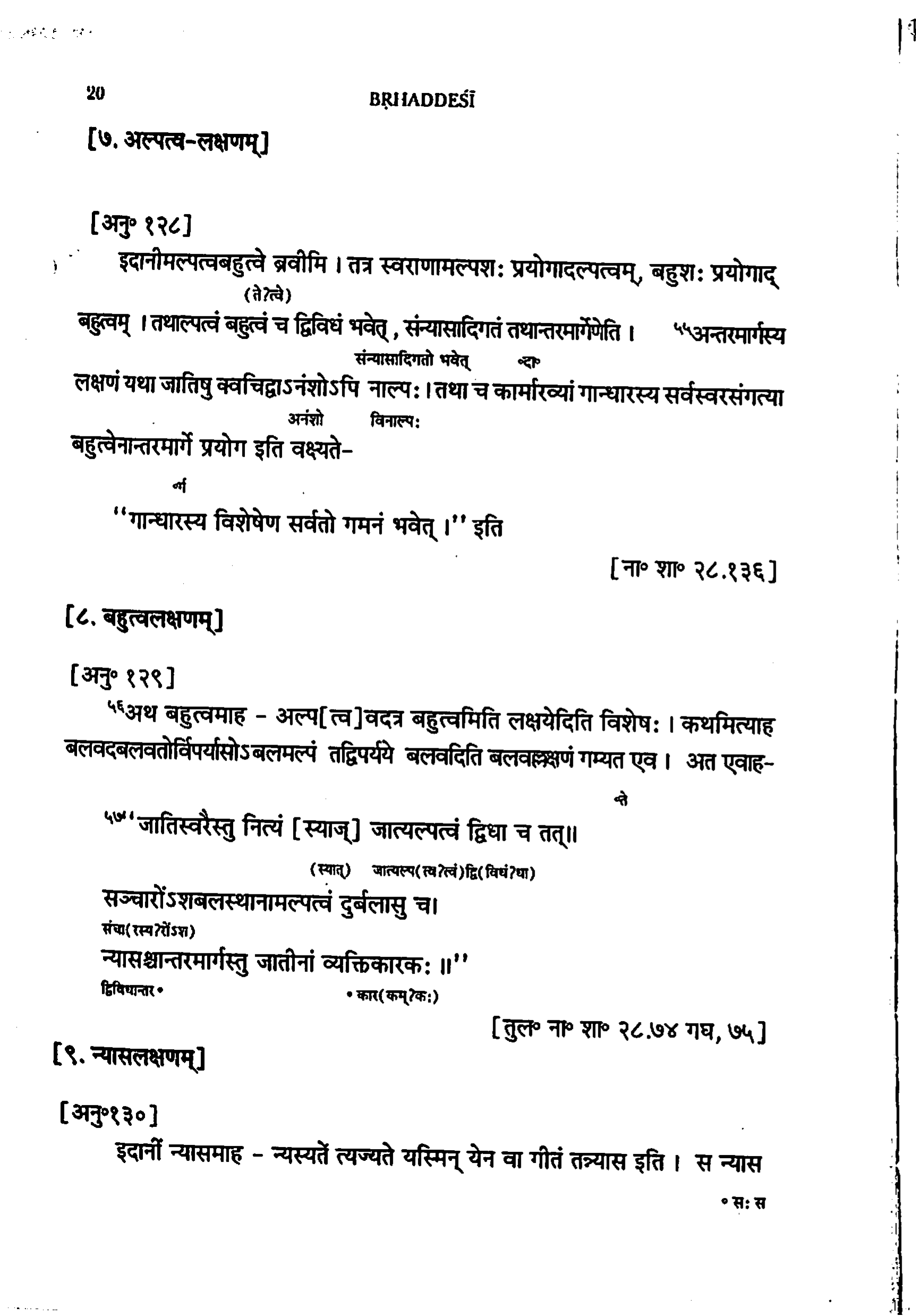
इदानीमल्पत्वबहुत्वे(ते?त्वे) ब्रवीमि । तत्र स्वराणामल्पशः प्रयोगादल्पत्वम्3, बहुशः प्रयोगाद्
बहुत्वम्5तथाल्पत्वं बहुत्वं च द्विविधं भवेत् , संन्यासादिगतं तथान्तरमार्गेणेति1276
५५अन्तरमार्गस्यसंन्यासादिगतो भवेत् ৽হা৽ लक्षणं यथा जातिषु क्वचिद्वाऽनंशोऽपिअनंशो नाल्पःविनास्प:।तथा च कार्मारव्यां गान्धारस्य सर्वस्वरसंगत्या बहुत्वेनान्तरमार्गे प्रयोग इति वक्ष्यते- ‘‘गान्धारस्य विशेषेण सर्वतो गमनं भवेत्11 ।’’ इति [ना॰ शा॰ २८.१३६]1
[८. बहुत्वलक्षणम्]
[अनु॰ १२९]
५६अथ बहुत्वमाह - अल्प[त्व]वदत्र बहुत्विमिति लक्षयेदिति विशेष:। कथमित्याह बलवदबलवतोर्विपर्यासोऽबलमल्पं तद्विपर्यये(स्यात्) बलवदितिजात्यस्प(स्व?त्वं)द्वि(विधं?धा) बलवक्ष्यणं गम्यतन्ते एव । अत एवाह-
५७ जातिस्वरैस्तु नित्यं [स्याज्] जात्यल्पत्वं द्विधा च तत्॥
सञ्चारोंऽशबलस्थानामल्पत्वं9संचा(रस्य/रोंऽश) दुर्बलासु च।
न्यासश्चान्तरमार्गस्तुद्विविधान्तर • जातीनां व्यक्तिकारक:10॥'' • कार(कम्?कः) [तुल॰ ना॰ शा॰ २८.७४ गघ, ७५]2
[९. न्यासलक्षणम्]
[अनु॰१३०]
इदानीं न्यासमाह - न्यस्यतें त्यज्यते यस्मिन् येन वा गीतं तत्र्यास इति4 । स न्यास॰ स: स
English — Sharma (translation)
[7. The definition of alpatva]
[Anu. 128]
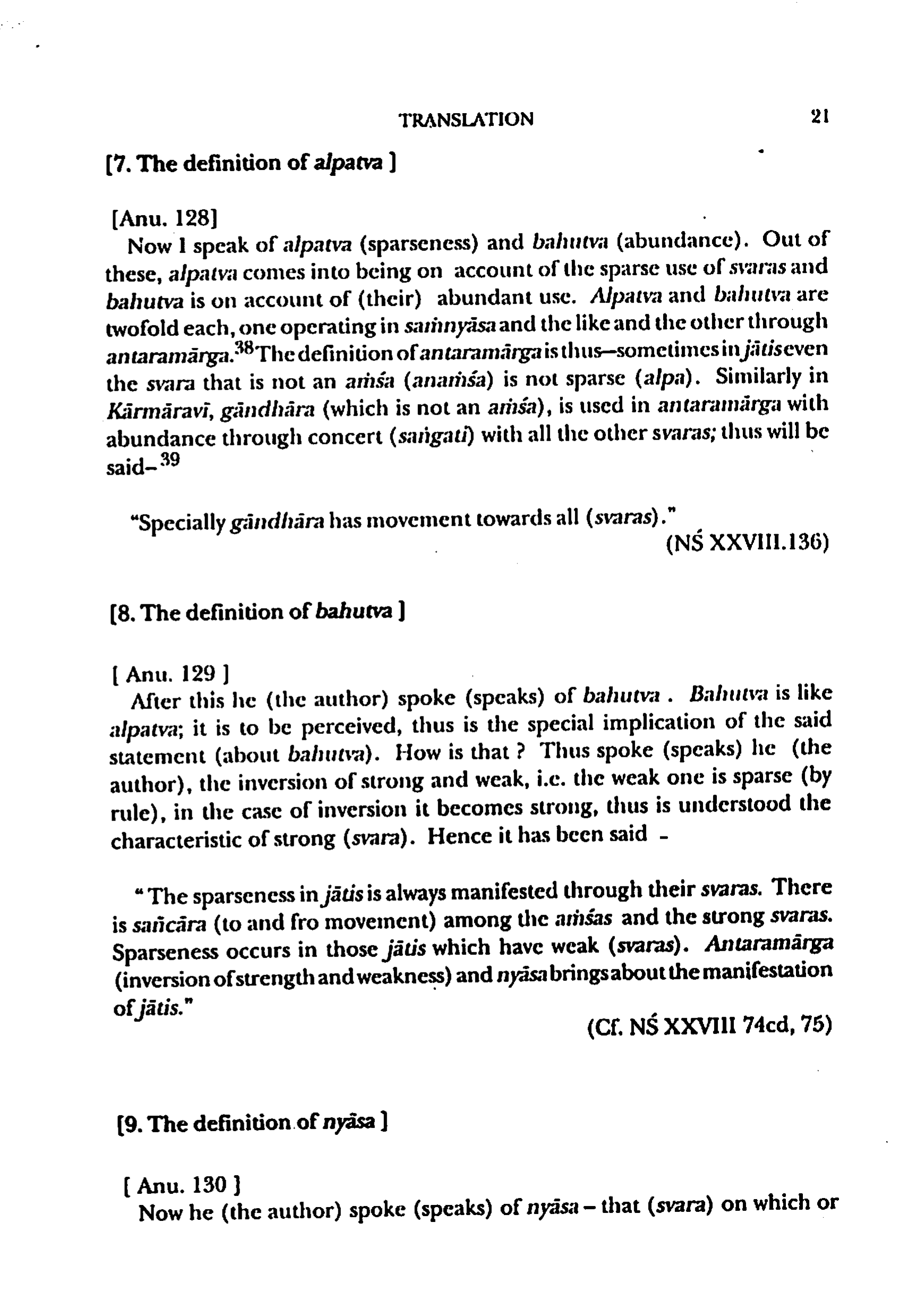
Now I speak of alpatva (sparseness) and bahutva (abundance). Out of these, alpatva comes into being on account of the sparse use of svaras3 and bahutva is on account of (their) abundant use5. Alpatva and bahutva are twofold each, one operating in samnyāsa and the like and the other through antaramārga12.76 38 The definition of antaramārga is thus—sometimes in jātis even the svara that is not an amsa (anamsa) is not sparse (alpa)13. Similarly in Kārmāravī, gāndhāra (which is not an amśa), is used in antaramārga with abundance through concert (saigati) with all the other svaras; thus will be said-39 "Specially gāndhāra has movement towards all (svaras).11" (NŚ XXVIII.136)
[8. The definition of bahutva]
After this he (the author) spoke (speaks) of bahutva. Bahutva is like alpatva; it is to be perceived, thus is the special implication of the said statement (about bahutva). How is that? Thus spoke (speaks) he (the author), the inversion of strong and weak, i.e. the weak one is sparse (by rule), in the case of inversion it becomes strong, thus is understood the characteristic of strong (svara). Hence it has been said - "The sparseness in jātis is always manifested through their svaras. There is sañcāra (to and fro movement) among the amsas and the strong svaras. Sparseness occurs in those jātis which have weak (svaras).9 Antaramārga (inversion of strength and weakness) and nyāsa brings about the manifestation of jātis.10" (Cf. NŚ XXVIII 74cd, 75)
[9. The definition of nyasa]
[Anu. 130]
Now he (the author) spoke (speaks) of nyāsa - that (svara) on which or
1.[citation]The statement about gāndhāra's movement is cited from Nāṭyaśāstra XXVIII.136[ना॰ शा॰ २८.१३६]
2.[citation]The definitions of jāty-alpatva and bahutva characteristics are compared with Nāṭyaśāstra XXVIII.74cd, 75[तुल॰ ना॰ शा॰ २८.७४ गघ, ७५]
3.[definition]Alpatva (sparseness) arises from sparse usage of svarasस्वराणामल्पशः प्रयोगादल्पत्वम्
4.[definition]Nyāsa is defined as that svara on which or by which a song is abandoned or concludedन्यस्यते त्यज्यते यस्मिन् येन वा गीतं तत्र्यास इति
5.[definition]Bahutva (abundance) arises from abundant usage of svarasबहुशः प्रयोगाद् बहुत्वम्
6.[enumeration]Alpatva is twofold: one operating in samnyāsa and another through antaramārgaतथाल्पत्वं बहुत्वं च द्विविधं भवेत् , संन्यासादिगतं तथान्तरमार्गेणेति
7.[enumeration]Bahutva is twofold: one operating in samnyāsa and another through antaramārgaतथाल्पत्वं बहुत्वं च द्विविधं भवेत् , संन्यासादिगतं तथान्तरमार्गेणेति
8.[relation]Gāndhāra (a non-amsa svara) in Kārmāravī is used abundantly in antaramārga through concert with all svarasतथा च कार्मारव्या गान्धारस्य सर्वस्वरसंगत्या अनंशो विनास्पः बहुत्वेनान्तरमार्गे प्रयोग इति
9.[relation]Sañcāra (to and fro movement) occurs among the amsas and strong svarasसञ्चारोंऽशबलस्थानामल्पत्वं
10.[relation]Antaramārga and nyāsa bring about the manifestation of jātisन्यासश्चान्तरमार्गस्तु ज?ातीना व्यक्तिकारकः
11.[structural]Gāndhāra has special movement towards all svarasगान्धारस्य विशेषेण सर्वतो गमनं भवेत्
12.[structural]Samnyāsa is one mode of operation for both alpatva and bahutvaसंन्यासादिगतं तथान्तरमार्गेणेति
13.[structural]In antaramārga, even non-amsa svaras may not be sparse in certain jātisअन्तरमार्गे क्वचिद्वाऽनंशोऽपि नाल्पः
1.[citation] The statement about gāndhāra's movement is cited from Nāṭyaśāstra XXVIII.136(NŚ XXVIII.136)
2.[citation] The definitions of jāty-alpatva and bahutva characteristics are compared with Nāṭyaśāstra XXVIII.74cd, 75(Cf. NŚ XXVIII 74cd, 75)
3.[definition] Alpatva (sparseness) arises from sparse usage of svarasalpatva comes into being on account of the sparse use of svaras
5.[definition] Bahutva (abundance) arises from abundant usage of svarasbahutva is on account of (their) abundant use
6.[enumeration] Alpatva is twofold: one operating in samnyāsa and another through antaramārgaAlpatva and bahutva are twofold each, one operating in samnyāsa and the like and the other through antaramārga.
7.[enumeration] Bahutva is twofold: one operating in samnyāsa and another through antaramārgaAlpatva and bahutva are twofold each, one operating in samnyāsa and the like and the other through antaramārga.
8.[relation] Gāndhāra (a non-amsa svara) in Kārmāravī is used abundantly in antaramārga through concert with all svarasgāndhāra (which is not an aṁśa), is used in antaramārga with abundance through concert (saigati) with all the other svaras
9.[relation] Sañcāra (to and fro movement) occurs among the amsas and strong svarasThere is sañcāra (to and fro movement) among the amsas and the strong svaras. Sparseness occurs in those jātis which have weak (svaras).
10.[relation] Antaramārga and nyāsa bring about the manifestation of jātisAntaramārga (inversion of strength and weakness) and nyāsa brings about the manifestation of jātis.
11.[structural] Gāndhāra has special movement towards all svarasSpecially gāndhāra has movement towards all (svaras).
12.[structural] Samnyāsa is one mode of operation for both alpatva and bahutvaone operating in samnyāsa and the like and the other through antaramārga
13.[structural] In antaramārga, even non-amsa svaras may not be sparse in certain jātissometimes in jātis even the svara that is not an amsa (anamsa) is not sparse (alpa)