Source scans · vol_II_p025
recto · open full
scan recto
verso · open full
scan verso
Bṛhaddeśī · Volume II
pp. 1–33folio 025
Devanāgarī (Bṛhaddeśī)
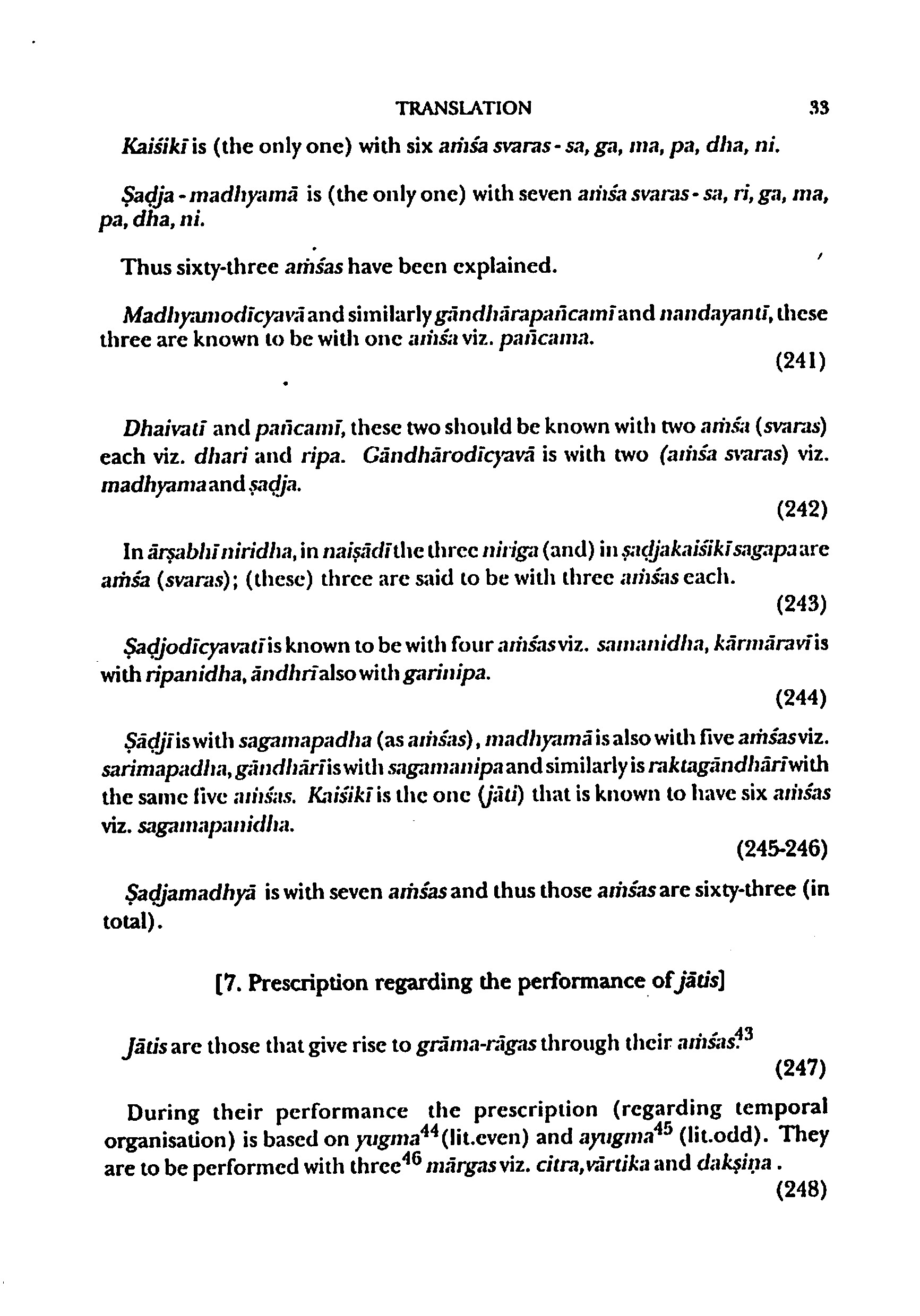
सगमपनि,सरिगमपंध सरिमपध । षट्स्वरांशापहज कैशिकी - सगमपधनि63मगसप्तस्वरांशा षड्जमध्यमा -
सरिगमपधनि । एवं त्रिषष्टिरंशा व्याख्याता:8
नन्दयन्ती च तिस्रस्ताः पश्चमैकांशतः स्मृताः ॥२४१॥
धैवती पञ्चमी चैव ज्ञेये धरिरिपांशके॰दिवां॰
गान्धारोदीच्यवा द्वाभ्यां मध्यम:(न्म)र्यभ षड्ज इत्यपि ॥२४२॥
आर्षभ्यां निरिधा(तिरि? निरि) अंशा नैषाद्यां निरिगास्त्रय:।
सगपाः(ला:?पा:) षड्जकैशिक्यां तिस्रस्त्र्यंशाः प्रकीर्तिताः ॥२४३॥
चतुरंशा समनिधै: षड्जोदीच्यवती स्मृता ।
कार्मारवी रिपनिधैरान्ध्री गरिनिपैरपि ॥२४४॥ (국 ?)
सगमपधै: षाड्जी स्यात् पञ्चभिश्चापि मध्यमा ।
सरिमपधैरंशै:, स्याद् गान्धारी सगमनिपै: ॥२४५॥
तद्वत् स्याद् रक्तगान्धारी पूर्वेरंशैश्च पञ्चभिः।
कैशिक्येका षडंशा स्यात् सगमपनिधैः स्मृता ॥२४६॥
षड्जमध्यान्मध्यमा तु सप्तांशा त्रिषष्टिरिति तेंऽशका: ।
[७. जातीनां प्रयोगविधिः]
८८अंशकैर्ग्रामरागांस्तु(ग्रा?र्ग्रा) जनयन्तीति जातय:51 ॥२४७॥
आसां प्रयोगकाले तु युग्मायुग्माश्रयो विधि:109
मार्गेस्त्रिभि: प्रयोक्तव्याश्चित्रवार्तिकदक्षिणै:2 ॥२४८॥
table
jāti → aṃśa-svaras (ṣaṭ-svarāṃśā / sapta-svarāṃśā enumeration, vv. ~240–246) — Brihaddeśī vol. II p. 32 (header), section preceding [7. jātīnāṃ prayogavidhiḥ]; verses enumerate which svaras are aṃśa for each jāti, with marginal variant readings.
jātiaṃśa-svarasverse
Kaiśikīsa ga ma pa dha niṣaṭ-svarāṃśā
Ṣaḍjamadhyamāsa sa(?) ga ma pa dha ni / sa ri ga ma pa dha nisapta-svarāṃśā
Madhyamodīcyavā?v. 241 (pañcamy-ekāṃśataḥ)
Gāndhāra-pañcamī?v. 241
Nandayantī?v. 241
Dhaivatī pañcamīdha ri ri pa aṃśake (dha ri ri pa)v. 242
Gāndhārodīcyavātwo svaras: madhyama, ṣaḍjav. 242
Ārṣabhīni ri dha aṃśāv. 243
Naiṣādīni ri ga (trayaḥ)v. 243
Ṣaḍja-kaiśikīsa ga pa (tisras tryaṃśāḥ)v. 243
Ṣaḍjodīcyavatīsa ma ni dha (catur-aṃśā)v. 244
Kārmāravīri pa ni dha / ga ri ni pa (?)v. 244
Ṣāḍjīsa ga ma pa dhav. 245 (pañcabhir api)
Madhyamāsa ri ma pa dha aṃśaiḥv. 245
Gāndhārīsa ga ma ni pav. 245
Raktagāndhārīpūrva-aṃśaiḥ pañcabhiḥv. 246
Kaiśikyekāṣaḍ-aṃśā: sa ga ma pa ni dhav. 246
Ṣaḍja-madhyāsapta-aṃśā (all seven)v. 246 (triṣaṣṭir iti te aṃśakāḥ)
— ṣaṭ-svarāṃśā / sapta-svarāṃśā / pañcasvarāṃśā / catur-aṃśā / triṣaṣṭi-aṃśāḥ
English — Sharma (translation)
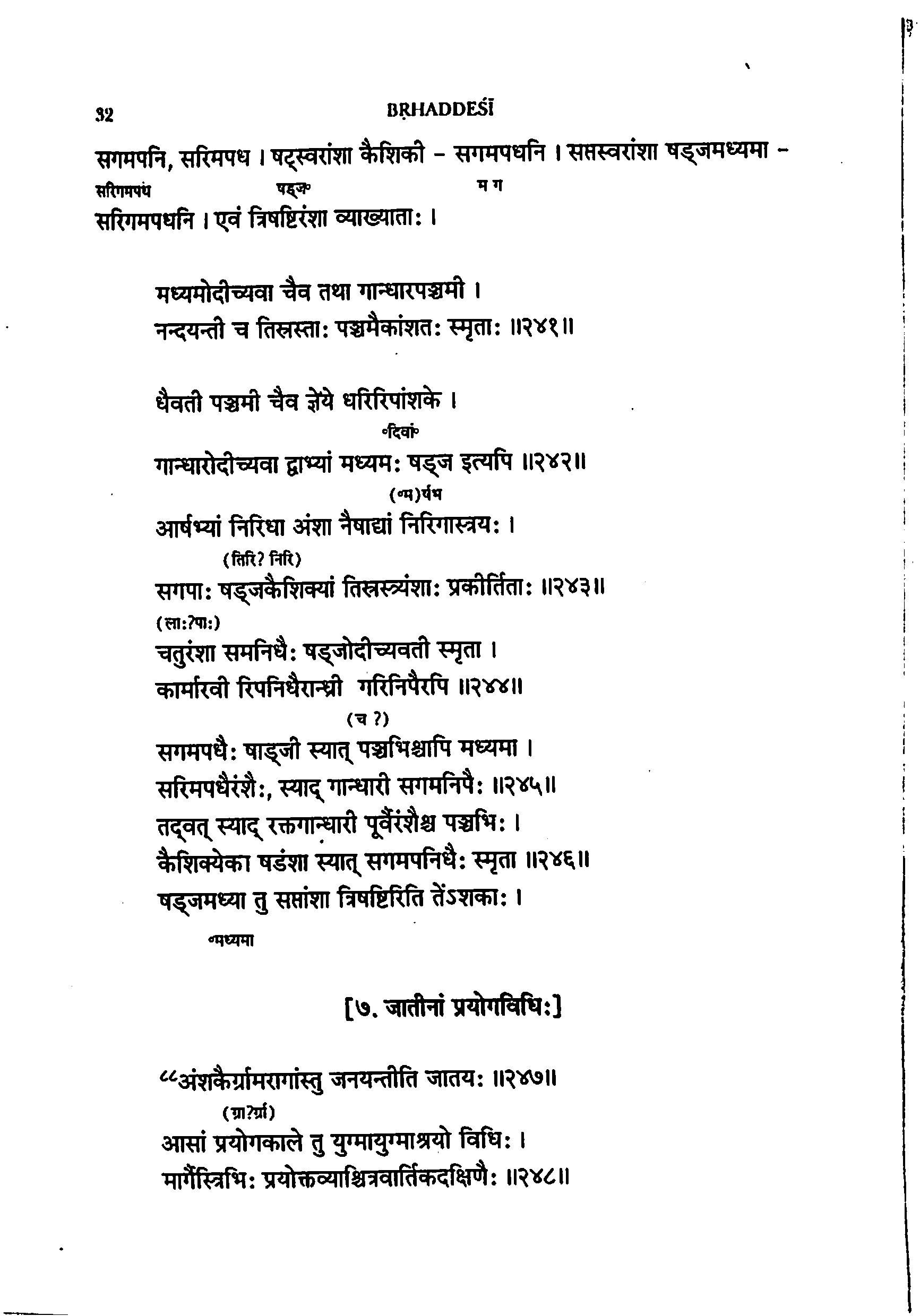
Kaiśikī is (the only one) with six aniśa svaras - sa, ga, ma, pa, dha, ni.63 Ṣaḍja - madhyamā is (the only one) with seven amśa svaras - sa, ri, ga, ma,
ordered sequence list
amsa_svaras_of_jati — kaisiki jati - six amsa svaras
s · a
g · a
m · a
p · a
d · h · a
n · i
— Kaisiki is (the only one) with six amsa svaras - sa, ga, ma, pa, dha, ni
Dhaivatī and pañcamī, these two should be known with two amśa (svaras) each viz. dhari and ripa. Gāndhārodīcyavā is with two (amśa svaras) viz. madhyama and şadja.
(242)
In ārṣabhī niridha, in naiṣādī the three niriga (and) in ṣaḍjakaiśikī sagapa are amsa (svaras); (these) three are said to be with three amsas each.
Ṣāḍjī is with sagamapadha (as amśas), madhyamā is also with five amśas viz. sarimapadha, gāndhārī is with sagamanipa and similarly is raktagāndhārī with the same five amśas. Kaiśikī is the one (jāti) that is known to have six amśas
Ṣadjamadhyā is with seven amsas and thus those amsas are sixty-three (in total).
[7. Prescription regarding the performance of jātis]
Jātis are those that give rise to grāma-rāgas through their amśas.5143
(247)
During their performance the prescription (regarding temporal organisation) is based on yugma44 (lit.even) and ayugma45 (lit.odd).109 They are to be performed with three 46 mārgas viz. citra, vārtika and dakṣiṇa.2
(248)
ordered sequence list
margas_of_jati_performance — verse 248 - three margas for jati performance
c · i · t · r · a
v · a · r · t · i · k · a
d · a · k · s · i · n · a
— They are to be performed with three margas viz. citra, vartika and daksina (248)
1.[definition] The defining characteristic of jātis is their capacity to generate grāma-rāgas through amsasअंशकैर्ग्रामरागांस्तु जनयन्तीति ज?ातयः
2.[enumeration] Three mārgas—citra, vārtika, and dakṣiṇa—are used in the performance of jātisमार्गेस्त्रिभिः प्रयोक्तव्याश्चित्रवार्तिकदक्षिणैः
3.[enumeration] The six aniśa svaras of Kaiśikī are sa, ga, ma, pa, dha, niषट्स्वरांशा कैशिकी - स ग म प ध नि
5.[relation] Jātis generate grāma-rāgas through their constituent amsasअंशकैर्ग्रामरागांस्तु जनयन्तीति ज?ातयः
6.[structural] Kaiśikī jāti is characterized by having six aniśa svarasषट्स्वरांशा कैशिकी - स ग म प ध नि
8.[structural] The total number of amsas across all jātis enumerated is sixty-threeएवं त्रिषष्टिरंशा व्याख्याताः
9.[structural] Yugma (even) is part of the temporal prescription system for performing jātisआसा प्रयोगकाले तु युग्मायुग्माश्रयो विधिः
10.[structural] Ayugma (odd) is part of the temporal prescription system for performing jātisआसा प्रयोगकाले तु युग्मायुग्माश्रयो विधिः
1.[definition]The defining characteristic of jātis is their capacity to generate grāma-rāgas through amsasJātis are those that give rise to grāma-rāgas through their amśas.
2.[enumeration]Three mārgas—citra, vārtika, and dakṣiṇa—are used in the performance of jātisThey are to be performed with three mārgas viz. citra, vārtika and dakṣiṇa.
3.[enumeration]The six aniśa svaras of Kaiśikī are sa, ga, ma, pa, dha, niKaiśikī is (the only one) with six aniśa svaras - sa, ga, ma, pa, dha, ni.
4.[enumeration]The seven aṁśa svaras of Ṣaḍja-madhyamā are sa, ri, ga, ma, pa, dha, niṢaḍja - madhyamā is (the only one) with seven aṁśa svaras - sa, ri, ga, ma, pa, dha, ni.
5.[relation]Jātis generate grāma-rāgas through their constituent amsasJātis are those that give rise to grāma-rāgas through their amśas.
6.[structural]Kaiśikī jāti is characterized by having six aniśa svarasKaiśikī is (the only one) with six aniśa svaras - sa, ga, ma, pa, dha, ni.
7.[structural]Ṣaḍja-madhyamā jāti is characterized by having seven aṁśa svarasṢaḍja - madhyamā is (the only one) with seven aṁśa svaras - sa, ri, ga, ma, pa, dha, ni.
8.[structural]The total number of amsas across all jātis enumerated is sixty-threeThus sixty-three amsas have been explained.
9.[structural]Yugma (even) is part of the temporal prescription system for performing jātisDuring their performance the prescription (regarding temporal organisation) is based on yugma (lit.even) and ayugma (lit.odd).
10.[structural]Ayugma (odd) is part of the temporal prescription system for performing jātisDuring their performance the prescription (regarding temporal organisation) is based on yugma (lit.even) and ayugma (lit.odd).