Source scans · vol_II_p024
recto · open full
scan recto
verso · open full
scan verso
Bṛhaddeśī · Volume II
pp. 30–31folio 024
Devanāgarī (Bṛhaddeśī)
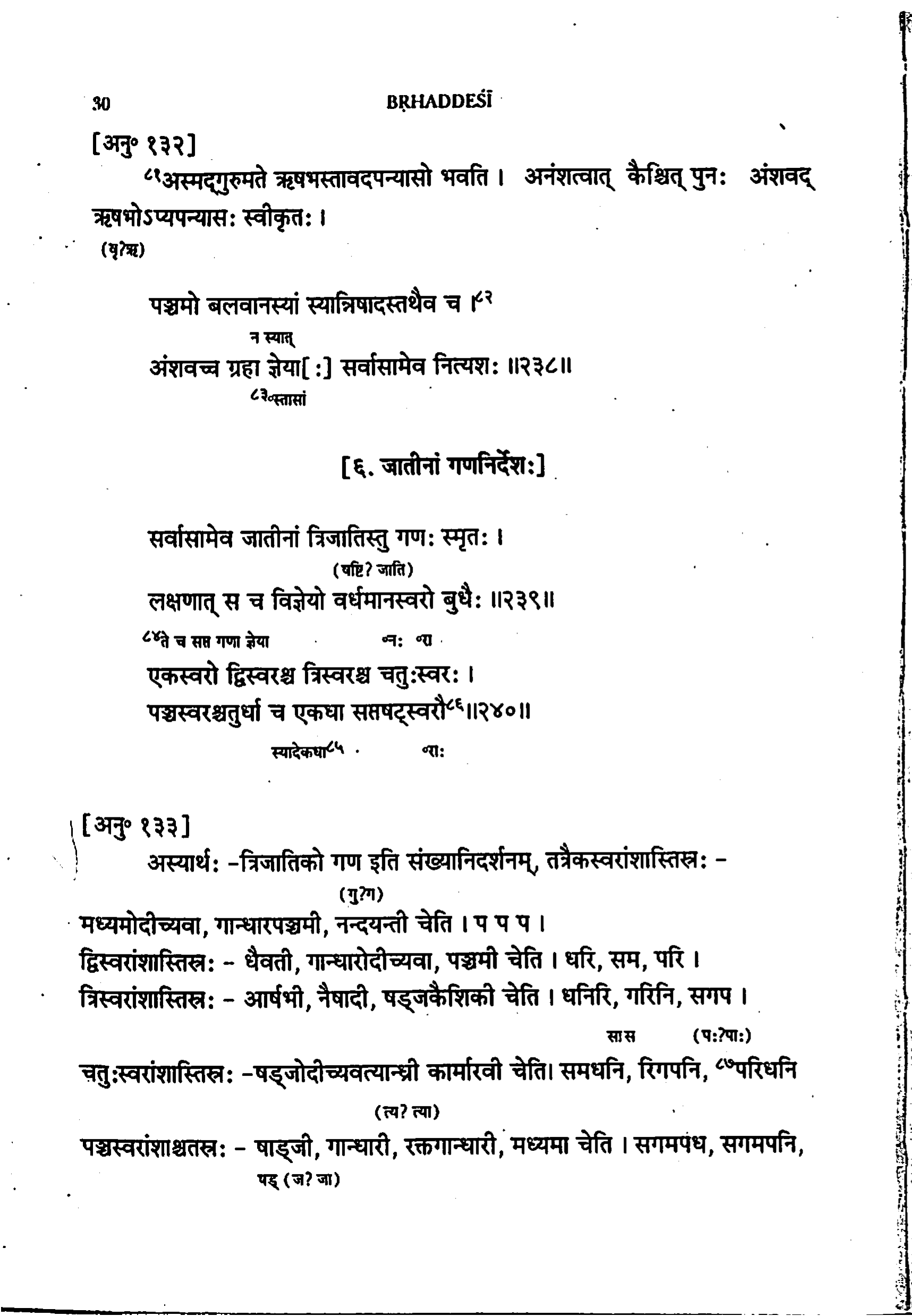
[अनु॰ १३२]
८१ अस्मद्गुरुमते ऋषभस्तावदपन्यासो भवति । अनंशत्वात्8 कैश्चित् पुनः अंशवद्
ऋषभोऽप्यपन्यासः(वृ?म्र) स्वीकृतः।
पञ्चमो बलवानस्यांन स्यात् स्यात्रिषादस्तथैव च ४२ अंशवच्च ग्रहा ज्ञेया[:] सर्वासामेव नित्यश:9 ॥२३८॥ ८३∞स्तासां
[६. जातीनां गणनिर्देश:]
सर्वासामेव जातीनां त्रिजातिस्तु(षष्टि? जाति) गणः स्मृतः1
लक्षणात्८४ते च सप्त गणा ज्ञेया स च विज्ञेयो वर्धमानस्वरोनः गा बुधै:10 ॥२३९॥ एकस्वरो द्विस्वरश्च त्रिस्वरश्च चतुःस्वरः। पञ्चस्वरश्चतुर्धा च एकधा सप्तषट्स्वरौ2८६॥२४०॥ स्यादेकधा८५ ·न्सः
[अनु॰ १३३]
अस्यार्थ: -त्रिजातिको गण इति(गु?ग) संख्यानिदर्शनम्11, तत्रैकस्वरांशास्तिस्न: -
मध्यमोदीच्यवा, गान्धारपञ्चमी, नन्दयन्ती चेति3 । प प प ।
द्विस्वरांशास्तिस्तः - धैवती, गान्धारोदीच्यवा, पञ्चमी चेति4 । धरि, सम, परि ।
त्रिस्वरांशास्तिस्न: - आर्षभी, नैषादी, षड्जकैशिकी चेति5धनिरि,सास गरिनि, सगप(प:?पा:)
चतुःस्वरांशास्तिस्न: -षड्जोदीच्यवत्यान्ध्री(त्य?त्या) कार्मारवी चेति6। समधनि, रिगपनि, ८७परिधनि पञ्चस्वरांशाश्चतस्तः - षाड्जी, गान्धारी, रक्तगान्धारी, मध्यमा चेति7 । सगमपंध, सगमपनि, पड् (ज? जा) Sec. 15.
English — Sharma (translation)
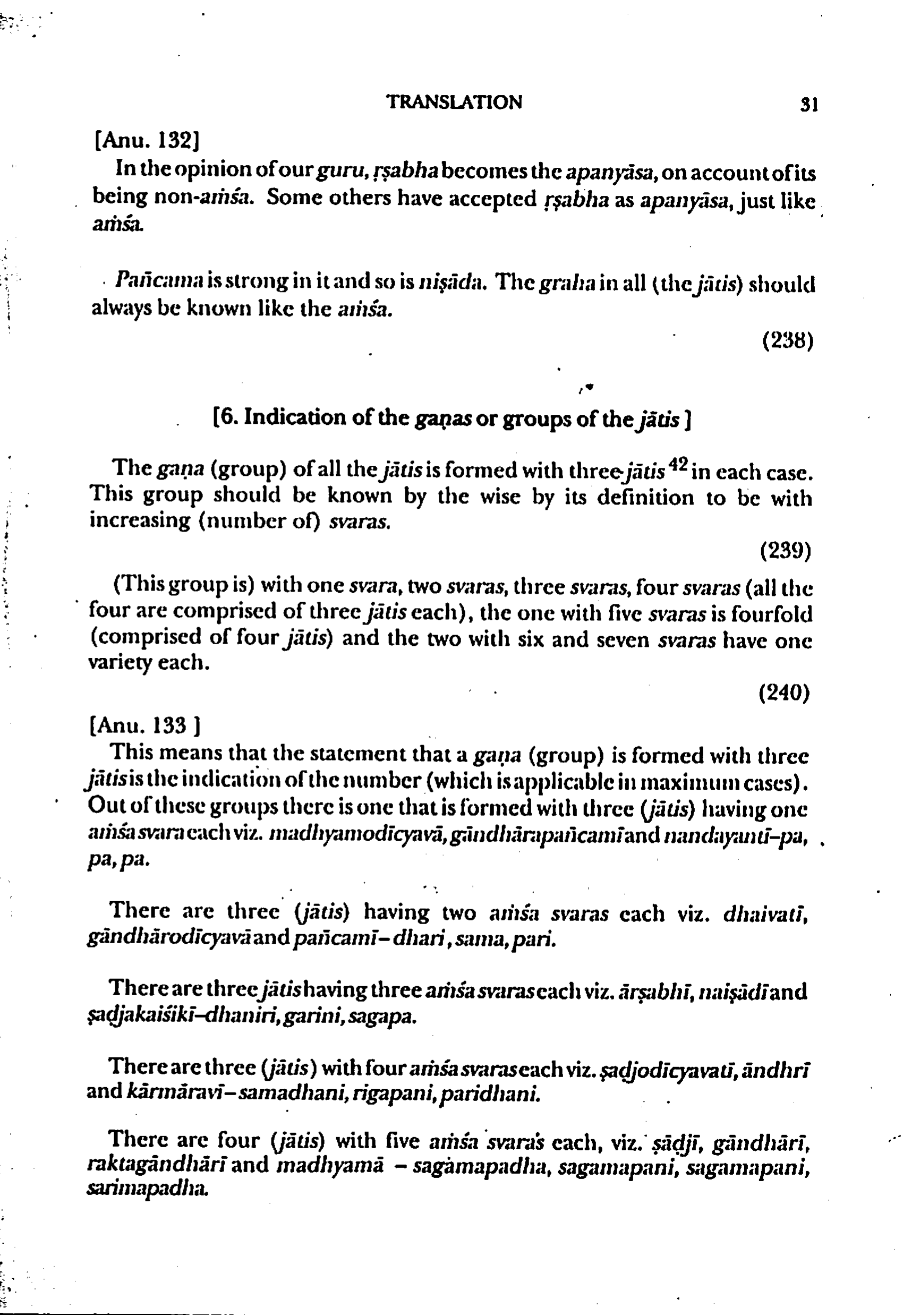
[Anu. 132]
In the opinion of our guru, ṛṣabha becomes the apanyāsa, on account of its being non-amśa. Some others have accepted rṣabha as apanyāsa, just like amsa. · Pañcama is strong in it and so is niṣāda. The graha in all (the jātis) should always be known like the amśa.
(238)
[6. Indication of the gaņas or groups of the jātis]
The gaṇa (group) of all the jātis is formed with three jātis 42 in each case.1 This group should be known by the wise by its definition to be with increasing (number of) svaras.10
(239)
(This group is) with one svara, two svaras, three svaras, four svaras (all the four are comprised of three jātis each), the one with five svaras is fourfold (comprised of four jātis) and the two with six and seven svaras have one variety each.2
(240)
[Anu. 133]
This means that the statement that a gana (group) is formed with three jātis is the indication of the number (which is applicable in maximum cases)11. Out of these groups there is one that is formed with three (jātis) having one amśa svara each viz. madhyamodicyavā, gāndhārapancamī and nandayantī3-pa, pa, pa. There are three (jātis) having two amśa svaras each viz. dhaivatī, gāndhārodīcyavā and pancamī4-dhari, sama, pari. There are three jātis having three amśa svaras each viz. ārṣabhī, naiṣādī and şadjakaiśikī5-dhaniri, garini, sagapa. There are three (jātis) with four amśa svaras each viz. şadjodīcyavatī, āndhrī and kārmāravī6 – samadhani, rigapani, paridhani. There are four (jātis) with five amśa svaras each, viz. ṣāḍjī, gāndhārī, raktagāndhārī and madhyamā7 - sagamapadha, sagamapani, sagamapani, sarimapadha.
1.[definition]A gaņa is a group formed with three jātis in each caseसर्वासामेव ज?ातीना त्रिज?ातिस्तु गणः स्मृतः
2.[enumeration]There are seven gaņa varieties: one svara, two svaras, three svaras, four svaras (each with three jātis), five svaras (four jātis), six svaras (one variety), and seven svaras (one variety)एकस्वरो द्विस्वरश्च त्रिस्वरश्च चतुःस्वरः। पञ्चस्वरश्चतुर्धा च एकधा सप्तषट्स्वरौ
3.[enumeration]These three jātis are grouped together, each having one aṁśa svaraमध्यमोदीच्यवा, गान्धारपञ्चमी, नन्दयन्ती चेति
4.[enumeration]These three jātis are grouped together, each having two aṁśa svarasधैवती, गान्धारोदीच्यवा, पञ्चमी चेति
5.[enumeration]These three jātis are grouped together, each having three aṁśa svarasआर्षभी, नैषादी, षड्जकैशिकी चेति
6.[enumeration]These three jātis are grouped together, each having four aṁśa svarasषड्ज?ोदीच्यवत्यान्ध्री कार्मारवी चेति
7.[enumeration]These four jātis are grouped together, each having five aṁśa svarasषाड्ज?ी, गान्धारी, रक्तगान्धारी, मध्यमा चेति
8.[relation]ṛṣabha becomes the apanyāsa on account of being non-aṁśaअस्मद्गुरुमते ऋषभस्तावदपन्यासो भवति । अनंशत्वात्
9.[relation]The graha in all jātis should always be known like the aṁśaअंशवच्च ग्रहा ज?्ञेया[:] सर्वासामेव नित्यशः
10.[structural]Gaņa groups are distinguished by the definition of having an increasing number of svarasलक्षणात् स च विज?्ञेयो वर्धमानस्वरो बुधैः
11.[structural]The statement that a gaņa is formed with three jātis is an indication of the maximum number applicable in most casesत्रिज?ातिको गण इति संख्यानिदर्शनम्
1.[definition] A gaņa is a group formed with three jātis in each caseThe gaṇa (group) of all the jātis is formed with three jātis 42 in each case.
2.[enumeration] There are seven gaņa varieties: one svara, two svaras, three svaras, four svaras (each with three jātis), five svaras (four jātis), six svaras (one variety), and seven svaras (one variety)(This group is) with one svara, two svaras, three svaras, four svaras (all the four are comprised of three jātis each), the one with five svaras is fourfold (comprised of four jātis) and the two with six and seven svaras have one variety each.
3.[enumeration] These three jātis are grouped together, each having one aṁśa svaramadhyamodicyavā, gāndhārapancamī and nandayantī
4.[enumeration] These three jātis are grouped together, each having two aṁśa svarasdhaivatī, gāndhārodīcyavā and pancamī
5.[enumeration] These three jātis are grouped together, each having three aṁśa svarasārṣabhī, naiṣādī and şadjakaiśikī
6.[enumeration] These three jātis are grouped together, each having four aṁśa svarasşadjodīcyavatī, āndhrī and kārmāravī
7.[enumeration] These four jātis are grouped together, each having five aṁśa svarasṣāḍjī, gāndhārī, raktagāndhārī and madhyamā
8.[relation] ṛṣabha becomes the apanyāsa on account of being non-aṁśaIn the opinion of our guru, ṛṣabha becomes the apanyāsa, on account of its being non-aṁśa.
9.[relation] The graha in all jātis should always be known like the aṁśaThe graha in all (the jātis) should always be known like the aṁśa.
10.[structural] Gaņa groups are distinguished by the definition of having an increasing number of svarasThis group should be known by the wise by its definition to be with increasing (number of) svaras.
11.[structural] The statement that a gaņa is formed with three jātis is an indication of the maximum number applicable in most casesthe statement that a gana (group) is formed with three jātis is the indication of the number (which is applicable in maximum cases)