Source scans · vol_II_p026
recto · open full
scan recto
verso · open full
scan verso
Bṛhaddeśī · Volume II
pp. 34–35folio 026
Devanāgarī
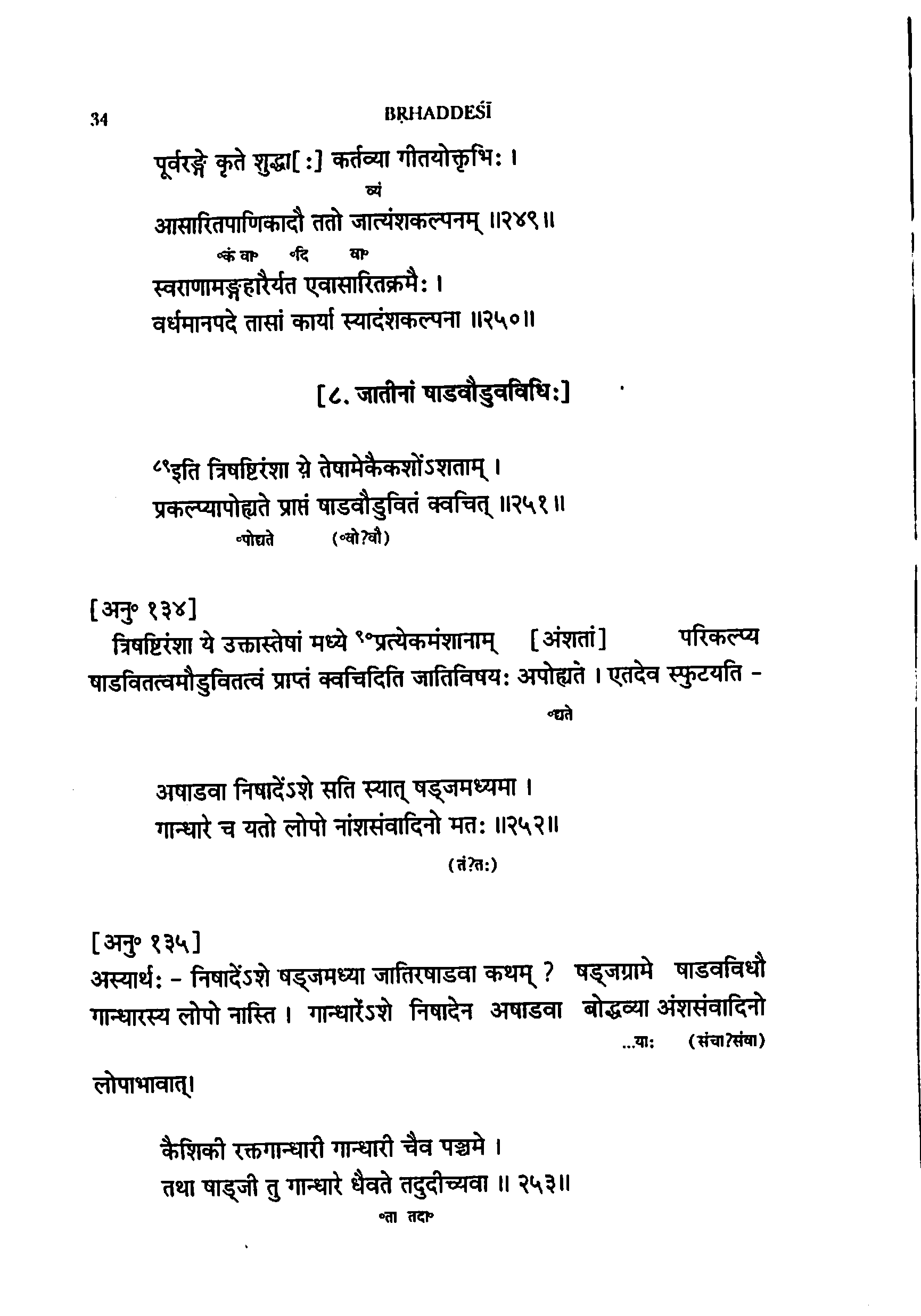
पूर्वरङ्गे कृते शुद्धा[:] कर्तव्या गीतयोक्तृभि:।3 आसारितपाणिकादौर्गद<b>ल्कं</b> वा॰ ततो जात्यंशकल्पनम्2 ॥२४९॥
स्वराणामङ्गहारैर्यत एवासारितक्रमै:।
वर्धमानपदे तासां कार्या स्यादंशकल्पना4 ॥२५०॥
[८. जातीनां षाडवौडुवविधि:]
८९इति त्रिषष्टिरंशा ये तेषामेकैकशोंऽशताम् ।
प्रकल्प्यापोह्यते॰पोद्यते प्राप्तं(॰वो?वौ) षाडवौडुवितं क्वचित्5२५१परिकल्प्य
[अनु॰ १३४]
त्रिषष्टिरंशा ये उक्तास्तेषां मध्ये ९०प्रत्येकमंशानाम् [अंशतां] षाडवितत्वमौडुवितत्वं प्राप्तं क्वचिदिति जातिविषय: अपोह्यतेन्छते । एतदेव स्फुटयति - अषाडवा निषादें ऽशे सित स्यात् षड्जमध्यमा गान्धारे च यतो लोपो नांशसंवादिनो(तं?त:) मत:10 ॥२५२॥
[अनु॰ १३५]
अस्यार्थ: - निषादेंऽशे षड्जमध्या जातिरषाडवा कथम् ? षड्जग्रामे षाडविवधौ गान्धारस्य लोपो नास्ति6 । गान्धारेंऽशे निषादेन अषाडवा बोद्धव्या...याः अंशसंवादिनो(संचा?संवा)
लोपाभावात्।
कैशिकी रक्तगान्धारी गान्धारी चैव पञ्चमे7
तथा षाड्जी तु गान्धारे8 धैवते॰ता तदा॰ तदुदीच्यवा9 ॥२५३॥
English — Sharma (translation)
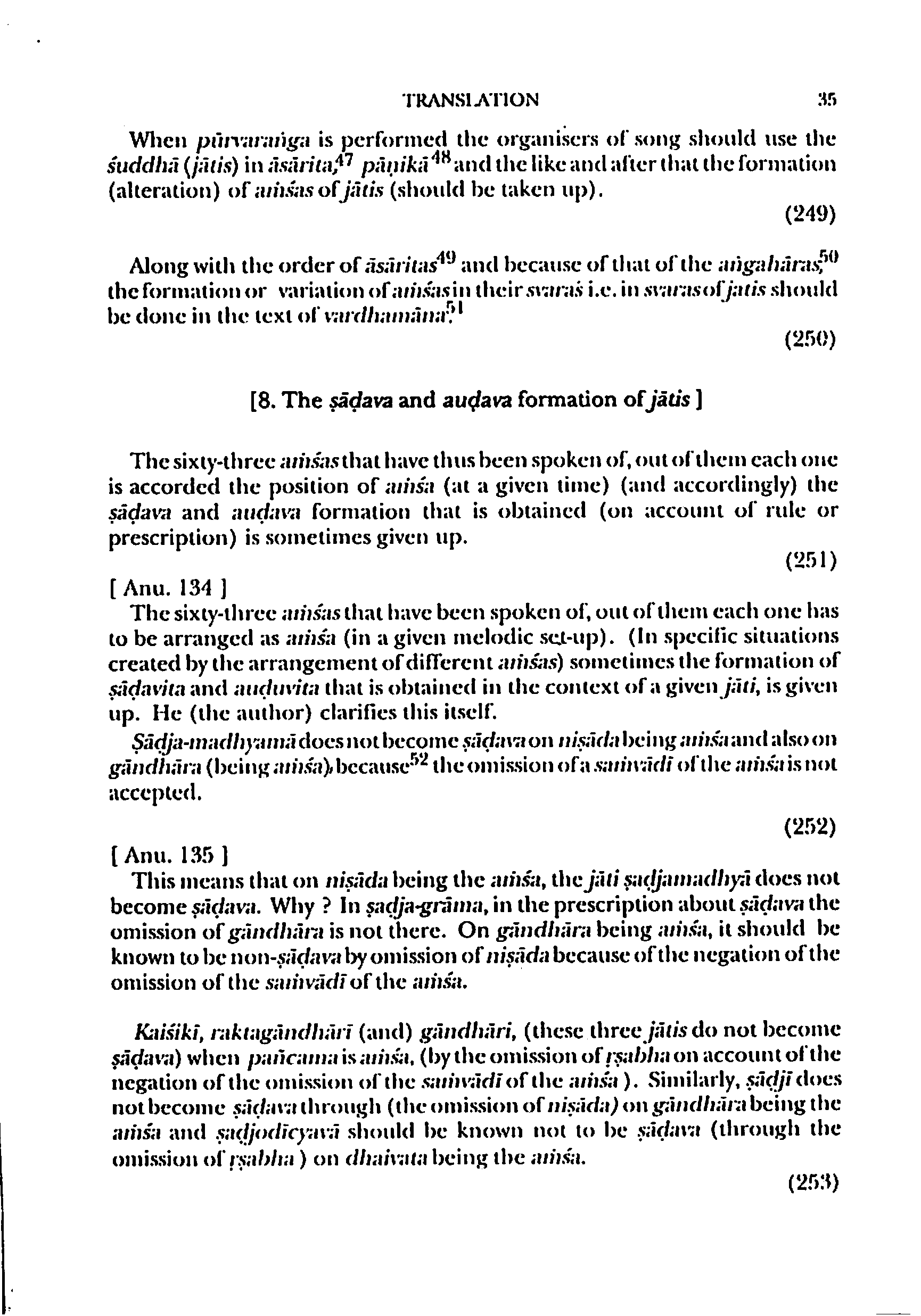
When pūrvaraiga is performed the organisers of song should use the śuddhā (jātis)3 in āsārita,47 pāņikā 48 and the like and after that the formation (alteration) of anisas of jātis (should be taken up).
(249)
Along with the order of <math>\bar{a}s\bar{a}ritas^{49}</math> and because of that of the <math>angah\bar{a}ras^{50}</math> the formation or variation of amsas in their svaras i.e. in svaras of jatis should be done in the text of vardhamāna451
(250)
[8. The ṣāḍava and auḍava formation of jātis]
The sixty-three amsas that have thus been spoken of, out of them each one is accorded the position of ainsa (at a given time) (and accordingly) the ṣāḍava and auḍava formation that is obtained (on account of rule or prescription) is sometimes given up.5
(251)
[Anu. 134]
The sixty-three amsas that have been spoken of, out of them each one has to be arranged as anisa (in a given melodic set-up). (In specific situations created by the arrangement of different anisas) sometimes the formation of ṣāḍavita and auḍuvita that is obtained in the context of a given jāti, is given up.1 He (the author) clarifies this itself. Şādja-madhyamā does not become ṣāḍava on niṣāda being amsaand also on <math>gandhara</math> (being amsa), because <math>^{52}</math> the omission of a samvadi of the amsa is not accepted.
(252)
[Anu. 135]
This means that on niṣāda being the amśa, the jāti ṣadjamadhyā does not become ṣāḍava. Why? In ṣaḍja-grāma, in the prescription about ṣāḍava the omission of gandhara is not there.6 On gandhara being amśa, it should be known to be non-ṣāḍava by omission of niṣāda because of the negation of the omission of the sanivādī of the aniśa. Kaiśikī, raktagāndhārī (and) gāndhāri, (these three jātis do not become ṣāḍava) when pañcama is amśa, (by the omission of ṛṣabha on account of the negation of the omission of the samvādī of the amśa). Similarly, ṣāḍjī does not become ṣāḍava through (the omission of niṣāda) on gāndhāra being the amśa and şadjodicyavā should be known not to be şādava (through the omission of ṛṣabha ) on dhaivata being the aṁśa.
(253)
2.[enumeration]āsārita and pāņikā are categories within which śuddhā jātis are used in pūrvaraigaआसारितपाणिकादौ ततो ज?ात्यंशकल्पनम्
3.[structural]When pūrvaraiga is performed, śuddhā jātis should be used by song organizersपूर्वरङ्गे कृते शुद्धा[:] कर्तव्या गीतयोक्तृभिः।
4.[structural]The formation or variation of amsas in svaras of jātis should be done in the text of vardhamānaवर्धमानपदे तासा कार्या स्यादंशकल्पना
5.[structural] ṣāḍava and auḍava formations of jātis can sometimes be given up based on amsa arrangementsत्रिषष्टिरंशा ये तेषामेकैकशोंऽशताम् । प्रकल्प्यापोह्यते प्राप्तं षाडवौडुवितं क्वचित्
6.[structural] In ṣaḍja-grāma, the omission of gandhara is not prescribed in ṣāḍava formationषड्जग्रामे षाडविवधौ गान्धारस्य लोपो नास्ति
7.[structural] Kaiśikī and raktagāndhārī do not become ṣāḍava when pañcama is amsa due to samvadi constraintsकैशिकी रक्तगान्धारी गान्धारी चैव पञ्चमे
8.[structural] ṣāḍjī does not become ṣāḍava when gāndhāra is the amsaतथा षाड्ज?ी तु गान्धारे
9.[structural] Şadjodicyavā should not be known as ṣādava when dhaivata is the amsaधैवते तदुदीच्यवा
10.[structural] The omission of a samvadi of the amsa is not accepted in jāti transformationsअषाडवा निषादे ऽशे सित स्यात् षड्जमध्यमा । गान्धारे च यतो लोपो नांशसंवादिनो मतः
1.[definition]ṣāḍava and auḍava are formations obtained in specific jāti contexts through amsa-based alterationsIn specific situations created by the arrangement of different anisas) sometimes the formation of ṣāḍavita and auḍuvita that is obtained in the context of a given jāti, is given up.
3.[structural] When pūrvaraiga is performed, śuddhā jātis should be used by song organizersWhen pūrvaraiga is performed the organisers of song should use the śuddhā (jātis)
4.[structural] The formation or variation of amsas in svaras of jātis should be done in the text of vardhamānathe formation or variation of amsas in their svaras i.e. in svaras of jatis should be done in the text of vardhamāna
5.[structural]ṣāḍava and auḍava formations of jātis can sometimes be given up based on amsa arrangementsThe sixty-three amsas that have thus been spoken of, out of them each one is accorded the position of ainsa (at a given time) (and accordingly) the ṣāḍava and auḍava formation that is obtained (on account of rule or prescription) is sometimes given up.
6.[structural]In ṣaḍja-grāma, the omission of gandhara is not prescribed in ṣāḍava formationIn ṣaḍja-grāma, in the prescription about ṣāḍava the omission of gandhara is not there.
7.[structural]Kaiśikī and raktagāndhārī do not become ṣāḍava when pañcama is amsa due to samvadi constraintsKaiśikī, raktagāndhārī (and) gāndhāri, (these three jātis do not become ṣāḍava) when pañcama is aṁśa
8.[structural]ṣāḍjī does not become ṣāḍava when gāndhāra is the amsaSimilarly, ṣāḍjī does not become ṣāḍava through (the omission of niṣāda) on gāndhāra being the aṁśa
9.[structural]Şadjodicyavā should not be known as ṣādava when dhaivata is the amsaşadjodicyavā should be known not to be şādava (through the omission of ṛṣabha ) on dhaivata being the aṁśa.
10.[structural]The omission of a samvadi of the amsa is not accepted in jāti transformationsŞādja-madhyamā does not become ṣāḍava on niṣāda being amsaand also on gandhara (being amsa), because the omission of a samvadi of the amsa is not accepted.